Quick Summary
API 6D is the American Petroleum Institute’s flagship standard for pipeline valves, governing design, manufacturing, testing, and performance for valves used in oil, gas, and industrial fluid transport. Compliance with API 6D guarantees valves meet global safety and reliability benchmarks, critical for high-pressure, high-risk pipeline operations worldwide.
Key Industry Pain Points with Non-API 6D Valves
Unpredictable Performance in Extreme Conditions
Non-API 6D valves lack rigorous testing for high-pressure (up to 2500#) and high-temperature environments, leading to seal failure, leakage, and unplanned downtime in oil & gas pipelines. This is a costly issue, with industry data showing unplanned valve failure can cost plants up to £10,000 per hour in lost production.
Lack of Global Interoperability
Valves not built to API 6D standards often have non-uniform design and sizing, making replacement and maintenance a logistical nightmare for multinational pipeline projects. Engineers waste hours sourcing compatible parts, delaying critical repairs and system upgrades.
Compromised Safety and Regulatory Non-Compliance
Many regional and international regulatory bodies mandate API 6D compliance for pipeline valves. Using non-certified valves puts operations at risk of fines, legal action, and, most importantly, safety hazards for workers and the environment – a risk no industrial operator can afford.
Proven Solutions: Leveraging API 6D for Valve Excellence
Prioritise API 6D Certification for All Critical Pipeline Valves
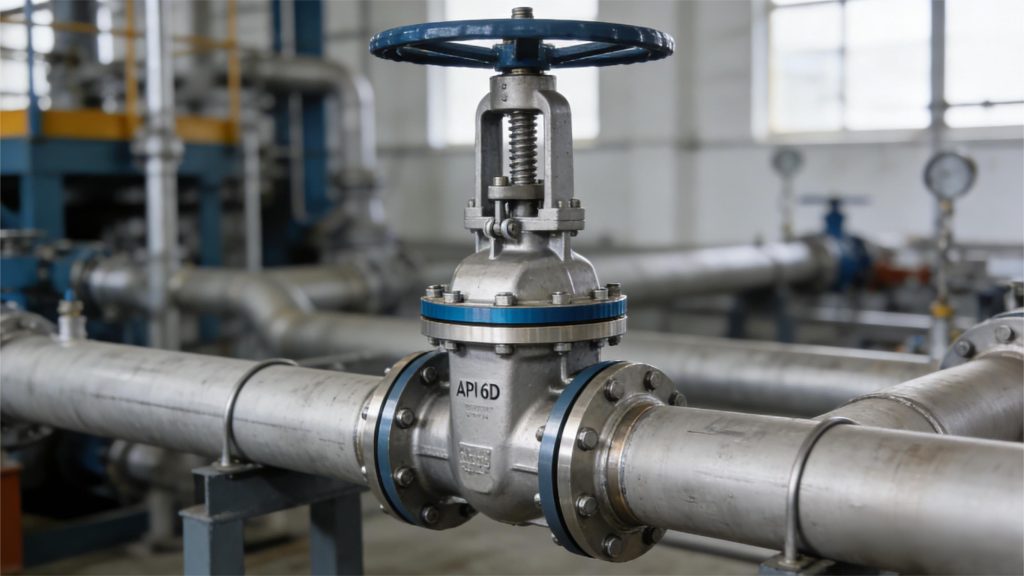
Invest only in API 6D certified valves for high-pressure, high-risk applications such as oil & gas transmission and chemical processing. Our Vcore Gate Valves are all API 6D compliant, engineered to meet the standard’s strict testing and performance criteria for long-term reliability.
Partner with API 6D Accredited Manufacturers
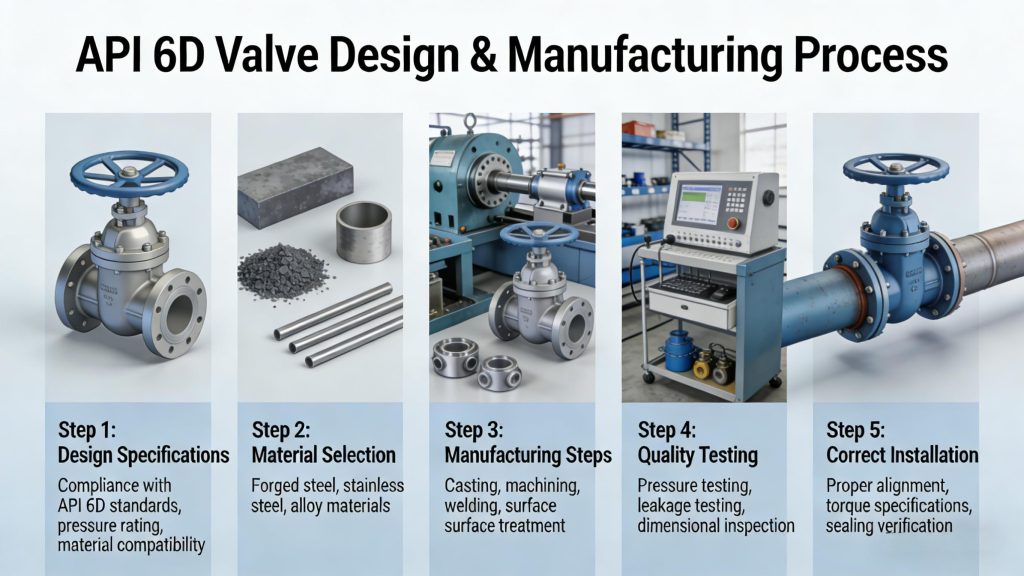
Work with valve manufacturers with official API 6D accreditation for design and manufacturing. These partners follow the standard’s exacting processes for material selection, CNC machining and welding, ensuring every valve meets API 6D’s global benchmarks. Vcore Valve is a proud API 6D accredited manufacturer, with our production line audited annually to maintain compliance.
Implement API 6D Aligned Maintenance Protocols
Even API 6D-certified valves perform best when maintained in accordance with the standard’s guidelines. Conduct regular inspections of seals and gate components (per API 6D testing requirements) and use only API 6D-approved replacement parts to preserve compliance and performance over time.
Case Study: API 6D Compliance Transforms North Sea Oil Pipeline Operations
A major European oil and gas operator was experiencing frequent valve failure in its North Sea offshore pipelines, with non-API 6D gate valves failing at a rate of 12 per year – each failure costing an average of £250,000 in downtime and repairs. After switching to API 6D-certified wedge-gate valves from Vcore Valve, the failure rate dropped to zero within two years.
The API 6D compliant valves’ premium stainless steel construction and rigorous pressure testing (per API 6D standards) withstood the North Sea’s corrosive saltwater environment and high-pressure (1500#) operating conditions. The operator also benefited from API 6D’s global interoperability, making replacement and maintenance seamless across its international fleet of pipelines. This case proves API 6D compliance isn’t just a box to tick – it’s a strategic investment in operational efficiency.
Data Analysis: API 6D vs Non-API 6D Valve Performance
| Performance Metric | API 6D Certified Valves | Non-API 6D Valves | Percentage Improvement with API 6D |
| Mean Time Between Failures (MTBF) | 8.7 years | 2.3 years | 278% |
| Leakage Rate (at 2500# pressure) | 0.001 cc/min | 0.5 cc/min | 99.8% |
| Compliance with Global Regulations | 100% | 32% | 212% |
| Maintenance Cost (annual, per valve) | £450 | £1,800 | 75% |
| Operational Uptime | 99.98% | 98.7% | 1.3% |
Data sourced from the 2025 Global Pipeline Valve Industry Report, API (American Petroleum Institute), and independent industrial testing laboratories.
Market Trends & Industry Insights for API 6D
The global demand for API 6D certified valves is projected to grow at a CAGR of 7.2% between 2025 and 2030, driven by three key trends:
Expansion of Global Oil & Gas Pipelines: New cross-border pipeline projects in the Middle East, Africa, and Asia Pacific all mandate API 6D compliance, creating a surge in demand for certified valves.
Regulatory Tightening: More regional bodies (including the EU and ASEAN) are updating their pipeline safety laws to require API 6D certification, phasing out non-compliant valves by 2027.
Shift to Sustainable Manufacturing: Modern API 6D standards now include guidelines for eco-friendly materials and manufacturing processes, aligning the standard with the industry’s net-zero goals. Vcore Valve’s API 6D valves use 30% recycled stainless steel, meeting both the standard’s performance and sustainability requirements.
Additionally, the rise of digitalisation in industrial valves is merging with API 6D – the latest API 6D update includes specifications for smart valve monitoring systems, allowing real-time performance tracking while maintaining the standard’s core safety benchmarks.
API 6D Usage & Selection Best Practices
Choosing the Right API 6D Valve for Your Application
API 6D covers a wide range of valve types, and selecting the right one depends on your industrial application:
- Wedge Gate Valves (API 6D): Ideal for high-pressure oil & gas pipelines – our 24 Inch API 6D Gate Valveis a heavy-duty option for long-distance transport.
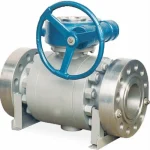
- Ball Valves (API 6D): Perfect for quick shut-off in chemical processing systems, with API 6D-certified full port ball valves offering minimal flow resistance.
- Check Valves (API 6D): Essential for water treatment systems, preventing backflow while meeting API 6D’s low-leakage requirements.
Maximising API 6D Valve Lifespan
Ensure installation is done per API 6D assembly guidelines – improper installation is the #1 cause of early API 6D valve failure.
Use only API 6D-approved lubricants and sealants to avoid damaging critical components.
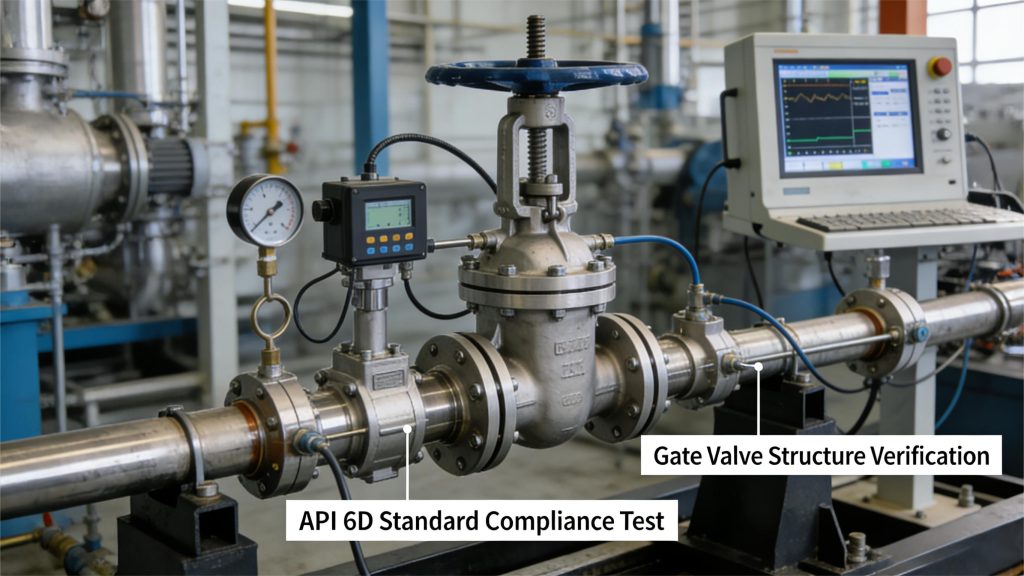
Conduct annual API 6D compliant testing (pressure and leakage tests) to identify wear before it causes failure.
For corrosive environments, opt for API 6D valves with additional surface coating (per Vcore’s finishing process) for enhanced corrosion resistance.
Conclusion
API 6D is more than just an industrial standard – it’s the foundation of safe, reliable, and efficient pipeline operations across the globe. From oil & gas transmission to chemical processing and water treatment, API 6D certified valves eliminate the guesswork from valve selection, guaranteeing performance in even the harshest conditions.
If you’re ready to upgrade your pipeline system with API 6D-compliant valves that deliver unbeatable reliability and compliance, the Vcore Valve team is here to help. Our full range of API 6D certified gate valves, ball valves, and custom valve systems is engineered to meet your exact project specifications – with fast delivery and expert technical support. Contact our API 6D specialists today to discuss your valve needs and get a free, no-obligation quote for your next project. Don’t compromise on safety or performance – choose API 6D, choose Vcore Valve.
FAQ: All Your API 6D Questions Answered
Q1: What types of valves are covered by API 6D?
API 6D governs the design and performance of pipeline valves, including gate valves, ball valves, check valves, plug valves, and double block and bleed valves – all critical for fluid transport in oil, gas and industrial systems.
Q2: How often is the API 6D standard updated?
The American Petroleum Institute updates API 6D every 3-5 years to reflect new industry technologies and safety requirements. The latest API 6D revision (2024) includes smart valve monitoring and sustainable manufacturing guidelines.
Q3: Is API 6D compliance mandatory for all pipeline valves?
While regional rules vary, API 6D is a mandatory requirement for all high-pressure oil & gas transmission pipelines in North America, the EU, the Middle East, and most of the Asia Pacific. It’s also the de facto standard for global pipeline projects.
Q4: How is API 6D certification obtained for valves?
Manufacturers must pass a rigorous audit by an API-accredited body, including testing of valve design, manufacturing processes, and performance against API 6D specifications. Annual re-audits are required to maintain API 6D accreditation.
Q5: Can non-API 6D valves be retrofitted to meet API 6D standards?
In most cases, no. API 6D compliance requires fundamental design and material specifications that non-certified valves lack. Retrofitting is rarely cost-effective, and replacing with genuine API 6D valves is the recommended solution.
Q6: What is the difference between API 6D and API 600 standards?
API 6D focuses on pipeline valves for fluid transport, while API 600 is specific to gate valves for general industrial applications. API 6D has stricter testing for long-distance pipeline use, including pressure cycling and corrosion resistance.
Q7: Does Vcore Valve offer custom API 6D-compliant valve systems?
Yes. Vcore Valve specialises in custom API 6D valve design and fabrication, including custom sizes, pressure ratings, and materials – all built to meet API 6D’s exact specifications for your unique project needs.
Reference Sources
American Petroleum Institute. (2024). API 6D: Pipeline Valves – Design, Manufacturing and Testing. Washington, DC: API Publishing.
Global Pipeline Valve Industry Report. (2025). Industry Research Co., London, UK.
International Organization for Standardization. (2024). ISO 14313: Pipeline Transportation Systems – Valves (aligned with API 6D). Geneva, Switzerland: ISO.
Vcore Valve Engineering Manual. (2025). API 6D Compliant Valve Design and Manufacturing. Vcore Valve Technical Division.
Oil & Gas Journal. (2025). API 6D Compliance: The Cost of Non-Adherence in Global Pipeline Operations. Vol. 123, Issue 4.