
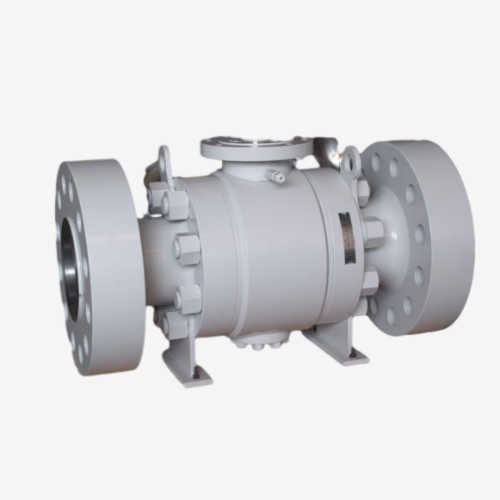
Forged Trunnion Ball Valve
 Production Overview
 Production Overview
The Forged Trunnion Ball Valve from Vcore Valves is a highly durable valve designed to handle high-pressure, high-temperature applications in critical pipeline systems. Unlike traditional ball valves, the trunnion design features a ball that is supported by two trunnions (fixed bearings), reducing the stress on the ball and increasing its lifespan. This feature makes the valve ideal for oil and gas, chemical processing, water treatment, and power generation applications where reliability and performance are essential.
Key Features
-
Forged Construction – Provides superior strength and durability under high pressure and temperature conditions
-
Trunnion Mounted Design – Reduces ball wear and increases valve lifespan by supporting the ball with bearings
-
Full-Bore Flow – Minimizes pressure drop and allows for high flow capacity
-
Reliable Sealing – Features tight sealing capabilities for minimal leakage and optimal fluid containment
-
High Pressure & Temperature Resistance – Ideal for demanding environments, including oil and gas pipelines, steam systems, and chemical processes
-
Easy Operation & Maintenance – Simple, robust design for easy operation and quick maintenance
-
Actuation Options – Available with manual, pneumatic, or electric actuators for automatic or remote operation
-
Global Standards Compliance – Manufactured in accordance with ANSI, ISO, API, and AWWA standards
Technical Specifications
| Item | Description |
|---|---|
| Valve Type | Forged Trunnion Ball Valve |
| Body Material | Forged Carbon Steel (A105), Stainless Steel (304, 316) |
| Ball Material | Stainless Steel (304, 316), Chrome-Plated Carbon Steel |
| Seat Material | PTFE, PEEK, Metal Seat (304, 316 Stainless Steel) |
| Stem Material | Stainless Steel (304, 316) |
| Coating | Fusion Bonded Epoxy (FBE) for corrosion resistance |
| Size Range | DN15–DN1200 (½”–48”) |
| Pressure Rating | PN10 / PN16 / PN25 / Class 150, 300 |
| Temperature Rating | -20°C to +200°C (PTFE seat), up to 350°C (metal seat) |
| Connection Type | Flanged (ANSI B16.34), Threaded, Butt-Weld, Socket Weld |
| Actuation Options | Manual, Pneumatic, Electric Actuator |
| Seal Type | Soft Seat (PTFE, EPDM) or Metal Seat (304, 316 Stainless Steel) |
| Application | Water, Oil, Gas, Steam, Chemicals, Slurries |
| Standards Compliance | API 6D, ISO 9001, ANSI B16.34, AWWA C507 |
Main Dimensions & Weight
| DN (mm) | L (mm) | H (mm) | W (mm) | Weight (kg) |
|---|---|---|---|---|
| 15 | 150 | 220 | 120 | 10 |
| 20 | 160 | 240 | 130 | 12 |
| 25 | 180 | 250 | 140 | 15 |
| 40 | 200 | 300 | 160 | 25 |
| 50 | 220 | 330 | 180 | 35 |
| 80 | 260 | 400 | 220 | 50 |
| 100 | 280 | 450 | 250 | 75 |
| 150 | 320 | 550 | 300 | 120 |

Function
The Forged Trunnion Ball Valve is designed to control the flow of various media in pipeline systems. The trunnion design provides additional support to the ball, ensuring that the ball does not float freely within the valve body. This design minimizes wear on the ball and seat, resulting in extended service life and reliable sealing over a longer period.
The valve operates smoothly even under high-pressure and high-temperature conditions due to the support provided by the trunnions. The full-bore design reduces pressure drop, allowing for greater flow rates, while the seat design ensures a tight seal, preventing leakage. The valve is operated by either a manual handwheel or an actuator (pneumatic or electric), making it suitable for a wide range of applications, including remote control or automated flow control systems.
The valve body is forged from high-strength materials, ensuring better resistance to pressure and temperature fluctuations. With a full-bore design, this valve allows for minimal flow resistance, making it highly efficient in fluid flow systems. The trunnion-supported design also ensures smoother operation, with more accurate control over fluid flow, making it a superior choice for industrial applications requiring high performance and low maintenance.
Application
-
Oil & Gas – Isolation and flow control in offshore and onshore pipeline systems
-
Chemical Processing – Flow control in chemical reactors, pipelines, and distribution systems
-
Water Treatment – Isolation of water flow in filtration and distribution networks
-
Power Generation – Steam and water flow control in cooling and heating systems in power plants
-
Mining – Flow regulation in slurry pipelines and tailing systems
-
HVAC – Control of hot and chilled water flow in heating and cooling systems
-
Food & Beverage – Flow control in production lines for liquid, oil, and chemical products