Pressure safety valve calibration is the controlled process of verifying and adjusting a PSV so it opens at the required set pressure, reseats correctly, and protects equipment from overpressure. PSV calibration should be performed only by qualified personnel using suitable test equipment, approved procedures and project safety requirements.
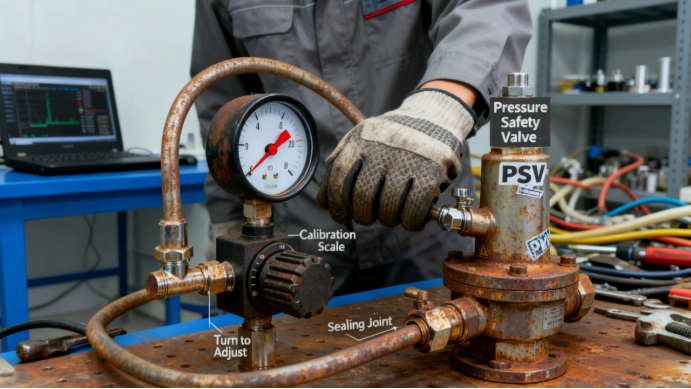
What Is a Pressure Safety Valve?
A pressure safety valve is a protective device used to release pressure when equipment exceeds a safe limit. It is commonly used on boilers, pressure vessels, compressed air systems, steam lines, chemical equipment and process pipelines.
The PSV must open at the specified set pressure. If it opens too early, the system may lose efficiency. If it opens too late, equipment may be exposed to dangerous overpressure. That is why calibration and documentation are critical.
For broader safety and documentation checks, compare PSV records with valve certificates and quality documents.
When Should a PSV Be Calibrated?
Calibration intervals depend on local regulations, plant safety rules, service severity and manufacturer recommendations. Common triggers include:
- Before first installation
- After repair or overhaul
- After a PSV lifts in service
- During scheduled shutdown maintenance
- After corrosion, leakage or abnormal operation is found
- When regulatory inspection requires verification
Critical steam, gas and chemical systems may require stricter intervals than general water service.
Key Terms in PSV Calibration
Set Pressure
Set pressure is the inlet pressure at which the PSV starts to open under test conditions. It should match the required protection pressure of the equipment.
Overpressure
Overpressure is the pressure increase above set pressure needed for the valve to reach rated capacity.
Blowdown
Blowdown is the difference between set pressure and reseating pressure. Incorrect blowdown can cause chattering, leakage or unstable operation.
Seat Tightness
Seat tightness confirms that the PSV does not leak beyond acceptable limits after calibration.
Basic PSV Calibration Procedure
Exact procedures depend on valve type, standard and local safety rules, but the process usually includes these steps:
Step 1: Identify the Valve
Check tag number, size, pressure rating, set pressure, service medium, manufacturer, serial number and last calibration record.
Step 2: Inspect the PSV Before Testing
Look for corrosion, damaged springs, blocked outlet, damaged nozzle, worn seat, missing seals, incorrect nameplate data or signs of unauthorized adjustment.
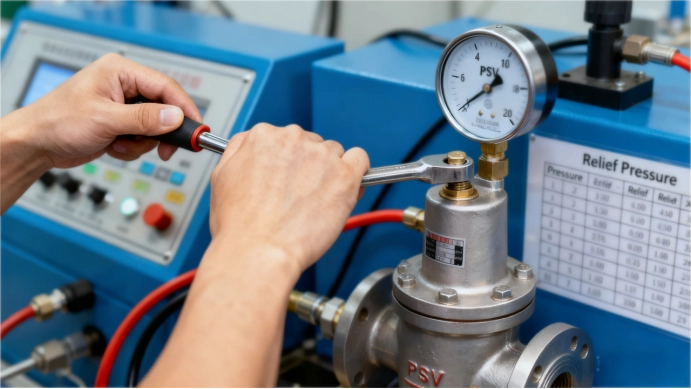
Step 3: Mount the Valve on a Test Bench
Use a suitable test bench and test medium. The setup must be rated for the required pressure and secured before pressurization.
Step 4: Increase Pressure Gradually
Raise pressure slowly and observe when the valve begins to open. Record the actual set pressure.
Step 5: Adjust if Required
If the set pressure is outside tolerance, adjust the spring compression according to approved procedure. Do not adjust beyond the valve design range.
Step 6: Verify Reseating and Leakage
After the valve opens, reduce pressure and confirm reseating behavior. Perform seat leakage checks if required.
Step 7: Seal and Document the Valve
After successful calibration, lock or seal the adjustment mechanism and complete the calibration report.
What Should Be Included in a PSV Calibration Report?
A complete report should include:
- Valve tag number and serial number
- Valve size, inlet/outlet connection and pressure rating
- Service medium and set pressure
- Test medium and test bench identification
- As-found set pressure
- As-left set pressure
- Leakage or seat tightness result
- Technician, date and calibration standard
- Seal number when applicable
For pressure-temperature suitability, buyers should also understand valve pressure-temperature rating before selecting or recalibrating pressure equipment valves.
Common PSV Calibration Mistakes
Mistake 1: Adjusting Without Confirming Valve Data
Set pressure, service medium and valve design must be confirmed before adjustment. Wrong data can create unsafe protection settings.
Mistake 2: Ignoring Seat Leakage
A PSV may open at the correct pressure but still leak after reseating. Seat condition must be checked.
Mistake 3: Using Incorrect Test Medium
The test medium and procedure should match valve design and applicable standards. Using the wrong method can produce misleading results.
Mistake 4: Failing to Seal the Adjustment
After calibration, unauthorized adjustment should be prevented by sealing or locking according to site requirements.
Mistake 5: Treating Calibration as Repair
Calibration verifies and adjusts performance. It does not replace repair of damaged springs, seats, nozzles or guides.
When Should a PSV Be Repaired Instead of Adjusted?
Repair may be required when the valve has:
- Damaged or corroded spring
- Worn seat or nozzle
- Damaged disc or guide
- External corrosion or body damage
- Unstable opening or chattering
- Leakage that cannot be corrected by adjustment
If valve condition is uncertain, compare symptoms with valve replacement warning signs.
Buyer Checklist for PSV Service
- Required set pressure
- Applicable code or standard
- Service medium and temperature
- Valve size and pressure rating
- Calibration interval
- As-found and as-left report requirements
- Seat leakage test requirements
- Third-party inspection requirement
Final Recommendations
PSV calibration is a safety-critical activity. Treat it as part of the plant protection system, not as a routine adjustment. Confirm valve data, use qualified technicians, record as-found and as-left results, check seat tightness and keep calibration documents traceable to the valve tag.
Bench Calibration vs Field Verification
Bench calibration is usually more controlled because the valve is tested on calibrated equipment under workshop conditions. Field verification may be used for some installed valves, but it can be limited by piping arrangement, operating pressure, safety access and site procedures. Buyers should confirm which method is accepted by the plant, regulator or inspection authority.
What Affects PSV Calibration Accuracy?
- Condition of the spring, nozzle, disc and guide
- Test bench accuracy and calibration status
- Test medium and pressure increase rate
- Temperature difference between test and service conditions
- Cleanliness of the seat and inlet passage
- Technician procedure and reading method
PSV Calibration Acceptance Review
| Item | Buyer Check |
|---|---|
| Set pressure | Matches equipment protection requirement and tolerance |
| As-found result | Shows whether the valve drifted in service |
| As-left result | Confirms final calibrated setting |
| Seat leakage | Confirms sealing after pop test |
| Seal number | Prevents unauthorized adjustment |
After Calibration: Reinstallation Checks
After calibration, the PSV should be reinstalled carefully. Check inlet and outlet orientation, gasket condition, flange tightening, discharge piping, drain hole, lifting lever position and nameplate visibility. A correctly calibrated PSV can still perform poorly if it is installed with blocked discharge, excessive back pressure or poor pipe support.
Safety Note for Plant Teams
Never adjust a PSV casually in the field to stop nuisance lifting. Nuisance lifting may indicate wrong set pressure, process instability, back pressure, wrong valve size or damaged internals. The cause should be reviewed before any setting change.
FAQ
What is PSV calibration?
PSV calibration verifies and adjusts a pressure safety valve so it opens at the required set pressure and reseats correctly.
Who should calibrate a pressure safety valve?
Only qualified personnel with suitable test equipment and approved procedures should calibrate a PSV.
What happens if a PSV set pressure is too high?
The protected equipment may be exposed to unsafe overpressure before the valve opens.
What is blowdown in a safety valve?
Blowdown is the pressure difference between opening pressure and reseating pressure.
Does calibration fix a leaking PSV?
Not always. A leaking PSV may need cleaning, seat repair, part replacement or overhaul before calibration.