Quick Summary: A 3-way ball valve works by rotating an internal L-port or T-port ball so that different valve ports are connected or blocked at different handle or actuator positions. An L-port design is usually used for diverting or switching flow between two outlets, while a T-port design may be used for mixing, splitting, bypass or multi-directional flow. The exact flow path depends on the ball port design, common-port orientation, handle stop position and actuator configuration. Buyers should confirm the required flow diagram before ordering, especially when shutoff, no-mixing, actuator feedback or fail-position requirements are important.
For many engineers, contractors, OEM equipment manufacturers, and sourcing teams, a 3-way ball valve looks simple from the outside. It has three ports, a handle or actuator, and a compact valve body. However, inside the valve, the flow path can change in several different ways depending on the ball bore design, port arrangement, handle position, and installation direction.
This is why the question how does a 3-way ball valve work is more important than it may first appear. Choosing the wrong 3-way valve can cause incorrect flow direction, unwanted mixing, blocked process lines, unnecessary pressure drop, leakage risk, or automation failure. In HVAC systems, chemical processing, water treatment, gas handling, and industrial pipeline projects, the difference between an L-port and a T-port valve affects actual system operation.
A ball valve product range normally uses a rotating drilled ball to control flow. A standard 2-way ball valve usually opens or closes one flow path. A 3-way ball valve has three ports and an internal L-shaped or T-shaped passage, allowing the valve to divert, mix, split, or switch flow between different lines.
For B2B buyers, the real question is not only what a 3-way ball valve is. The more important question is: which port pattern, common-port orientation, material, pressure rating and actuator configuration match your actual flow diagram?
What Is a 3-Way Ball Valve?
A 3-way ball valve is a quarter-turn valve with three connection ports instead of two. It is designed to control how fluid or gas moves between multiple pipelines. Depending on the internal ball design, it can connect one inlet to one of two outlets, two inlets to one outlet, or three ports in different flow combinations.
The three ports are commonly used in one of the following ways:
- One common inlet and two alternative outlets
- Two alternative inlets and one common outlet
- One inlet, one outlet, and one bypass line
- Three process lines that need controlled flow switching
Most industrial 3-way ball valves use one of two internal ball designs:
- L-port 3-way ball valve
- T-port 3-way ball valve
Both designs use the same operating principle: the ball rotates inside the valve body and aligns its internal passage with selected ports. However, their flow behavior is different. An L-port valve is usually selected for diverting or switching flow. A T-port valve is usually selected for mixing, splitting, bypass circulation, or more flexible multi-directional flow control.
Why Buyers Use 3-Way Ball Valves Instead of Multiple 2-Way Valves
A 3-way ball valve can often replace two or more separate 2-way valves in a piping system. This is one reason it is widely used in compact industrial equipment, skid-mounted systems, HVAC loops, water treatment units, and process lines where installation space and leakage control matter.
Using one correctly selected 3-way valve can help reduce:
- The number of valve bodies in the system
- The number of threaded, flanged, or welded connection points
- Installation space
- Manual operation points
- Potential leakage points
- Piping complexity
- Actuator quantity in automated systems
For example, if one pump needs to send water to Tank A or Tank B, a single L-port 3-way ball valve may be more compact than installing two separate 2-way valves. If a system needs to blend two incoming fluids into one outlet, a T-port 3-way ball valve may be more practical than using several separate valves and pipe fittings.
For distributors and OEM buyers, this can also simplify inventory. Instead of stocking several different flow-routing components, one correctly selected 3-way valve can cover several project needs. However, this advantage only applies when the valve is correctly selected. A wrong port pattern can make the system harder to control, not easier.
How Does a 3-Way Ball Valve Work Internally?
A 3-way ball valve has three pipeline ports and a ball with an internal L-shaped or T-shaped passage. When the handle or actuator rotates the stem, the ball passage lines up with different ports. The valve does not simply open or close like a 2-way ball valve; it changes which ports are connected.
The basic working logic is:
- Fluid or gas enters one of the valve ports.
- The internal ball passage connects selected ports according to the ball port design.
- The handle stop or actuator position determines which flow path is active.
- Seats and seals help close the blocked port or ports where the design allows.
Most 3-way ball valves are selected for switching, diverting, mixing or splitting service, but the exact position logic is not universal. Buyers should always confirm the manufacturer’s flow diagram before production. A product photo alone cannot show whether the internal ball is L-port, T-port, or a special configuration.
Main Components of a 3-Way Ball Valve
Valve Body
The valve body contains the three ports and supports the ball, seats, seals, and stem assembly. The body material may be brass, stainless steel, carbon steel, PVC, or another engineered material depending on the medium and working environment.
Ball
The ball is the core control component. It has an internal passage machined into an L shape or T shape. The shape of this passage determines how the valve connects or blocks different ports.
Seats
The seats support the ball and create a sealing surface. PTFE is widely used because of its low friction and chemical resistance, but reinforced PTFE, PEEK, or metal seats may be selected for demanding services.
Stem
The stem connects the handle or actuator to the ball. When the stem turns, the ball turns. Stem sealing is important because leakage around the stem is a common problem in low-quality or incorrectly selected valves.
Handle or Actuator
A manual handle is used for simple operation. Electric or pneumatic actuators are used when the valve needs remote control, frequent cycling, or integration with a control system. For automated applications, buyers may consider an electric three way ball valve when the system requires stable remote switching and repeatable flow direction control.
Seals and Packing
Seals and packing help prevent external leakage. Their material must be compatible with the fluid, gas, temperature, pressure, and operating cycle.
L-Port vs T-Port 3-Way Ball Valve: What Is the Difference?
The most important selection decision is whether the system needs an L-port or T-port design. Many purchasing mistakes happen because buyers confirm valve size and body material, but do not confirm the internal flow pattern, common port and handle or actuator stop positions.
L-Port 3-Way Ball Valve
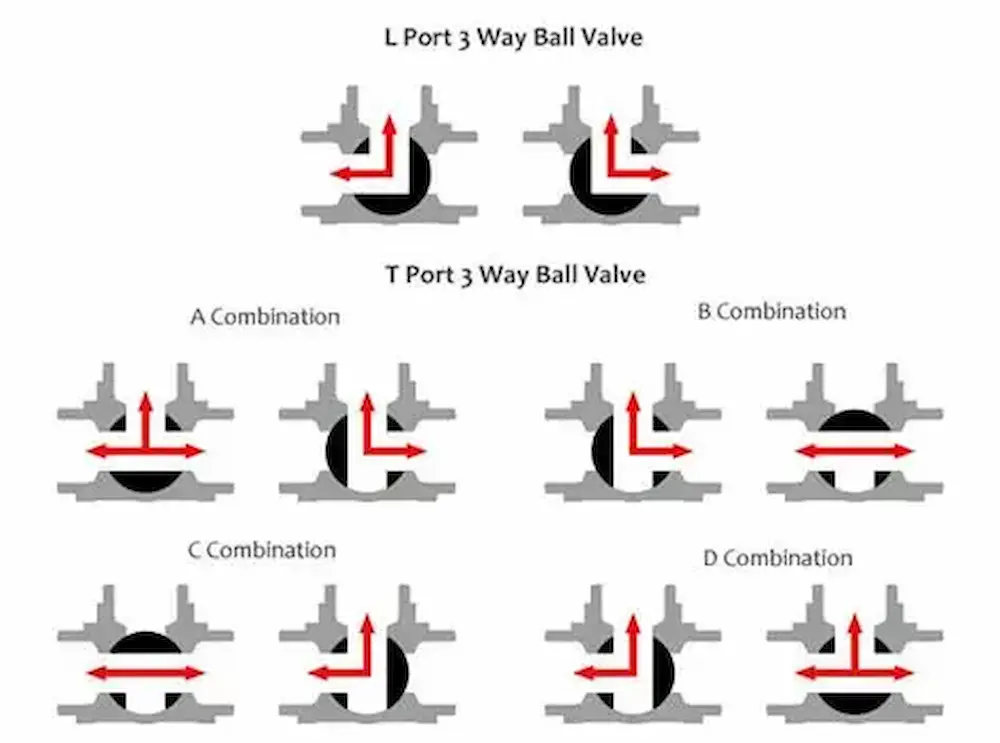
An L-port 3-way ball valve has an L-shaped passage inside the ball. It typically connects one common port to one of two side ports while blocking the other side port. This makes it suitable for diverting or switching service where two branches should not normally be connected at the same time.
Typical L-port functions include:
- Diverting one inlet to one of two outlets
- Switching between two supply sources
- Selecting between two tanks, filters, pumps, or process lines
- Keeping one branch isolated while another branch operates
The shutoff or center position, if required, must be specified. L-port designs do not share one universal 0-degree, 90-degree or 180-degree position logic.
T-Port 3-Way Ball Valve
A T-port 3-way ball valve has a T-shaped passage inside the ball. It may connect two ports or three ports depending on the ball design and stop arrangement. T-port valves are often selected when the system needs mixing, splitting, bypass or multi-directional distribution.
Typical T-port functions include:
- Mixing two inlet streams into one outlet
- Splitting one inlet stream into two outlet paths
- Creating bypass or circulation flow paths
- Supporting more complex process flow routing
A T-port valve provides more flexibility, but it also creates a higher risk of unwanted mixing or an unexpected open path if the flow diagram is not confirmed.
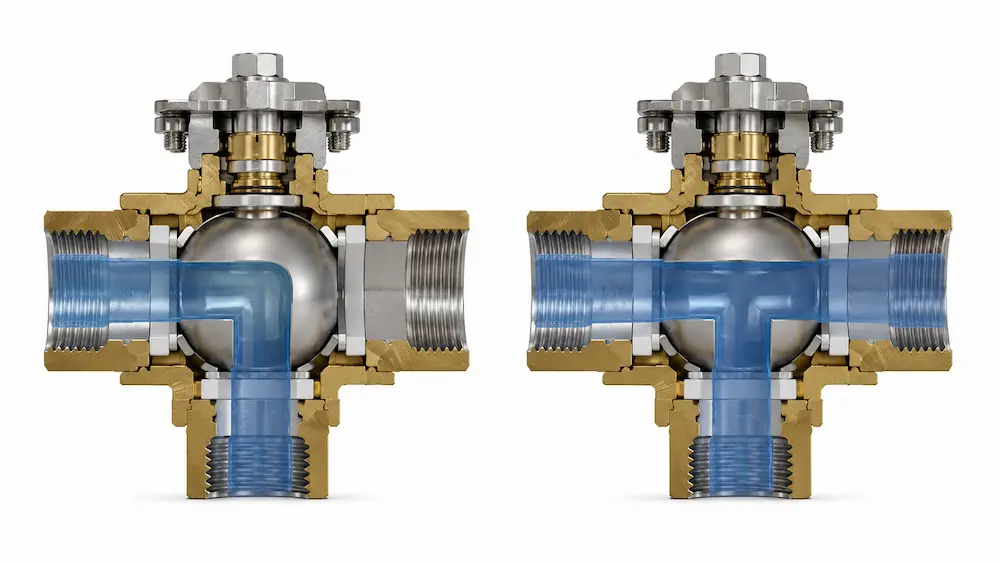
Typical 3-Way Ball Valve Flow Position Logic
Typical examples only: actual flow positions must be confirmed from the manufacturer’s flow diagram. Port letters, common-port location, handle stop design and actuator travel can vary by manufacturer and project requirement.
| Ball Port Type | Typical Position | Possible Flow Connection | Common Function | Buyer Check |
|---|---|---|---|---|
| L-port | Position 1 | Port A connected to Port B; Port C blocked | Diverting or switching to one line | Confirm which port is the common port. |
| L-port | Position 2 | Port A connected to Port C; Port B blocked | Diverting or switching to the alternate line | Confirm handle or actuator travel angle. |
| L-port | Optional center / shutoff position | May close all ports or may not exist, depending on design and handle stop | Isolation, if specified | Confirm whether any position fully closes the valve. |
| T-port | Position 1 | Port A connected to Port B | Routing, bypass or straight-through flow | Confirm whether Port C is blocked or partially connected. |
| T-port | Position 2 | Port A connected to Port C | Routing to an alternate line | Confirm port labels and handle position marking. |
| T-port | Position 3 | Port A connected to both Port B and Port C, or Port B and Port C connected to Port A, depending on design | Mixing, splitting or distribution | Confirm whether mixing is allowed or must be avoided. |
| T-port | Possible all-port connection | All three ports may be connected in some T-port designs and stop arrangements | Multi-directional flow | Confirm the flow diagram before production. |
Technical Comparison: L-Port vs T-Port 3-Way Ball Valve
| Item | L-Port 3-Way Ball Valve | T-Port 3-Way Ball Valve |
|---|---|---|
| Main Flow Logic | Connects one common port to one of two side ports. | May connect two or three ports depending on position and stop design. |
| Typical Function | Diverting, switching, source selection. | Mixing, splitting, bypass, distribution. |
| Can It Mix Flow? | Normally not the main purpose; usually selected to avoid simultaneous connection of two branches. | Often used where mixing or combined flow is required, but the allowed positions must be confirmed. |
| Can It Shut Off Flow? | Depends on ball design and handle stop position. Do not assume shutoff unless specified. | Depends on ball design and stop arrangement. Some positions may still leave a flow path open. |
| Main Risk | Wrong common-port orientation can route or block flow incorrectly. | Unwanted mixing or an unexpected open path can occur if position logic is misunderstood. |
| Buyer Must Confirm | Flow diagram, port labels, common port, handle or actuator position, and shutoff position if required. | Flow diagram, port labels, allowed flow paths, mixing permission, actuator travel and position feedback. |
Common Industrial Applications of 3-Way Ball Valves
HVAC Systems
In HVAC systems, 3-way ball valves may be used to divert or mix water in heating and cooling loops. They can direct chilled water to different zones, support bypass control, or help manage flow between supply and return lines.
Water Treatment Systems
In filtration, softening, and reverse osmosis systems, 3-way ball valves can switch flow between filters, bypass equipment during maintenance, or direct water to different treatment stages. For water treatment equipment where compact isolation is also required, related products such as a slip ball valve may also be evaluated depending on system design.
Chemical Processing
Chemical plants may use 3-way ball valves for transferring, blending, or diverting compatible fluids. In this application, material compatibility is critical. The wrong body, seat, or seal material can lead to corrosion, leakage, swelling, cracking, or contamination. For aggressive chemical, food, beverage, or water treatment applications, buyers may also compare PTFE-lined or PTFE-fabricated options such as a PTFE ball valve.
Gas Handling Systems
For air, fuel gas, nitrogen, oxygen-compatible service, or other gas systems, sealing reliability and material compatibility are especially important. Gas applications require careful attention to leakage class, seat material, stem packing, and pressure rating. Buyers comparing gas valve options can also review technical considerations for ball valves for gases.
OEM Equipment
OEM machinery manufacturers often use 3-way ball valves because they save space and simplify the piping layout inside compact equipment. Automated 3-way valves are especially useful when the equipment requires programmed flow switching.
Industrial Pipeline Systems
In larger or more demanding pipeline projects, the connection type becomes a major selection factor. Threaded connections may be suitable for smaller systems, while flanged or welded connections may be preferred for higher pressure, larger size, vibration, or long-term installation. For heavy-duty pipeline isolation, buyers may compare related products such as a flanged welded ball valve or a floating ball valve.
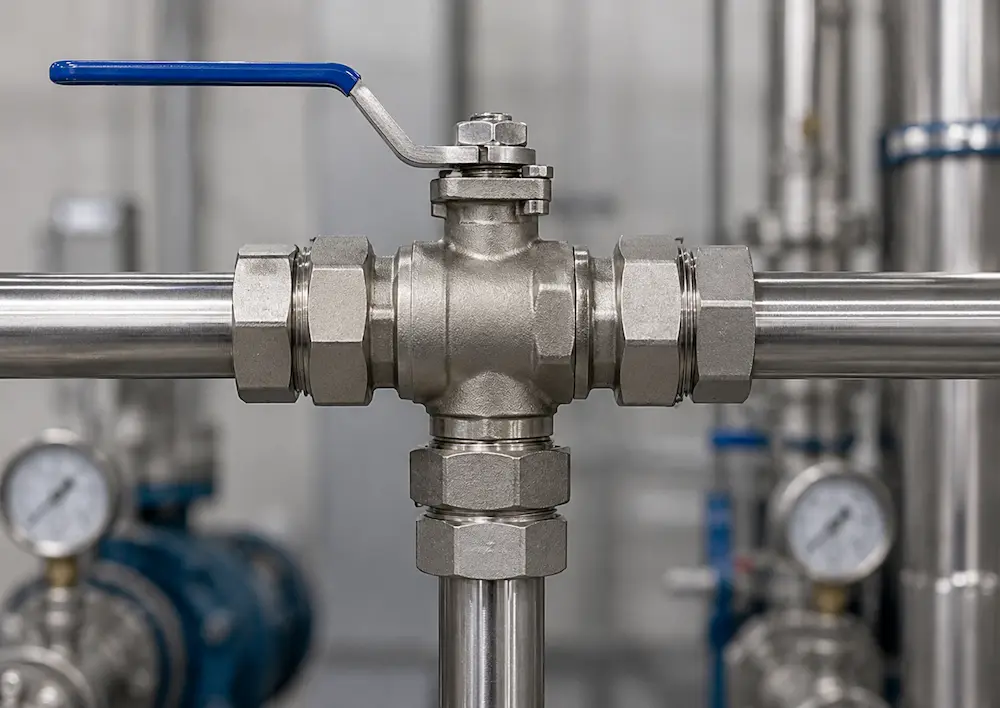
Manual, Electric, and Pneumatic 3-Way Ball Valves
Manual 3-Way Ball Valve
A manual 3-way ball valve uses a handle. It is suitable when operation is infrequent, the valve is easy to access, and the system does not require remote control. Manual valves are simple and cost-effective, but the handle marking must match the actual flow diagram.
Electric 3-Way Ball Valve
An electric 3-way ball valve uses an electric actuator to rotate the ball. It is suitable when the valve is installed in a hard-to-reach location, requires remote operation, or needs integration with a PLC, BMS, or industrial control system. For automated switching or mixing service, buyers may evaluate an electric three way ball valve when the valve needs to change flow paths through a control signal.
When selecting an electric actuator, buyers should confirm:
- Voltage and control signal
- Open-close or modulating control
- Actuator travel angle and stop position
- Position feedback matched to the actual flow path
- Valve torque and actuator safety factor
- Duty cycle and operating time
- Enclosure rating and manual override
- Fail-safe position if required
For broader automation decisions, compare the valve actuator selection guide. If the valve will be automated, actuator torque should be checked against break torque, running torque and service factor; see valve actuator torque sizing.
Pneumatic 3-Way Ball Valve
A pneumatic 3-way ball valve uses compressed air to operate the actuator. It is suitable for fast operation, high cycle frequency, industrial automation, or applications where a spring-return safety position is required. Pneumatic designs should still be checked against the required flow diagram and fail position.
Material Selection for 3-Way Ball Valves
Material selection affects valve life, corrosion resistance, leakage risk, cost, and compliance. Buyers should not choose a 3-way ball valve only by price. The correct material depends on the working medium, temperature, pressure, environment, and cleaning requirements.
| Material | Strengths | Limitations | Common Applications |
|---|---|---|---|
| Brass | Cost-effective, good machinability, suitable for water and air | Not ideal for strong corrosive fluids or some high-temperature services | Water systems, HVAC, compressed air, light industrial use |
| Stainless Steel | Good corrosion resistance and mechanical strength | Higher cost than brass | Chemical processing, water treatment, food-related systems, industrial fluids |
| Carbon Steel | Strong and suitable for many industrial pressure services | Requires corrosion consideration | Oil, gas, steam, industrial process lines |
| PVC / UPVC | Lightweight and corrosion-resistant for many low-pressure fluids | Limited pressure and temperature capability | Water treatment, irrigation, low-pressure chemical systems |
| PTFE-Lined or PTFE-Fabricated | Strong chemical resistance for many aggressive media | Must be checked for pressure, temperature, and mechanical conditions | Chemical, food, beverage, and water treatment applications |
Pressure, Temperature, Seat, and Seal Considerations
A 3-way ball valve must match the actual working conditions of the system. The most common technical factors include pressure rating, temperature range, seat material, seal material, bore size, and connection type.
Pressure Rating
The pressure rating must be suitable for the maximum working pressure of the system, including possible pressure spikes. In pumping systems, water hammer can create short-term pressure surges that exceed normal operating pressure.
Temperature Range
Temperature affects the valve body, seats, seals, and actuator. A metal body may tolerate a high temperature, but the seat or seal material may have a lower practical limit.
Seat Material
PTFE seats are common because they provide low friction and chemical resistance. Reinforced PTFE, PEEK, or metal seats may be required for high-temperature, abrasive, or high-pressure applications.
Seal Material
Common seal materials include NBR, EPDM, FKM, and PTFE. The correct choice depends on the fluid or gas. For example, EPDM is often used for water-related services, while FKM may be selected for many oils and chemicals. Compatibility should always be checked.
Flow Bore
A full-port valve provides lower pressure drop than a reduced-port valve. For systems where flow capacity is important, bore size should be confirmed instead of assuming that nominal pipe size alone is enough.
Connection Type
Common connection types include threaded, flanged, welded, clamp, and union connections. B2B buyers should match the connection type with pipeline standards, installation space, maintenance requirements, and project approval needs.
How to Choose the Right 3-Way Ball Valve
Choosing the right 3-way ball valve requires more than selecting size and price. A practical sourcing checklist should confirm the flow path first, then the valve construction and actuator requirements.
1. Define the Flow Function
Confirm whether the system needs diverting, switching, mixing, splitting, bypassing, or full shutoff. L-port valves are usually selected for diverting or switching; T-port valves may be selected for mixing, splitting or distribution.
2. Confirm the Flow Diagram
Never rely only on product photos. Ask the supplier for a flow path diagram showing each handle or actuator position. Confirm port labels, common port, allowed flow paths, and whether any position fully closes the valve.
3. Confirm Mixing and Shutoff Requirements
State whether mixing is allowed or prohibited. If full shutoff is required, specify it clearly because not every 3-way ball valve has an all-closed position.
4. Identify the Medium
The medium determines body, seat, and seal materials. Water, air, gas, oil, steam, acid, alkali, solvent, and slurry all have different compatibility requirements.
5. Check Pressure and Temperature
Confirm normal operating pressure, maximum pressure, design pressure, and temperature range. Also consider pressure spikes, thermal expansion and seat material limits.
6. Choose Manual or Automated Operation
Manual operation is suitable for low-frequency switching. Electric or pneumatic actuation is better for remote operation, frequent cycling, or process automation. For actuated valves, confirm control signal, actuator position, torque and fail position.
7. Confirm Connection and Installation Space
3-way ball valves are compact, but actuated valves require space for the actuator, wiring, tubing, brackets, and future maintenance access. Confirm thread, flange, weld or sanitary connection standard before ordering.
8. Review Testing and Documentation
For industrial projects, ask for pressure test reports, material certificates, dimensional drawings, actuator specifications, wiring diagrams and the final flow diagram. Buyers comparing broader options may also review our ball valve product range.
Common Buyer Mistakes and Their Consequences
Mistake 1: Confusing L-Port and T-Port Designs
If a buyer orders an L-port valve for a mixing application, the valve may block the flow instead of blending fluids. If a buyer orders a T-port valve where strict separation is required, unwanted mixing may occur.
Mistake 2: Ignoring the Common Port
The common port determines how the valve should be installed. If the valve is installed in the wrong orientation, the flow direction may not match the system design.
Mistake 3: Selecting Only by Pipe Size
A valve with the correct pipe size may still be wrong if the pressure rating, material, bore pattern, seat material, or actuator logic is unsuitable.
Mistake 4: Not Confirming Chemical Compatibility
Chemical compatibility problems can cause swelling, cracking, corrosion, leakage, or premature valve failure. This can lead to downtime, safety risk, or contamination.
Mistake 5: Using Manual Operation in Complex Systems
Manual valves are simple, but in complex systems the operator may turn the handle to the wrong position. For critical switching, automated actuation and position feedback may reduce risk.
Mistake 6: Not Asking for Test Documentation
For B2B procurement, documentation is part of product value. Without pressure testing, material confirmation, or drawings, the buyer may face project approval delays.
3-Way Ball Valve vs 2-Way Ball Valve vs Gate Valve vs Globe Valve
A 3-way ball valve is not always the right solution. Buyers should compare the function of different valve types before specifying a product. For a broader comparison, see this guide on ball valve vs gate valve vs globe valve.
| Valve Type | Main Function | Strengths | Limitations | Best Use |
|---|---|---|---|---|
| 2-Way Ball Valve | Open or close one line | Simple, reliable, low operating torque | Cannot divert or mix by itself | Basic shutoff and pipeline isolation |
| 3-Way Ball Valve | Divert, mix, split, or switch flow | Compact and flexible | Requires correct port selection | Industrial flow routing |
| Gate Valve | Open or close straight-through flow | Good for full open or full close service | Not ideal for frequent operation or throttling | Large pipeline isolation |
| Globe Valve | Regulate flow | Better throttling control | Higher pressure drop | Flow regulation |
| Butterfly Valve | Control larger pipelines | Compact for large sizes | Not ideal for every tight shutoff or mixing task | Large water, HVAC, and utility lines |
Compliance, Testing, and Documentation to Ask From a Supplier
For industrial projects, buyers should ask about applicable testing and manufacturing standards. The exact standard depends on valve type, material, pressure class, industry, and project location.
Useful documents may include:
- Pressure test report
- Seat leakage test report
- Material certificate
- Dimensional drawing
- Flow path diagram
- Torque data
- Actuator specification
- Surface treatment information
- Packaging and marking details
- Installation and maintenance instructions
The key point is simple: do not buy a 3-way ball valve for a serious project without confirming the flow diagram, working conditions, and documentation. In B2B sourcing, a low unit price can become expensive if the valve causes installation rework, leakage, downtime, or project approval problems.
Why Correct Flow Pattern Confirmation Matters
A 3-way ball valve is often selected to simplify piping, automate switching or reduce the number of separate valves in a system. The benefit only appears when the internal flow pattern matches the process logic. Wrong L-port or T-port selection can route flow to the wrong line, allow unwanted mixing, or leave a path open when the buyer expects shutoff.
For automated valves, the actuator position feedback must match the actual valve flow position. The supplier should provide a flow diagram before production, and the buyer should confirm port labels, handle or actuator travel, shutoff position, mixing permission and fail position before approving the order.
Final Recommendation for B2B Buyers
A 3-way ball valve is a practical solution when your system needs more than simple open-close control. It can divert flow, mix two streams, split one flow, or switch between process lines in a compact valve body. But the valve must match the actual flow function and flow diagram.
Choose an L-port design when you need simple switching or diverting. Choose a T-port design when you need mixing, splitting, bypass circulation, or more flexible port connection. For automated systems, confirm actuator travel, control signal, torque, fail-safe position, and position feedback. For industrial projects, always check pressure rating, temperature range, material compatibility, seat and seal material, connection standard, and supplier documentation.
A reliable 3-way ball valve supplier should not only quote a price. They should help you confirm the flow diagram, working conditions, material selection, testing requirements, actuator logic and installation arrangement. Buyers can start from the ball valve product range and then narrow the selection based on port pattern, flow path and automation requirements.
FAQ
How does a 3-way ball valve work?
A 3-way ball valve works by rotating an internal L-port or T-port ball so that different ports are connected or blocked. Unlike a 2-way ball valve, it changes the active flow path between three ports. The exact flow position depends on the ball port design, common port, handle stop and actuator configuration.
What is the difference between an L-port and T-port 3-way ball valve?
An L-port valve is usually used for diverting or switching flow between two paths. A T-port valve may be used for mixing, splitting, bypass or multi-directional distribution. Actual flow positions must be confirmed from the manufacturer flow diagram because port layout and stop positions can vary.
Can a 3-way ball valve shut off flow completely?
Some 3-way ball valves can provide a full shutoff position, but not all designs do. Shutoff depends on the ball bore, handle stop, actuator travel and manufacturer design. If shutoff is required, it should be stated in the RFQ and checked against the flow diagram.
Can a 3-way ball valve be used for mixing?
Yes, a T-port 3-way ball valve is often selected for mixing or combining flow streams. However, not every T-port valve behaves the same in every position. Buyers should confirm whether mixing is allowed, prohibited, or required in each operating position.
How do L-port and T-port flow positions work?
Typical L-port positions connect a common port to one side port while blocking the other. Typical T-port positions may connect two ports or, in some designs, all three ports. These are only typical examples; actual flow positions must be confirmed from the valve flow diagram before ordering.
What information should I provide before ordering a 3-way ball valve?
Provide the required L-port or T-port pattern, port labels, common port, flow diagram, handle or actuator positions, shutoff requirement, mixing permission, medium, pressure rating, temperature range, body and seat materials, connection standard, actuator control signal, fail position and required drawings or documents.
When should I choose an electric three-way ball valve?
Choose an electric three-way ball valve when the valve must switch or mix flow by control signal, remote operation, PLC or BMS command, or scheduled automation. Confirm voltage, control signal, actuator travel, valve torque, position feedback and fail position before ordering.