Quick Overview
A needle valve is a precision flow-adjustment valve mainly used for low-flow, instrumentation, calibration, dosing, hydraulic, pneumatic, and high-pressure control applications. It is not intended for large-flow pipeline regulation or fast on/off isolation. From instrumentation lines to high-pressure fluid control, needle valves allow operators to regulate flow accurately rather than simply turning it on or off. At Vcore Valve, we see needle valves specified where stability, repeatability, and fine adjustment matter most. This guide explains how needle valves work, where they perform best, and how to select the right one without costly mistakes.
Opening Scenario: A Familiar Engineering Conversation
“Why can’t we just use a ball valve here?”
“We need to control flow, not guess it.”
This conversation happens more often than you might think. When precision matters, a standard on/off valve quickly becomes a liability. That’s exactly where needle valves earn their reputation.
User Pain Points
Inconsistent Flow Control
Many systems fail because operators try to throttle flow using valves that were never designed for precision.
Leakage Under High Pressure
Incorrect valve geometry or poor machining leads to micro-leaks, especially in high-pressure instrumentation lines.
Wrong Material Selection
Choosing the wrong alloy can result in corrosion, galling, or premature wear.
Solutions & Expert Recommendations
Use Needle Valves for Regulation, Not Isolation
A needle valve is designed for gradual, controlled flow adjustment—not rapid shut-off.
Match Valve Design to Pressure and Media
High-pressure or aggressive fluids demand properly engineered needle valves.
Work with Experienced Manufacturers
At Vcore Valve, each industrial needle valve is CNC-machined and pressure-tested to ensure repeatable performance.
What Is a Needle Valve and How Does It Work?
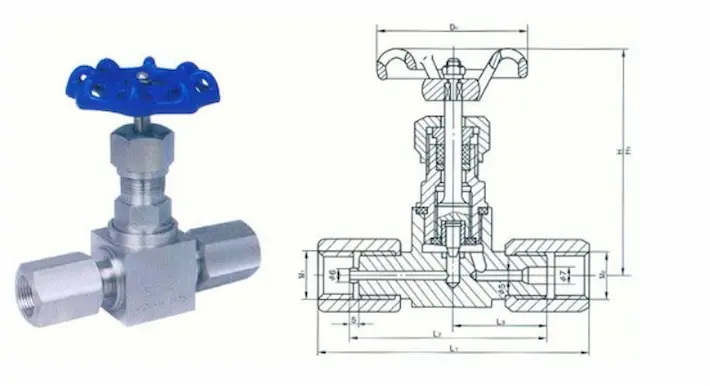
A needle valve uses a long, tapered stem (the “needle”) that moves gradually into a small orifice. As the stem advances, flow reduces incrementally, allowing extremely fine control.
Key characteristics of a needle valve:
-
Linear stem movement
-
Small flow passage
-
High control resolution
-
Excellent sealing when properly designed
This design makes the needle valve ideal for applications where precision outweighs flow capacity.
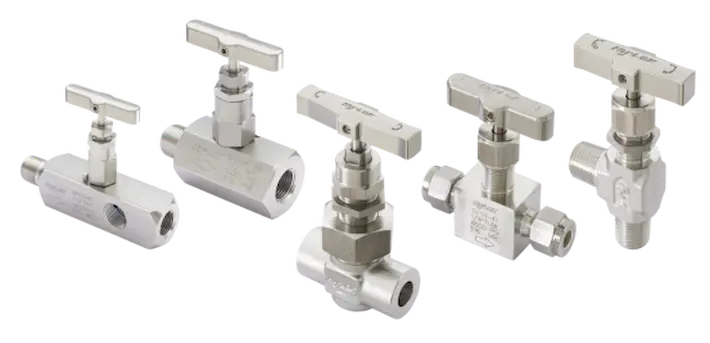
Common Types of Needle Valves
Straight Needle Valve
Used in straight-through piping where compact precision is required.
Angle Needle Valve
Redirects flow at 90°, reducing fittings and potential leak points.
High-Pressure Needle Valve
Designed with reinforced bodies and stems for demanding pressure conditions.
Instrumentation Needle Valve
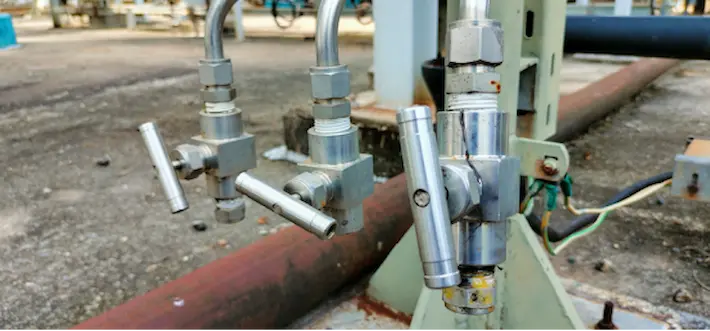
Used in measurement systems for gases and liquids.
Typical Application Examples
Case 1: Instrumentation Skid Upgrade
Replacing ball valves with stainless steel needle valves improved flow stability and eliminated pressure spikes.
Case 2: Chemical Dosing Line
A precision industrial needle valve reduced chemical waste by over 20% through accurate metering.
Data & Technical Comparison
| Valve Type | Best Use | Flow-Control Behavior | Main Limitation |
|---|---|---|---|
| Needle valve | Low-flow manual regulation, instrumentation, dosing, test lines | Very fine adjustment over a small flow range | Low flow capacity; slow operation; sensitive to debris |
| Ball valve | Fast on/off isolation | Poor throttling in standard full-bore designs | Not suitable for precise low-flow adjustment unless V-port/characterized design |
| Globe valve | General throttling and control | Better regulation for wider flow ranges | Higher pressure drop than many isolation valves |
| Gate valve | Full open/full closed isolation | Not recommended for throttling | Slow operation; seat erosion if partially open |
Usage & Selection Tips
-
Use needle valves only for flow regulation
-
Avoid using needle valves as high-cycle on/off valves. Frequent full open/close operation can wear the needle tip, seat, stem threads, and packing, reducing repeatability and sealing performance.
-
Select valve material according to fluid composition, corrosion mechanism, pressure rating, temperature, end connection, packing material, cleanliness requirement, and applicable project specification. Stainless steel is common, but brass, alloy steel, Monel, Hastelloy, or other alloys may be required depending on service.
-
Verify stem tip geometry for sealing performance
-
Always check pressure and temperature ratings
Conclusion
A needle valve is not a substitute for an on/off valve—it is a precision tool. When selected correctly, it delivers stable flow control, protects sensitive equipment, and improves system efficiency. At Vcore Valve, we design needle valves for engineers who care about accuracy, reliability, and long-term performance.
If your system demands control rather than compromise, a properly specified needle valve is the answer.
FAQ – Needle Valves
Q1: What is a needle valve used for?
A needle valve is used for precise flow regulation in low-flow or high-pressure systems.
Q2: Can a needle valve be used for shut-off?
Needle valves can provide shutoff in some small-flow or instrumentation services when designed for it, but they are primarily selected for fine flow adjustment. For frequent on/off isolation, a ball valve, plug valve, gate valve, or other shutoff valve may be more suitable.
Q3: Are needle valves suitable for gas applications?
Needle valves can be suitable for gas service, especially in instrumentation, calibration, sampling, and test systems. The valve must be selected for gas pressure, leakage requirement, material compatibility, seat/packing design, cleanliness, and any oxygen, hydrogen, toxic or flammable gas requirements.
Q4: What materials are needle valves made from?
Common materials include brass, stainless steel, and alloy steel.
Q5: How do I choose the right needle valve size?
Selection depends on flow rate, pressure, temperature, and media.