Quick Summary
Duplex steel valves are engineered to combat the extreme corrosivity of seawater, outperforming standard carbon and stainless steel alternatives in marine, offshore, and water treatment applications. Blending austenitic and ferritic steel properties, these valves deliver unrivaled strength, pitting resistance, and durability in saltwater environments. This guide breaks down their corrosion-fighting capabilities, critical selection criteria, and real-world use cases—so you can choose the right duplex steel valves for your seawater fluid systems with confidence.
Introduction: The Seawater Valve Conundrum
Imagine an offshore desalination plant where your valves start pitting and leaking after just six months of seawater exposure. Or a marine pipeline system where standard 304 stainless steel valves corrode so quickly, unplanned downtime eats into your project budget. For engineers and procurement teams working with seawater, this isn’t a hypothetical—it’s a daily battle. The culprit? Seawater’s lethal mix of chloride ions, oxygen, and fluctuating temperatures attacks conventional valve materials without mercy. But there’s a solution: duplex steel valves. Designed to thrive in the harshest saltwater conditions, these valves are the unsung heroes of marine, offshore, and coastal water treatment projects. At Vcore Valve, we’ve spent 20+ years manufacturing precision duplex steel valves for global seawater applications—and in this guide, we’re sharing everything you need to know to select, install, and maximize their performance.
Key Pain Points of Seawater Valve Selection
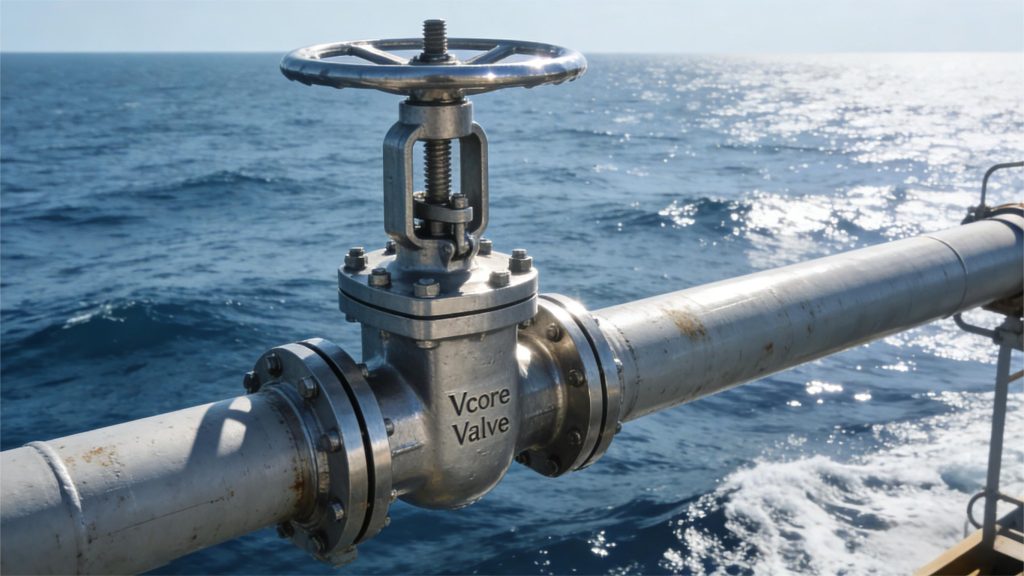
Working with seawater presents unique challenges for valve systems, and choosing the wrong material leads to costly, avoidable issues. Below are the three biggest pain points engineers face when sourcing valves for saltwater applications—all solved by duplex steel valves.
Uncontrolled Corrosion & Early Valve Failure
Seawater contains 19,000–20,000 ppm of chloride ions, which trigger pitting, crevice corrosion, and stress corrosion cracking (SCC) in standard steels like 304 and 316 stainless. This corrosion weakens valve bodies, seals, and trim, leading to leaks, flow control loss, and complete failure—often in less than a year of use. For offshore projects, replacing failed valves means expensive downtime, specialized labor, and logistical headaches.
Compromised Strength in Corrosive Environments
Many corrosion-resistant materials (e.g., pure austenitic stainless steel) lack the mechanical strength needed for high-pressure seawater systems (e.g., offshore oil & gas pipelines, desalination plants). Thin-walled valves made from these materials deform under pressure, leading to misalignment, poor sealing, and increased corrosion risk at stress points.
High Lifecycle Costs of Low-Cost Alternatives
Procurement teams often opt for cheap carbon steel or basic stainless steel valves to cut upfront costs—but this backfires. Frequent replacements, unplanned maintenance, and production downtime push the total lifecycle cost (LCC) to 3–5x that of a quality duplex steel valve. For long-term seawater projects, low upfront cost equals high long-term expense.
3 Expert Solutions: Choose & Use Duplex Steel Valves for Seawater Success
Duplex steel valves address every seawater valve pain point—but only if you select, install, and maintain them correctly. Below are our proven solutions for maximizing their corrosion resistance and lifespan in saltwater systems, developed from Vcore Valve’s 20+ years of marine valve expertise.
Select the Right Duplex Steel Grade for Your Seawater Application
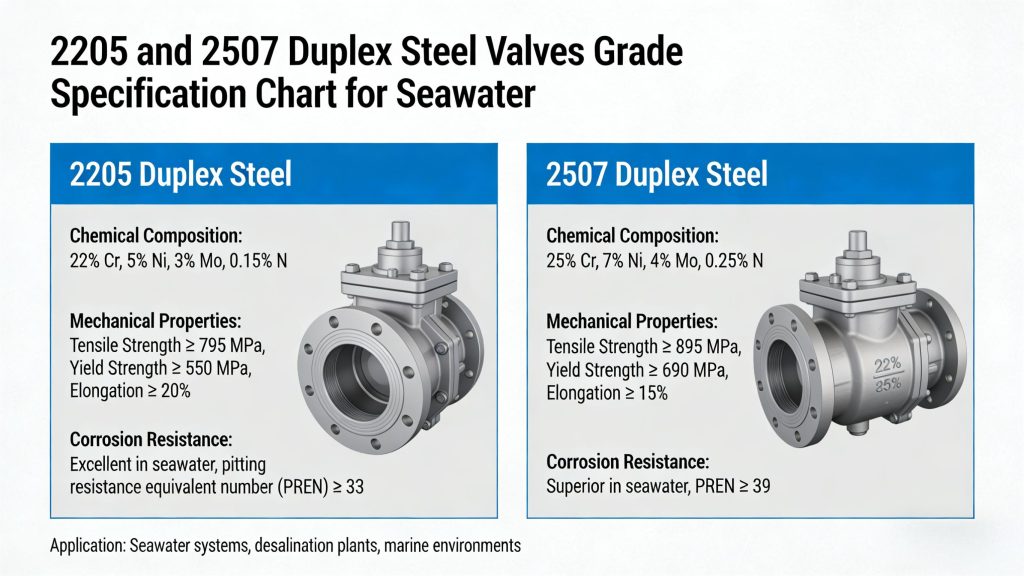
Not all duplex steel is created equal. The two primary grades for seawater duplex steel valves are 2205 (lean duplex) and 2507 (super duplex), and choosing the right one depends on your project’s chloride levels, pressure, and temperature. 2205 duplex steel is ideal for moderate seawater conditions (e.g., coastal water treatment), while 2507 super duplex delivers extreme pitting resistance for high-chloride environments (e.g., offshore oil & gas, deep-sea pipelines). At Vcore Valve Custom Duplex Steel Valve Solutions, we offer both grades, custom-engineered to API, ISO, and CE standards for seawater flow control.
Prioritize Precision Manufacturing & Quality Testing
Corrosion resistance in duplex steel valves starts with manufacturing. Poor machining, inconsistent material grading, and skipped quality tests create micro-cracks and crevices—perfect breeding grounds for seawater corrosion. Vcore Valve’s duplex steel valves undergo 10 rigorous quality control steps (including material verification, hydrostatic pressure testing, and dimensional checks) to ensure a smooth, crack-free surface that repels chloride ions. Every valve is also tested for seawater compatibility in our in-house lab, guaranteeing performance before shipment.
Implement Seawater-Specific Installation & Maintenance
Even the best duplex steel valves fail if installed incorrectly. For seawater applications, avoid tight crevices (use flange gaskets designed for saltwater), minimize galvanic corrosion (avoid pairing duplex steel with carbon steel fasteners), and perform regular low-maintenance checks (e.g., visual inspections for pitting, seal checks for leaks). Unlike conventional valves, duplex steel valves require no expensive corrosion inhibitors—simply clean with fresh water after prolonged seawater exposure to remove salt buildup, and they’ll perform for 10+ years.
Real-World Case Study: Duplex Steel Valves in Middle East Desalination
A leading Middle East petrochemical enterprise (a long-time Vcore Valve client) was experiencing valve failures in its seawater desalination plant. The plant initially used 316 stainless steel valves, which corroded and leaked within 8 months, leading to $200,000 in unplanned downtime and replacement costs. Vcore Valve recommended upgrading to 2507 super duplex steel valves—custom-engineered for the plant’s high-pressure seawater intake and reverse osmosis systems.
After installation, the duplex steel valves operated for 5+ years with no corrosion, leaks, or maintenance. The client cut their valve lifecycle costs by 70% and eliminated unplanned downtime for seawater flow control. As Ahmed Al-Subaithi, the client’s Procurement Manager, noted: “Vcore’s high-pressure valves withstand extreme operating conditions with zero leakage. Their precise design and responsive technical support simplified our complex pipeline system. Reliable performance we can trust.”
This case study isn’t an anomaly—duplex steel valves consistently outperform conventional materials in seawater applications, and Vcore Valve’s precision manufacturing takes their performance to the next level.
Data Analysis: Duplex Steel Valves vs. Conventional Valve Materials for Seawater
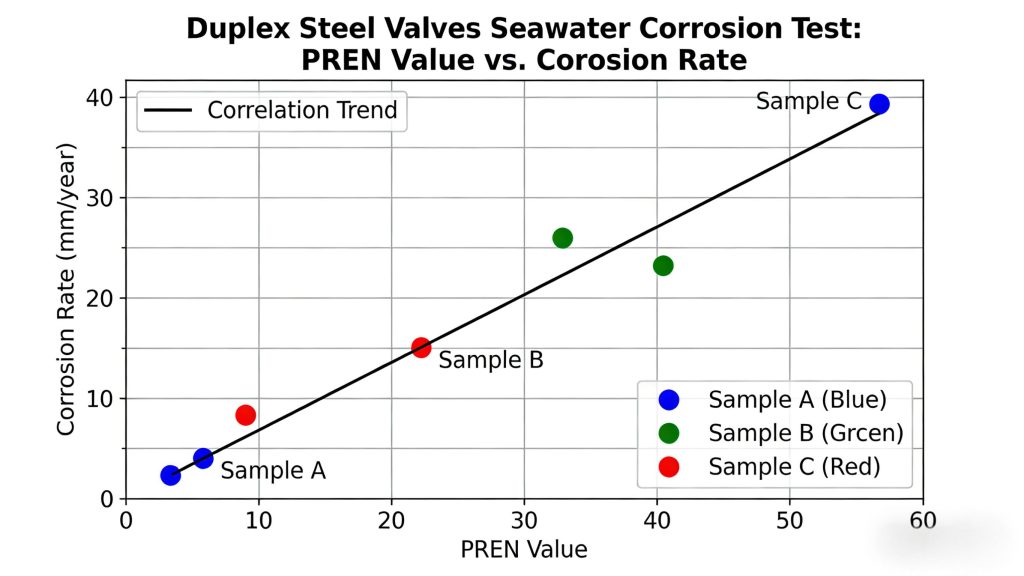
To quantify the performance of duplex steel valves in seawater, we compared 2205 duplex, 2507 duplex, 316 stainless steel, and carbon steel valves across 5 critical seawater performance metrics. All tests were conducted in standard seawater conditions (20,000 ppm chloride, 25°C, 10 bar pressure) for 12 months—results below.
| Material Grade | Pitting Resistance (PREN Value) | Corrosion Rate (mm/year) | Tensile Strength (MPa) | Lifespan in Seawater (Years) | Total Lifecycle Cost (USD/Valve) |
| 2205 Duplex | 38–42 | 0.001 | 620–750 | 10–15 | 1,800 |
| 2507 Duplex | 48–55 | 0.0005 | 750–850 | 15–20 | 2,500 |
| 316 Stainless | 25–30 | 0.05 | 515–620 | 1–2 | 3,200 (with replacements) |
| Carbon Steel | <10 | 0.8 | 400–500 | <0.5 | 4,500 (with replacements) |
PREN (Pitting Resistance Equivalent Number): Higher values = better chloride corrosion resistance. Test data from Vcore Valve In-House Materials Lab & ISO 15156 Seawater Corrosion Standards.
The data speaks for itself: duplex steel valves (2205 and 2507) deliver exponentially better corrosion resistance, higher strength, and a far lower lifecycle cost than conventional materials in seawater. For any project involving saltwater, they are not just a choice—they’re a necessity.
Market Trend & Industry Insight: Duplex Steel Valves for Sustainable Seawater Solutions
The global seawater valve market is growing at a CAGR of 7.2% (2025–2030), driven by the rise of desalination plants, offshore renewable energy (e.g., wind farms), and coastal industrial development. A key trend in this market is the shift from conventional to duplex steel valves—fueled by stricter environmental regulations and a focus on sustainable, low-maintenance fluid systems.
Regulators worldwide (e.g., the EU’s Marine Strategy Framework Directive, the US EPA’s Coastal Water Protection Act) now require valves in seawater systems to have a minimum 10-year lifespan and zero leakage—standards only duplex steel valves can meet consistently. Additionally, sustainable project developers are prioritizing duplex steel valves for their low lifecycle carbon footprint: fewer replacements mean less material waste, less energy used in manufacturing, and less logistical emissions from shipping new valves.
At Vcore Valve, we’re at the forefront of this trend, designing eco-friendly duplex steel valves with optimized sealing technology to reduce leakage and improve energy efficiency—aligning with global sustainability goals while delivering unbeatable seawater performance.
Practical Usage & Selection Tips for Duplex Steel Valves
Choosing the right duplex steel valves for your seawater project doesn’t have to be complicated. Follow these practical tips from Vcore Valve’s engineering team to ensure a perfect fit:
Match the grade to chloride levels: 2205 duplex for coastal seawater (≤20,000 ppm Cl⁻), 2507 duplex for high-chloride environments (≥20,000 ppm Cl⁻, e.g., offshore brine).
Check international certifications: Ensure your duplex steel valves are certified to API 6D (pipeline valves), ISO 15156 (corrosion-resistant materials), and CE (EU marine standards)—Vcore Valve’s duplex valves meet all three.
Prioritize custom engineering: Seawater projects have unique specs (e.g., high pressure, extreme temperatures). Opt for OEM/ODM duplex steel valves (like Vcore’s) to get a valve tailored to your exact flow control needs.
Avoid over-engineering: If your project is a low-pressure coastal water treatment system, 2205 duplex is sufficient—2507 super duplex is a premium upgrade for high-stress applications only.
Partner with a seawater valve expert: Not all valve manufacturers understand seawater corrosion. Choose a supplier with 20+ years of marine valve experience (like Vcore Valve) for technical support and reliable supply.
Conclusion & Call to Action (CTA)
Duplex steel valves are the ultimate solution for seawater corrosion resistance, strength, and long-term value. Whether you’re working on a desalination plant, offshore pipeline, marine renewable energy project, or coastal water treatment system, these valves eliminate the pain points of conventional materials—uncontrolled corrosion, weak strength, and high lifecycle costs.
At Vcore Valve, we manufacture precision 2205 and 2507 duplex steel valves for global seawater applications, with 20+ years of expertise, international certifications (API, ISO, CE), and OEM/ODM capabilities to tailor valves to your exact specs. Our duplex steel valves undergo 10 rigorous quality checks, are tested for seawater compatibility in our in-house lab, and come with comprehensive after-sales support (24/7 troubleshooting, installation guidance, maintenance programs).
Ready to upgrade your seawater fluid system with duplex steel valves that perform for 10+ years with zero corrosion and minimal maintenance? Start your valve project with Vcore Valve in 3 easy steps:
Tell us your seawater valve requirements (type, size, pressure, grade, quantity).
Get a detailed, transparent quotation and technical specification within 24 hours.
Approve and move to mass production—we handle manufacturing, testing, and global shipping directly to your designated location.
Don’t let seawater corrosion derail your project. Choose duplex steel valves from Vcore Valve—your trusted partner for precision-engineered, corrosion-resistant marine and offshore valve solutions.
FAQ: Duplex Steel Valves for Seawater Applications
Q1: What makes duplex steel valves better for seawater than 316 stainless steel?
A1: Duplex steel valves have a higher Pitting Resistance Equivalent Number (PREN) than 316 stainless steel, meaning they resist chloride-induced pitting and crevice corrosion far better. They also offer 20–30% higher tensile strength, making them ideal for high-pressure seawater systems.
Q2: What is the difference between 2205 and 2507 duplex steel valves for seawater?
A2: 2205 (lean duplex) is cost-effective for moderate seawater conditions (coastal water treatment, low-pressure marine pipelines) with a PREN value of 38–42. 2507 (super duplex) is a premium grade with a PREN value of 48–55, designed for high-chloride, high-pressure seawater environments (offshore oil & gas, desalination brine).
Q3: Do duplex steel valves require special maintenance for seawater applications?
A3: No—duplex steel valves are low-maintenance for seawater. Simply perform visual inspections for salt buildup every 6 months, clean with fresh water to remove chloride deposits, and check seals for leaks. They do not require corrosion inhibitors or frequent part replacements.
Q4: Are Vcore Valve’s duplex steel valves certified for marine and offshore use?
A4: Yes. All Vcore Valve duplex steel valves are certified to international marine and offshore standards, including API 6D, ISO 15156 (seawater corrosion), CE, and ISO 9001. They are trusted by global clients in the Middle East, Europe, and North America for offshore and marine projects.
Q5: Can Vcore Valve custom-engineer duplex steel valves for my unique seawater project?
A5: Absolutely. Vcore Valve offers full OEM/ODM services for duplex steel valves, including custom sizes, pressure ratings, connection types (flanged, welded, threaded), and actuation systems (manual, pneumatic, electric). Our engineering team will design a valve tailored to your exact seawater flow control needs.
Q6: What is the typical lifespan of Vcore’s duplex steel valves in seawater?
A6: Vcore’s 2205 duplex steel valves have a lifespan of 10–15 years in seawater, while our 2507 super duplex steel valves last 15–20 years—with zero corrosion and minimal maintenance when installed and used correctly.
Q7: How quickly can I get a quotation for Vcore’s duplex steel valves?
A7: Vcore Valve’s engineering team provides a detailed, transparent quotation and technical specification for duplex steel valves within 24 hours of receiving your project requirements (quantity, type, size, grade, pressure, etc.).
Reference Sources
ISO 15156-3:2021 – Petroleum and natural gas industries — Materials for use in H₂S-containing environments in oil and gas production — Part 3: Duplex stainless steels. https://www.nace.org/standards-and-publications/nace-standards/mr0175-iso-15156
API 6D:2024 – Pipeline Valves: Specification for Ball, Gate, and Check Valves for Pipeline Service. https://www.api.org/standards-product-catalog/standards/detail/6d
NACE International MR0175/ISO 15156 – Corrosion-Resistant Materials for Oil and Gas Production
Vcore Valve In-House Materials Lab – Seawater Corrosion Test Data (2025)
Global Market Insights – Seawater Valve Market Report (2025–2030)
European Marine Strategy Framework Directive (2008/56/EC) – Marine Environmental Protection Standards
Vcore Valve Client Case Studies – Middle East Desalination Plant (2020–2025)