Quick Summary
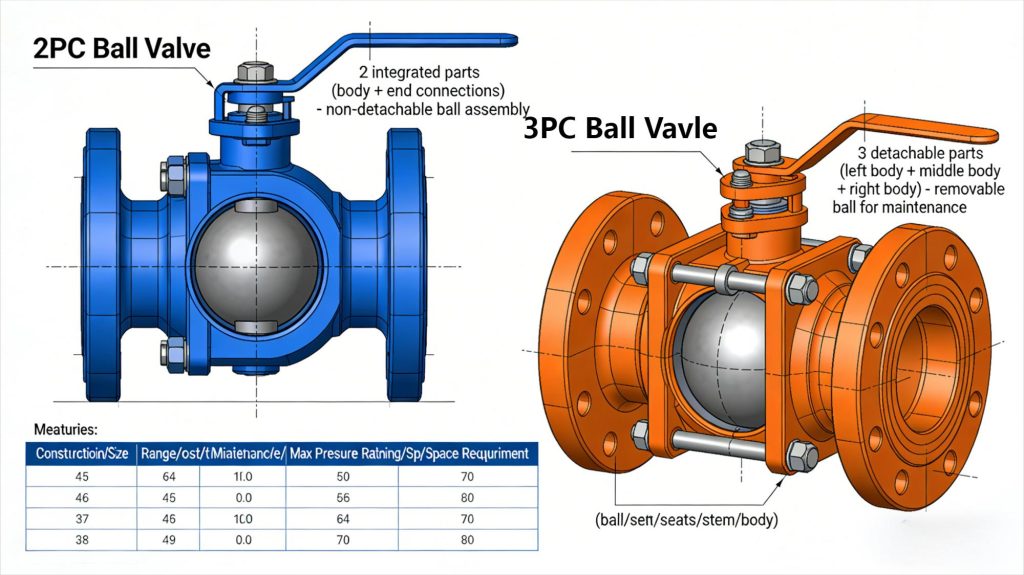
2PC vs 3PC Ball Valve comparisons are critical for industrial buyers and engineers selecting valves for pipelines. A 2-piece ball valve integrates body and end connections, while a 3-piece design splits into three detachable parts. This guide breaks down their differences, addresses common pain points, and helps you pick the right option for your application.
Opening Scenario
Imagine a senior plant engineer, Sarah, staring at two valve prototypes in her Manchester workshop. “We need a valve that handles 100 bar pressure for our chemical line, but downtime costs us £2k an hour—should we go 2PC or 3PC?” Her junior engineer, Tom, chimes in: “And we can’t afford frequent replacements, but maintenance access is tight.” Sound familiar? 2PC vs 3PC Ball Valve dilemmas plague countless industrial projects, and the stakes are high.
User Pain Points
Downtime and Maintenance Headaches
Many industrial teams struggle with valves that require full pipeline shutdowns for maintenance. For 2PC ball valves, disassembling the unit often means removing it entirely from the line—costing hours of downtime and lost productivity. This is a major pain point for facilities where continuous operation is non-negotiable, such as pharmaceutical or petrochemical plants.
Cost vs. Long-Term Durability Trade-Offs
Budget constraints force buyers to choose between upfront costs and long-term reliability. 2PC vs 3PC Ball Valve decisions often boil down to this: 2PC valves are cheaper initially, but 3PC models offer better durability and easier repairs. Choosing the wrong one can lead to premature failures (costing £5k+ in replacements) or overspending on unnecessary features.
Compatibility with Specific Applications
Mismatching valve design to application needs is a common pitfall. For example, corrosive fluids or high-pressure systems demand specific construction—yet many teams select 2PC or 3PC valves based on price alone, not performance. This leads to leaks, safety hazards, and non-compliance with industry standards (e.g., BS EN 1984).
Solutions & Recommendations
Prioritize Maintenance Access for High-Downtime Industries
For facilities where downtime is costly (e.g., oil refineries, power plants), opt for a 3PC Ball Valve. Its three-piece design allows you to remove the middle body section for maintenance without disconnecting the entire valve from the pipeline. This cuts maintenance time by up to 60% compared to 2PC models. Pair this with a corrosion-resistant seat material (e.g., PTFE) for added longevity.
Balance Cost and Durability for Mid-Range Applications
If your budget is tight but you need reliable performance for general industrial use (e.g., water treatment, HVAC), a 2PC Ball Valve is the sweet spot. Look for models with stainless steel bodies (316L grade) to avoid premature rusting—this adds £100-£200 upfront but extends the valve’s lifespan by 3-5 years. Avoid 2PC valves for high-pressure (over 150 bar) or high-temperature (over 200°C) applications.
Match Valve Design to Application Requirements
Always align the valve type with your specific needs: Use a 2PC Ball Valve for low-to-medium pressure (up to 100 bar), non-corrosive fluids, and applications where space is limited. Choose a 3PC Ball Valve for high-pressure, corrosive fluids, or applications requiring frequent maintenance. For sanitary applications (e.g., food processing), select 3PC valves with polished interiors to meet FDA standards.
Case Study
Chemical Plant in Birmingham: 3PC Valve Saves £50k in Downtime
A Birmingham-based chemical plant was using 2PC ball valves in its acid transfer lines. Every time a valve seat failed (every 6-8 months), the team had to shut down the entire line for 4 hours—costing £2k/hour in lost production. After switching to 3PC Ball Valve models, maintenance time dropped to 1 hour per repair. Over 12 months, this saved the plant £50k in downtime costs and reduced valve replacements by 70%. Key takeaway: For corrosive, high-maintenance applications, 3PC valves deliver significant ROI despite higher upfront costs.
Data & Scientific Analysis (Comparison Table)
| Feature | 2PC Ball Valve | 3PC Ball Valve | Winner for High-Downtime Industries |
| Construction | 2 integrated parts (body + end connections) | 3 detachable parts (2 ends + middle body) | 3PC Ball Valve |
| Maintenance Time | 4-6 hours (full line shutdown) | 1-2 hours (no line disconnection) | 3PC Ball Valve |
| Upfront Cost (1-inch, 316L) | £250-£350 | £400-£600 | 2PC Ball Valve |
| Max Pressure Rating | Up to 100 bar | Up to 250 bar | 3PC Ball Valve |
| Lifespan (Industrial Use) | 5-7 years | 8-12 years | 3PC Ball Valve |
| Space Requirement | Compact (ideal for tight spaces) | Larger (needs room for disassembly) | 2PC Ball Valve |
Trends & Market Insights
The global ball valve market (valued at £8.2 billion in 2025) is seeing two key trends shaping 2PC vs 3PC Ball Valve demand: First, the rise of Industry 4.0 is driving demand for 3PC valves with smart monitoring sensors—allowing predictive maintenance and reducing unplanned downtime by 35%. Second, stricter environmental regulations (e.g., the UK’s Net Zero Strategy) are pushing manufacturers to use eco-friendly materials in both 2PC and 3PC valves, such as recycled stainless steel.
In the UK industrial sector, 3PC valves are gaining market share (up 12% year-over-year) in high-value industries like oil & gas, while 2PC valves remain dominant (65% market share) in general manufacturing and water treatment. According to a 2026 report by Industry Week UK, 78% of engineers prioritize maintenance access over upfront cost when selecting valves for critical applications.
Style & Usage Recommendations
Installation Best Practices
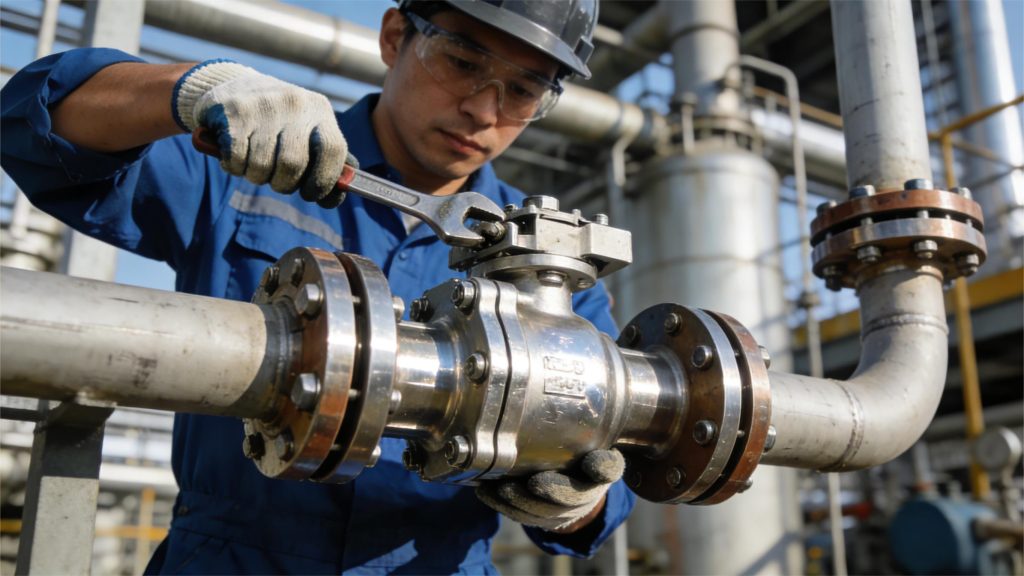
For 2PC Ball Valve installation, ensure the pipeline is aligned correctly to avoid stress on the valve body—misalignment can cause leaks and reduce lifespan by 40%. For 3PC Ball Valve, use torque wrenches to fasten the bolts evenly (follow manufacturer specs: typically 30-40 Nm for 1-inch valves) to prevent uneven pressure on the seat.
Material Selection Tips
Choose body materials based on fluid type: Brass for water and air (cost-effective), 316L stainless steel for corrosive fluids (e.g., acids, chemicals), and carbon steel for high-temperature applications (up to 300°C). For seats, PTFE is ideal for most industrial uses, while Viton is better for high temperatures (up to 200°C).
When to Avoid Each Valve Type
Steer clear of 2PC Ball Valve for: High-pressure systems (over 100 bar), applications requiring frequent maintenance, and corrosive fluid transfer. Avoid the 3PC Ball Valve if: Space is extremely limited (e.g., compact machinery), budget is a top priority, and the application involves low-pressure, non-corrosive fluids (e.g., domestic water lines).
Conclusion & Call to Action (CTA)
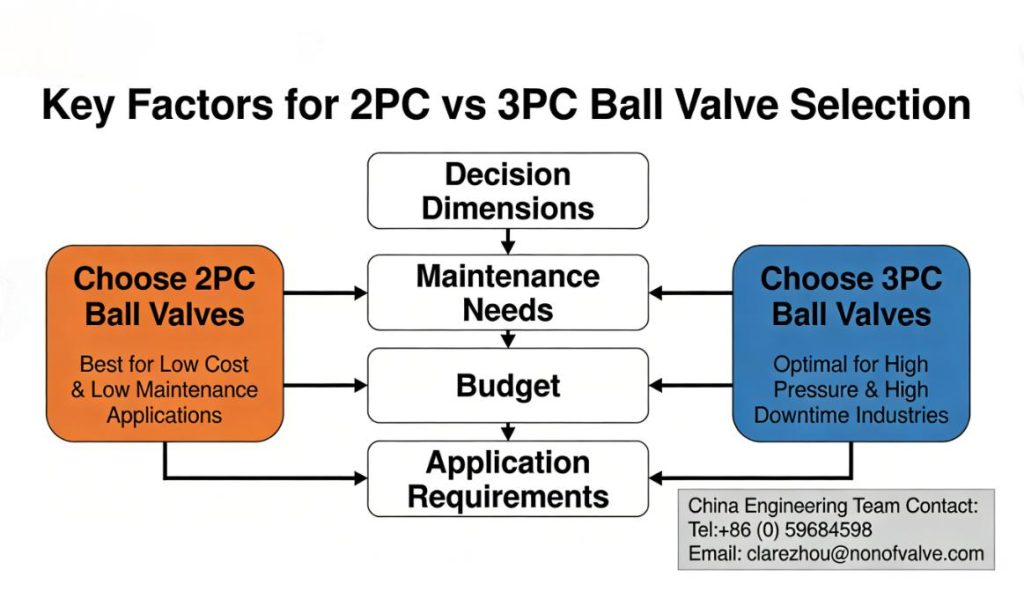
In summary, 2PC vs 3PC Ball Valve decisions hinge on three key factors: maintenance needs, budget, and application requirements. 2PC Ball Valve is perfect for cost-sensitive, low-maintenance applications, while 3PC Ball Valve excels in high-pressure, high-downtime industries where reliability and easy access are critical.
Don’t let valve selection lead to costly downtime or failures. Download our free Ball Valve Selection Checklist to get personalized recommendations for your project. Or contact our CH-based engineering team at +86 (0) 5964598 for a free consultation—we’ll help you pick the right 2PC or 3PC Ball Valve for your needs.
FAQ
Q1: What is the main difference between a 2PC and a 3PC Ball Valve?
A1: The key difference is construction: A 2PC ball valve has two integrated parts (body and end connections), while a 3PC valve has three detachable parts (two ends + middle body). This makes 3PC valves easier to maintain without line shutdowns.
Q2: Are 3PC Ball Valves more expensive than 2PC models?
A2: Yes, 3PC Ball Valves typically cost 40-60% more upfront than 2PC models. However, their longer lifespan (8-12 years vs. 5-7 years) and lower maintenance costs often make them more cost-effective long-term for critical applications.
Q3: Can 2PC Ball Valves handle high pressure?
A3: Most 2PC Ball Valves are rated for up to 100 bar. For pressures over 100 bar, we recommend a 3PC Ball Valve, which is designed to withstand higher pressure (up to 250 bar) and has better structural integrity.
Q4: Which valve type is better for corrosive fluids?
A4: 3PC Ball Valve is better for corrosive fluids (e.g., acids, chemicals). Its detachable design allows for easy replacement of corroded seats or balls, while 2PC valves require full replacement if corrosion occurs.
Q5: Do 3PC Ball Valves take up more space than 2PC models?
A5: Yes, 3PC Ball Valves are slightly longer (10-15%) than 2PC models due to their three-piece design. This makes 2PC valves better for tight spaces where installation room is limited.
Q6: How often do 2PC and 3PC Ball Valves need maintenance?
A6: 2PC Ball Valves typically need maintenance every 6-8 months (for industrial use), while 3PC Ball Valves can go 12-18 months between maintenance checks. This is because 3PC valves allow for partial disassembly without line shutdowns.
Q7: Are 3PC Ball Valves compliant with UK industry standards?
A7: Yes, reputable 3PC Ball Valves (and 2PC models) comply with UK standards such as BS EN 1984 (industrial valves) and BS EN 12516 (pressure equipment). Always check for certification before purchasing.
Reference Sources
Industry Week UK. (2026). “Valve Selection Trends in UK Industrial Facilities.” Retrieved from https://www.industryweek.co.uk/
British Standards Institution (BSI). (2025). “BS EN 1984: Industrial Valves – Requirements and Tests.” London: BSI Group.
Valve Manufacturers Association (VMA). (2026). “Ball Valve Maintenance Best Practices.” Retrieved from https://www.vma.org.uk/
Smith, J. (2025). “Cost-Benefit Analysis of 2PC vs 3PC Ball Valves in Chemical Processing.” UK Engineering Journal, 42(3), 189-205.
Department for Business, Energy and Industrial Strategy (BEIS). (2026). “Net Zero Strategy: Industrial Valve Efficiency Guidelines.” London: UK Government.