Quick Overview
Buying an electric actuated wafer butterfly valve involves more than selecting a diameter and voltage. Define the process conditions, verify the valve and flange arrangement, match the actuator to the valve torque and operating duty, compare complete quotations, approve the technical documents and agree inspection requirements before production. Send Vcore Valve one consistent enquiry package so that the proposed configuration and any deviations can be reviewed clearly.
When choosing a wafer butterfly valve manufacturer, buyers need to evaluate the complete assembly: valve, seat, shaft, mounting kit, electric actuator and controls. A competitive unit price can become an expensive purchase if the valve does not fit the pipeline or the actuator cannot perform the required duty.
This guide explains a practical procurement process for an electric actuated butterfly valve, from the initial request for quotation to commissioning. Materials and actuator features mentioned below are reference options; availability and suitability must be confirmed in the project quotation.
1. Define the Service Before Requesting a Price
Begin with a process datasheet or a clear enquiry table. Distinguish normal operating conditions from design limits and upset conditions. Line pressure alone does not establish the pressure difference across the closed valve, which is important for shut-off performance and torque selection.
| Enquiry item | Information to provide | Procurement purpose |
|---|---|---|
| Size and quantity | DN or NPS, quantity and valve tags | Identify each assembly and its document requirements. |
| Medium | Fluid name, concentration, solids and relevant chemical composition | Assess wetted materials, sealing and wear. |
| Pressure and temperature | Normal and design conditions, maximum differential pressure, vacuum and possible reverse flow | Check the complete assembly against the service envelope. |
| Pipeline interface | Flange standard and rating, facing, pipe bore and required face-to-face dimension | Verify fit, sealing and disc clearance. |
| Operating function | Isolation or modulation, flow range, cycles or starts per hour and required travel time | Select the appropriate valve and actuator duty. |
| Electrical requirements | Voltage, phase, frequency, controls, feedback and failure behaviour | Define the automation package. |
| Site conditions | Ambient temperature, indoor or outdoor location, humidity, corrosion and hazardous-area classification where applicable | Specify enclosure protection and any required approvals. |
For modulating service, include minimum, normal and maximum flow rates together with upstream and downstream pressures. Request a sizing review covering flow capacity, controllable operating range and possible cavitation, noise or vibration. A line-sized isolation valve is not automatically suitable for stable flow control.
2. Confirm That the Wafer Arrangement Fits the Installation
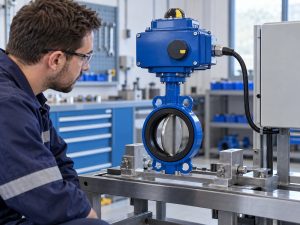
A wafer valve normally fits between mating pipe flanges and is retained by the pipeline bolting arrangement. Check the actual valve drawing against both flanges, including bolt paths, centring features and the disc movement envelope.
- Confirm the flange designation and dimensions; do not treat PN16 and Class 150 as interchangeable.
- Check disc clearance against the pipe bore, internal lining, reducers and adjacent equipment throughout travel.
- Confirm the face-to-face dimension for replacement work rather than relying on nominal size.
- Follow the valve-specific gasket instructions. Some resilient seats provide flange sealing; additional gaskets are not universally required or permitted.
- Obtain explicit approval for end-of-line service or operation with a downstream flange removed. Do not infer this capability from the wafer description.
Vcore’s butterfly valve bolt chart guide provides related installation context. Use the approved assembly drawing and installation instructions for the final bolt selection and tightening procedure.
3. Review Materials as a Complete Wetted System
Review the body, disc, shaft, seat, liner and seals together. A corrosion-resistant disc does not compensate for an incompatible seat or an exposed shaft material. Temperature capability also depends on pressure, fluid chemistry and the selected construction.
| Reference option | Potential application | Conditions and limitations to check |
|---|---|---|
| EPDM seat or lining | Water and selected aqueous services | Check the exact compound, temperature and chemicals. Do not assume compatibility with petroleum oils or fuels. |
| NBR seat or lining | Selected oil-containing media | Confirm compatibility with the actual oil, additives and temperature; NBR is not a universal chemical-service solution. |
| PTFE-lined construction | Selected corrosive chemical duties | Verify the full lining system, permeation risk, pressure-temperature envelope and vacuum capability. |
| Stainless steel disc and shaft options | Services requiring a specified level of corrosion resistance | Confirm exact grades and chloride exposure; generic stainless steel is not a universal seawater specification. |
| Coated ductile iron or carbon steel body | Applications compatible with the specified body and protective system | Review pressure-temperature limits, coating specification and whether the body is isolated from the medium. |
For initial product comparisons, review Vcore’s rubber-lined butterfly valve, EPDM-lined butterfly valve for water treatment and PTFE-lined butterfly valve for chemical service. Request a project-specific configuration rather than copying a general product description into the purchase order.
4. Specify the Electric Actuator Separately
Torque, duty and mounting
Ask for the valve torque basis at the specified differential pressure and service conditions, including breakaway, running and seating requirements where applicable. The selection should state the actuator output, any gearbox, the sizing margin and relevant operating limitations. Excessive available torque can damage the valve, so confirm protective settings and shaft limits as well as adequate operating torque.
Specify on/off or modulating duty, starts per hour and travel time. An actuator intended for occasional isolation should not be assumed suitable for frequent repositioning. Check mounting flange, shaft connection, bracket strength and alignment. ISO 5211 addresses part-turn actuator attachments; a matching flange designation alone does not prove that the complete assembly is correctly sized.
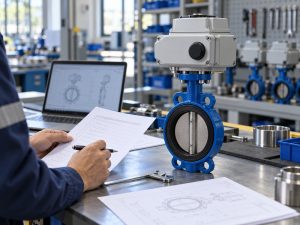
Power, signals and failure behaviour
- State the actual voltage, AC or DC supply, phase and frequency.
- Identify command signals, such as open/close contacts or a specified analogue signal, and define the required feedback separately.
- Confirm local controls, remote selection, position indication, manual override and alarm contacts.
- Specify the enclosure protection and any hazardous-area certification required for the exact actuator model.
- Define behaviour on loss of power and loss of control signal separately. Automatic fail-open or fail-close movement requires a suitable engineered arrangement.
Choose travel time with the process engineer. Rapid closure can create hydraulic transients in liquid systems, while a slow stroke may not meet the process requirement. Neither the fastest actuator nor the largest actuator is automatically the best choice.
Field Insight: Give Vcore Valve One Package to Review
For a Vcore Valve enquiry, combine the process datasheet, pipeline interface details and electrical requirements in one controlled package. If the valve and actuator are quoted separately, identify who is responsible for sizing, mounting, wiring and testing the assembled unit.
What to Check:
- Does the quotation identify the exact valve construction, seat compound and actuator model?
- Are the torque basis, operating duty, controls and failure behaviour documented?
- Are mounting components, assembly tests and required documents included in the price?
Keep a written list of deviations and resolve each item before order release. This makes the final technical agreement easier to trace during production, inspection and commissioning.
5. Compare Quotations on an Equal Basis
A useful quotation separates the valve, actuator, mounting kit, accessories, testing and documentation where needed. Compare the total compliant scope, including exclusions, rather than the headline price.
| Comparison area | Required clarification |
|---|---|
| Technical compliance | Materials, pressure-temperature limits, flange compatibility, leakage acceptance and deviations. |
| Automation scope | Actuator model, torque, duty, signals, feedback, failure behaviour and mounting responsibility. |
| Quality evidence | Applicable standards and editions, inspection plan, certificates and test records included. |
| Commercial terms | Currency, validity, payment terms, warranty and agreed Incoterms rule with named place. |
| Schedule and logistics | Lead-time starting point, approval periods, packing, weights, dimensions and freight exclusions. |
When assessing a wafer butterfly valve manufacturer, request evidence relevant to the actual order. Confirm who manufactures the valve, supplies the actuator and performs assembly testing. A general catalogue or certificate should not be treated as evidence that every proposed model meets the project requirements.
6. Approve the Technical Package and Release the Order
Before production release, agree the final datasheet, general arrangement drawing, material schedule, actuator selection, wiring diagram, inspection plan and deviation list. Record the approved revisions in the purchase order or its supporting documents.
State the applicable valve design and testing standards with agreed editions and acceptance criteria. API 609 may be specified for the butterfly valve where appropriate, but a design-standard reference does not define the entire electrical package or establish a certification claim. Specify pressure and leakage testing separately, including test medium, direction, pressure, duration and permitted leakage under the agreed procedure.
Clarify whether delivery time runs from order acceptance, advance payment or drawing approval. For replacement projects, obtain customer approval of critical installation dimensions before committing to manufacture.
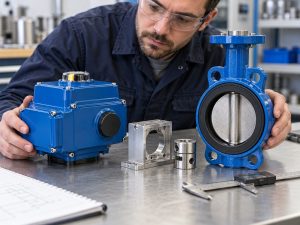
7. Inspect the Assembled Valve Before Dispatch
Agree inspection and witness points before production. Valve pressure testing and assembled functional testing address different requirements; one does not replace the other.
- Verify nameplates, valve tags, materials documentation and approved configuration.
- Review shell and seat test reports against the contracted procedure.
- Check full travel, position indication, limit settings, direction of rotation and manual operation.
- Verify remote commands, feedback and specified alarms using an agreed test arrangement.
- Where supplied, test failure behaviour against the agreed acceptance criteria.
- Check packing, protection of sealing surfaces, spare parts and the final document package.
Define factory acceptance testing in the contract if it is required. Factory functional checks do not establish suitability for every site operating condition; installation and commissioning remain necessary.
8. Receive, Install and Commission the Package
On receipt, inspect for transport damage and confirm the delivered tags and documents. Follow the approved instructions for storage, lifting and installation. Keep pipework aligned, support the assembly appropriately and verify disc clearance before powered operation.
A qualified electrical installer should verify the supply, protective earthing, cable entries and wiring. Commission the valve under a controlled procedure, checking local and remote operation, feedback, travel settings and the required failure response. Retain the final settings and test records for maintenance.
Prepare Your Enquiry for Vcore Valve
To request an electric actuated butterfly valve quotation, send Vcore Valve the service conditions, quantity, flange details, material requirements, electrical specification and required delivery date. Attach existing drawings for replacement work and identify any dimensions that cannot change. Review the Vcore butterfly valve range as a starting point, then obtain written confirmation of the proposed assembly.
Frequently Asked Questions
What information should I send to a wafer butterfly valve manufacturer?
Send the valve size, quantity, medium, temperature, operating and design pressures, maximum differential pressure, flange standard, material requirements and installation details. For an electric actuated butterfly valve, also specify the power supply, control signal, feedback, operating frequency, travel time and required failure behaviour.
Can I select an electric actuator by valve size alone?
No. Actuator selection requires the valve torque under the specified service conditions, the required operating duty and an agreed sizing margin. The mounting interface, coupling, bracket and valve shaft limits must also be checked.
Will an electric actuated butterfly valve close automatically if power fails?
Only if the supplied package includes a suitable and specified fail-safe arrangement. Confirm the required position, available stored energy, operating time and verification method before placing the order.
Are PN16 and Class 150 wafer connections interchangeable?
Do not assume they are interchangeable. Confirm the actual flange dimensions, bolt pattern, facing, pipe bore and valve compatibility against the approved drawing. A valve described as compatible with several flange standards still requires verification for the selected pipeline.
What should be approved before production starts?
Approve the final datasheet, general arrangement drawing, materials, actuator model, torque selection, wiring diagram, control functions, inspection plan and technical deviation list. Record the approved revisions in the purchase order or its agreed supporting documents.
Which documents should accompany the completed valve package?
Agree the document list before ordering. It may include valve and actuator datasheets, approved drawings, wiring diagrams, specified material certificates, pressure and leakage test reports, functional test records, installation instructions and a packing list. The supplied documents must match the contracted scope.
Technical References
- ISO 5211: Industrial valves — Part-turn actuator attachments: reference scope for the mechanical attachment interface.
- API standards programme updates: reference information for API 609. Agree the applicable edition and scope in the purchase specification.