304 vs 316 stainless steel valves is a common comparison in industrial valve selection. Both materials are widely used for ball valves, gate valves, globe valves, check valves, butterfly valves, control valves, and other process valves. They look similar from the outside, but their corrosion resistance and application suitability can be different.
For buyers, the key question is not simply whether a valve is “stainless steel.” The real question is whether the stainless steel grade is suitable for the medium, chloride level, temperature, pressure, cleaning process, chemical exposure, and project documentation requirement.
This guide explains the difference between 304 and 316 stainless steel valves, how CF8 and CF8M cast valve materials relate to 304 and 316, when each material should be selected, and what buyers should check before ordering.
For a broader review of valve body, trim, seat, seal, gasket, and bolting materials, read our valve material selection guide.
What Is a 304 Stainless Steel Valve?
A 304 stainless steel valve is commonly used in general stainless steel service where the medium is not highly corrosive. It is widely selected for clean water, air, mild chemicals, food-related service, general industrial pipelines, and indoor process systems.
304 stainless steel provides better corrosion resistance than carbon steel in many normal environments. However, it has limitations in chloride-rich water, seawater, strong acids, high-temperature chloride service, and some chemical applications.
Typical 304 stainless steel valve applications include:
- Clean water service
- Air and non-corrosive gas systems
- Mild chemical processing
- Food and beverage related utility lines
- General stainless steel process pipelines
- Indoor or low-corrosion industrial environments
- Applications where cost control is important and corrosion risk is moderate
What Is a 316 Stainless Steel Valve?
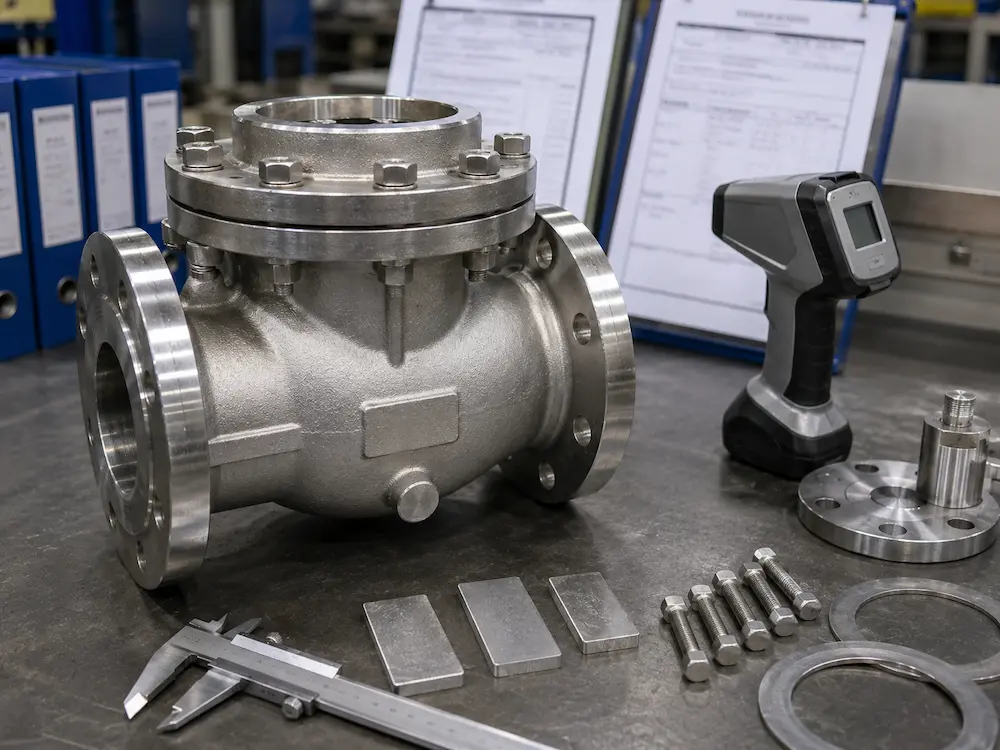
A 316 stainless steel valve is selected when better corrosion resistance is required. Compared with 304 stainless steel, 316 stainless steel contains molybdenum, which improves resistance to pitting and crevice corrosion in many chloride-containing and chemical environments.
316 stainless steel valves are commonly used in chemical processing, marine exposure, coastal environments, wastewater, chloride-containing water, food and beverage systems, pharmaceutical-related service, and more demanding industrial applications.
Typical 316 stainless steel valve applications include:
- Chemical processing pipelines
- Chloride-containing water service
- Marine and coastal environments
- Wastewater and process water with higher corrosion risk
- Food, beverage, and pharmaceutical-related systems
- More demanding stainless steel valve applications
- Projects where 316 or CF8M material is specified
Stainless Steel 316 vs 304 Valve: Main Difference
| Item | 304 Stainless Steel Valve | 316 Stainless Steel Valve |
|---|---|---|
| Main Material Feature | General austenitic stainless steel | Austenitic stainless steel with molybdenum |
| Corrosion Resistance | Good in many mild environments | Better in many chloride-containing and chemical environments |
| Chloride Resistance | Limited compared with 316 | Improved chloride resistance |
| Typical Cast Valve Grade | CF8 | CF8M |
| Common Use | Clean water, air, mild chemical, food-related service | Chemical, marine, wastewater, chloride-containing service |
| Cost | Usually more economical | Usually higher cost |
| Main Selection Risk | May fail earlier in chloride or aggressive chemical service | May still be insufficient for severe acids, seawater, or high-temperature chlorides |
CF8 vs CF8M: How They Relate to 304 and 316 Valves
Industrial buyers often use 304 and 316 to describe stainless steel valves. However, for cast valve bodies and bonnets, the material is often specified as CF8 or CF8M.
- CF8 is a cast stainless steel valve material broadly comparable to cast 304 stainless steel.
- CF8M is a cast stainless steel valve material broadly comparable to cast 316 stainless steel.
This distinction matters because many industrial valves use cast components. A purchase order may say “316 stainless steel valve,” but the valve body material may be listed as ASTM A351 CF8M in the datasheet or material certificate.
Simple buyer reference:
| Buyer Term | Common Cast Valve Material | Typical Meaning |
|---|---|---|
| 304 stainless steel valve | CF8 | General cast stainless steel valve material |
| 316 stainless steel valve | CF8M | Cast stainless steel valve material with better corrosion resistance in many services |
What Is CF8 Valve Material?
CF8 is a cast austenitic stainless steel material commonly used for valve bodies, bonnets, covers, discs, and pressure-containing cast components. It is often associated with ASTM A351 CF8.
CF8 is widely used when buyers need stainless steel valve construction for general service but do not require the higher corrosion resistance of CF8M or special alloy materials.
CF8 may be suitable for:
- Clean water
- Air and non-corrosive gas
- Mild chemical service
- General stainless steel process lines
- Food-related utility systems
- Applications where 304-type stainless steel performance is acceptable
What Is CF8M Valve Material?
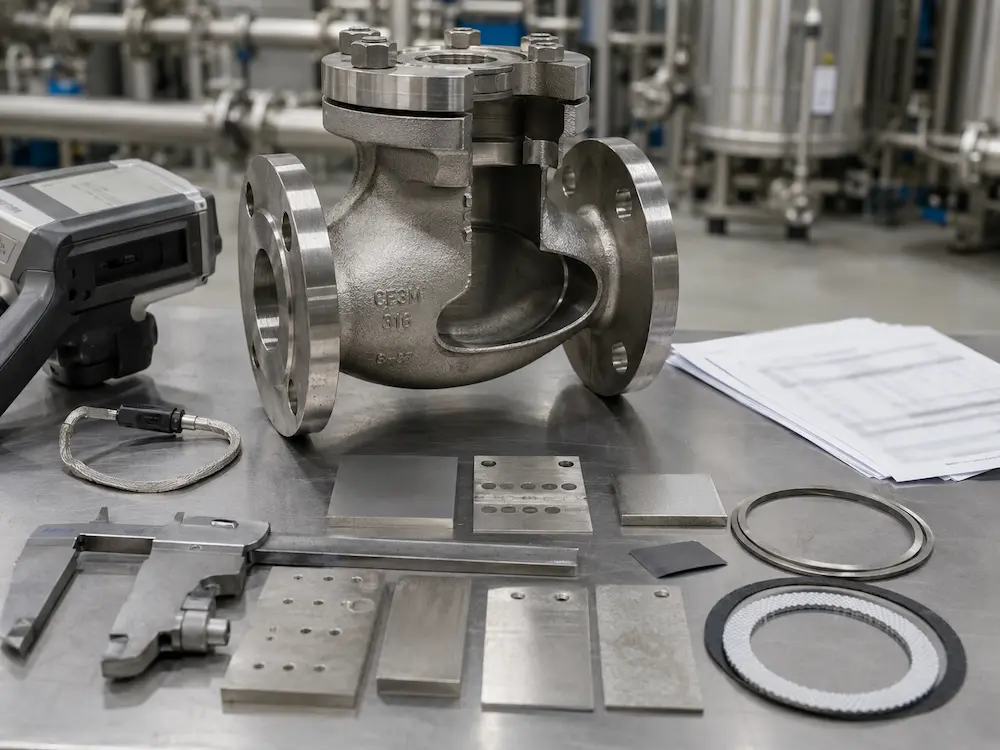
CF8M is a cast austenitic stainless steel material commonly used when better corrosion resistance is required. It is often associated with ASTM A351 CF8M.
The “M” indicates molybdenum content. Molybdenum improves corrosion resistance in many chloride-containing and chemical environments. This is why CF8M is commonly selected for chemical processing, marine exposure, coastal service, wastewater, and more demanding industrial conditions.
CF8M may be suitable for:
- Chemical processing
- Chloride-containing water
- Marine and coastal exposure
- Wastewater with higher corrosion risk
- 316-type stainless steel project requirements
- Applications where CF8 may not provide enough corrosion resistance
Corrosion Resistance: 304 vs 316 Stainless Steel Valves
Corrosion resistance is the main reason buyers compare 304 and 316 stainless steel valves. 304 stainless steel performs well in many general environments, but 316 stainless steel is usually preferred where chlorides or more aggressive chemicals are present.
304 stainless steel may be enough when:
- The medium is clean water, air, or mild process fluid
- Chloride exposure is low
- The valve is used indoors or in a mild environment
- The project does not specify 316 or CF8M
- Cost control is more important than maximum corrosion resistance
316 stainless steel should be reviewed when:
- The medium contains chlorides
- The valve is used in chemical processing
- The installation is near marine or coastal environments
- Wastewater or process water may be corrosive
- Cleaning chemicals are used frequently
- The project specification requires 316 or CF8M
For chemical applications, buyers can also read our guide on industrial valves for chemical processing.
Can 304 Stainless Steel Replace 316?
304 stainless steel should not replace 316 when the project specification, datasheet, or purchase order requires 316, CF8M, or equivalent corrosion resistance. Although 304 and 316 are both stainless steel materials, their corrosion resistance is not the same.
If the service is clean water, air, or mild process fluid, 304 may be acceptable. But if the application involves chlorides, seawater exposure, chemical media, or a 316 material requirement, 316 should be reviewed instead.
Can 316 Stainless Steel Replace 304?
316 stainless steel can often be used in applications where 304 is acceptable, but it usually costs more. It may be selected when buyers want better corrosion resistance, when the environment is uncertain, or when project standards specify 316 or CF8M.
However, 316 should not be treated as a universal solution. In severe chloride service, strong acids, high-temperature chemical service, or highly corrosive media, even 316 or CF8M may not be enough. Duplex stainless steel, super duplex, titanium, nickel alloy materials, PTFE lining, or rubber lining may be required depending on the working condition.
304 vs 316 Stainless Steel Valves by Application
Water Treatment
304 stainless steel may be suitable for clean water and mild utility water systems. 316 stainless steel is preferred when water contains chlorides, chemicals, or higher corrosion risk. For wastewater, buyers should also consider pH, solids, chemical dosing, and coating or lining requirements.
Chemical Processing
316 stainless steel or CF8M is often preferred over 304 or CF8 for many chemical processing applications. However, chemical concentration, temperature, pressure, and compatibility must still be checked. Some chemical services may require PTFE lined valves or special alloys instead of stainless steel alone.
Marine and Coastal Service
316 stainless steel is generally more suitable than 304 for marine exposure and chloride-containing environments. However, severe seawater service may still require duplex, super duplex, bronze, special coatings, or lined valve designs.
Food and Beverage
Both 304 and 316 stainless steel valves may be used in food and beverage related systems depending on cleanliness requirements, cleaning chemicals, corrosion risk, and project standards. 316 may be preferred where stronger cleaning chemicals or chloride exposure are expected.
Oil and Gas
Stainless steel valve material selection for oil and gas service depends on medium composition, pressure, temperature, corrosion risk, sour service requirement, and project specification. 316 or CF8M may be selected in more corrosive process conditions, but NACE or other project requirements should be reviewed separately if specified.
Pharmaceutical and Clean Process Systems
316 stainless steel is often preferred for clean process and pharmaceutical-related systems because of stronger corrosion resistance and cleaning compatibility. However, buyers should still confirm surface finish, cleaning method, seat material, gasket material, and documentation requirements.
304 vs 316 Stainless Steel Valves by Valve Type
| Valve Type | 304 / CF8 Use | 316 / CF8M Use |
|---|---|---|
| Ball Valve | Clean water, air, mild chemical, general stainless service | Chemical, marine, chloride-containing, and more corrosive service |
| Gate Valve | General stainless steel isolation service | Corrosive industrial isolation service requiring 316-type material |
| Globe Valve | Mild process flow control and shut-off | Chemical or chloride-related process regulation |
| Check Valve | General stainless steel backflow prevention | Seawater exposure, chemical lines, wastewater, and corrosive pump discharge |
| Butterfly Valve | Stainless disc or body for mild water and process service | More corrosion-resistant body or disc for chemical and chloride-containing service |
| Control Valve | Mild process control with suitable trim | Corrosive process control with suitable trim, seat, and packing |
Buyers can compare product options in Vcore Valve’s industrial valve product range, including ball valves, gate valves, globe valves, butterfly valves, check valves, control valves, and lined valves.
Seat, Seal, Gasket and Trim Materials Still Matter
Selecting 304 or 316 stainless steel body material does not complete the valve material selection. The seat, seal, gasket, packing, stem, trim, bolting, and spring materials must also match the medium and temperature.
Important material details include:
- Stem material and corrosion resistance
- Ball, disc, gate, plug, or trim material
- Seat material such as PTFE, reinforced PTFE, PPL, EPDM, NBR, FKM, or metal seat
- Gasket material such as PTFE, graphite, or spiral wound gasket
- Packing material such as PTFE or graphite
- Spring material in check valves or spring-return designs
- Bolting material and external corrosion resistance
For example, a 316 stainless steel valve body may still fail if the seat material is not compatible with the chemical medium or if the gasket cannot handle the temperature.
Material Certificate, MTC and PMI Requirements
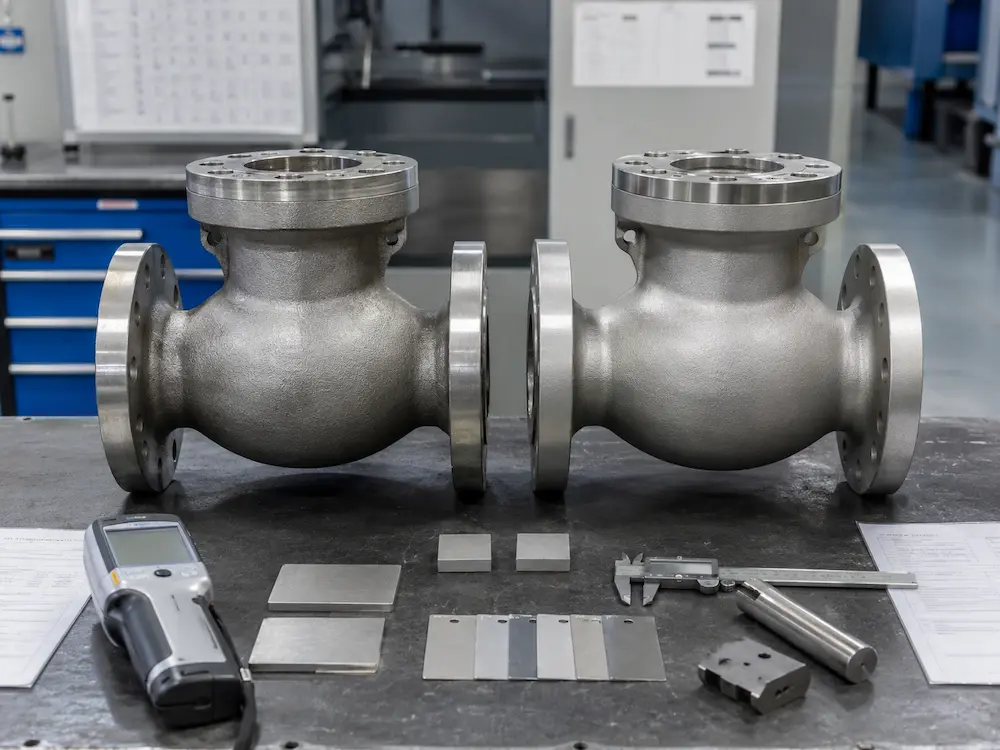
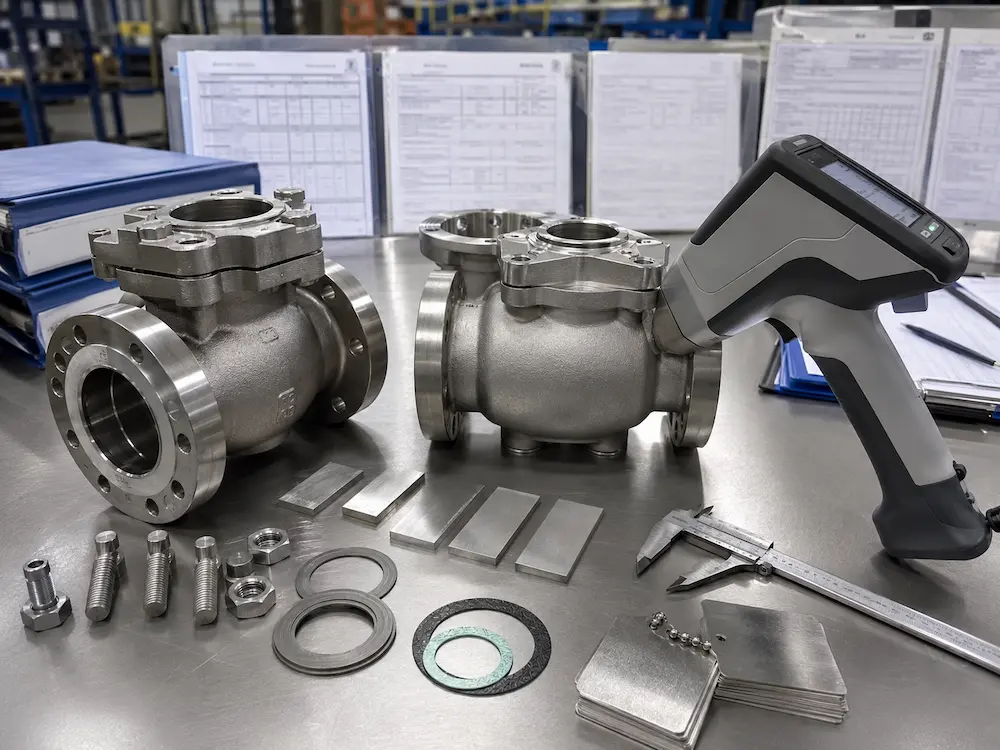
For stainless steel valve orders, material documents are important. Buyers should confirm the material grade, heat number traceability, chemical composition, and whether the certificate matches the supplied valve components.
For 304 / CF8 valve orders, buyers should check:
- Material grade such as ASTM A351 CF8 or approved equivalent for cast components
- Heat number traceability
- Chemical composition
- Mechanical properties if required
- Certificate connection with supplied valve body or pressure-containing parts
For 316 / CF8M valve orders, buyers should check:
- Material grade such as ASTM A351 CF8M or approved equivalent for cast components
- Molybdenum-containing stainless steel chemistry
- Heat number traceability
- Chemical composition and mechanical properties
- Project specification consistency
- Whether PMI is required for stainless steel verification
For more details about certificates and quality documents, read our article on valve certificates and quality documents.
Common Mistakes When Selecting 304 or 316 Stainless Steel Valves
Mistake 1: Treating All Stainless Steel Valves as the Same
304, 316, CF8, and CF8M are not identical in corrosion resistance or project meaning. Buyers should confirm the exact material grade before ordering.
Mistake 2: Using 304 in Chloride Service Without Review
304 stainless steel may not be suitable for chloride-rich environments. If the system contains chlorides or seawater exposure, 316, CF8M, duplex, or other materials should be reviewed.
Mistake 3: Assuming 316 Solves All Corrosion Problems
316 stainless steel has better corrosion resistance than 304 in many services, but it is not suitable for all severe acids, high-temperature chlorides, or aggressive chemical media.
Mistake 4: Ignoring Seat and Seal Compatibility
A 316 stainless steel valve body may still fail if the seat, gasket, or packing material is not compatible with the medium or operating temperature.
Mistake 5: Not Checking MTC or PMI Requirements
For project orders, buyers should confirm material certificates and PMI requirements before production, especially for stainless steel, alloy, and critical service valves.
How to Choose Between 304 and 316 Stainless Steel Valves
| Question | Choose 304 / CF8 If | Choose 316 / CF8M If |
|---|---|---|
| Is the medium strongly corrosive? | No, the service is mild | Yes, corrosion risk is higher |
| Is chloride present? | Low or not significant | Chloride-containing service requires better resistance |
| Does the project specify 304 or 316? | 304 / CF8 is allowed | 316 / CF8M is required |
| Is cost the main concern? | Usually more economical | Higher cost but better corrosion resistance |
| What is the application? | Clean water, air, mild process service | Chemical, marine, wastewater, chloride-containing service |
Information Buyers Should Provide Before Quotation
- Valve type: ball, gate, globe, check, butterfly, plug, or control valve
- Valve size and pressure class
- Required body material: 304, 316, CF8, CF8M, or other material
- Medium name and chemical composition
- Chloride content if known
- Operating pressure and design pressure
- Operating temperature and maximum temperature
- Required seat, seal, gasket, packing, and trim materials
- Required ASTM material standard
- Whether PMI is required
- Required material certificate or MTC
- Project specification or datasheet if available
Related Valve Material Guides
- Valve Material Selection Guide — main guide for valve body, trim, seat, seal, gasket, and bolting material selection.
- WCB vs LCB Valve Material — explains carbon steel and low-temperature carbon steel valve material selection.
- Anti-Corrosion Valve Materials for Chemical Processing — explains stainless steel, PTFE, rubber lining, duplex, titanium, and other corrosion-resistant material options.
- Valve Certificates and Quality Documents — explains material certificates, pressure test reports, inspection documents, and project documentation.
Final Recommendations for Industrial Buyers
304 and 316 stainless steel valves are both widely used, but they should not be treated as the same material. 304 stainless steel is practical and economical for many clean water, air, mild chemical, and general process services. 316 stainless steel provides better corrosion resistance in many chloride-containing, chemical, marine, and more demanding environments.
For cast stainless steel valve components, buyers should also understand CF8 and CF8M. CF8 is broadly comparable to cast 304 stainless steel, while CF8M is broadly comparable to cast 316 stainless steel. The quotation, datasheet, material certificate, and purchase order should clearly state the required material grade.
For severe corrosion, high-chloride service, strong acids, or high-temperature chemical media, even 316 or CF8M may not be enough. Buyers should review duplex stainless steel, super duplex, titanium, nickel alloy, PTFE lined valves, rubber lined valves, or other special material solutions.
If you need help selecting 304, 316, CF8, CF8M, WCB, LCB, duplex, alloy steel, PTFE lined, rubber lined, trim, seat, or seal materials for industrial valves, Vcore Valve can review your medium, pressure, temperature, corrosion risk, and project documentation requirements.
For industrial sourcing, the key question is not only “Is this valve stainless steel?” The better question is: “Does this stainless steel grade match the corrosion risk, chloride level, chemical medium, temperature, seat material, and certificate requirement?”
External Material Standard Reference
For stainless steel valve material verification, buyers should compare the MTC/MTR against the material grade and project specification. When an order calls for ASTM stainless steel requirements, the official standards source is ASTM International; the valve supplier should still confirm the exact ASTM designation, heat number, chemistry and mechanical properties for each pressure-containing part.
FAQ
1. What is the main difference between 304 and 316 stainless steel valves?
The main difference is corrosion resistance. 316 stainless steel contains molybdenum and usually provides better corrosion resistance than 304 in many chloride-containing and chemical environments.
2. What is CF8 valve material?
CF8 is a cast stainless steel valve material broadly comparable to cast 304 stainless steel. It is commonly used for valve bodies, bonnets, covers, and other cast valve components.
3. What is CF8M valve material?
CF8M is a cast stainless steel valve material broadly comparable to cast 316 stainless steel. It contains molybdenum and is often selected for improved corrosion resistance.
4. Is 316 stainless steel always better than 304 for valves?
No. 316 stainless steel has better corrosion resistance in many services, but it is more expensive and not always necessary. 304 stainless steel may be suitable for clean water, air, mild chemical, and general service.
5. Can 304 stainless steel valves be used in seawater?
304 stainless steel is generally not preferred for seawater or high-chloride service. 316 stainless steel has better chloride resistance, but severe seawater service may require duplex, super duplex, bronze, coatings, or lined valve designs.
6. Do stainless steel valves need material certificates?
For project orders, stainless steel valves often require material certificates or MTC documents. Buyers should confirm material grade, heat number traceability, chemical composition, and PMI requirements before production.