Stainless steel vs carbon steel valves is not a simple choice between “cheap” and “corrosion resistant.” In a real RFQ, the buyer must check body grade, trim, seat, gasket, bolting, coating, temperature and inspection documents. A WCB carbon steel valve may be correct for clean service, while a CF8M stainless steel valve may still fail early if chlorides, sour service or unsuitable soft parts are ignored.
This guide focuses on practical valve material selection for international industrial buyers. It keeps the comparison tight, but adds the technical checks that prevent wrong material quotations and costly project revisions.
Fast Selection Rule
Choose carbon steel when the medium is compatible, external corrosion is controlled and the project needs cost efficiency. Choose stainless steel when corrosion resistance, cleaning, hygiene or exposure risk justifies the higher material cost. For uncertain chemical service, start with the medium and temperature first, then check the approved material grade.
If chloride, acid, seawater, food contact, pharmaceutical cleaning or sour gas is involved, do not make the decision from body material alone. Review the full valve construction and compare it with a broader corrosion-resistant valves guide before sending the RFQ.
Stainless Steel vs Carbon Steel Valves Comparison Table
| Selection Check | Carbon Steel Valves | Stainless Steel Valves | Main RFQ Risk |
|---|---|---|---|
| Common cast grades | ASTM A216 WCB/WCC for many cast steel valves; ASTM A352 LCB/LCC for low-temperature cast carbon steel service. | ASTM A351 CF8, CF8M, CF3 and CF3M for cast austenitic stainless steel valve bodies. | Using a generic “CS” or “SS” description without a material grade. |
| Corrosion resistance | Needs compatible medium, coating or corrosion allowance when corrosion is possible. | Better general corrosion resistance, but grade and chemistry still matter. | Assuming stainless steel means corrosion-proof. |
| Chloride service | May corrode quickly without lining, coating or another approved material strategy. | 304/CF8 and 316/CF8M can suffer chloride pitting or chloride stress corrosion cracking under the wrong conditions. | Not stating chloride concentration, temperature and cleaning media. |
| Low-temperature suitability | WCB is not a low-temperature choice by default; LCB/LCC may be specified when impact toughness is required. | Many austenitic stainless steels keep good toughness at low temperature, but the standard and test requirement still need confirmation. | Ordering WCB when the project actually needs low-temperature impact testing. |
| Coating requirement | Often needs painting, epoxy, galvanizing or other external protection depending on site exposure. | Usually less coating-dependent, but passivation or surface finish may be specified. | No coating system or site exposure stated in the RFQ. |
| Maintenance | May need more attention where coating damage, rust or erosion-corrosion is possible. | Often lower external corrosion maintenance, but crevice areas and deposits still need inspection. | Ignoring maintenance access and cleaning method. |
| Initial cost | Usually lower for compatible service and common pressure classes. | Usually higher because of alloy content and machining/processing cost. | Selecting by purchase price only. |
| Lifecycle cost | Can be low when corrosion is controlled and service is stable. | Can be lower over time if it prevents shutdowns, coating repairs or premature replacement. | No lifecycle view for aggressive or hard-to-access service. |
| Typical service | Clean oil, gas, steam, water and many general industrial lines when compatible with the process. | Chemical, food, beverage, pharmaceutical, marine exposure and corrosive utilities when the grade is suitable. | Using application labels without fluid chemistry and temperature. |
| Main RFQ risk | Forgetting coating, corrosion allowance, low-temperature grade or sour service requirement. | Confusing 304/316 wrought grades with CF8/CF8M cast grades, or ignoring chloride/SCC risk. | Specifying only the valve body and forgetting trim, seat, gasket and bolting. |
What The Material Grades Mean
ASTM A216 WCB is a common cast carbon steel grade for pressure-containing valve bodies. ASTM A351 CF8 and CF8M are common cast stainless steel grades for pressure-containing parts. ASTM A351/A351M covers austenitic steel castings for valves, flanges, fittings and other pressure-containing parts, and notes that grade selection depends on design and service conditions, mechanical properties and corrosion or high-temperature characteristics.
For buyers, the practical relationship is this: CF8 is commonly treated as the cast-valve counterpart to 304 stainless steel, and CF8M is commonly treated as the cast-valve counterpart to 316 stainless steel. Do not write only “304 valve body” or “316 valve body” if the valve is a casting. Ask whether the quoted body is CF8, CF8M, CF3, CF3M or another approved cast grade. For a more focused stainless comparison, use our 304 vs 316 stainless steel valves guide.
Low-temperature carbon steel is another common RFQ mistake. WCB, LCB and LCC are not interchangeable labels. LCB/LCC are normally considered when low-temperature toughness and impact testing are required by the project. If the project includes cold climate, refrigerated service or low design temperature, compare the requirement with WCB vs LCB valve material before choosing the body grade.
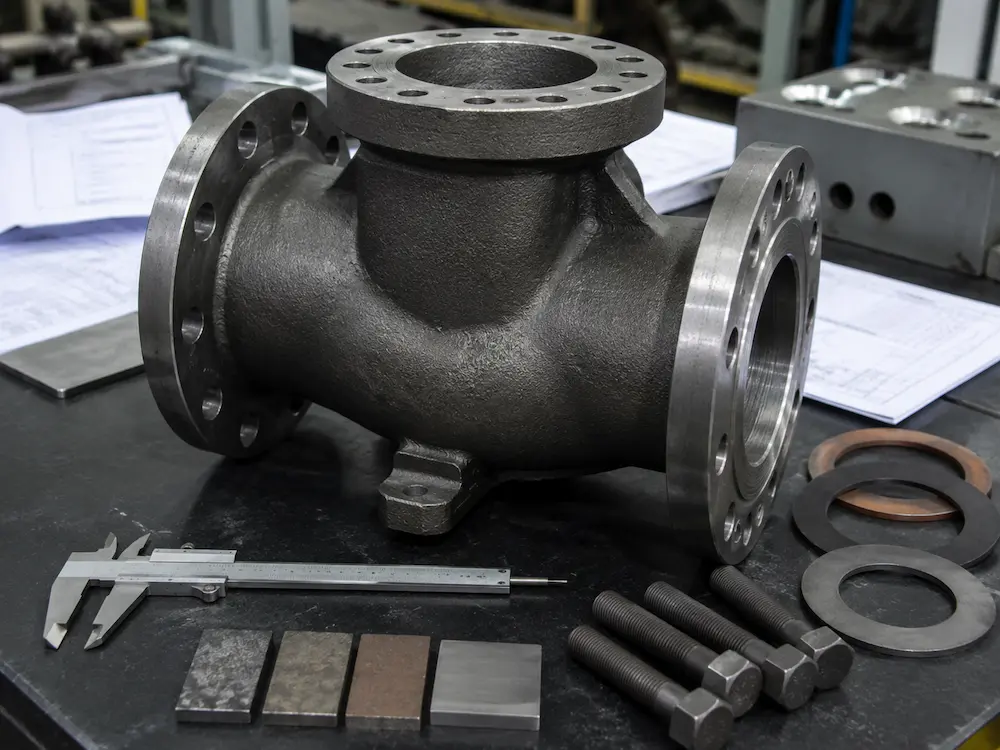
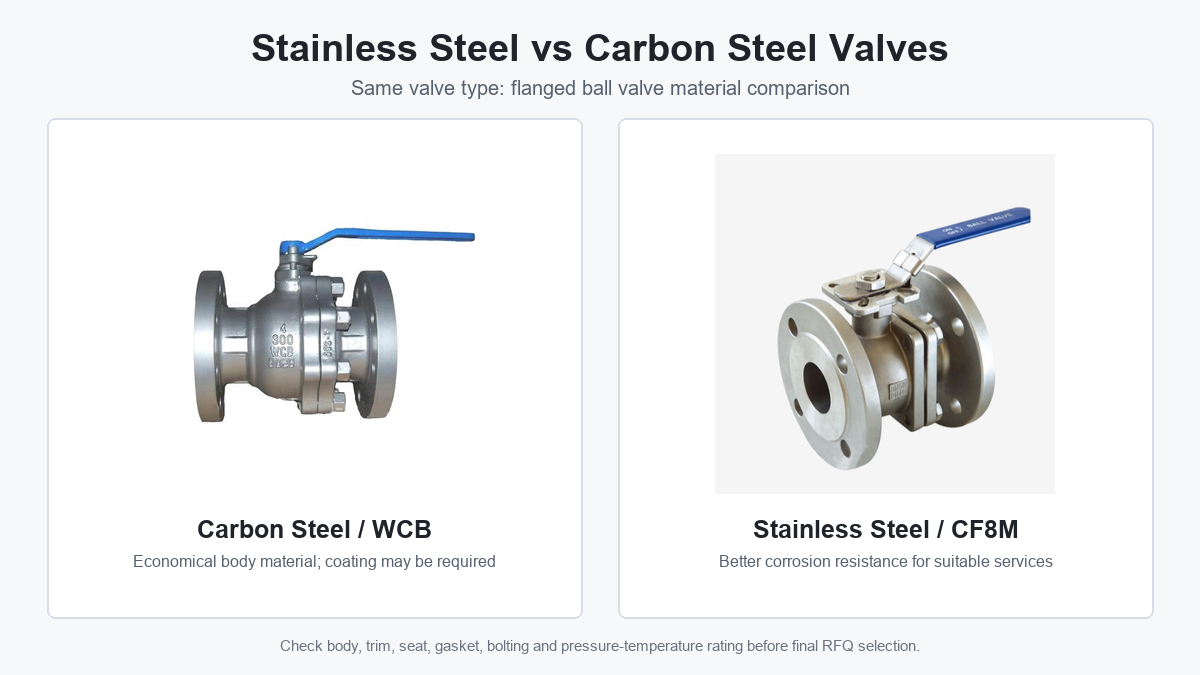
WCB cast carbon steel body material example.
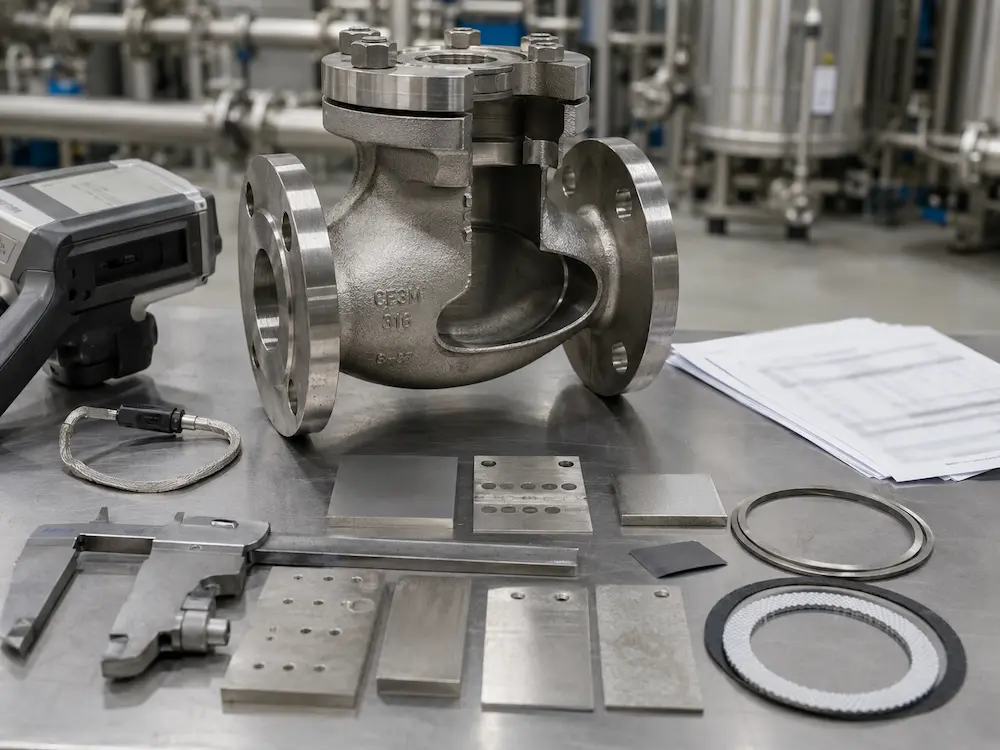
316/CF8M stainless steel valve material example.
Corrosion Risks Buyers Should Not Skip
Chloride pitting and stress corrosion cracking: Stainless steel can be vulnerable when chloride concentration, temperature and tensile stress combine. 316/CF8M usually performs better than 304/CF8 in many chloride environments, but it is not a universal seawater or brine solution. For severe chloride service, duplex, super duplex or lined valves may be more suitable.
Sour service: If H2S is present, do not approve material only by WCB or CF8M. ISO 15156-1:2020 and ANSI/NACE MR0175 / ISO 15156 deal with materials for H2S-containing oil and gas production environments and cracking mechanisms such as sulfide stress cracking and stress corrosion cracking. The RFQ should state whether NACE/ISO 15156 compliance, hardness limits, heat treatment or material qualification is required.
Coating and corrosion allowance: Carbon steel valves may need external coating, internal lining or corrosion allowance depending on atmosphere, buried service, insulation, splash zone or chemical exposure. Stainless steel may still need passivation, correct surface finish or crevice-control details in some applications.
Food and pharmaceutical service: Stainless steel alone does not make a valve sanitary. Check hygienic structure, dead-leg control, surface roughness, polishing, elastomer compatibility, clean-in-place chemicals and drainage. A standard industrial stainless valve may not satisfy a sanitary process.
Pressure-Temperature Rating Still Matters
Two valves can both be Class 150, Class 300 or PN-rated and still have different allowable pressure at elevated temperature because the material group and standard table are different. ASME B16.34 covers pressure-temperature ratings, dimensions, tolerances, materials, testing and marking for many steel and alloy valves. In practice, the buyer should confirm the exact body material group and the rating table, not only the pressure class stamped on the nameplate.
For a deeper explanation of why pressure class changes with temperature, see our valve pressure-temperature rating guide. This is especially important for steam, hot oil, thermal cycling and high-temperature chemical service.
Do Not Select Only By Body Material
The valve body is only one part of the material decision. A stainless body with the wrong seat can leak. A carbon steel body with the wrong trim can gall, corrode or seize. Before approval, check the complete construction:
- Body and bonnet: WCB, LCB, CF8, CF8M, duplex or other approved grade.
- Trim: stem, ball/disc, seat ring, wedge, hardfacing and corrosion allowance.
- Seat and seal: PTFE, RPTFE, PEEK, EPDM, FKM, metal seat or other project-specific material.
- Gasket and packing: graphite, PTFE, spiral wound gasket, fire-safe or low-emission requirement.
- Bolting: carbon steel, alloy steel, B8/B8M stainless, coating and temperature suitability.
Use Valve Material Selection Guide: Body, Trim, Seat and Seal Materials and Valve Trim Materials Selection Guide to keep the RFQ complete.
RFQ Checklist Before Asking For Price
A high-quality quotation needs more than valve size and material name. Send these items when asking for stainless steel or carbon steel valves:
- Fluid name, concentration, solids content, chloride level and whether H2S is present.
- Normal, maximum and design temperature; low-temperature impact requirement if applicable.
- Design pressure, pressure class, end connection and applicable valve standard.
- Valve type, size, operation method and installation position.
- Body, bonnet, trim, seat, gasket, packing and bolting material requirements.
- Coating, painting, lining, passivation, polishing or surface finish requirement.
- Required documents: MTC, PMI, pressure test report, NDE, coating report or third-party inspection.
If documentation is important for your project, review Valve Certificates and Quality Documents before sending the inquiry. It helps avoid unclear MTC, PMI or inspection expectations after the order is placed.
Decision Summary
Choose carbon steel valves when the medium, temperature and corrosion environment are compatible and the project benefits from lower initial cost. Choose stainless steel valves when corrosion resistance, cleanability, exposure or lifecycle reliability justify the higher material cost. For both options, the final decision should include pressure-temperature rating, trim, seat, gasket, bolting, coating and required quality documents.
For project-specific selection, send your service conditions through the Vcore Valve contact page. A complete RFQ lets us recommend a material that fits the medium, standard and inspection requirement instead of only quoting a generic valve.
FAQ
Are stainless steel valves always better than carbon steel valves?
No. Stainless steel usually provides better corrosion resistance, but carbon steel can be the better choice for compatible clean service where corrosion is controlled and cost efficiency matters.
What is the difference between WCB and CF8M valve bodies?
WCB is a common cast carbon steel valve body grade. CF8M is a common cast austenitic stainless steel grade often associated with 316 stainless steel in valve castings. The correct choice depends on service conditions and the project standard.
Can 316 stainless steel valves be used for chloride service?
Sometimes, but not automatically. Chloride concentration, temperature, oxygen, deposits and stress can cause pitting or stress corrosion cracking. Severe chloride service may require duplex, super duplex, lined valves or another approved solution.
When should LCB or LCC be considered instead of WCB?
LCB or LCC may be considered when the project has low design temperature or impact toughness requirements. The RFQ should state the design temperature, impact test requirement and applicable standard.
What documents should buyers request for valve material verification?
Typical documents include MTC, heat number traceability, PMI report when required, pressure test report, coating or surface treatment records and any third-party inspection documents specified by the project.