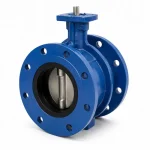
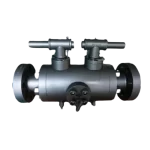
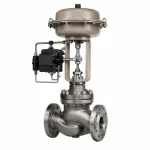
Quick Summary
Butterfly valves are versatile flow control devices widely used in industries such as water treatment, HVAC, and chemical processing. But can they serve as the control valves in your process? In this article, we explore their performance, advantages, and limitations in control applications.
Imagine a large manufacturing facility where precise flow control is essential for the process to run smoothly. You’re tasked with selecting the right valve for the job. Should you go for the commonly used butterfly valves? In many industrial systems, butterfly valves are often used as control valves, but not without certain considerations. Let’s delve into whether they should be the go-to option in your process.
Challenges in Flow Control: Can Butterfly Valves Deliver?
1. The Challenge of Precise Flow Control
-
Problem: For industries like chemicals, oil & gas, and pharmaceuticals, maintaining precise control over fluid or gas flow is crucial. Poor flow control can lead to inefficiencies, safety concerns, or even catastrophic failures.
-
Solution: Butterfly valves can provide fine control in low-pressure systems, but in high-precision applications, they may not be the best fit.
2. Limited Performance Under High-Pressure and High-Temperature
-
Problem: Butterfly valves are often not the first choice for high-pressure and high-temperature applications because their performance may degrade under extreme conditions.
-
Solution: Understanding the specific requirements of your process, such as pressure, temperature, and fluid type, is key to deciding if butterfly valves are suitable for control purposes in these scenarios.
3. Space Constraints and Valve Installation
-
Problem: In some systems, there is limited space for large, bulky control valves. Some industries face the challenge of installing valves in compact, cramped spaces.
-
Solution: Butterfly valves are compact and lightweight, making them ideal for installations with space limitations. However, it’s important to weigh their capabilities against system demands before opting for them.

Why Butterfly Valves Could Be the Right Control Valve for You
1. When Butterfly Valves Are Ideal for Control Applications
-
Butterfly valves are perfect for applications involving lower to moderate pressure systems, where cost-effectiveness and space-saving designs are a priority. They are excellent for water treatment, HVAC systems, and other low-pressure flow control systems where fine regulation is less critical.
2. Consider Alternatives for High-Pressure Systems
-
For applications involving high pressure, temperature, or fluids with a high viscosity, other valve types such as globe valves or ball valves may be more appropriate. Ball valves provide tighter shut-off capabilities, while globe valves offer superior control in higher pressure settings.
3. Hybrid Approach: Use Butterfly Valves with Actuators
-
For applications that need precise control, pairing butterfly valves with actuators can improve their performance. Actuators can help to adjust the valve more accurately, making butterfly valves a more suitable option for dynamic flow control.

Butterfly Valves in Water Treatment Systems
Case Study: Butterfly Valves in Water Treatment Plants
In a large municipal water treatment facility, butterfly valves are used for flow control in the distribution system. Due to their compact size and cost-effectiveness, they are ideal for managing the flow of water through pipelines. However, for more critical stages in the process where precise flow control is vital, the facility uses a combination of globe valves and ball valves to ensure greater precision in high-pressure areas.
Butterfly Valves vs Other Control Valves: Which Performs Best?
| Feature | Butterfly Valve | Globe Valve | Ball Valve |
|---|---|---|---|
| Control Accuracy | Moderate accuracy, suitable for low-pressure | High accuracy, ideal for pressure regulation | Excellent for tight shut-off and flow control |
| Pressure and Temperature Range | Best for low to moderate pressure systems | Suitable for high-pressure systems | Suitable for high-pressure systems |
| Size & Weight | Compact and lightweight | Larger and heavier | Varies, but often larger than butterfly valves |
| Cost | Cost-effective | More expensive than butterfly valves | Generally more expensive |
| Maintenance | Low maintenance | Requires more maintenance | Low maintenance with fewer parts |
Rising Popularity of Butterfly Valves in Process Control Systems
The demand for butterfly valves in control applications is growing, driven by the need for space-saving, cost-effective solutions in industries like water treatment, HVAC, and chemical processing. However, the shift towards automation and smart control systems means that butterfly valves are often paired with advanced actuators and control systems to improve accuracy. This hybrid approach is especially important as industries look for ways to enhance process efficiency without sacrificing safety.
Best Practices for Using Butterfly Valves in Industrial Application
-
In Water Treatment: Butterfly valves are ideal for regulating the flow of water through large pipelines. They’re often used in systems that do not require high-precision control but benefit from compact size and cost-efficiency.
-
In HVAC Systems: For regulating heating and cooling systems, butterfly valves can efficiently control airflow, helping maintain system stability without excessive space requirements.
-
For Low-Pressure Systems: Butterfly valves are excellent choices for low-pressure systems where cost-effectiveness and size matter most. They provide reliable performance in these applications, even when installed with actuators for better control.

Conclusion
Choosing the right valve for your process depends on the specific demands of your application. While butterfly valves offer significant advantages in terms of space-saving, cost-effectiveness, and ease of use in lower-pressure systems, they might not always be the best choice for high-precision control. If you’re unsure whether a butterfly valve is the right fit, contact Vcore Valves to discuss your needs and explore the best options for your flow control requirements.
FAQ
1. What is the difference between a butterfly valve and a ball valve?
-
Butterfly valves are lightweight and cost-effective, ideal for low-pressure systems, while ball valves provide superior control in high-pressure systems and offer tight shut-off capabilities.
2. Can butterfly valves be used for high-pressure systems?
-
While butterfly valves can handle moderate pressure, for high-pressure applications, valves like globe valves or ball valves are typically recommended for better control and performance.
3. How do actuators improve the performance of butterfly valves?
-
Actuators help improve the precision of butterfly valves, making them more effective for control applications, especially when flow regulation is critical.
4. Are butterfly valves cost-effective for large-scale applications?
-
Yes, butterfly valves are cost-effective, especially in systems where space and budget are limited. They are widely used in large-scale applications like water treatment and HVAC systems.
5. What industries use butterfly valves for control?
-
Butterfly valves are commonly used in industries like water treatment, HVAC, chemical processing, and oil & gas, particularly for low-pressure flow control.
6. How long do butterfly valves last?
-
Butterfly valves typically have a long service life with minimal maintenance, depending on the material, fluid type, and application conditions.
7. What is the flow control range for butterfly valves?
-
Butterfly valves are suitable for moderate flow control in low-pressure systems. For more precise control, pairing with actuators can improve their performance