
Key Product Features
- Automatic return to predefined open or closed position
- Available with spring return handle, pneumatic actuator or electric fail-safe actuator
- Normally closed or normally open configuration according to safety requirement
- Suitable for automatic shut-off and safety isolation service
- Threaded, flanged, socket-weld or butt-weld connections available by selected series
- Stainless steel, carbon steel or project-specific body material options
- Soft seat, reinforced seat or metal seat options according to medium and temperature
- Limit switch, solenoid valve, position indicator and manual override options available when specified
Product Configuration
| Configuration Item | Common Configuration | Project Options |
|---|---|---|
| Valve Type | Spring return ball valve | Manual spring return or actuator-operated spring return design |
| Fail Position | Normally closed | Normally open or project-specific fail position |
| Return Mechanism | Spring return handle | Pneumatic spring return actuator or electric fail-safe actuator |
| Body Structure | Two-piece or three-piece ball valve | Flanged, threaded, welded or project-specific construction |
| Seat Material | PTFE or RPTFE | PEEK, PCTFE, metal seat or project-specific seat after review |
| Accessories | Position indicator | Limit switch, solenoid valve, positioner, manual override or lockout device |
Technical Specifications
| Specification Item | Typical / Available Options |
|---|---|
| Product Type | Spring return ball valve / automatic shut-off ball valve |
| Primary Function | Automatic return, fail-safe isolation and emergency shut-off service |
| Valve Construction | One-piece, two-piece, three-piece, flanged or project-specific ball valve |
| Size Range | According to selected valve series and actuator torque capacity |
| Pressure Rating | According to body material, end connection, seat material and approved pressure-temperature rating |
| Body Material | CF8, CF8M, F304, F316, WCB, A105 or project-specified material |
| Seat Material | PTFE, RPTFE, PEEK, PCTFE, metal seat or project-specific seat material |
| End Connection | Threaded, flanged, socket weld, butt weld or project-specific connection |
| Operation Method | Spring return handle, pneumatic spring return actuator or electric fail-safe actuator |
| Fail Position | Normally closed, normally open or project-specified fail position |
| Control Accessories | Solenoid valve, limit switch, position feedback, speed controller or manual override when specified |
| Design Reference | ASME B16.34, API 608 or approved project specification where applicable |
| Testing Reference | API 598, EN 12266 or approved inspection specification where applicable |
| Typical Media | Water, gas, compatible chemicals, utility fluids, fuel lines and selected industrial fluids |
Technical note: Do not publish fixed size range, pressure rating, actuator torque, fail position, cycle life or standard compliance until the selected valve model, actuator package, medium condition and project requirement are confirmed.
How the Spring Return Function Works
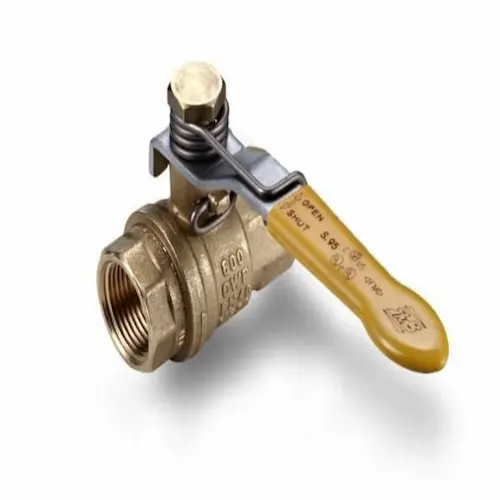
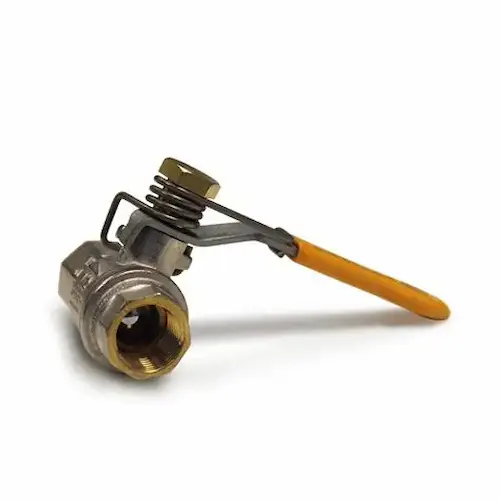
A spring return ball valve uses a spring mechanism to return the valve to a defined position after the operating force is removed. In a manual spring return handle design, the operator turns the handle and the spring returns it when released. In an actuated design, the spring inside the actuator returns the valve when air supply or power is lost, depending on the actuator type.
The most common safety arrangement is normally closed, where the valve returns to the closed position. Some applications require normally open, where the valve returns to the open position. The correct fail position should be selected according to process safety logic, medium risk and system operation requirement.
Normally Closed vs Normally Open
| Fail Position | Valve Behavior | Typical Use |
|---|---|---|
| Normally Closed | Valve returns to closed position after release, air failure or power failure | Fuel gas shut-off, chemical isolation, equipment protection and emergency shut-off |
| Normally Open | Valve returns to open position after release, air failure or power failure | Cooling water bypass, drainage, venting or selected safety logic applications |
| Fail Last | Valve remains in last position when power or air is lost | Only when supported by actuator design and project control philosophy |
Spring Return Handle vs Spring Return Actuator
Spring return ball valves can be supplied in manual or actuated configurations. A spring return handle is suitable for simple local operation where the valve should automatically return after the handle is released. A pneumatic or electric fail-safe actuator is used when remote operation, automation or safety interlock is required.
| Type | Main Advantage | Selection Note |
|---|---|---|
| Spring Return Handle | Simple automatic return for local manual operation | Suitable for small to medium valves where manual force is acceptable |
| Pneumatic Spring Return Actuator | Fail-safe return during air failure | Common for process automation, fuel gas and emergency shut-off service |
| Electric Fail-Safe Actuator | Remote electric operation with fail-safe function when designed for it | Confirm battery, capacitor, spring mechanism or other fail-safe method before quotation |
| Hydraulic Spring Return Actuator | High torque output for large or high-pressure valves | Used for selected heavy-duty pipeline or emergency shutdown applications |
Actuator Accessories and Control Options
For automated spring return service, the valve and actuator should be selected as one package. Valve torque, seat material, medium pressure, safety factor, cycle frequency and fail position must be confirmed before actuator sizing.
- Solenoid valve: controls air supply to pneumatic actuator.
- Limit switch: provides open and closed position feedback.
- Position indicator: shows local valve position.
- Speed controller: adjusts actuator opening or closing speed when needed.
- Manual override: allows emergency or maintenance operation when supported by actuator design.
- Lockout device: supports safety control during maintenance procedures.
For pneumatic automation, compare our Pneumatic Ball Valve. For electric automation in chemical service, review Electric Ball Valves in Chemical Plants. For fire-risk service, see the Fire Safe Ball Valve.
 Typical Applications
 Typical Applications
Spring return ball valves are selected where the valve must return automatically to a safe position after operation or failure. Common service areas include:
- Fuel gas and natural gas shut-off lines
- Chemical dosing and chemical transfer isolation
- Water treatment equipment protection
- Compressed air and utility gas systems
- Skid-mounted process equipment
- Emergency shut-off points in industrial pipelines
- Burner, heater and boiler auxiliary systems after service review
- Laboratory, pilot plant and equipment isolation systems
- Automatic return service where operators should not leave the valve open
For high-pressure applications, compare the High Pressure Ball Valve. For flow regulation rather than fail-safe shut-off, review the V Port Ball Valve. Additional structures are available in the Ball Valve category.
Application Limits
- A spring return ball valve is not a check valve and should not be used as a non-return valve.
- It is not a pressure relief valve and should not be used to release excess pressure automatically.
- Spring return function must be matched with valve torque, pressure, seat material and actuator sizing.
- Normally closed or normally open position must be confirmed before quotation.
- Manual spring return handles may not be suitable for large-size or high-torque valves.
- High cycling frequency can affect spring life, seat wear and actuator performance.
- Continuous throttling is not recommended for standard ball valve construction.
- Fire-safe, explosion-proof, NACE, low-emission or SIL-related requirements must be stated before quotation.
Inspection and Documentation
| Inspection / Document | Purpose |
|---|---|
| Material Test Certificate | Confirms pressure-containing and wetted component material grades. |
| Dimensional Inspection | Checks end connection, bore, face-to-face or end-to-end length and actuator interface. |
| Shell Pressure Test | Verifies pressure-containing body integrity. |
| Seat Leakage Test | Confirms shutoff performance under the agreed test condition. |
| Spring Return Function Test | Confirms that the valve returns to the specified open or closed position. |
| Actuator Functional Test | Checks air failure, power failure, limit switch feedback and manual override when specified. |
| Torque Test | Supports actuator sizing and confirms smooth ball movement. |
| PMI | Verifies alloy material chemistry when specified. |
| Final Data Book | Collects drawings, MTCs, inspection reports, functional test records and certificates. |
Export packing should protect the spring return handle, actuator, coupling, valve stem, end connections, sealing surfaces and accessories. Actuated spring return valves should be packed with actuator protection, moisture-resistant wrapping, foam separation, port caps or flange covers and reinforced export cases according to valve size and transport method.
Information Required for Valve Selection
- Valve size and quantity
- Required fail position: normally closed or normally open
- Manual spring return handle, pneumatic actuator or electric fail-safe actuator
- Medium name, composition, temperature and pressure
- Operating pressure, design pressure and pressure rating
- Body, ball, stem, seat and seal material requirements
- Threaded, flanged, socket-weld or butt-weld connection
- Cycle frequency and required response time
- Air supply pressure for pneumatic actuator
- Power supply and fail-safe method for electric actuator
- Limit switch, solenoid valve, position feedback or manual override requirement
- Fire-safe, explosion-proof, NACE, low-emission or third-party inspection requirement
FAQ
1. What is a spring return ball valve?
A spring return ball valve is a ball valve designed to automatically return to a predefined open or closed position after manual release, air failure or power failure. It is used for automatic shut-off and fail-safe isolation service.
2. Is a spring return ball valve the same as a check valve?
No. A spring return ball valve controls valve position through a spring return handle or actuator. A check valve prevents reverse flow automatically. They are different valve types and should not be used interchangeably.
3. Is a spring return ball valve a pressure relief valve?
No. A spring return ball valve is not designed to relieve excess pressure automatically. If overpressure protection is required, a suitable relief valve or safety valve should be selected separately.
4. What is the difference between normally closed and normally open?
Normally closed means the valve returns to the closed position after release or failure. Normally open means the valve returns to the open position. The correct position depends on the process safety requirement.
5. What information is needed for quotation?
For quotation, provide valve size, pressure, medium, temperature, fail position, operation method, body material, seat material, end connection, actuator type, control accessories and testing requirement.