Electric ball valves in chemical plants are used when manual valve operation is not safe, efficient, or consistent enough for the process. In chemical processing, valves may handle acids, alkalis, solvents, water treatment chemicals, corrosive liquids, dosing fluids, or automated transfer lines. Adding an electric actuator allows the valve to open, close, or sometimes modulate from a control panel, PLC, timer, or remote system.
For B2B buyers, an electric ball valve is not just a ball valve with a motor on top. It is a complete automated valve assembly. The valve body, ball, stem, seat, seal, actuator, bracket, coupling, wiring, control signal, and enclosure protection must all match the chemical plant service condition. If the valve material is wrong, the valve may corrode. If the seat is wrong, it may leak. If the actuator torque is too low, the valve may stop midway. If the actuator housing is not protected, moisture or corrosive vapor may reduce service life.
This guide explains how to choose electric ball valves for chemical plants from a practical industrial buyer’s perspective. It covers automation functions, valve materials, actuator selection, safety factors, control signals, torque sizing, installation risks, and documentation. For a broader chemical valve selection framework, start with our main guide on industrial valves for chemical processing.
What Is an Electric Ball Valve?
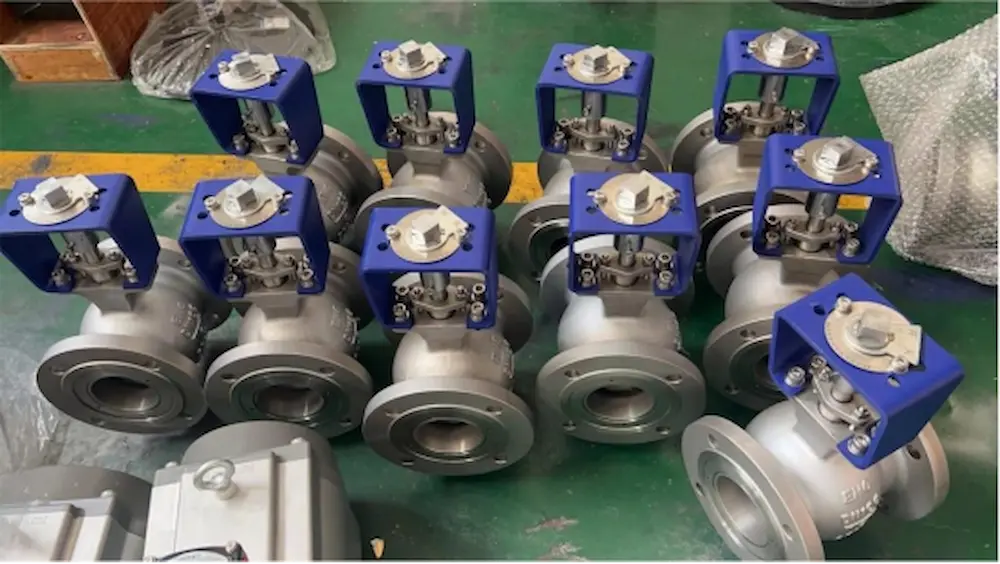
An electric ball valve combines a ball valve with an electric actuator. The ball valve provides the flow shutoff or flow routing function, while the electric actuator rotates the ball, usually 90 degrees, to open or close the pipeline.
In a manual ball valve, an operator turns the handle. In an electric ball valve, the actuator receives an electrical signal and drives the valve automatically. Depending on the actuator type, the valve may be used for simple open-close control, position feedback, remote operation, or proportional flow control.
Buyers comparing general automated ball valve applications can also review our guide on electric ball valves. This article focuses more specifically on chemical plant applications where corrosion resistance, safety, automation reliability, and process control are critical.
Why Chemical Plants Use Electric Ball Valves
Chemical plants often require controlled, repeatable, and remote valve operation. Manual valves may be acceptable for occasional maintenance isolation, but many chemical systems need faster response, safer operation, or integration with control systems.
Main Reasons to Use Electric Ball Valves
- Remote shutoff for hazardous or difficult-to-access pipelines
- Automated chemical transfer between tanks or process lines
- Batch process control and timed operation
- Dosing and fluid routing systems
- Reduced operator exposure to corrosive or hazardous media
- Integration with PLC, control panels, or plant automation systems
- Consistent open-close operation compared with manual handling
- Improved repeatability in process sequencing
In chemical processing, automation can improve safety and process consistency, but only when the valve and actuator are correctly selected. A low-cost actuator on an unsuitable valve can create more risk than a properly selected manual valve.
Common Applications of Electric Ball Valves in Chemical Plants
| Application | Valve Function | Key Selection Concerns |
|---|---|---|
| Chemical Transfer Lines | Automated open-close shutoff | Body material, seat compatibility, actuator torque |
| Acid and Alkali Pipelines | Remote isolation and safer operation | Corrosion-resistant materials, PTFE seats, actuator protection |
| Dosing Systems | Controlled chemical feed or shutoff | Small valve sizes, reliable sealing, control timing |
| Tank Inlet and Outlet Lines | Automated filling, draining, and isolation | Fail-safe requirement, position feedback, leakage risk |
| Flow Routing | Switching media between different lines | 2-way or 3-way valve design, port configuration, sealing |
| Water Treatment Chemicals | Automated chemical handling | EPDM/PTFE compatibility, enclosure rating, duty cycle |
| Utility Chemical Lines | General automated isolation | Cost-performance, wiring, maintenance access |
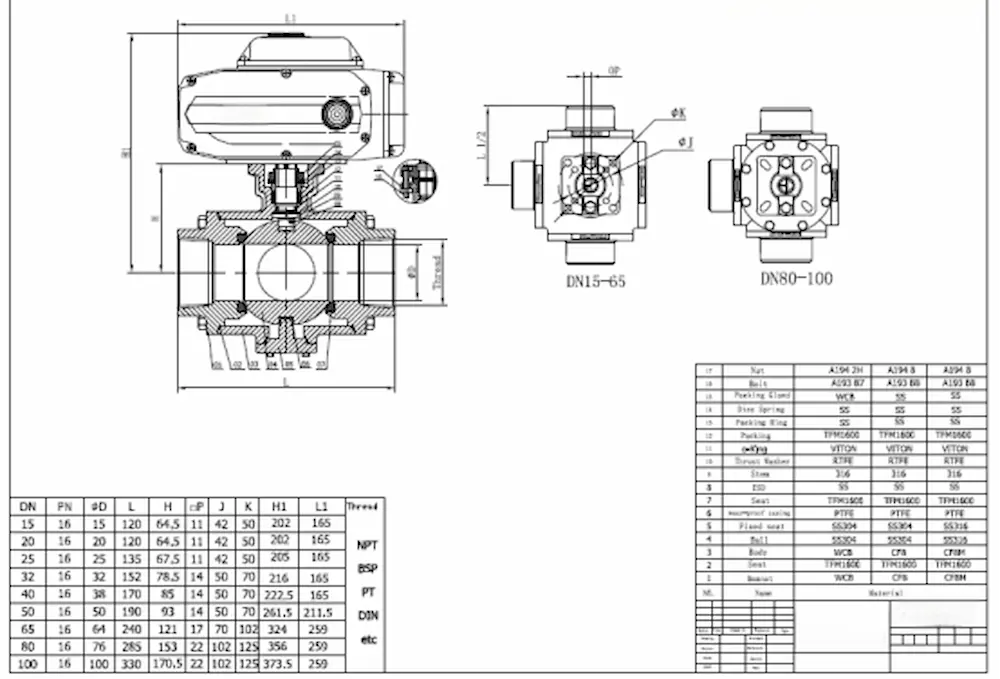
Electric Ball Valve Structure for Chemical Service
An electric ball valve assembly includes several important parts. Each part should be checked for chemical compatibility and mechanical reliability.
- Valve body: stainless steel, carbon steel, lined body, plastic, or alloy depending on media
- Ball: stainless steel, coated metal, lined ball, or alloy material
- Seat: PTFE, reinforced PTFE, PEEK, or other suitable material
- Stem: corrosion-resistant metal with proper sealing design
- Seals and O-rings: EPDM, FKM, PTFE, or other compatible materials
- Actuator: electric quarter-turn actuator sized by torque and control requirements
- Mounting bracket and coupling: mechanical connection between actuator and valve stem
- Position feedback: optional signal for open, closed, or intermediate position
- Manual override: allows operation during power loss or maintenance
For corrosive media, buyers should review both the wetted parts and the surrounding environment. A valve may resist the chemical internally, but the actuator may still fail if exposed to corrosive vapor, washdown, or outdoor moisture.
Material Selection for Chemical Electric Ball Valves
Material selection is one of the most important parts of electric ball valve specification. The valve body, ball, seat, seal, and stem may all require different materials.
Stainless Steel Electric Ball Valves
Stainless steel electric ball valves are common in chemical plants because they offer good mechanical strength and corrosion resistance in many industrial services. 304 stainless steel may be used for less aggressive fluids, while 316 or 316L stainless steel is often selected for better corrosion resistance.
However, stainless steel is not universal. Chloride-rich chemicals, strong acids, high-temperature corrosive media, or severe chemical mixtures may require lined valves, titanium, duplex stainless steel, or special alloys. Buyers can review this guide on stainless steel valves for high-pressure applications when evaluating stainless steel performance in demanding industrial conditions.
PTFE-Seated Electric Ball Valves
PTFE seats are widely used in chemical ball valves because PTFE offers broad chemical resistance and low friction. For clean corrosive chemical service, PTFE-seated ball valves are often practical. For projects that require a ball valve structure with PTFE sealing performance, buyers may evaluate a PTFE ball valve depending on working conditions.
PTFE is useful, but buyers should still check temperature, pressure, media cleanliness, operation frequency, and whether the valve will experience abrasive particles or crystallization.
Titanium and Alloy Electric Ball Valves
For severe corrosive service, standard stainless steel may not be enough. Titanium or high-alloy materials may be considered for chloride-rich systems, seawater, oxidizing chemicals, or high-risk chemical transfer lines. A titanium ball valve may be evaluated where corrosion resistance is more important than lowest initial cost.
Seat and Seal Materials
Seat and seal materials are often the first components to fail in chemical service. PTFE, reinforced PTFE, EPDM, FKM, NBR, graphite, and other materials have different compatibility ranges. Buyers selecting chemical electric ball valves should check the medium, concentration, temperature, pressure, and cleaning process before confirming soft materials.
For a broader comparison of corrosion-resistant materials, see our guide on anti-corrosion valve materials for chemical processing.
2-Way vs 3-Way Electric Ball Valves in Chemical Plants
Most electric ball valves are 2-way valves used for open-close isolation. However, chemical plants may also use 3-way electric ball valves for flow diversion, mixing, bypass, or switching between process lines.
2-Way Electric Ball Valve
A 2-way electric ball valve has one inlet and one outlet. It is mainly used for automated shutoff, tank inlet/outlet control, pump discharge isolation, and chemical transfer line control.
3-Way Electric Ball Valve
A 3-way electric ball valve can direct flow between different ports. It may use L-port or T-port configurations depending on whether the system needs diversion, mixing, or switching. For automated routing applications, buyers may consider an electric three way ball valve when the process requires one actuator-controlled valve to switch flow between multiple chemical lines.
| Valve Type | Main Function | Typical Chemical Plant Use | Selection Risk |
|---|---|---|---|
| 2-Way Electric Ball Valve | Open-close shutoff | Chemical transfer, tank isolation, dosing line shutoff | Seat compatibility and actuator torque must be checked |
| 3-Way Electric Ball Valve | Diversion, mixing, or routing | Switching between tanks, bypass lines, process routing | Port configuration must match the flow logic |
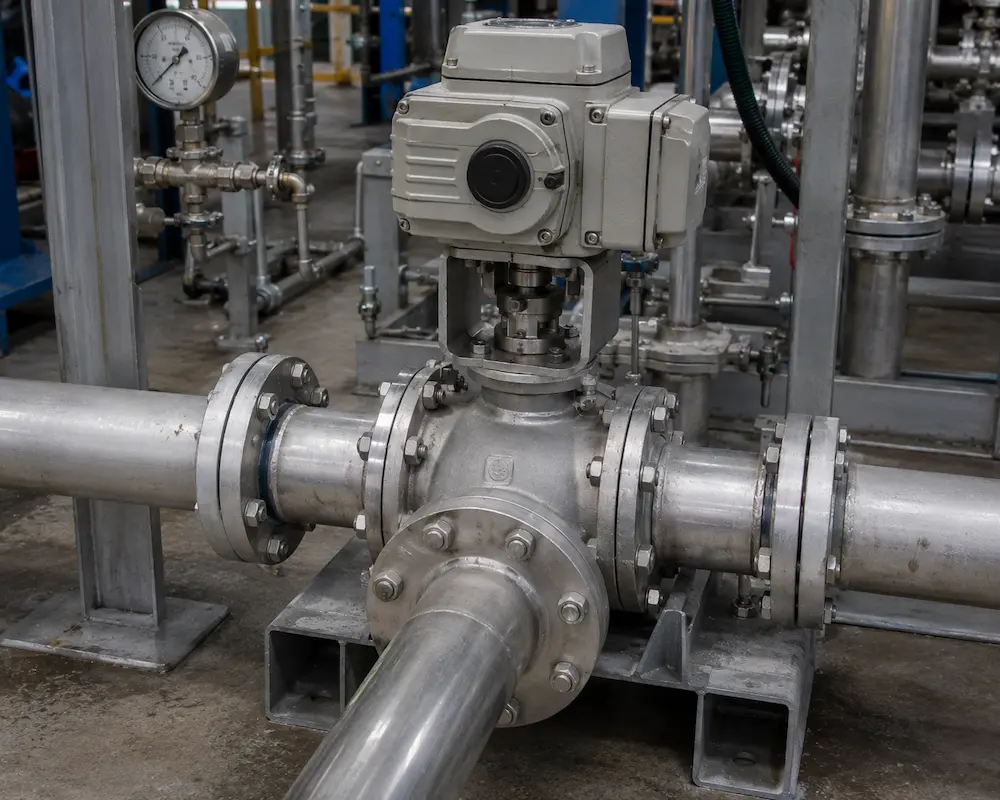
Actuator Selection for Chemical Electric Ball Valves
The actuator must be selected based on actual valve torque and control requirements. In chemical service, torque may increase over time because of corrosion, deposits, seat swelling, crystallization, or long idle periods.
Torque Requirement
The most important actuator parameter is torque output. Buyers should confirm the valve breakaway torque, running torque, and required safety margin. Selecting actuator torque only by valve size is risky because different valve designs and seat materials can have different torque requirements.
Voltage
Common actuator voltages include 24 V DC, 24 V AC, 110 V AC, 220 V AC, and other project-specific options. The selected actuator must match the site power supply and control system.
Control Mode
Electric actuators may support different control modes:
- On-off control: fully open or fully closed
- Floating control: open-stop-close operation
- Modulating control: proportional control such as 4-20 mA or 0-10 V
- Position feedback: open/closed signal or position output
Most electric ball valves in chemical plants are used for on-off service. Modulating control should only be selected when the valve and actuator are suitable for frequent positioning. A standard on-off actuator should not be used as a continuous control actuator unless it is designed for that duty.
Duty Cycle
Duty cycle matters when the valve operates frequently. Dosing, batching, or process sequencing may require more cycles than simple isolation. Frequent operation can overheat an actuator if the duty rating is too low.
Enclosure Protection
Chemical plants may expose actuators to moisture, dust, washdown, outdoor weather, and corrosive vapor. Buyers should confirm actuator enclosure protection, cable entry, sealing quality, coating, and installation location.
Electric Ball Valve Selection Checklist
| Selection Item | What to Confirm | Why It Matters |
|---|---|---|
| Medium | Chemical name and composition | Determines valve body, seat, and seal material |
| Concentration | Normal and maximum concentration | Chemical compatibility may change with concentration |
| Temperature | Normal and maximum temperature | Affects seat life, seal material, and actuator environment |
| Pressure | Operating and design pressure | Determines pressure rating and valve structure |
| Valve Size | DN/NPS size and connection type | Impacts valve torque, flow capacity, and installation |
| Valve Material | Body, ball, stem, seat, seal | Controls corrosion resistance and sealing reliability |
| Actuator Torque | Breakaway torque and safety margin | Prevents actuator overload or incomplete closure |
| Voltage | AC/DC voltage and phase | Must match site power supply |
| Control Signal | On-off, modulating, feedback signal | Must match PLC or control panel |
| Environment | Indoor, outdoor, washdown, corrosive vapor | Determines actuator enclosure and protection needs |
Safety Considerations in Chemical Plant Automation
Electric ball valves can improve safety by reducing manual exposure to hazardous areas. However, automated valves can also create risk if the control logic, fail-safe position, and maintenance procedures are not carefully planned.
Fail-Safe Position
Buyers should decide what the valve should do during power loss or control failure. Some systems require fail-closed behavior, while others require fail-open or fail-in-place logic. Electric actuators may need battery backup, spring return design, or plant-level control logic depending on the safety requirement.
Manual Override
A manual override allows maintenance teams to operate the valve if the actuator loses power or fails. For chemical pipelines, manual override access should be safe and practical.
Position Feedback
Position feedback helps the control system confirm whether the valve is open, closed, or in an intermediate position. This is important for batch processes, tank transfer, safety interlocks, and remote operation.
Lockout and Maintenance
Automated valves should be included in plant lockout and maintenance procedures. Maintenance teams should isolate power, release pressure, drain the line, and confirm media safety before disassembly or inspection.
Flow Control: On-Off or Modulating?
Ball valves are usually strongest as open-close isolation valves. They can be used for simple flow switching and shutoff, but they are not always the best choice for precise throttling unless the valve design and actuator are selected for modulating service.
On-Off Service
On-off electric ball valves are suitable for chemical transfer, tank filling, draining, dosing shutoff, utility line isolation, and process sequencing. This is the most common use in chemical plants.
Modulating Service
Modulating electric ball valves may be used when proportional flow control is required. Buyers should confirm actuator duty cycle, control signal, valve characteristic, seat wear risk, and whether a ball valve is appropriate for the control accuracy needed.
For many precise chemical control loops, a control valve may be more suitable than a standard ball valve. Buyers should not assume that every electric ball valve is suitable for accurate throttling.
Common Electric Ball Valve Failure Risks
Many electric ball valve failures in chemical plants are preventable. They usually happen because the valve, actuator, material, or control system was not matched to the real operating condition.
| Failure Risk | Common Cause | Prevention Method |
|---|---|---|
| Valve Cannot Close Fully | Seat swelling, particles, high torque, actuator undersizing | Select compatible seats and correct actuator torque |
| Internal Leakage | Seat wear, chemical attack, particles on sealing surface | Choose suitable seat material and maintain media cleanliness |
| External Leakage | Stem packing failure, gasket damage, corrosion | Check packing, gaskets, installation, and material compatibility |
| Actuator Overload | Torque too low, deposits, crystallization, long idle periods | Use torque margin and operate/flush valves periodically |
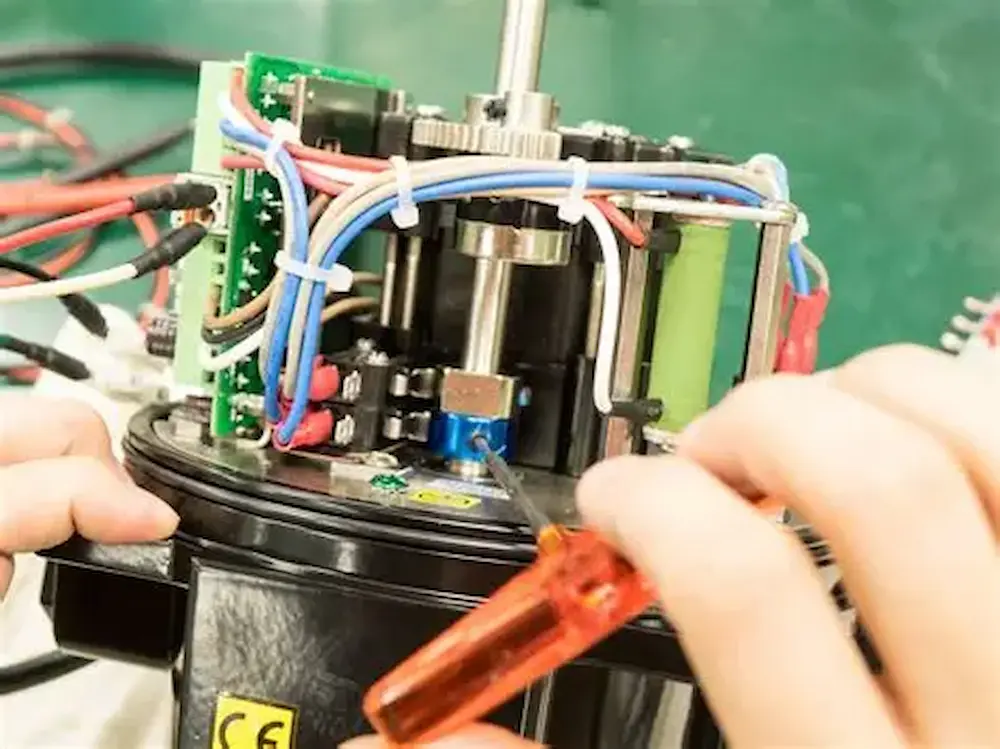
| Electrical Failure | Wrong voltage, water ingress, poor cable sealing | Confirm voltage, wiring, enclosure, and cable entry protection |
| Corrosion Damage | Wrong material or corrosive external environment | Select compatible materials and protect actuator housing |
For a broader failure-prevention framework, see our article on common valve failures in chemical pipelines.
Installation and Commissioning Tips
Correct installation is essential for electric ball valve reliability. Even a good valve can fail early if piping stress, wiring errors, or poor commissioning procedures are ignored.
- Confirm flow direction and valve orientation before installation
- Check flange alignment and avoid pipe stress on the valve body
- Use compatible gaskets and correct bolt tightening procedures
- Flush the pipeline before operating the valve
- Confirm actuator voltage before energizing
- Check open and closed limit settings
- Verify position feedback signals
- Test manual override function
- Confirm the valve fully opens and closes under real system conditions
What Documents Should Buyers Request?
For B2B chemical plant projects, documentation helps reduce selection and commissioning risk. Buyers should request documents according to project requirements.
- Valve datasheet
- Actuator datasheet
- Valve material confirmation
- Seat and seal material confirmation
- Pressure test report
- Seat leakage test report
- Valve torque information where available
- Actuator wiring diagram
- Dimensional drawing
- Installation and maintenance manual
- Packing and marking details
Final Recommendations for B2B Buyers
Electric ball valves are valuable in chemical plants when remote operation, automated shutoff, safer process control, and reliable flow routing are required. However, the valve and actuator must be selected as one complete assembly. Buyers should not choose the actuator only by price or the valve only by size.
The correct selection should begin with chemical media, concentration, temperature, pressure, valve material, seat material, torque requirement, voltage, control signal, duty cycle, enclosure protection, and safety logic. For corrosive or hazardous service, material compatibility and actuator protection are especially important.
If you need help selecting electric ball valves for chemical plant applications, Vcore Valve can review your medium, concentration, pressure, temperature, valve size, torque requirement, voltage, control signal, operation frequency, and installation environment. Buyers can also browse our industrial valve product range to compare ball valves, lined valves, stainless steel valves, corrosion-resistant valves, and automated valve solutions.
For industrial sourcing, the best question is not only “Can this valve open and close electrically?” The better question is: “Can this electric ball valve operate safely and reliably in this exact chemical plant service?”
FAQ
1. What are electric ball valves used for in chemical plants?
Electric ball valves are used for automated shutoff, chemical transfer, tank filling and draining, flow routing, dosing systems, remote operation, and process sequencing in chemical plants. They help reduce manual operation and improve control consistency.
2. How do I choose an electric ball valve for corrosive chemicals?
To choose an electric ball valve for corrosive chemicals, confirm the chemical name, concentration, temperature, pressure, valve body material, ball material, seat and seal materials, actuator torque, voltage, control signal, and installation environment. Chemical compatibility must be checked before selection.
3. What actuator torque is needed for an electric ball valve?
The actuator torque should be based on the valve breakaway torque, operating pressure, seat material, valve size, media condition, and a suitable safety margin. Buyers should not select actuator torque only by valve size because torque varies by valve design and service condition.
4. Can electric ball valves be used for flow control?
Electric ball valves are most commonly used for open-close service. They can be used for modulating control only when the valve and actuator are designed for proportional positioning. For precise control loops, a dedicated control valve may be more suitable.
5. Why do electric ball valves fail in chemical service?
Electric ball valves may fail because of wrong valve material, incompatible seat or seal, actuator undersizing, high operating torque, wrong voltage, water ingress, corrosive vapor, poor wiring, or using an on-off actuator for frequent modulating service.