Quick Summary
In fluid control systems, a bronze check valve and Y strainer often work together to protect pumps, meters, and downstream valves. While one prevents backflow and the other removes debris, misunderstanding their roles can lead to costly failures. In this guide, Vcore Valve explains how these two essential bronze valves function, where they should be installed, and how to select the right specifications for long-term reliability.
Opening Scenario: A Common Installation Mistake
“We installed a new pump, but it failed within months.”
After inspection, the cause was simple: no Y strainer upstream, and a poorly selected check valve downstream. This scenario is far more common than most engineers like to admit.
User Pain Points
Pain Point 1: Confusing Valve Functions
Many users assume a check valve can also stop debris—or that a strainer can prevent reverse flow.
Pain Point 2: Incorrect Installation Order
Installing a Y strainer after a pump or a check valve in the wrong orientation causes performance issues.
Pain Point 3: Material Mismatch
Using cast iron or plastic instead of bronze valves in corrosive or potable water systems leads to early failure.
Solutions & Recommendations
Solution 1: Understand Functional Differences
A check valve controls flow direction, while a Y strainer filters solid particles.
Solution 2: Use Bronze for Reliability
Bronze offers excellent corrosion resistance, machinability, and long service life.
Solution 3: Source from Experienced Manufacturers
At Vcore Valve, valve selection is based on real operating conditions, not generic catalog data.
What Is a Bronze Check Valve?
A bronze check valve, also known as a non-return valve, allows fluid to flow in one direction only and automatically prevents backflow.
Key Functions of Bronze Check Valves:
-
Protect pumps from reverse flow damage
-
Prevent pressure shock and water hammer
-
Maintain system pressure stability
Common Types:
-
Swing check valve
-
Lift check valve
-
Spring-loaded check valve
Typical Applications:
-
Water supply systems
-
HVAC installations
-
Marine and offshore piping
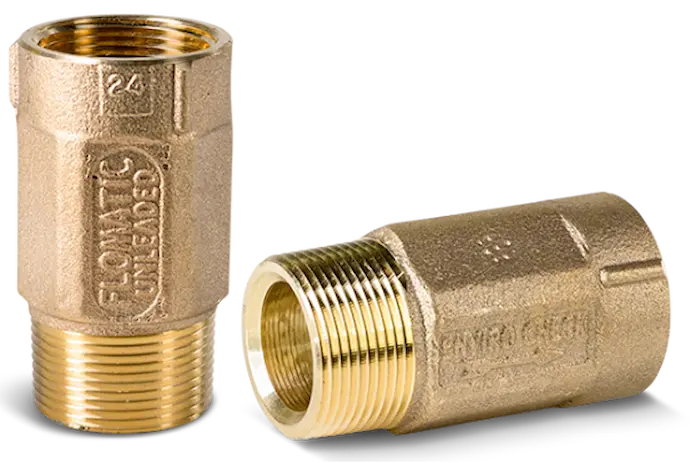
What Is a Bronze Y Strainer?
A bronze Y strainer removes unwanted debris such as rust, sand, and scale from the fluid before it reaches sensitive equipment.
Key Functions of Bronze Y Strainers:
-
Protect downstream valves and pumps
-
Reduce maintenance costs
-
Improve system efficiency
Why Y-Type Design?
The angled screen allows debris to collect without blocking flow completely.
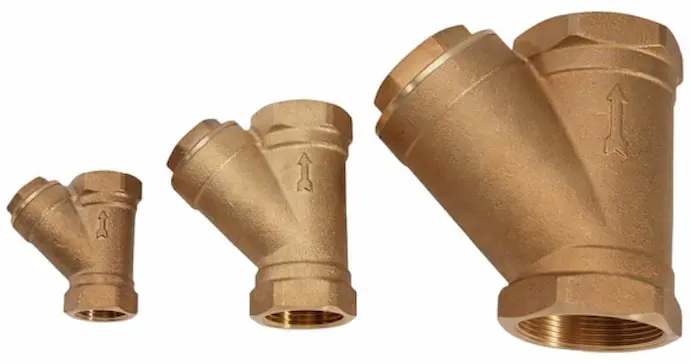
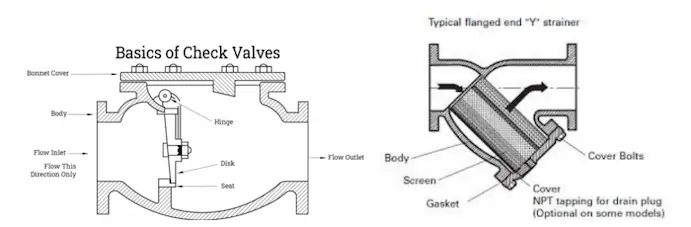
Bronze Check Valve and Y Strainer: Comparison
| Feature | Bronze Check Valve | Bronze Y Strainer |
|---|---|---|
| Primary Function | Prevent backflow | Filter debris |
| Moving Parts | Yes | No |
| Flow Direction Control | Yes | No |
| Maintenance | Low | Periodic screen cleaning |
| Installation Position | After pumps | Before pumps/valves |
| Pressure Drop | Minimal | Moderate |
Case Studies & Practical Examples
Case 1: Domestic Water System
A bronze Y strainer installed upstream prevented debris from damaging a bronze check valve, extending system life by years.
Case 2: HVAC Circulation Loop
A spring-loaded bronze check valve prevented reverse circulation during pump shutdown, improving temperature control.
Data, Engineering & Performance Analysis
Studies show that up to 70% of early pump failures are caused by solid contaminants. Installing a bronze Y strainer upstream can reduce this risk dramatically.
Meanwhile, bronze check valves offer smoother sealing surfaces than cast iron, reducing leakage and vibration over time.
Market Trends & Industry Insights
-
Growing demand for lead-free bronze valves in potable water systems
-
Increased use of compact spring check valves
-
Higher awareness of filtration requirements in HVAC and plumbing systems
Modern building standards increasingly specify bronze components for safety and durability.
Style & Usage Recommendations
Use a bronze check valve when:
-
Backflow prevention is critical
-
Space is limited
-
Automatic operation is required
Use a bronze Y strainer when:
-
Fluids contain particles
-
Protecting pumps or meters
-
Reducing downstream maintenance
Best Practice: Always install the Y strainer upstream and the check valve downstream.
Conclusion
A bronze check valve and a bronze Y strainer are not optional accessories—they are essential system protectors. Used together, they significantly improve reliability, safety, and service life.
👉 Contact Vcore Valve today for expert guidance on bronze valve and strainer selection tailored to your application.
FAQs
Q1: Can a check valve replace a Y strainer?
No. A check valve does not filter debris.
Q2: Where should a Y strainer be installed?
Upstream of pumps, meters, and control valves.
Q3: Why choose bronze instead of brass or iron?
Bronze offers superior corrosion resistance and durability.
Q4: Do Y strainers require maintenance?
Yes, periodic screen cleaning is necessary.
Q5: Are bronze check valves suitable for potable water?
Yes, especially lead-free bronze designs.
Q6: Can both be installed vertically?
Yes, but orientation must follow manufacturer guidelines.