Quick Summary
In water and wastewater infrastructure, reliability is non-negotiable. Gate valves play a critical role in isolating pipelines, controlling flow during maintenance, and protecting treatment processes from disruption. From municipal water supply networks to wastewater treatment plants, these valves ensure safe, efficient, and long-term system operation. At Vcore Valve, we design gate valves for water and wastewater management with durability, tight shut-off, and easy maintenance in mind.
A Real-World Water System Scenario
“We need to shut down this section—now.”
In a water treatment plant, every second counts. A properly specified water gate valve allows operators to isolate pipelines smoothly without draining entire systems. When designed correctly, gate valves become silent guardians of public health and environmental safety.
Key User Pain Points
Leakage and Water Loss
Poor-quality or ageing valves often cause leakage, leading to non-revenue water and higher operating costs.
Difficult Maintenance and Isolation
Without reliable isolation valves, maintenance requires shutting down large sections of the network.
Corrosion and Sediment Build-Up
Water and wastewater environments accelerate corrosion and debris accumulation, shortening valve lifespan.

How Gate Valves Address These Challenges
Full-Bore, Unrestricted Flow
Gate valves provide minimal flow resistance when fully open, making them ideal for large-diameter pipelines.
Reliable Shut-Off for Maintenance
A well-designed wastewater gate valve ensures tight sealing, even after long periods without operation.
Adaptability to Harsh Media
Modern materials and coatings allow industrial gate valves to withstand corrosive wastewater and treated water.
At Vcore Valve, we focus on valve designs that reduce leakage while simplifying maintenance.
Typical Water and Wastewater Applications
Case 1: Municipal Water Supply Network
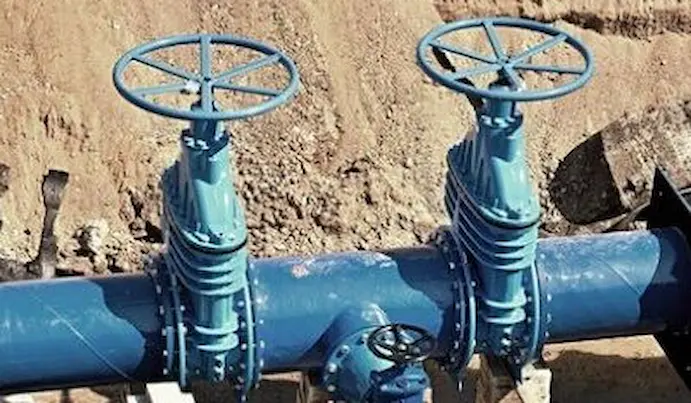
In municipal water networks, resilient-seated gate valves are commonly used for pipeline isolation, district shutoff, hydrant branches, and maintenance zones.
Results:
-
Reduced leakage rates
-
Faster maintenance isolation
-
Improved service reliability
Case 2: Wastewater Treatment Plant
In wastewater treatment plants, gate valves may be selected where corrosion-resistant coatings, suitable stem materials, and debris-tolerant sealing are required.
Results:
-
Extended valve service life
-
Lower maintenance frequency
-
Stable operation in sludge-heavy lines
Engineering Data and Performance Comparison
Gate Valves vs Butterfly Valves in Water Systems
| Selection Factor | Gate Valve | Butterfly Valve |
|---|---|---|
| Main function | On/off isolation | On/off isolation or limited regulation, depending on design |
| Full-open flow path | Often low resistance, especially full-bore designs | Disc remains in flow path |
| Space and weight | Larger face-to-face and heavier in many sizes | Compact and lighter |
| Operation speed | Slower multi-turn operation | Faster quarter-turn operation |
| Common water use | Isolation in distribution and treatment systems | Large-diameter water lines, HVAC, treatment plants, pumping stations |
| Must confirm | Standard, coating, stem type, seat, pressure rating | Seat type, disc material, torque, pressure rating, end-of-line limits |
Gate valves are commonly selected for water pipeline isolation where low full-open resistance and reliable shutoff are required. Butterfly valves may be preferred where compact installation, lower weight, faster operation, or actuator compatibility is more important.
Design Features for Water and Wastewater Applications
Resilient Seated Design
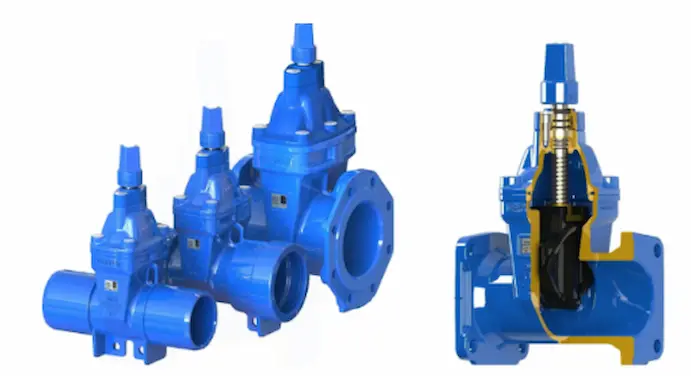
A resilient-seated wedge can improve shutoff performance in clean or moderately dirty water service, but debris, grit, fibrous solids, and sediment accumulation can still affect sealing and operation.
Corrosion-Resistant Materials
Epoxy coatings, stainless steel stems, and ductile iron bodies enhance durability.
Simple Gate Valve Operation
Gate valve service life depends on wedge design, stem material, coating quality, seat condition, water quality, sediment level, operating frequency, and maintenance practice.
Installation and Usage Best Practices
-
Operate valves fully open or fully closed—avoid throttling
-
Schedule periodic cycling to prevent seizure
-
Verify flange alignment during gate valve installation
-
Select appropriate coatings for wastewater environments
Conclusion
From clean water delivery to wastewater treatment, gate valves are indispensable. Their simple design, reliable shut-off, and long service life make them the backbone of water infrastructure worldwide.
Vcore Valve supplies high-performance gate valves for water and wastewater management, engineered for real-world operating conditions.
👉 Contact Vcore Valve today to discuss your municipal or industrial water project.
FAQs
Why are gate valves commonly used in water systems?
They provide low flow resistance and reliable isolation.
Are gate valves suitable for wastewater?
Yes, when designed with corrosion-resistant materials and proper sealing.
What is a resilient seated gate valve?
A valve with an elastomer-coated gate for improved sealing.
Can gate valves be used for flow control?
No, they are designed for on/off isolation only.
How often should water gate valves be maintained?
Regular inspection and periodic operation are recommended.
Does Vcore Valve supply valves for wastewater plants?
Yes, Vcore Valve offers a full range of water and wastewater gate valves.
References
-
AWWA C509 – Resilient-Seated Gate Valves
-
AWWA C515 – Reduced Wall Gate Valves
-
ISO 2531 – Ductile Iron Pipes and Valves
-
World Health Organization – Water Safety Guidelines
-
Valve Manufacturers Association (VMA) – Water Valve Standards
-
Engineering Toolbox – Gate Valve Applications
-
Vcore Valve Water Industry Technical Data