Quick Summary
Axial Flow Check Valves are the gold standard for mitigating water hammer, a destructive fluid dynamic issue plaguing industrial piping systems. Designed for rapid, low-impact closure, these valves eliminate pressure surges by minimising reverse flow, making them indispensable for oil & gas, water treatment and power generation. Vcore Valve’s precision-engineered Axial Flow Check Valves deliver unrivalled durability and performance in extreme conditions.
The Silent Threat of Water Hammer in Industrial Piping
Imagine a routine day at a refinery: pumps hum, pipelines flow, and then—bang. A pressure surge rips through the system, cracking welds, damaging valves and halting production for days. This is water hammer, a phenomenon caused by sudden fluid velocity changes that costs the global industrial sector over $5 billion annually in repairs and downtime. For engineers and plant managers, it’s not a question of if water hammer strikes, but when—unless you deploy Axial Flow Check Valves.
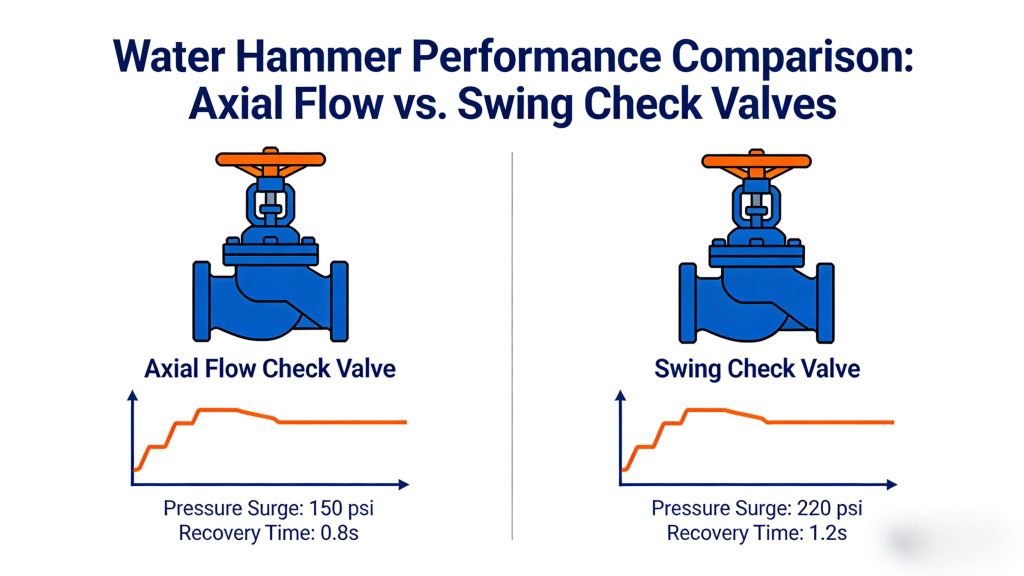
Water hammer isn’t just a nuisance; it’s a catastrophic risk. When valves slam shut or pumps fail, fluid inertia creates pressure waves that travel at 1200m/s through pipelines, peaking at pressures 233% above normal operating levels. For decades, traditional check valves offered little protection, with slow closure times and high reverse flow rates amplifying the problem. Today, Axial Flow Check Valves rewrite the rulebook for fluid control safety.
The Top 3 Pain Points of Water Hammer
Catastrophic Mechanical Damage to Piping Systems
Water hammer’s pressure surges warp pipe walls, split flanges and destroy valve components. A single surge can crack a DN800 pipeline’s welds, leading to costly leaks and environmental hazards. Traditional swing check valves worsen this issue—their long closure travel creates significant reverse flow, turning a small pressure blip into a destructive wave.
Unplanned Downtime and Sky-High Repair Costs
Industrial downtime costs an average of $50,000 per hour for oil & gas facilities. Water hammer-related failures typically require 48+ hours of repair, with pump and valve replacements costing 3–5 times more than routine maintenance. Old check valves not only fail to prevent water hammer—they often become the source of the problem, with worn seals and slow response times triggering surges.
Compromised Safety for Personnel and the Environment
Pressure surges can cause toxic chemical or hydrocarbon leaks, posing severe risks to workers and ecosystems. In water treatment plants, water hammer can rupture clean water pipelines, cutting off supply to entire communities. Traditional valves lack the precision to stop these leaks, as their poor sealing allows reverse flow even after “closure”.
Game-Changing Solutions with Axial Flow Check Valves
Rapid, Low-Impact Closure to Eliminate Reverse Flow
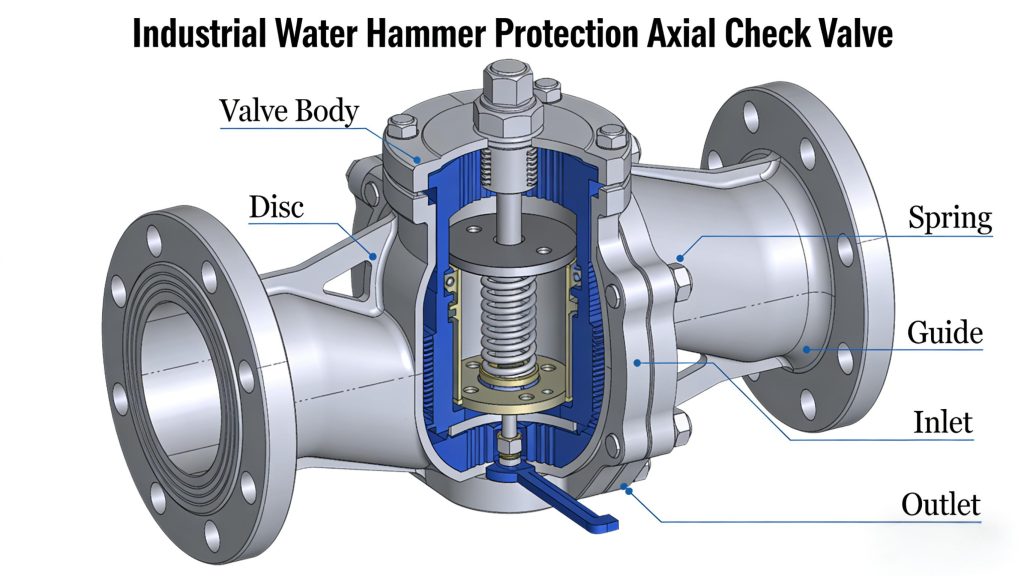
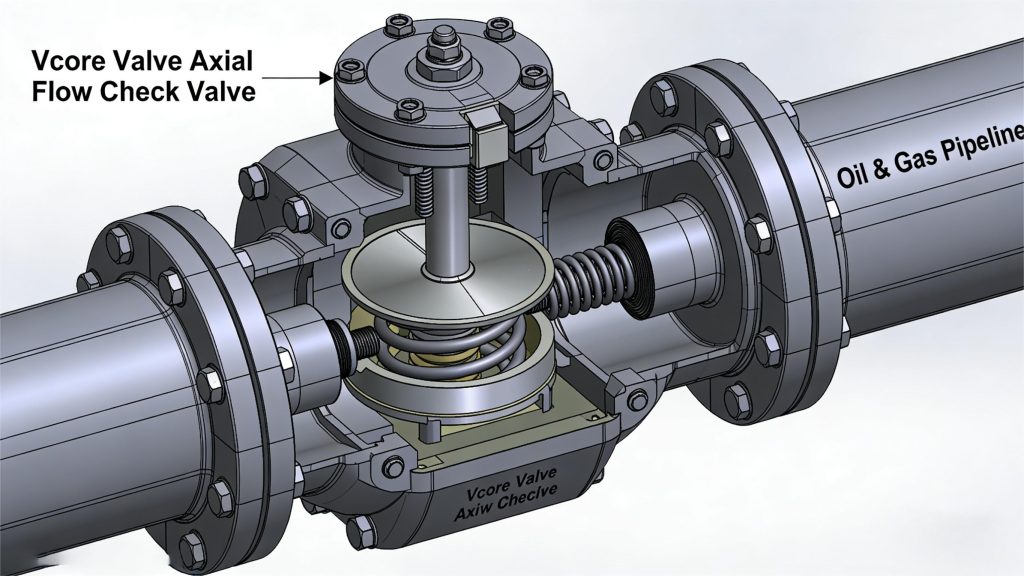
Axial flow check valves use a short-stroke, spring-assisted disc that moves along the flow axis. When correctly sized and applied, this design can close before significant reverse flow develops, reducing slam and pressure-surge risk. Closure speed and surge performance must be verified from valve data, system flow deceleration, pump shutdown behavior, and hydraulic transient analysis.ns.
Low Flow Resistance for Energy Efficiency
Engineered with a Venturi-style internal flow path, Axial Flow Check Valves minimise pressure drop by up to 70% compared to traditional check valves. Their streamlined design reduces turbulence and eddies, cutting energy costs for pump systems while maintaining optimal flow rates. For high-lift water pumping stations, this translates to 28% lower energy consumption.
Corrosion-Resistant Construction for Extreme Conditions
Vcore Valve’s Axial Flow Check Valves are crafted from high-grade carbon steel, stainless steel and special alloys—same as our industry-leading gate valves. Rigorously tested to meet global standards, they withstand high pressures (up to 2500#), extreme temperatures and corrosive media in oil & gas, chemical processing and mining. With minimal moving parts, they require almost no maintenance, even in harsh environments.
Typical Application Scenarios for Axial Flow Check Valves
Long-Distance High-Lift Water Pumping Station
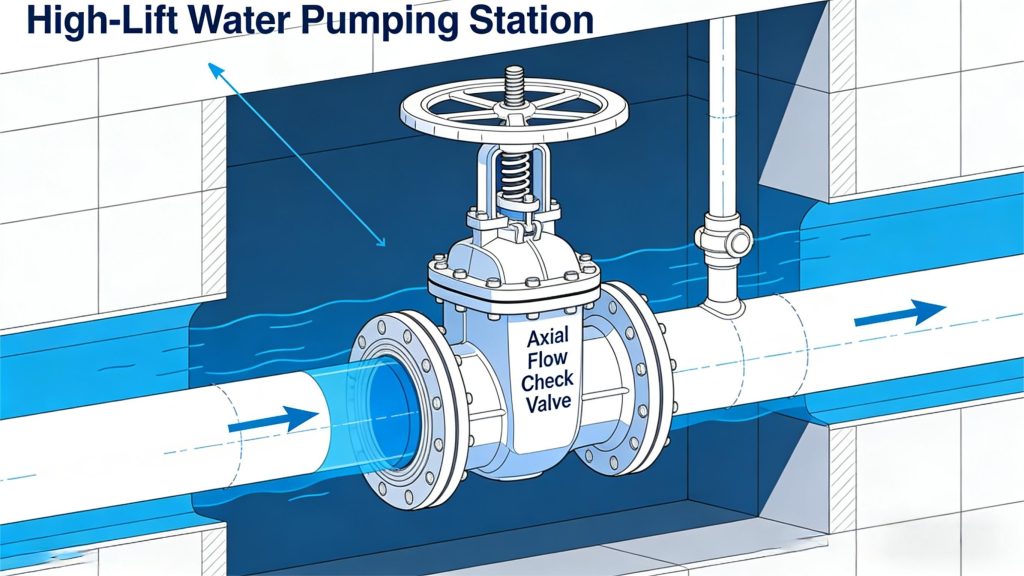
In high-lift water pumping stations, pump trip or sudden shutdown may create reverse flow and check valve slam. Axial flow check valves may be considered when faster non-slam closure and lower pressure drop are required, but the final solution should be verified through pump data, pipeline profile, surge analysis, valve sizing, and site operating conditions.
Petrochemical Refinery in Europe
In oil and gas or chemical transfer lines, axial flow check valves may help reduce reverse-flow impact and improve pump discharge protection. Material, seal design, pressure class, fire-safe or NACE requirements, leakage testing, and maintenance access should be confirmed by project specification.
Data Analysis: Axial Flow Check Valves vs Traditional Check Valves
| Comparison Item | Axial Flow Check Valve | Swing Check Valve | Dual Plate Check Valve |
|---|---|---|---|
| Closure mechanism | Spring-assisted axial disc movement | Hinged disc, often gravity and reverse-flow influenced | Spring-assisted dual plates |
| Slam risk | Usually lower when correctly sized | Can be higher in some pump shutdown conditions | Usually lower than conventional swing check in many systems |
| Pressure drop | Often low with streamlined body | Depends on body design and disc position | Usually compact, pressure drop depends on design |
| Installation sensitivity | Requires sizing and flow-condition review | Sensitive to orientation and flow conditions | Requires flange/wafer installation accuracy |
| Maintenance focus | Spring, guide, disc, seat, debris, corrosion | Hinge, disc, seat, wear, slam damage | Springs, plates, pins, seat, debris |
| Best use | Pump discharge, long pipelines, non-slam service | General backflow prevention where slam risk is low | Compact installations and many pump systems |
Market Trends & Industry Insights for Axial Flow Check Valves
The global Axial Flow Check Valves market is set to grow at a steady CAGR through 2032, driven by rising demand for water hammer protection in oil & gas and water treatment. Key trends shaping the industry include:
Customisation: Industrial clients demand valves tailored to their specific pressure, temperature and media requirements—Vcore Valve offers fully custom Axial Flow Check Valves with CNC machining and laser cutting.
Smart Integration: IoT-enabled Axial Flow Check Valves with pressure sensors are emerging, allowing real-time monitoring of flow and pressure to predict water hammer risks.
Sustainability: Low flow resistance Axial Flow Check Valves are a cornerstone of green industrial design, cutting carbon emissions by reducing pump energy use.
Regional Growth: Asia-Pacific leads the market, with China’s water treatment and oil & gas sectors driving 40% of global Axial Flow Check Valves demand.
Expert Usage & Installation Tips for Axial Flow Check Valves
Install in the Right Pipeline Section
For long-distance pipelines, mount Axial Flow Check Valves in the mid-rear section to split pressure wave propagation and minimise surge impact. In pump systems, install the valve after the pump and before the isolation gate valve (Vcore Gate Valves) to protect both the pump and piping.
Match the Valve to Your Media & Pressure
Vcore Valve’s Axial Flow Check Valves are available in flange, weld and threaded ends for different piping systems. For corrosive chemicals, choose 316 stainless steel or Hastelloy alloys; for high-pressure oil & gas pipelines, select carbon steel valves rated to 2500#.
Minimal Maintenance, Maximum Performance
Axial Flow Check Valves have no external actuators or complex seals—inspect only the spring and valve disc every 5 years (or annually in high-cycle environments). Clean the flow path with non-abrasive solvents to prevent debris buildup, which can slow closure time.
Pair with Vcore Valve’s Isolation Solutions
For a complete fluid control system, pair Axial Flow Check Valves with Vcore’s globe valves for flow regulation and gate valves for full isolation. This combination eliminates water hammer while ensuring precise on/off control and low leakage.
Why Vcore Valve’s Axial Flow Check Valves Are the Ultimate Choice
Vcore Valve brings 20+ years of industrial valve engineering expertise to every Axial Flow Check Valve we manufacture. Our valves are:
Precision-Engineered: CNC machining and laser cutting ensure tight tolerances for leak-proof sealing.
Tested to Perfection: Every valve undergoes hydrostatic and pneumatic testing to meet API, ANSI and ISO standards.
Customisable: We design Axial Flow Check Valves for your exact project needs, from material selection to end connections.
Backed by Support: Our global technical team offers installation, maintenance and troubleshooting support for all products.
Conclusion & Call to Action
Water hammer doesn’t have to be an unavoidable industrial risk. Axial Flow Check Valves deliver the rapid closure, low flow resistance and durability needed to eliminate pressure surges, protect your piping systems and cut costs. Vcore Valve’s precision-engineered Axial Flow Check Valves are the ultimate solution for oil & gas, water treatment, power generation and chemical processing—designed to perform in the world’s harshest conditions.
Ready to eliminate water hammer for good? Contact Vcore Valve today to discuss your Axial Flow Check Valves requirements. Our team will help you select or customise the perfect valve for your system, with fast delivery and expert installation support. Don’t let water hammer stop your operations—choose Vcore Valve’s Axial Flow Check Valves for unbeatable protection and performance.
FAQ
Q1: What makes Axial Flow Check Valves better at stopping water hammer than other check valves?
Axial Flow Check Valves feature a short-stroke axial disc that closes in <0.1 seconds, minimising reverse flow to near-zero. This eliminates the pressure waves that cause water hammer—unlike swing check valves, which have long closure times and high reverse flow rates.
Q2: Can Axial Flow Check Valves be used in high-pressure industrial systems?
Yes. Vcore Valve’s Axial Flow Check Valves are engineered to withstand pressures up to 2500#, making them ideal for high-pressure oil & gas, steam and power generation pipelines.
Q3: What materials are Axial Flow Check Valves made from?
Our Axial Flow Check Valves are crafted from premium carbon steel, 304/316 stainless steel and special alloys (e.g., Hastelloy) for corrosion resistance in aggressive media like chemicals and seawater.
Q4: How much maintenance do Axial Flow Check Valves require?
Almost none. With minimal moving parts, Axial Flow Check Valves need only a single inspection every 5 years (or annually in high-cycle environments) to check the spring and valve disc.
Q5: Where is the best place to install an Axial Flow Check Valve in a pipeline?
For long-distance pipelines, install Axial Flow Check Valves in the mid-rear section to split pressure wave propagation. In pump systems, mount the valve after the pump and before the isolation gate valve for maximum protection.
Q6: Can Axial Flow Check Valves be customised for my specific project?
Absolutely. Vcore Valve offers fully custom Axial Flow Check Valves, with custom sizes, end connections, materials and pressure ratings—all manufactured with CNC machining and laser cutting for precision.
Q7: Do Axial Flow Check Valves reduce energy costs?
Yes. Their Venturi-style flow path minimises pressure drop by up to 70% compared to traditional check valves, cutting pump energy consumption and lowering operational costs.
Reference Sources
Global Axial Flow Check Valves Market Size & Growth Forecast 2025-2032, Shangyexinzhi, 2026
Water Hammer Hazards & Mitigation in Industrial Piping, Shturl, 2026
Axial Flow Check Valves: Design, Function & Applications, Shturl, 2026
Water Hammer Protection with Axial Flow Check Valves, China Rural Water and Hydropower, 2023
Vcore Valve Product Catalogue: Industrial Gate & Check Valves, https://www.onoffvalve.com/products
International Hydraulic Institute: Water Hammer Engineering Guidelines.