Quick Overview
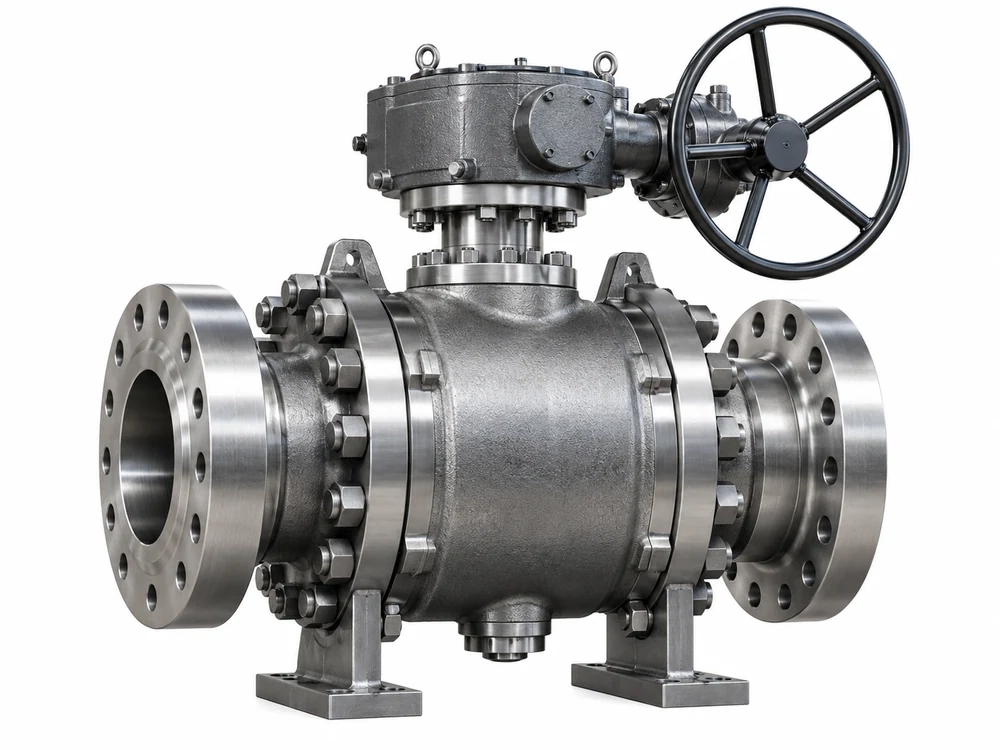
A high pressure trunnion ball valve provides quarter-turn isolation in demanding oil and gas systems. For oilfield gathering stations, separation facilities and high-pressure transmission lines, buyers must assess pressure class, seat arrangement, corrosive fluids, cavity pressure relief, operating torque and inspection requirements together. Trunnion support helps stabilise the ball and manage seat loading, but does not remove the need for application-specific engineering.
Buyer’s priority: establish whether the service belongs to an API 6D pipeline/process piping specification or an API 6A wellhead equipment specification before selecting a valve.
1. Where High-Pressure Trunnion Ball Valves Are Used in Oilfields
Oil and gas production infrastructure is not one uniform service. Fluids may contain natural gas, crude oil, produced water, dissolved carbon dioxide, hydrogen sulphide, sand and chemical treatment residues. Pressures can fluctuate during start-up, shutdown, pigging and compressor operation. An isolation valve that works on a clean-product pipeline may fail prematurely on a wet, abrasive gathering line.
Common locations include gathering manifolds downstream of the wellhead assembly, production separators, gas compression skids, crude transfer lines, pig launcher and receiver stations, metering bypasses and export pipelines. The operator normally needs a positive isolation function, rather than continuous throttling.
Scope distinction: equipment that forms part of a wellhead or Christmas tree can fall under API 6A; pipeline valves commonly reference API 6D. The project equipment specification and design authority determine applicability. An API 6D valve is not automatically API 6A-qualified simply because its pressure rating appears high.
2. Trunnion-Mounted Construction versus Floating Ball Design
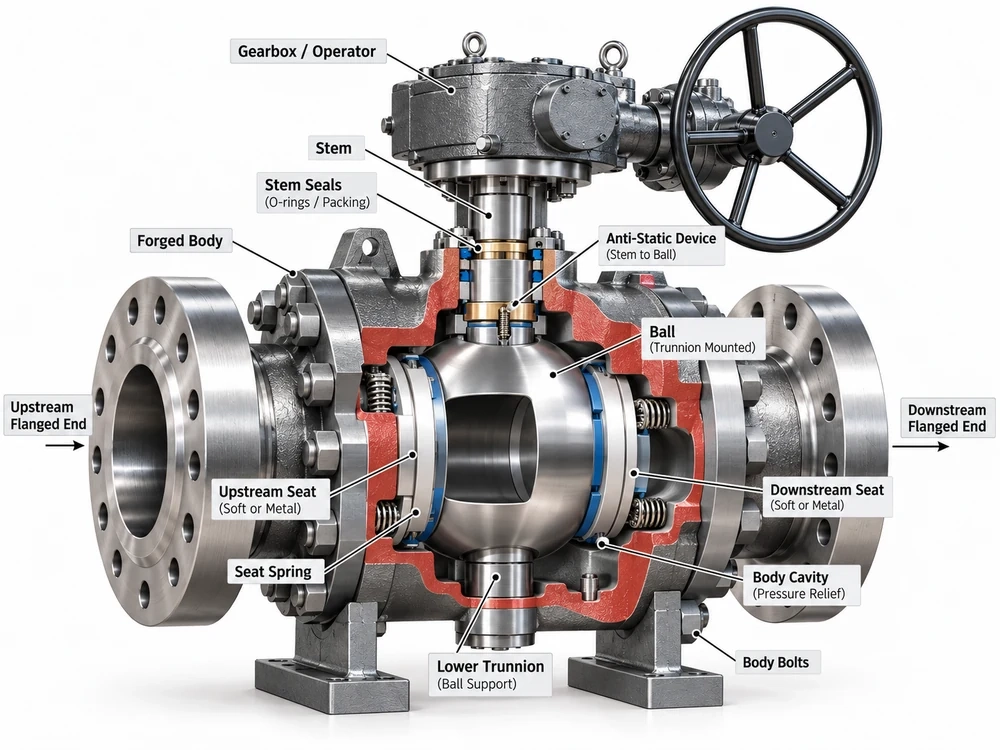
With a floating ball design, the ball can move slightly under differential pressure and load the downstream seat. With a trunnion-mounted arrangement, the ball is mechanically supported through a lower trunnion and stem/support system, while spring-loaded seat assemblies establish sealing contact. This arrangement is often preferred for larger bores or higher differential pressures because it can make seat loading and operation more manageable.
However, “low torque” is not a fixed property. Opening torque can change with differential pressure, seat design, fluid temperature, deposits, lubrication and time spent closed. For automated valves, request manufacturer-generated breakaway, running and reseating torque at the specified conditions, not a generic catalogue number.
A split-body arrangement may simplify certain overhaul procedures. Top-entry designs permit access from above under appropriate depressurised maintenance conditions, while fully welded bodies minimise body-joint leak paths but have different repair constraints. See the trunnion ball valve product range and forged trunnion ball valve for project configurations.
3. Choosing Class 600, 900, 1500 or 2500
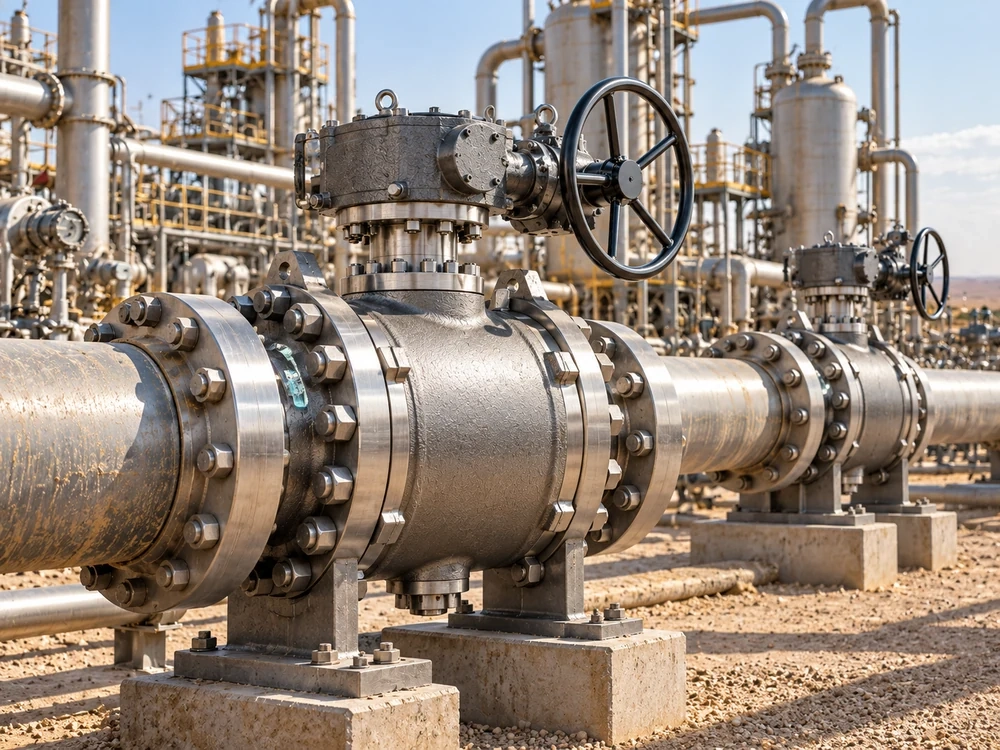
A pressure class is a standardised rating designation; Class 900 does not mean the valve is rated for 900 psi in every condition. The allowable pressure changes with material group and temperature. Determine the design pressure, maximum and minimum design temperature, transient conditions and relevant pressure–temperature rating before requesting offers.
Class 600 may suit some high-pressure gathering or transfer systems, while Class 900 and 1500 are encountered where design pressure demands higher ratings. Class 2500 is used for more severe specified pressure duty, subject to size and model limitations. These are indicative application categories, not replacements for the pressure–temperature tables.
At the connection, distinguish RF from RTJ facing and identify the proper flange standard and series; for butt-weld ends specify pipe outside diameter, schedule, wall thickness and weld preparation. An expensive high-class valve does not solve a mismatch in end connections.
Example purchase specification table
| Parameter | What to specify |
|---|---|
| Application | High-pressure upstream gathering, production manifold downstream of wellhead, separation, compressor or pipeline isolation |
| Size and rating | NPS / DN and ASME Class 600, 900, 1500 or 2500 as supported by selected design |
| Valve design | Trunnion mounted, two- or three-piece / split body, full or reduced bore |
| Body material | A105 or LF2 forgings; WCB or LCC castings; stainless or duplex grades where justified |
| Ball / stem | Material and coating selected for corrosion, wear and pressure; verify stem anti-blowout design |
| Seat / seals | RPTFE, PEEK, qualified elastomers or metal seats; verify chemical and temperature limits |
| Ends | ASME B16.5 RF/RTJ where within size range; ASME B16.47 for applicable larger flanges; butt-weld per approved pipe details |
| Special functions | Specified DBB / DIB seat arrangement, vent and drain, cavity relief, anti-static and fire-tested design |
| Operator | Gearbox, pneumatic, electric or hydraulic actuator sized from manufacturer torque data |
| Testing and records | Specified API 6D testing, pressure test reports, MTC / EN 10204 3.1 if required, PMI, NDE and coating records |
4. DBB, DIB, Seat Orientation and Cavity Pressure
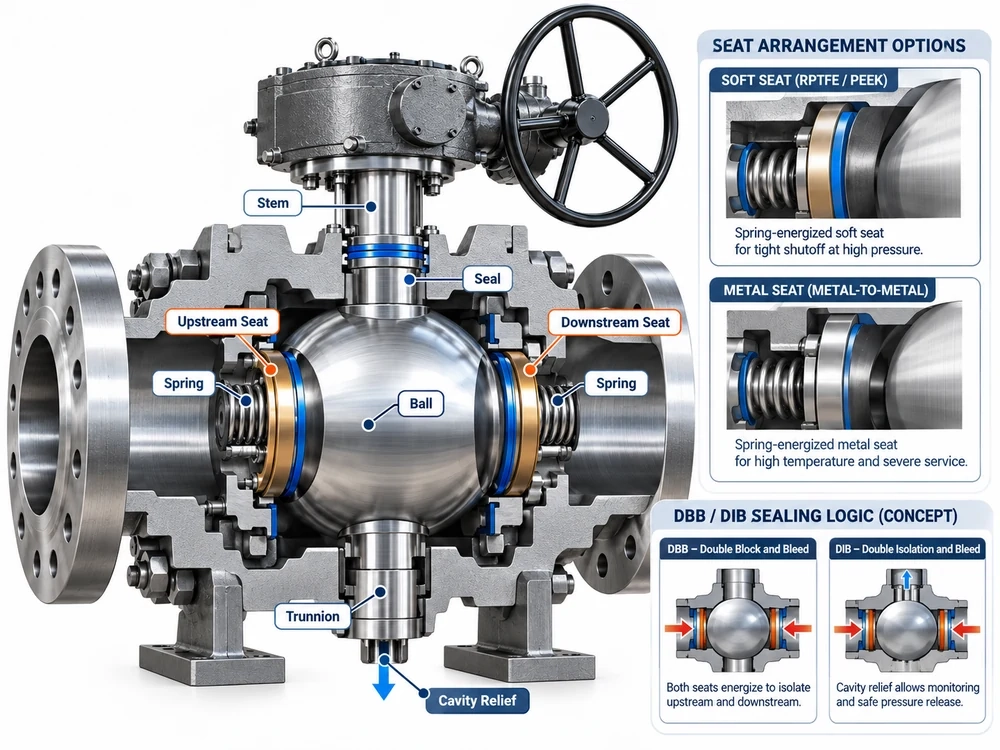
For hydrocarbon isolation, procurement specifications often request double block and bleed (DBB) or double isolation and bleed (DIB). These terms refer to defined isolation arrangements and testing behaviour, not simply “two seats in one valve”. With common single-piston-effect (SPE) seats, trapped cavity pressure can be relieved past a seat according to the design. Double-piston-effect (DPE) seats can provide a different isolation response, but their ability to retain cavity pressure creates a separate relief obligation.
Where liquid becomes trapped between closed seats, warming can raise cavity pressure sharply. Specify the permitted relief direction, the relevant seat configuration, any external relief device and how the assembly will be tested. A downstream relief destination is not interchangeable with an upstream one when the operation requires positive isolation.
For a more detailed treatment see cavity relief in ball valves and the existing trunnion design guide. In the purchase order, describe the exact seat and bleed performance to be witnessed instead of relying only on the abbreviation DBB.
5. Oilfield Materials: Carbon Steel, Low-Temperature Steel and Sour Service
Body material selection starts with the fluid, design temperature, corrosion allowance where relevant, environmental exposure and project piping class. ASTM A105 forged carbon steel and A216 WCB cast carbon steel are familiar candidates for suitable non-corrosive temperatures and environments. ASTM A350 LF2 and A352 LCC are considered for low-temperature designs when their qualified impact properties are needed. Stainless or duplex materials may be appropriate for particular corrosion conditions but require careful chloride, temperature and fabrication evaluation.
For a wet gas or produced-fluid line with H2S, assess applicable NACE MR0175 / ISO 15156 requirements. Material limits depend on the actual sour-service environment, component metallurgy, hardness, heat treatment and exposure conditions. A generic certificate saying “NACE compliant” cannot substitute for a documented material selection review.
Ball and stem surfaces may use suitable stainless materials or engineered coatings. Electroless nickel plating (ENP) can improve certain surface properties, but it is not a universal corrosion barrier for all oilfield chemistries. Verify coating specification, thickness, adhesion, porosity and suitability for the expected wear mechanism.
6. Seats, Fire-Safe Performance and Fugitive Emissions
Soft seats based on PTFE blends, reinforced PTFE or PEEK can give effective shut-off within their approved pressure, temperature and fluid exposure envelopes. Severe abrasion, solids, frequent cycling or elevated temperature may justify engineered metal seating, often at the expense of different leakage and torque characteristics. Elastomer seals require verification against hydrocarbons, amines, methanol, rapid gas decompression and any injection chemicals actually present.
Fire-safe construction may be specified with verification against applicable standards such as API 607 or ISO 10497, but a claim of fire-safe design is not the same as evidence of a relevant tested configuration. Likewise, anti-static continuity, blowout-resistant stem design and low-emission packing require their own checks. Request reports or certificates with model, size and configuration applicability established.
Sand-laden multiphase service deserves special attention: solids can scratch ball coatings and cause seat damage even where the nominal pressure class is adequate. Confirm expected solids loading and erosion risk before treating a conventional soft-seated pipeline valve as acceptable.
7. Selecting Manual, Pneumatic, Electric or Hydraulic Actuation
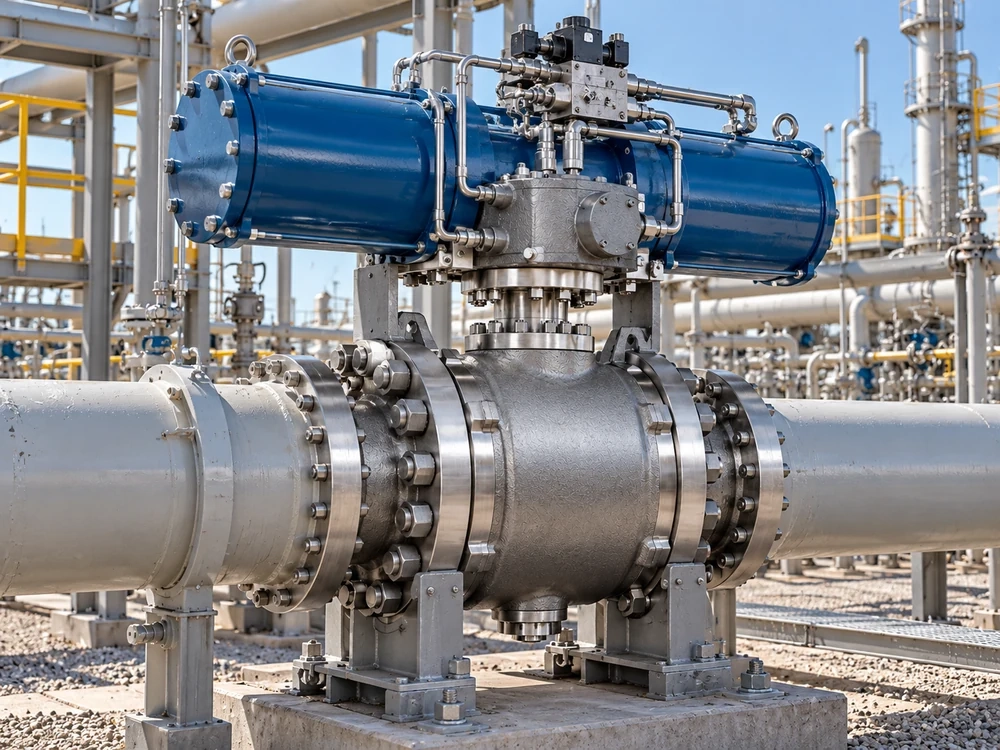
A gear operator can suit locally accessible valves where operating frequency is low and shut-off time is not critical. Pneumatic actuators are common when clean instrument air or gas is available. Electric actuators suit remote control where electrical infrastructure exists. Hydraulic or electro-hydraulic packages can supply high torque and controlled emergency operation, but their complexity must be considered.
For emergency shutdown (ESD) duty, the engineer should specify the safe position, closure time, available energy on loss of power or signal, partial-stroke requirements and interface with the control system. Closing too quickly can produce an unacceptable pressure transient. The manufacturer should size the package against its verified torque curve with an appropriate project-approved margin.
8. Inspection, Testing and Documentation for EPC Procurement
API 6D is a key pipeline-valve specification addressing manufacturing, inspection, testing and documentation. The applicable edition and amendments should be defined by contract, and special tests should not be assumed to be included in a standard shop test. The American Petroleum Institute’s API 6D update illustrates why edition control matters to equipment purchasers.
A project inspection and test plan (ITP) can identify hold and witness points for shell and seat testing, cavity venting, low-pressure gas testing when specified, dimensional inspection, PMI, NDE, coating examination and final functional checks. The test medium, duration, pressure, acceptance criteria and witness status must be agreed before production.
Typical document packages include an approved general arrangement (GA) drawing, datasheet, bill of materials, material test certificates (MTCs) with traceable heat numbers, pressure-test reports, any applicable fire-test evidence, coating records, torque calculation and actuator wiring or hydraulic schematic. Confirm the requested format and language before quotation.
9. A More Useful Oilfield Ball Valve RFQ
Rather than asking only for “10-inch Class 900 trunnion ball valve”, state: size and bore; pressure class and end facing; fluid composition, H2S and CO2 concentration; maximum and minimum pressure and temperature; pipeline schedule; seat and cavity arrangement; allowable leakage; fire-safe and anti-static requirements; operator and controls; and the inspection and certification regime.
For a commercial comparison, also request EXW / FOB / CIF / CPT Incoterms (named place and Incoterms version), unit price, MOQ if any, production lead time, packing dimensions, net and gross weight, country of origin, warranty conditions and quotation validity. Keep the manufacturing lead time distinct from shipping transit time.
Buyers comparing welded pipeline solutions can also review fully welded ball valves, while a broader selection summary is available on the high-pressure ball valve product page.
10. Final Selection Checklist
A reliable oilfield isolation package starts with clear design boundaries and verifiable requirements. Confirm that the valve’s API scope fits the location, its pressure–temperature rating fits the design case, its seat configuration provides the specified isolation behaviour, and its materials suit the actual fluid. Then review actuator sizing and documented acceptance tests. This workflow often prevents costly late changes to flanges, seats, actuators or certification.
For a project-specific proposal, send Vcore Valve the operating conditions, piping specification, required documents and estimated order quantity. A technical comparison can then be made against the approved specification rather than against nominal size and class alone.
Frequently Asked Questions
Is a trunnion ball valve suitable for a high-pressure oilfield pipeline?
Yes, provided the selected valve design, pressure–temperature rating, materials, seats, connections and qualification requirements match the actual line conditions. API 6D pipeline valves should not automatically be substituted for API 6A wellhead equipment.
Should I choose Class 900, 1500 or 2500?
Choose the pressure class using the maximum design pressure, minimum and maximum design temperature, material group and applicable pressure–temperature tables. The class number is not an operating-pressure value in psi.
What is the difference between DBB and DIB?
DBB and DIB describe different specified seat isolation and bleed performance. A DIB arrangement may use double-piston-effect seats and requires an engineered cavity pressure-relief solution. Always specify the required test and seat arrangement.
Are forged steel bodies always better than cast bodies?
Not necessarily. Forged and cast bodies can both be acceptable when their materials, pressure design, manufacturing quality and inspection meet the project specification. Forgings are frequently considered for demanding high-pressure service.
What changes when the well fluid contains H2S?
Materials exposed to the process fluid require a sour-service review against the applicable edition of NACE MR0175/ISO 15156, including hardness, heat treatment and environmental limits. A generic NACE statement is not enough.
Do all high-pressure trunnion valves need a hydraulic actuator?
No. Gear-operated, pneumatic, electric and hydraulic options are possible. Selection depends on breakaway and running torque, available utilities, closing time, duty cycle and any emergency shutdown requirement.
What documents should be supplied with an oilfield valve quotation?
Request a signed datasheet, general arrangement drawing, material list, pressure–temperature rating, seat schematic, torque data, test and inspection plan, MTCs and applicable compliance evidence, together with delivery and commercial terms.
Technical references: API 6D publication notice; SLB WKM 370D oil-and-gas valve applications. Standards, qualification and compliance are subject to the specified edition and exact valve configuration.