What Does API 6A Mean for Gate and Check Valves in Oil Production?
Oil-production wellhead valves operate in a very different environment from ordinary utility piping. Pressure can be high, fluids may contain produced water, CO₂, H₂S, sand or other solids, and a valve failure can affect well control, production continuity and personnel safety. This is why a purchase specification that says only “gate valve, 3,000 psi” is incomplete.
For wellhead and tree equipment, API Specification 6A establishes requirements covering design, materials, performance, dimensional and functional interchangeability, manufacturing, testing, inspection, marking and documentation for defined wellhead and tree products. The standard includes gate valves and check valves within its equipment scope.

1. What Does API 6A Actually Mean?
Specifying API 6A means the valve is being evaluated as part of the wellhead/tree equipment system defined by that specification. It does not mean that every API 6A valve has the same metallurgy, testing scope or performance qualification.
A technically complete specification normally needs to address several independent variables:
| Selection Item | Why It Matters | Typical RFQ Question |
|---|---|---|
| Valve type | Defines isolation or reverse-flow function | Gate valve, check valve, ball valve or other API 6A equipment? |
| Rated working pressure | Defines pressure-containing design basis | 2,000 / 3,000 / 5,000 / 10,000 psi, etc.? |
| Nominal size | Affects bore, end connection, loads and envelope | 2-1/16 in., 3-1/8 in., 4-1/16 in., etc.? |
| Temperature class | Controls qualified temperature range | What minimum and maximum service temperatures apply? |
| Material class | Relates material requirements to well-fluid conditions | Is H₂S or other corrosive well fluid present? |
| PSL | Defines applicable technical quality requirements | Is PSL 2 specifically required by the project? |
| Performance validation | Confirms performance qualification where specified | Is PR2 required for the exact product/configuration? |
| End connection | Controls interface and pressure integrity | API 6A flanged, studded or another approved connection? |
| Documentation | Provides traceability and acceptance evidence | MTR, NDE, pressure test, dimensional report, certificates? |
2. Why Gate Valves Are Common in Oil-Production Wellheads
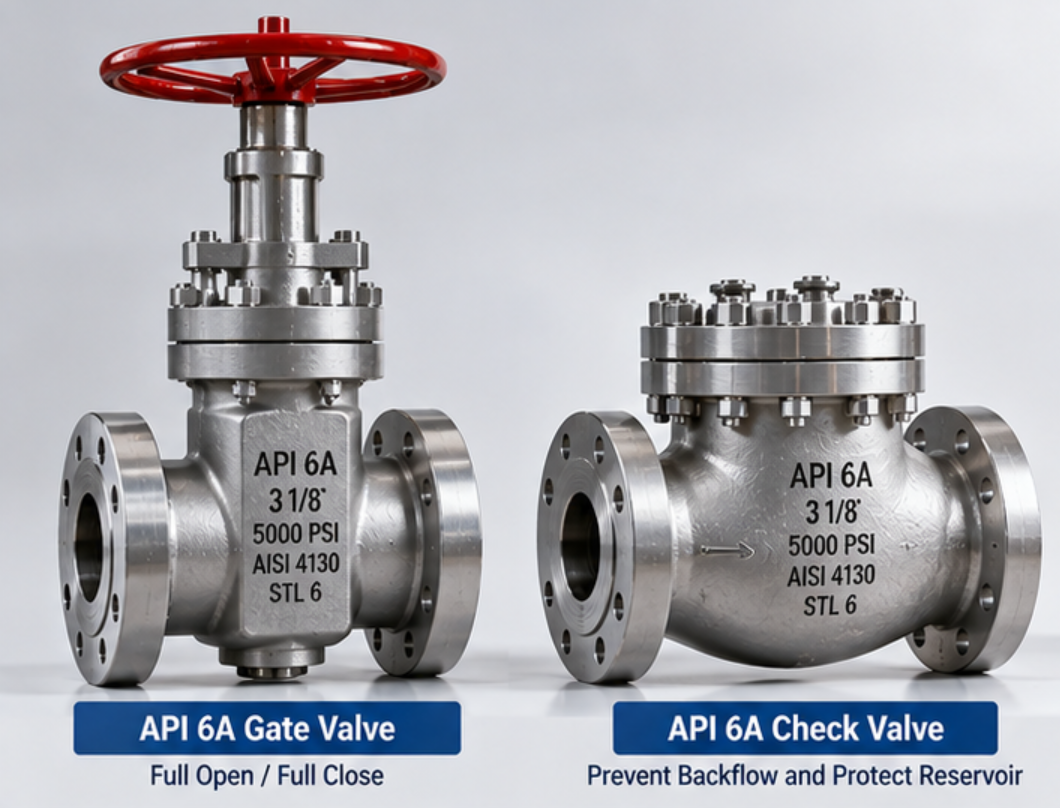
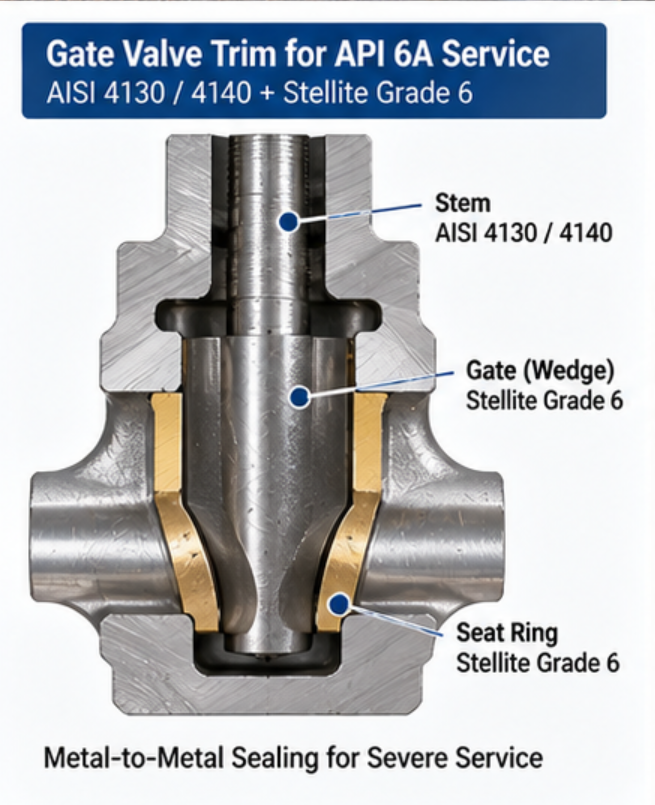
A gate valve is primarily an isolation valve. When fully open, the gate is removed from the main flow path and a full-bore design can provide a relatively unobstructed passage. When closed, the gate and seats isolate the flow.
For wellhead service, this operating principle is important because the valve is generally expected to be used for full-open/full-close duty rather than routine throttling. Holding a conventional gate valve partially open can expose the gate and seat region to concentrated velocity, erosion and unstable loading, particularly when produced fluids contain sand or when differential pressure is high.
Where Stellite Grade 6 Fits
Stellite 6 is a cobalt-based hardfacing alloy widely considered for wear, galling and erosion resistance on selected valve sealing or trim surfaces. In oil-production valves, hardfacing may be applied to gate/seat contact areas or other wear-critical surfaces depending on the manufacturer’s qualified design.
However, “use Stellite 6” should not be treated as a complete material specification. The engineer still needs to define the base material, hardfacing location, overlay procedure, thickness or acceptance criteria where required, corrosion environment and compatibility with the approved valve design.
3. Why Check Valves Matter in Production Systems
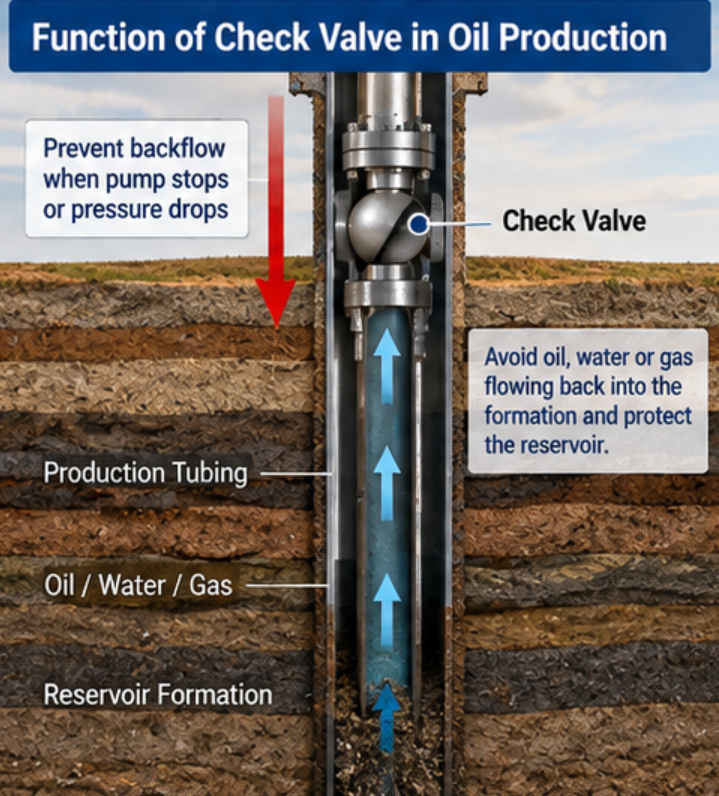
A check valve operates automatically in response to differential pressure. Its purpose is to allow flow in the intended direction and restrict reverse flow when downstream pressure becomes higher than upstream pressure.
In oil-production systems, reverse-flow protection can be important during pump shutdown, pressure fluctuation or abnormal operating conditions. Depending on the valve location and system architecture, a check valve can help prevent produced oil, water or other process fluid from reversing into upstream equipment or back toward the well. The exact protective function must be defined from the wellhead and piping arrangement rather than assumed from the valve name alone.
4. PSL 2 and PR2 Are Not the Same Requirement
This is one of the most common points of confusion in API 6A enquiries.
| Term | Meaning | Procurement Significance |
|---|---|---|
| PSL | Product Specification Level | Defines applicable levels of technical quality requirements for manufacturing, inspection, testing, traceability and related controls. |
| PSL 2 | A specified API 6A product specification level | Must be stated and verified against the exact product and service requirements. |
| PR | Performance Requirement / performance validation designation used for applicable equipment | Addresses performance qualification rather than simply production quality documentation. |
| PR2 | Higher defined performance-validation requirement where applicable | Requires confirmation that the offered design/configuration is covered by the required qualification. |
5. Material Selection: Do Not Choose the Body Grade by Pressure Alone
Oil-production valve material selection must consider pressure, temperature and well-fluid chemistry together. H₂S, CO₂, chlorides, produced water, sand, erosion and low-temperature conditions can change the appropriate metallurgy.
| Material Family | Where It May Be Considered | Engineering Caution |
|---|---|---|
| Carbon steel / low-alloy steel | General oil and gas pressure-containing components where service permits | Confirm API 6A material requirements, heat treatment, mechanical properties and sour-service restrictions. |
| 4130 / 4140 low-alloy steel | Commonly considered for forged wellhead components and valve internals/base components | Hardness, heat treatment and H₂S compatibility can be critical. |
| 13Cr martensitic stainless steel | Selected corrosion-resistant trim/components in suitable production environments | Not universally suitable for every sour/chloride condition. |
| 304 / 316 stainless steel | Corrosion-resistant components where chemistry and strength permit | Chloride and sour-service limits must be reviewed; 316 is not automatically adequate for severe produced-water service. |
| Duplex / super duplex stainless steel | More demanding chloride-containing and corrosive service where specified | Requires control of grade, heat treatment, welding, PMI and project acceptance. |
| Stellite Grade 6 hardfacing | Gate, seat or other wear-critical sealing surfaces in qualified designs | Hardfacing is a surface solution, not a substitute for correct base-material selection. |
What About WCB and WC6?
ASTM A216 WCB carbon steel and ASTM A217 WC6 chromium-molybdenum alloy steel are familiar materials in conventional industrial valves. They may appear in oil and gas piping applications, but an API 6A wellhead valve should not be specified merely by transferring a conventional ASME pipeline-valve body grade into an API 6A datasheet. API 6A has its own material/service framework, and the offered material must comply with the exact product, pressure, temperature, material class and project requirements.
This distinction is particularly important for high-pressure wellhead valves, where forged low-alloy materials such as 4130/4140 are frequently encountered.
6. Sour Service: API 6A Alone Is Not Enough
If H₂S is present, the RFQ should identify the sour-service requirement and the applicable material standard. For production environments, NACE MR0175 / ISO 15156 material requirements may become a critical part of the selection process.
Hardness control, heat treatment, welding procedure, bolting, trim materials and material condition can all matter. A generic statement such as “stainless steel” or “NACE material” is not sufficiently precise for a critical wellhead purchase.
7. Gate Valve vs Check Valve in an Oil-Production System
| Selection Point | API 6A Gate Valve | API 6A Check Valve |
|---|---|---|
| Main function | Positive isolation | Automatic reverse-flow prevention |
| Normal operation | Fully open or fully closed | Opens/closes automatically with differential pressure |
| Flow direction | Depends on qualified design | Directional by function |
| Key wear concern | Gate/seat erosion, galling, stem and sealing wear | Disc/poppet, seat, hinge/spring components depending on design |
| Material focus | Pressure boundary + gate/seat/stem/hardfacing | Pressure boundary + seat/closure element + moving components |
| Procurement mistake | Using it for continuous throttling | Ignoring cracking pressure, orientation or reverse differential |
8. A Practical API 6A RFQ Checklist
For a quotation that can actually be engineered, the buyer should provide more than valve size and pressure.
- Valve type and exact wellhead/tree function.
- Nominal size and bore requirement.
- Rated working pressure.
- API 6A edition required by the project.
- Temperature class / design temperature range.
- Material class and complete well-fluid composition.
- H₂S, CO₂, chloride, produced-water and sand/solids information.
- PSL requirement, for example PSL 2.
- PR2 requirement where applicable to the specified equipment.
- Body/pressure-boundary material requirement.
- Gate, seat, stem or check-valve internal material requirements.
- Hardfacing requirement, including Stellite Grade 6 where specified.
- End connection type, size and pressure rating.
- Manual, hydraulic or other actuation requirements.
- Required NDE, hardness, PMI and pressure testing.
- MTRs, GA drawing, datasheet, test reports and qualification documentation.
- NACE MR0175 / ISO 15156 requirements where sour service applies.
- Quantity, delivery terms and third-party inspection requirements.

9. Common Procurement Mistakes
- Buying by psi only: rated pressure does not define material class, temperature, PSL or fluid compatibility.
- Treating PSL 2 and PR2 as one requirement: they address different aspects of conformity and qualification.
- Assuming Stellite solves corrosion: hardfacing mainly addresses wear/galling/erosion; corrosion resistance still depends on the complete metallurgy.
- Using a gate valve as a throttling valve: this can accelerate localized trim damage.
- Writing “316 SS” without fluid chemistry: chloride, H₂S, temperature and stress conditions still need review.
- Ignoring documentation: an API 6A project often requires traceability and verification beyond a commercial datasheet.
10. How Vcore Approaches an API 6A Valve Enquiry
For an API 6A enquiry, Vcore recommends confirming the service condition before fixing the material and price. The engineering review should connect the valve function with pressure, temperature, well-fluid chemistry, material class, PSL, performance requirement, trim metallurgy and inspection scope.
For broader pressure/material selection, see our Valve Pressure-Temperature Rating Guide. For H₂S service, review the Sour Service Valve Material Guide. Buyers comparing isolation functions can also read Isolation Valves vs Gate Valves.
If your project requires API 6A gate valves, check valves or customized wellhead valve components, send the datasheet, pressure rating, size, temperature class, material class, PSL/PR requirement and fluid composition through the Vcore contact page for technical review.
FAQ
Is API 6A only a pressure standard?
No. API 6A covers wellhead and tree equipment requirements including design, materials, manufacturing, testing, inspection, performance, marking and documentation. Rated working pressure is only one part of the specification.
Does PSL 2 automatically mean PR2?
No. PSL and performance validation are separate concepts. If the project requires both PSL 2 and PR2, both requirements should be stated and verified for the exact equipment being supplied.
Why is Stellite Grade 6 used on API 6A gate valves?
It may be used as hardfacing on qualified sealing or wear surfaces to improve resistance to galling, wear and erosion. It does not replace correct base-material and corrosion-service selection.
Can WCB be used for every API 6A valve?
No. Conventional industrial valve material designations should not be assumed acceptable for every API 6A wellhead application. Material selection must comply with the applicable API 6A product and service requirements and the project specification.
What information is most important for an API 6A valve quotation?
At minimum, provide valve type, size, rated working pressure, temperature, fluid composition, material/service requirements, PSL, PR requirement where applicable, end connection, actuation, testing and documentation requirements.