Why We Rarely Recommend Lug Butterfly Valves for ASME Class 600 Service
Lug butterfly valves are popular because they are compact, light and convenient to install. Threaded lugs around the valve body allow each pipeline flange to be bolted independently, which can simplify maintenance and can permit one side of the piping to be disconnected when the specific valve is rated for dead-end service.
Those advantages are valuable in HVAC, fire protection, water systems and general industrial pipelines. But when a project specification moves to ASME Class 600, the selection question changes. The engineer is no longer choosing only a convenient body style. The complete pressure boundary, flange interface, body and lug strength, shaft, disc, seat, bolting, actuator torque and piping loads must be evaluated as one system.
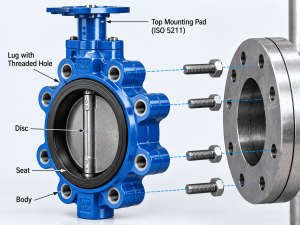
1. How a Lug Butterfly Valve Is Connected
A lug butterfly valve has projecting lugs around the body. The pipeline flange bolts engage the lugs from each side rather than passing completely through the valve assembly as they normally do with a wafer arrangement. This independent bolting is one reason lug valves are attractive for maintenance and dead-end applications.
In moderate-pressure service, the compact arrangement can be very practical. For example, many resilient-seated butterfly valves are used successfully in water, HVAC, fire-protection and general utility systems. Vcore’s rubber-lined butterfly valve range, for example, is focused on PN10, PN16 and Class 150 applications rather than Class 600 service.
At Class 600, however, the lug connection becomes an engineering feature that must be explicitly verified. Thread engagement, lug section thickness, body material, flange bolting, gasket loading and external piping loads all matter. A Class 600 nameplate cannot compensate for a connection design that was never engineered for the resulting loads.
2. Why Class 600 Changes the Mechanical Load Case
Pressure force increases directly with pressure and with the effective area on which that pressure acts. In a pressurized piping system, axial pressure thrust is primarily carried through the piping, flanges, anchors, supports and connected equipment. The valve connection must safely transmit the loads imposed at its interfaces.
For that reason, it is more accurate to say that a Class 600 valve must tolerate a substantially more demanding combination of internal pressure, flange loads, piping reactions, thermal expansion, vibration and operating torque than to say that pressure alone simply “pulls the lug valve apart.”
For a DN150 / NPS 6 project, these effects are already significant enough that Vcore normally reviews the connection style before treating a lug-body solution as the default. If the valve is intended for dead-end isolation, the requirement becomes even more critical because one downstream flange may be removed while the valve remains pressurized.
What should be checked?
- Body and lug stress at the specified pressure and temperature.
- Minimum thread engagement and allowable bolt loads.
- Compatibility with the actual ASME flange drilling and fasteners.
- Dead-end pressure rating, if one-sided service is required.
- Allowable external piping loads and moments.
- Shaft and disc strength under differential pressure.
- Required operating and seating torque.
- Pressure-temperature derating of body, seat and sealing materials.
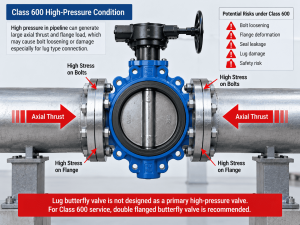
Engineering cross-section: lug butterfly valve between Class 600 flanges showing threaded lugs, bolts, disc, shaft, seat and pressure/load paths.
3. The Butterfly Valve’s Compact Design Is an Advantage — but It Has Limits
One reason engineers select butterfly valves is their excellent packaging efficiency. A quarter-turn disc provides isolation or control in a much shorter and lighter assembly than many gate or globe valve designs. This makes butterfly valves particularly attractive where weight, installation space and actuation speed matter.
That does not mean butterfly valves cannot handle high pressure. It means that as pressure, temperature and service severity increase, the design normally evolves from a simple concentric resilient-seated valve toward a double-offset butterfly valve or a triple-offset butterfly valve with a pressure-rated body, stronger shaft and more appropriate sealing system.
For compact lug valves in the DN50–DN300 range, Vcore commonly sees the strongest economic and maintenance case in low- and medium-pressure projects. When a DN150 valve is specified at Class 600, we therefore do not simply assume that the same conventional lug construction should be retained. We first reconsider the entire valve architecture.
4. Why We Often Prefer Double-Flanged Construction at Class 600
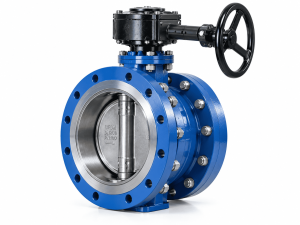
A double-flanged butterfly valve incorporates integral flanges on both sides of the body. For demanding installations, this provides a more substantial valve-to-pipeline interface and can improve alignment and installation rigidity. It is also a familiar arrangement for projects where the valve is expected to behave as a robust, independently supported pipeline component.
Vcore already uses double-flanged construction in industrial applications where stable installation is important; see our hydraulic double-flanged butterfly valve. Our flanged butterfly valve sizing guide also explains why double-flanged designs are commonly considered when connection rigidity and larger or more demanding piping systems become priorities.
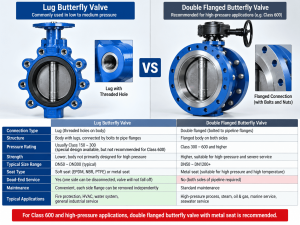
| Selection Point | Conventional Lug Butterfly Valve | Double-Flanged High-Performance Design |
|---|---|---|
| Installation | Compact, independent bolts on each side | Integral flange-to-flange connection |
| Maintenance access | Very convenient when dead-end rated | Conventional flanged removal procedure |
| Weight / envelope | Lower | Higher |
| High-pressure project preference | Requires model-specific verification | Often preferred when rigidity is prioritized |
| Class 600 suitability | Possible only with a purpose-designed Class 600 valve | Possible with a properly engineered Class 600 design |
| Dead-end service | Useful advantage, but rating must be confirmed | Model-specific; confirm manufacturer rating |
The key point is not that double-flanged construction is automatically stronger in every possible design. The engineering advantage is that it gives the manufacturer more freedom to design a robust pressure-containing body and flange interface without relying on a compact threaded-lug connection. Actual suitability must still be demonstrated by design calculations, pressure-temperature ratings and testing.
5. Soft Seat vs Metal Seat at High Pressure
Soft-seated butterfly valves are popular because resilient or polymeric seats can provide very tight shutoff with relatively low seating torque. EPDM, NBR, PTFE and reinforced PTFE all have legitimate applications, but their allowable pressure-temperature envelope and resistance to extrusion, creep, wear and chemical attack must be respected.
For a demanding Class 600 project, Vcore generally does not treat a conventional soft seat as the default. A high-performance engineered polymer seat may be valid for a specific manufacturer and service, but for severe pressure, temperature, erosive flow or long-term isolation duty, we usually evaluate a metal-seated double-offset or triple-offset design.
A triple-offset valve is especially relevant where the project combines high pressure with high temperature or critical isolation because its geometry minimizes rubbing between the sealing surfaces. See Vcore’s triple offset butterfly valve for the general design concept.
Comparison diagram: conventional soft-seated lug butterfly valve vs double-flanged metal-seated offset butterfly valve.
6. A Realistic Selection Example: DN150, ASME Class 600
Consider a customer requesting a DN150 butterfly valve at ASME Class 600. If the original request is for a conventional lug, soft-seated butterfly valve, Vcore would normally stop before quoting the same structure at a higher pressure class.
Our first recommendation would usually be to evaluate:
- Double-flanged body for a more robust pipeline connection.
- Double-offset or triple-offset geometry depending on temperature, leakage requirement and cycling duty.
- Metal sealing system for severe high-pressure/high-temperature service.
- Gear operator or actuator sized from calculated torque, not simply selected by nominal size.
- API 609 / ASME requirements and API 598 testing as applicable to the confirmed design and project specification.
- Full review of medium, operating temperature, design temperature, differential pressure and flow direction before manufacturing.
This approach may produce a heavier and more expensive valve than the original lug design, but the priority at Class 600 is not minimum body weight. It is a verified pressure boundary, stable installation, reliable isolation and an acceptable service life.
7. But Can a Lug Butterfly Valve Actually Be Class 600?
Yes. This distinction is important. Reputable manufacturers offer high-performance lug butterfly valves rated to ASME Class 600, including designs qualified for full-pressure dead-end service. Therefore, it would be technically incorrect to state that the lug connection itself can never withstand Class 600.
The practical rule is different: never infer Class 600 capability from the body style alone. A lug valve should only be selected when the exact series, size, body material, seat configuration, pressure-temperature rating, bolting arrangement and dead-end rating are documented for the required service.
8. Where Lug Butterfly Valves Remain Very Attractive
For lower and moderate pressure systems, lug butterfly valves retain clear practical advantages. The body is compact, installation is straightforward, and independent bolting can make downstream maintenance easier when the valve has the appropriate dead-end rating.
Common applications include:
- Fire protection and fire-water piping.
- HVAC chilled-water and condenser-water systems.
- Cooling-water circulation.
- General industrial water and utility pipelines.
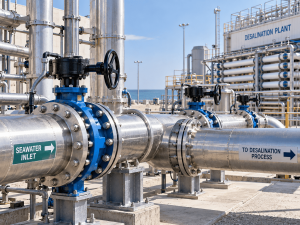
- Selected marine and seawater systems with appropriate materials.
- Process isolation where the specified pressure-temperature envelope is within the valve’s documented rating.
In these services, the lug body’s compact footprint and maintenance convenience can be more valuable than the additional mass of a double-flanged valve.
Outdoor industrial application: double-flanged metal-seated butterfly valve installed in a high-pressure process pipeline.
9. Class 600 Seawater Service Needs More Than a Pressure Upgrade
Seawater adds a separate corrosion problem. A valve that is mechanically suitable for Class 600 may still fail prematurely if its wetted materials, crevices, fasteners and drainage details are poorly selected.
For seawater projects, 316/CF8M stainless steel is often considered a starting point for corrosion resistance, but it should not be treated as universally sufficient. Warm seawater, high chloride concentration, stagnant crevices and long exposure can cause pitting and crevice corrosion in 316 stainless steel. Depending on temperature, chloride level, velocity and design life, duplex or super duplex stainless steels, nickel-aluminium bronze or higher-alloy materials may be more appropriate.
What about 316 + Stellite 6?
A 316 stainless steel disc with Stellite 6 hardfacing on selected sealing or wear surfaces can provide a useful combination of corrosion resistance, hardness and wear resistance in some designs. However, Stellite hardfacing should be selected for its actual sealing, galling, erosion and wear requirements rather than used as a universal seawater corrosion solution. The complete material couple, galvanic compatibility and project corrosion specification still need review.
For a high-pressure seawater butterfly valve, Vcore would normally confirm at least the body, disc, shaft, seat/seal ring, hardfacing, fasteners, packing, gasket and coating system individually.
10. Drainage and Water Trapping Matter in Marine Installations
Drainage is easy to overlook. Outdoor, marine and semi-marine piping can trap seawater or wash water around body cavities, flange interfaces, actuator brackets and external recesses. Stagnant chloride-rich water can accelerate localized corrosion even when the main wetted components use stainless steel.
The installation should therefore avoid unnecessary water pockets. Depending on the valve and piping arrangement, drainage provisions, orientation, external coating, sealed fastener details and inspection access should be considered during design rather than after commissioning.
Engineering sketch: Class 600 double-flanged offset butterfly valve for seawater service showing metal seat, 316/duplex wetted parts and drainage considerations.
11. Vcore Selection Logic for Lug vs Double-Flanged Butterfly Valves
| Project Condition | Typical Starting Point | Engineering Reason |
|---|---|---|
| HVAC / fire water / utility, low to moderate pressure | Lug soft-seated butterfly valve | Compact, economical and maintenance-friendly |
| Need one-sided pipeline removal | Dead-end-rated lug valve | Independent flange bolting; exact dead-end rating must be confirmed |
| Higher pressure / temperature | High-performance double-offset valve | Reduced seat wear and stronger pressure-temperature capability |
| Class 600 critical isolation | Double-flanged metal-seated double/triple-offset valve as a conservative starting point | Robust connection, severe-service sealing options and easier project-specific engineering |
| Class 600 lug explicitly required | Purpose-designed Class 600 lug HPBV/TOV | Accept only with documented model-specific ratings and testing |
| Class 600 seawater | Corrosion-resistant double-flanged offset design | Pressure capability plus chloride corrosion, drainage and material compatibility must be addressed |
12. RFQ Checklist for a Class 600 Butterfly Valve
Before asking a manufacturer to quote a Class 600 butterfly valve, provide enough information to select the actual structure rather than only a pressure class:
- Nominal size: DN / NPS.
- Pressure class and design pressure.
- Operating and design temperature.
- Medium, including seawater chemistry if applicable.
- Required body style: lug, wafer or double flanged.
- Offset design: concentric, double offset or triple offset.
- Body, disc, shaft and sealing materials.
- Soft seat or metal seat and required leakage performance.
- Required flow direction and differential pressure.
- Dead-end service requirement.
- Manual gearbox, pneumatic, electric or hydraulic operation.
- Flange standard and face-to-face requirement.
- Fire-safe, fugitive-emission, NACE or marine requirements where applicable.
- Design, testing and inspection standards.
- Required GA drawing, MTRs, pressure test records and compliance documentation.
Conclusion
Lug butterfly valves are excellent valves when their compact construction and independent flange bolting match the service. Their advantages are especially clear in HVAC, fire-water, utility and moderate-pressure industrial systems.
For Class 600, however, Vcore does not recommend taking a conventional lug or soft-seated butterfly valve and simply increasing the pressure designation. We normally re-evaluate the connection, body rigidity, offset geometry, shaft, seat, actuator torque, piping loads and materials. For demanding isolation, a double-flanged, metal-seated double-offset or triple-offset butterfly valve is often our preferred starting point.
A Class 600 lug butterfly valve can still be a valid solution when it is a purpose-designed, fully documented high-performance product. The final choice should therefore be based on the exact manufacturer’s pressure-temperature and dead-end ratings — not on a blanket assumption that all lug valves are weak or that all double-flanged valves are automatically suitable.
If you are evaluating a Class 600 butterfly valve project, send Vcore the size, medium, temperature, pressure, flange standard, material requirement and operating method through our contact page. We can compare lug, double-flanged, double-offset and triple-offset configurations before quotation.
FAQ
Can a lug butterfly valve be rated ASME Class 600?
Yes. Purpose-designed high-performance and triple-offset lug butterfly valves are available at Class 600. The exact size, material, seat configuration, temperature range and dead-end rating must be verified from the manufacturer’s documented series data.
Why does Vcore often recommend double-flanged construction for Class 600?
For customized severe-service projects, double-flanged construction provides a robust pipeline interface and gives more design freedom for a heavier pressure-containing body. It is a conservative starting point when connection rigidity, metal sealing and long-term mechanical stability are priorities.
Is a soft-seated butterfly valve unsuitable for all Class 600 service?
No. Engineered high-performance polymer seats exist for high-pressure valves. However, seat pressure-temperature limits, extrusion resistance, chemical compatibility and cycling duty must be verified. Metal-seated offset designs are often preferred for severe high-pressure/high-temperature or critical isolation service.
Is 316 stainless steel enough for seawater butterfly valves?
Not always. 316/CF8M can be a useful starting material, but chloride concentration, temperature, stagnation, crevices and design life may justify duplex, super duplex, nickel-aluminium bronze or another alloy. Material selection should follow the actual seawater conditions and project corrosion specification.
What should I confirm before ordering a Class 600 butterfly valve?
Confirm size, pressure and temperature, medium, connection style, offset geometry, materials, seat system, differential pressure, flow direction, dead-end requirement, actuator, flange standard, testing and required project documentation.