Seawater Valve Corrosion: How to Select Body, Disc, Shaft and Seat Materials
Engineering scope: This guide addresses corrosion-driven material specification for butterfly, check and gate valves in raw seawater intake, pump discharge, cooling-water and desalination pretreatment systems. For valve type, installation location, NPSH and pump-trip surge selection, first read Seawater Intake Pump Station Valves: Butterfly, Check and Gate Selection. The present article focuses instead on how a valve can fail even when its nameplate says “stainless steel” or its body is fully coated.
1. Start With the Exposure Map, Not a Material Grade
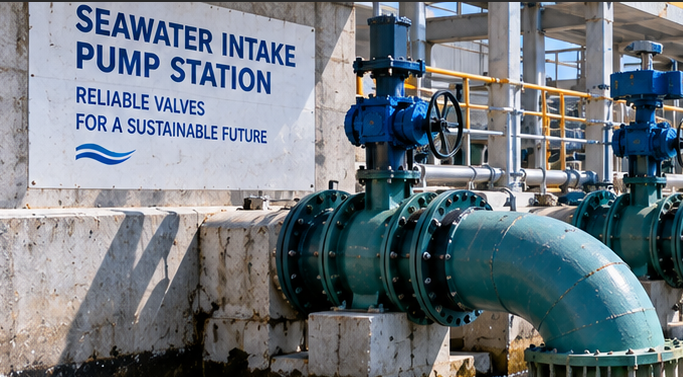
Full-strength seawater contains substantial chloride and conducts electricity, enabling localized and galvanic corrosion. The same valve design can face very different conditions in a continuously flushed intake header, a stagnant standby branch, a warm cooling-water return or a chemically treated pretreatment skid.
| Input | Why it changes material selection | RFQ question |
|---|---|---|
| Chloride / salinity | Promotes localized corrosion and affects alloy screening | Raw seawater, brackish water or concentrated brine? Supply analysis. |
| Normal / maximum temperature | Higher temperature can increase pitting and crevice-corrosion risk | Include seasonal peaks and shutdown temperature. |
| Flow, sand and silt | Can remove coatings or protective films at the disc edge and valve throat | Specify velocity, solids loading and operating frequency. |
| Stagnation and deposits | Crevices and under-deposit conditions can be more severe than flowing water | How long can a valve remain closed or idle? |
| Chlorination / cleaning | Oxidizing treatment and chemical cleaning may alter material compatibility | Give chemical identity, concentration, duration and dosing location. |
| Immersion and external atmosphere | Submerged bodies, splash-zone hardware and indoor actuators have different exposures | Which components are permanently wetted or externally exposed? |
Also specify pressure, design life, maintenance intervals and any cathodic protection. A generic statement such as “suitable for seawater” is not an adequate material specification.
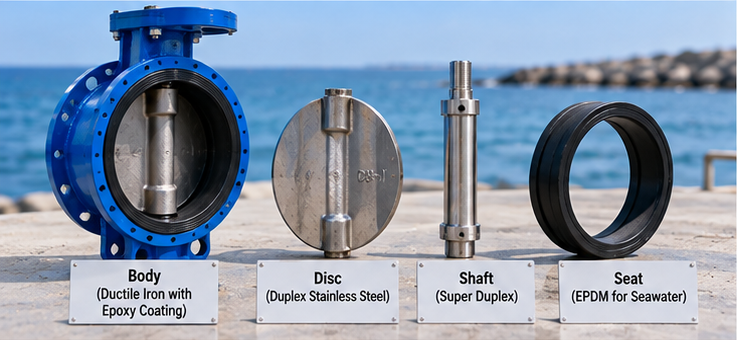
2. Body: Coated Ductile Iron or Corrosion-Resistant Alloy?
Coated ductile iron or carbon steel
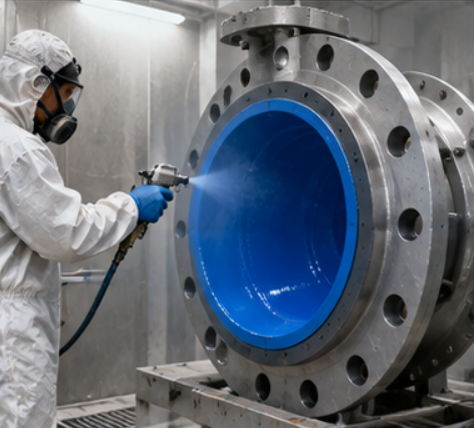
For an owner-approved low-pressure intake system, ductile iron with a qualified internal lining and external marine coating may be economical. The lining—not the bare iron—is the seawater barrier. Confirm surface preparation, minimum and maximum dry-film thickness, holiday testing where specified, edge protection, coating continuity around ports and flanges, repair procedure and compatibility with the seat and pipe lining. Coating damage can expose the substrate and initiate local attack.
For related configurations, see Vcore’s Rubber Lined Flanged Butterfly Valve and Rubber Lined Butterfly Valve. Their standard material options are starting points; the project must still approve the actual seawater lining and exposed trim.
Nickel-aluminum bronze, duplex and super duplex
Nickel-aluminum bronze (NAB) can be considered for selected marine valve bodies and internals, with review of polluted or sulfide-containing water, velocity and dissimilar-metal interfaces. Duplex 2205 and super duplex grades such as UNS S32750/S32760 may be considered where the corrosion study calls for higher chloride resistance and strength. They still require grade-specific fabrication, weld and crevice-control requirements. No single alloy is automatically approved for every temperature, chlorination regime or stagnant seawater duty.
Procurement distinction: “Stainless steel body” is incomplete. State the exact wrought or cast grade, product standard, heat treatment, weld requirements and which wetted parts use the alloy.
3. Disc: The Exposed Surface May Control Valve Life
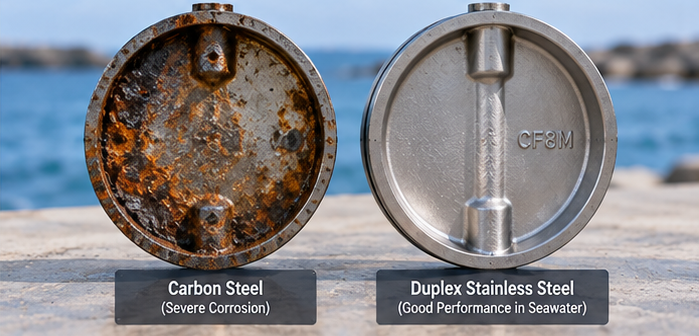
In a resilient-seated butterfly valve, the disc is often the most directly exposed metal. The seat may protect much of the body while leaving the disc faces and edges in contact with seawater. For check valves, the disc or flap can also experience local turbulence, repeated movement and impact.
| Disc option | Where it may fit | Key risk / approval check |
|---|---|---|
| Coated ductile iron | Owner-approved low-pressure systems | Edge damage, coating wear, impact and repairability |
| 316 / CF8M stainless | Only when a specific corrosion assessment permits it | Pitting and crevice corrosion in full-strength or stagnant seawater |
| Duplex or super duplex | Higher chloride-resistance requirements | Exact grade, heat treatment, weld quality and seat contact geometry |
| Nickel-aluminum bronze | Selected marine designs | Water pollution, erosion, galvanic pairing and casting quality |
| Fully encapsulated / lined disc | Compatible low-pressure lined systems | Seal integrity, pinholes, abrasion and pressure/temperature limits |
Do not copy a freshwater butterfly-valve specification that lists “SS316 disc” into an intake project without review. Vcore’s EPDM Lined Butterfly Valve for Water Treatment identifies several disc options and notes that chloride-rich service needs additional disc and shaft evaluation.
4. Shaft and Stem: Hidden Crevices Matter
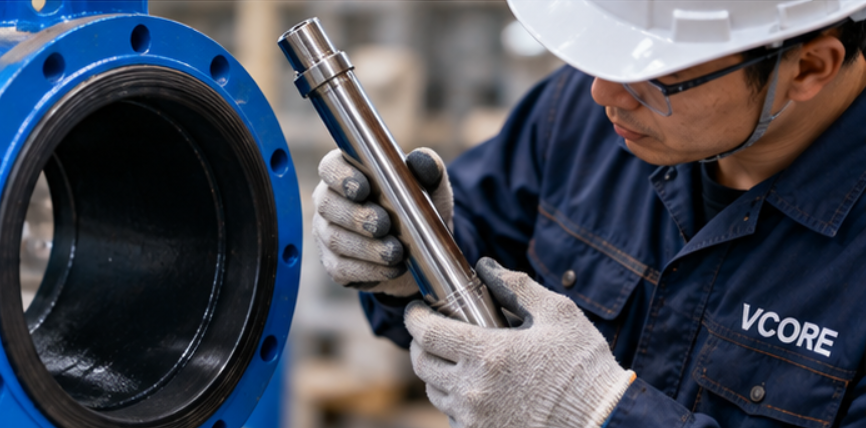
The shaft may be partially shielded by the seat yet exposed at bearings, packing, seals, retaining pins and the disc connection. Chloride-rich water trapped in these narrow spaces can create severe local attack even when the visible disc looks sound.
Specify the shaft material independently from the disc. Common 410/420 martensitic stainless grades used in other valve services should not be accepted for direct seawater exposure by default. A 316 shaft likewise requires a service-specific assessment; duplex, super duplex or a suitably engineered isolation arrangement may be needed. Confirm shaft-to-disc connection, key/pin material, bearing and bushing compatibility, seal integrity and replacement access.
5. Seat: EPDM Is Often Useful, but It Is Not a Corrosion Cure
EPDM is frequently considered for compatible seawater and water-treatment service, especially resilient-seated butterfly and check valves. The exact compound must be qualified for operating temperature, pressure, chlorination, ozone/cleaning exposure, swelling, compression set and cycling. NBR may be selected for some oil-containing services, but its suitability for the actual seawater treatment chemicals must be checked. PTFE or other seat systems can be considered where project chemistry or temperature requires them.
A rubber seat does not protect every metal surface. Verify whether the liner completely isolates the body, whether the shaft penetrations remain wetted, and whether the disc edge and fasteners contact seawater. For broader material trade-offs, see Anti-Corrosion Valve Materials for Chemical Processing.
6. Three Assembly-Level Examples
| Duty | Illustrative material strategy | Do not overlook |
|---|---|---|
| Low-pressure raw-seawater isolation butterfly valve | Approved lined/coated ductile-iron body; qualified seawater disc and shaft; compatible EPDM seat | Disc-edge exposure, liner holidays, flange dimensions, external coating |
| Pump discharge check valve | Owner-approved body protection plus corrosion-qualified closure member, hinge/pin and seat | Hinge crevices, slam loads, solids and transient analysis |
| Critical or higher-pressure seawater isolation | Corrosion-study-approved alloy body/trim or engineered lined construction | Exact grade, pressure rating, galvanic coupling, welding and inspection |
These are RFQ screening examples, not fixed bills of material. For pump discharge location and reverse-flow control, see Check Valves for Pump Discharge and the Rubber Lined Swing Check Valve product page. Valve type and closure dynamics must be selected separately from corrosion materials.
7. Inspection and Documentation: Verify the Whole Assembly
- Material traceability: MTRs for body, disc, shaft, pins and other specified pressure-containing or wetted metal parts; positive material identification where required.
- Alloy fabrication: grade-specific heat treatment, weld procedure, surface cleaning and supplementary corrosion testing when the project specification calls for it.
- Coating and lining: approved procedure, surface preparation, dry-film thickness, holiday inspection where specified, adhesion/repair criteria and records for inaccessible surfaces.
- Elastomer: approved compound, batch traceability and documented compatibility for seawater and treatment chemicals.
- Functional checks: shell and seat tests, actuator operation, disc/shaft movement, torque and dimensional verification to the applicable valve design and test standard.
- Interface review: mating flanges, gasket materials, external fasteners, pipe materials and cathodic-protection arrangement.
Use the project-specific test specification; a successful hydrostatic test does not demonstrate long-term seawater corrosion resistance. See Vcore’s Valve Pressure Test Methods for the distinction between pressure testing and service qualification.
8. RFQ Template: Specify Each Component, Not Just “Seawater Grade”
Request a component-by-component material schedule with the quotation. If a supplier proposes an alternative, require a marked deviation list rather than an unqualified “equivalent material” statement.
9. Five Questions Before Approving a Seawater Valve
- Which exact metal surfaces will touch seawater when the valve is open, closed and idle?
- Is the proposed body protection continuous through the bore, flange edges and shaft penetrations?
- Are the disc, shaft, pins, hinges and fasteners independently qualified for the chloride and crevice conditions?
- Has the elastomer been checked against chlorination, cleaning chemistry and cycling?
- Do material certificates, coating reports and assembly tests match the quoted configuration?
Bottom line: For seawater valves, the correct question is not “Is the body stainless steel?” but “Are every wetted component, seal and interface qualified for this specific seawater exposure?” For application-level selection, return to Seawater Intake Pump Station Valves; for project quotations and drawing-based configurations, contact Vcore Valve with the completed RFQ data.
FAQ
Is SS316 suitable for seawater butterfly valve discs and shafts?
Not as a blanket specification. 316/CF8M can suffer pitting and crevice corrosion in seawater, especially in stagnant or warmer conditions. Obtain service-specific corrosion approval for the actual geometry and exposure.
Can a coated ductile-iron valve body be used in seawater?
It may be used in an owner-approved application when the internal lining, external coating, exposed trim and inspection plan are suitable. Bare ductile iron should not be treated as inherently seawater-resistant.
Does an EPDM seat make a valve corrosion-resistant?
No. EPDM may be suitable for the specified fluid, but the disc, shaft, body edges, pins and other wetted metallic parts still need independent corrosion protection or alloy selection.
Should every seawater valve use super duplex?
No. Material selection depends on temperature, chemistry, crevice geometry, pressure, design life, fabrication, galvanic compatibility and project requirements. A qualified lined construction or marine copper alloy may be appropriate for some duties.