Seawater Intake Pump Station Valves: How to Select Butterfly, Check and Gate Valves
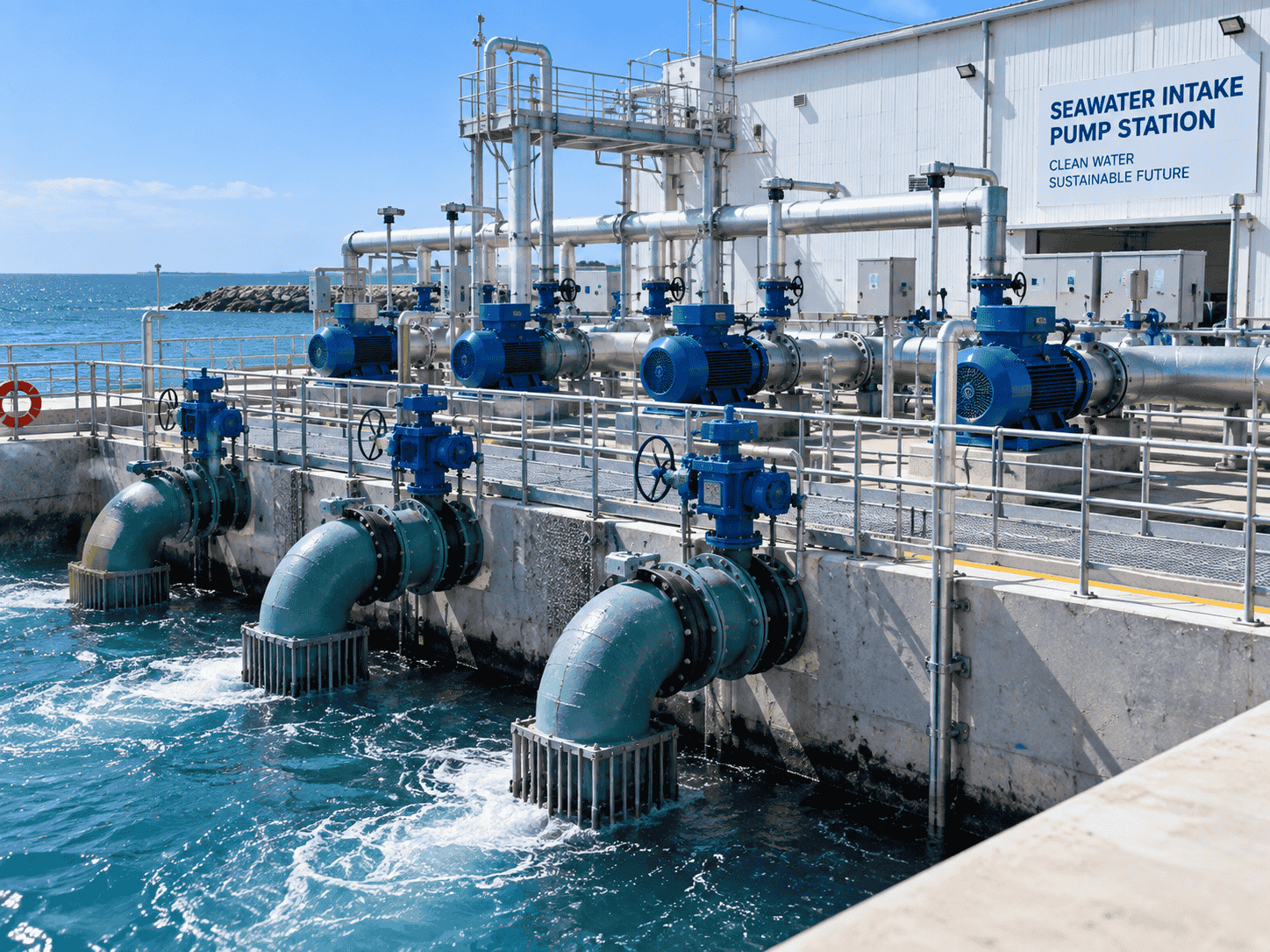
A seawater intake pump station supplies raw seawater to screening, pretreatment and desalination equipment. Unlike a clean-water distribution station, it may face salt spray, chloride-rich water, marine organisms, sand, intermittent solids, tidal variation and difficult maintenance access. The practical procurement question is therefore not simply “butterfly valve or gate valve?” It is which valve belongs at each point in the pump train, and what happens when a pump stops unexpectedly?
1. Start with the P&ID: Three Different Valve Duties
A conceptual arrangement for one pump train is:
This is a selection starting point, not a universal construction drawing. Actual sequence, distances, bypasses, air valves and surge-protection equipment must follow the hydraulic design, pump manufacturer’s requirements and site P&ID. Published pump-station guidance commonly places the discharge check valve between the pump and its isolation valve, allowing isolation of the non-return device for maintenance.
| Position | Primary Duty | Typical Valve Choice | Failure / Design Question |
|---|---|---|---|
| Intake or pump suction | Isolate pump for maintenance | Full-bore gate or suitable butterfly valve | Does the valve and nearby fitting reduce available NPSH or disturb pump inlet flow? |
| Immediately downstream of pump | Prevent reverse flow after pump trip | Engineered swing, tilting-disc, dual-plate or axial check valve | Will closure occur before substantial reverse velocity develops? |
| Discharge isolation / header | Isolate equipment and pipework | Gear-operated or actuated butterfly; gate where justified | Can the valve close safely under the specified differential pressure? |
| Maintenance bypass / drain | Drain, vent or controlled bypass | Project-specific smaller valve | Does its material and rating match raw seawater and cleaning conditions? |
For general installation principles, see Vcore’s Check Valve Installation Guide. This article adds the seawater-intake-specific hydraulic and materials decisions.
2. Suction Isolation: Butterfly or Gate Valve?
At the pump inlet, minimizing avoidable head loss matters because available net positive suction head (NPSHa) must exceed the pump’s required NPSH with the specified engineering margin. The valve’s loss coefficient, nearby elbows, reducers, screens, fouling and lowest expected intake water level all contribute to the suction-side hydraulic assessment.
A fully open gate valve provides a comparatively unobstructed flow path and may be useful where suction pressure loss or passage clearance is critical. It generally needs more face-to-face length and vertical operating clearance. A butterfly valve is compact and often attractive for large intake mains, but its disc remains in the flow path even when fully open. Compare actual manufacturer loss data at design flow rather than assuming either type has negligible resistance.
For large-diameter lined isolation, review Vcore’s Rubber Lined Flanged Butterfly Valve and Butterfly Valve product range. For full-open isolation alternatives, see the Gate Valve range. Confirm actual seawater compatibility for the selected model rather than treating every listed valve as seawater-qualified.
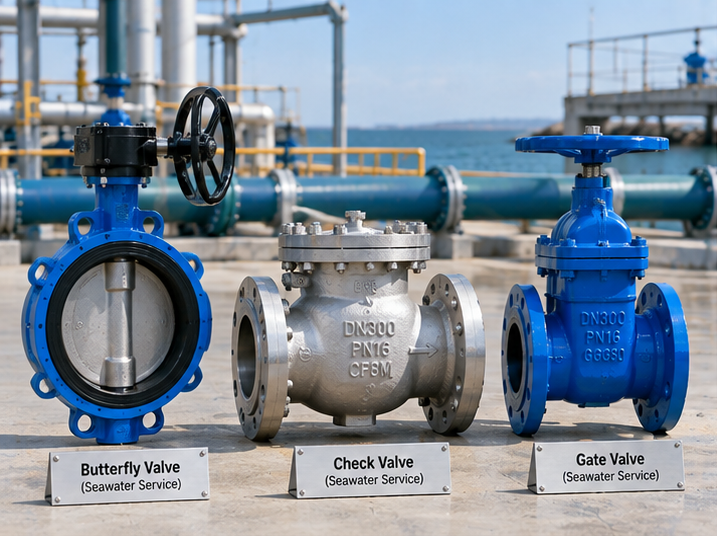
3. Pump Discharge Check Valve: Closing Dynamics Matter More Than the Name
When a seawater pump trips, forward flow decelerates and the header may drive flow backward through the stopped pump. A discharge check valve should limit reverse flow, but an unsuitable closing response can itself produce valve slam and damaging pressure transients. “Fast closing” and “slow closing” are not universal substitutes for a transient study: the appropriate disc travel, spring force and damping depend on system deceleration and reverse-flow conditions.
| Check Valve Design | Potential Advantage | Confirm Before Selection |
|---|---|---|
| Swing check | Established configuration; suitable for selected large water lines | Disc inertia, minimum velocity, installation orientation, hinge corrosion and slam risk |
| Dual-plate spring-assisted | Compact face-to-face; spring-assisted closure | Actual closing response, plate flutter, pressure loss, spring/hinge materials and debris tolerance |
| Tilting-disc / damped check | Closure characteristic can be engineered for selected large-pump duties | Dashpot setting, reverse velocity, available space and maintenance |
| Axial / nozzle check | Short-stroke, spring-assisted closure for suitable clean-flow duties | Raw-water debris, pressure loss, flow range and corrosion-resistant internals |
Use the station’s pump-trip and parallel-pump scenarios to assess minimum and maximum pressure, column separation, reverse velocity and disc impact. A check valve alone cannot guarantee a water-hammer-free system; air/vacuum valves, controlled pump operation, surge vessels or relief devices may also be needed after hydraulic transient analysis.
For the general selection of pump-discharge non-return valves, read Check Valves for Pump Discharge. For an available lined product concept, review the Rubber Lined Swing Check Valve, with seawater-wetted hinge, disc and lining materials confirmed for the project.
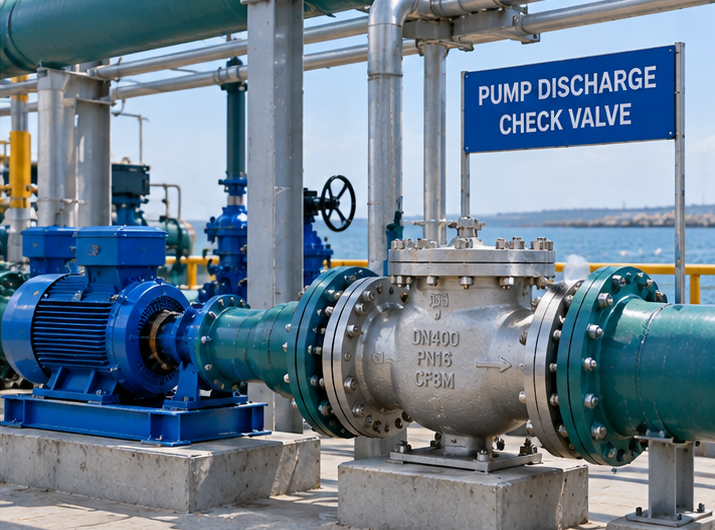
4. Discharge Isolation: Large-Diameter Butterfly Valve or Gate Valve?
On a large discharge main, a double-flanged butterfly valve often offers compact installation, quarter-turn operation and practical gearbox or electric/hydraulic actuation. A gate valve may be considered when a full-open passage is a priority, the specified differential pressure or pipeline architecture favors that design, and sufficient operating clearance exists.
For either valve, specify shutoff differential pressure, not merely nominal PN or Class rating. An actuator must have sufficient torque or thrust for the worst credible operating condition, including differential pressure, fouling, seat friction and emergency closure duty. If the valve participates in pump start/stop sequencing, the closing profile should be reviewed alongside the transient study.
Compare actuator options using Vcore’s Valve Actuator Selection Guide and Valve Actuator Torque Sizing Guide.
5. Seawater Corrosion: Specify the Complete Wetted Assembly
“Stainless steel body” or “EPDM seat” alone is not a complete seawater specification. Chloride-rich water, oxygen, crevices, stagnant periods, biological fouling and abrasive sand can affect different components in different ways. Material choice should follow site salinity, temperature, chlorination/biocide regime, solids loading, flow velocity and expected service life.
| Component | Project Selection Questions |
|---|---|
| Body | Is coated/lined ductile iron acceptable, or does the project require nickel-aluminum bronze, duplex or another alloy? |
| Disc / gate / closure | Will exposed metal resist chloride corrosion, erosion and deposits at the design velocity? |
| Stem / shaft / hinge / spring | Are all wetted small components and crevice locations covered by the corrosion specification? |
| Seat / liner | Is the EPDM, NBR or other elastomer compatible with seawater, chlorination, temperature and abrasion? |
| Bolting / fasteners | Are wetted and externally exposed fasteners specified separately? Is galvanic compatibility addressed? |
| External coating | Is the coating system suitable for salt spray, splash-zone exposure and the required surface preparation? |
316/316L should not automatically be accepted for every continuously wetted or crevice-prone seawater component. Duplex/super-duplex alloys, nickel-aluminum bronze and fully lined constructions may be evaluated according to exposure and project requirements. For lined alternatives, browse Vcore’s Rubber-Lined Valve range; for a broader material comparison, read Anti-Corrosion Valve Materials.
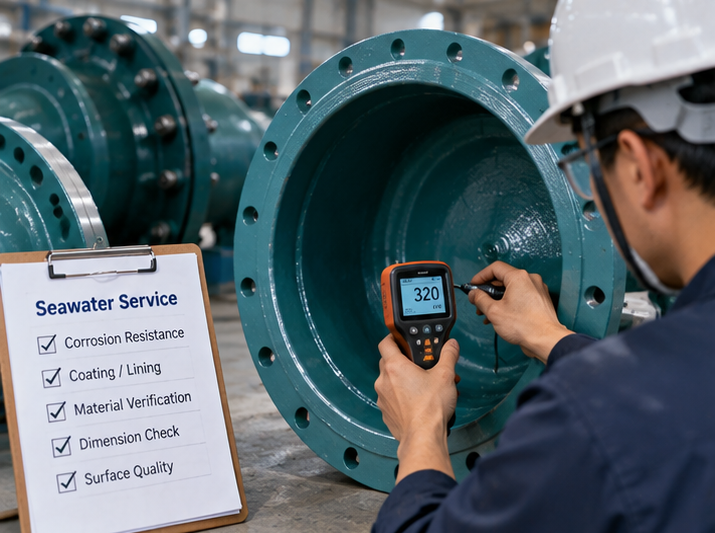
6. Debris, Biofouling and Maintainability Change the Valve Specification
Intake screens do not guarantee that all sand, shell fragments or marine organisms are removed. A valve suitable for filtered seawater may not perform equally well upstream of screening. Confirm the largest expected particle, solids concentration, screen position, flushing method and cleaning access. Deposits may increase butterfly operating torque, prevent check-valve seating or obstruct a gate valve’s closing path.
For maintenance, confirm whether a valve can be removed without draining the entire header; whether a dismantling joint is required; whether the actuator, bonnet and check-valve cover can be accessed; and whether lifting equipment has adequate clearance. A double-flanged body can simplify alignment in some large-bore layouts, but the actual dismantling sequence must be checked against the piping supports and isolation boundaries.
7. Pressure Class and Flange Standard: Do Not Assume PN16 or Class 150 from “Low Pressure”
Raw seawater intake lines are often lower pressure than downstream reverse-osmosis high-pressure feed circuits, but pressure class must still cover maximum operating and design pressure, static head, pump shutoff head and credible surge conditions. Confirm the governing flange standard (for example EN 1092, ASME B16.5/B16.47 or the project-specific waterworks standard), flange facing, bolt pattern, face-to-face dimension, test requirements and coating/lining at the flange faces.
Use Vcore’s Valve Pressure-Temperature Rating Guide for rating terminology and Valve Pressure Test Methods for inspection planning. The applicable valve design and testing standard must be selected for the actual product and contract, rather than applying one API or EN standard to every valve type.
8. Example Valve Schedule for a Seawater Intake Pump Train
| Tag / Location | Function | Initial Valve Concept | Critical Datasheet Fields |
|---|---|---|---|
| XV-101 / suction | Pump maintenance isolation | Full-bore gate or double-flanged butterfly | DN, minimum suction level, design flow, loss coefficient, material, actuator clearance |
| NRV-102 / discharge | Stop reverse flow | Engineered check valve | Flow range, orientation, pump trip, reverse velocity, closing response, pressure loss |
| XV-103 / discharge | Isolate pump from header | Actuated or geared butterfly; gate alternative | Shutoff ΔP, operating torque, stroke time, fail action, flange/F-F |
| XV-104 / header | Sectional isolation | Large-bore butterfly or gate | Design surge pressure, lining, gearbox/actuator, maintenance space |
Illustrative tags only; not a universal valve count, pressure class or approved arrangement.
9. RFQ Checklist: Data That Prevents Re-Quotation
- P&ID, valve tag, location and duty (suction isolation, discharge check or header isolation).
- Quantity, DN/NPS, pipeline internal diameter and design flow range.
- Operating/design pressure and temperature; pump shutoff head and maximum transient pressure.
- Minimum intake water level, suction losses and pump NPSH requirements for suction-side valves.
- Pump curve, rotational inertia, number of parallel pumps, start/stop frequency and trip scenarios for check valves.
- Seawater salinity/chlorides, temperature, chlorination, dissolved oxygen, solids and biological fouling.
- Body, disc, stem, hinge/spring, liner, seat and bolting materials; coating specification.
- Flange standard, drilling, facing, face-to-face dimension and installation orientation.
- Allowable pressure drop, seat tightness, check-valve cracking pressure and minimum stable flow as applicable.
- Manual/gear/electric/pneumatic/hydraulic operation, supply utilities, required fail action and closure time.
- Maintenance and dismantling clearance, access to check-valve internals, lifting provisions and spares.
- Applicable design, inspection, pressure/leakage test and documentation requirements.
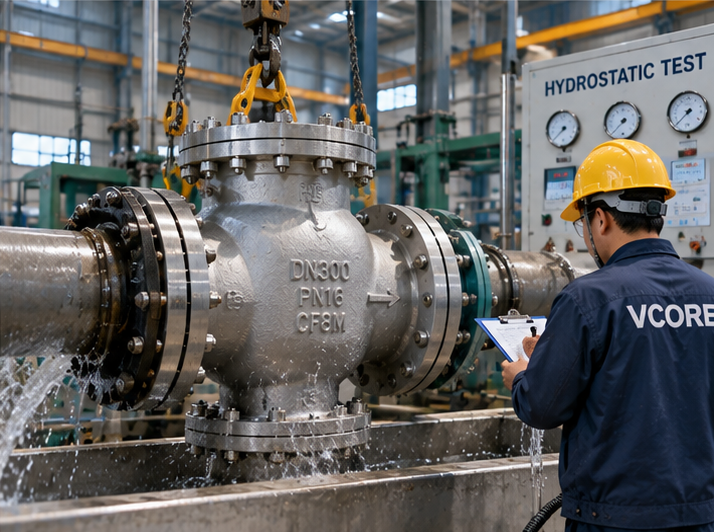
10. Final Decision: Select by Valve Position and Pump-Trip Behavior
For seawater intake pump stations, the strongest selection logic is location → hydraulic duty → failure scenario → wetted materials → dimensions and operation → verification documents. Butterfly and gate valves provide isolation in different installation envelopes; check valves protect against reverse flow but must be matched to pump-trip dynamics. A complete valve schedule should show how all three work together rather than specify each as an isolated catalog item.
Explore Vcore’s Water Treatment Valve Solutions or send your P&ID and valve schedule for project-specific configuration review.
Frequently Asked Questions
Where should a check valve be installed in a seawater intake pump station?
A common conceptual arrangement places the check valve downstream of the pump and upstream of the discharge isolation valve. Final location and spacing must follow the approved P&ID, valve manufacturer and hydraulic design.
Is a butterfly valve always better than a gate valve for large seawater lines?
No. Butterfly valves are compact and often practical at large diameters; gate valves offer a comparatively unobstructed full-open passage. Compare suction pressure loss, installation space, corrosion protection, actuator duty and maintenance requirements.
Will a non-slam check valve eliminate water hammer?
No check-valve type can guarantee that result for every system. Closure dynamics, pump trip, reverse velocity and the full pipeline transient response must be assessed together.
Can a standard 316 stainless steel valve be used for seawater intake?
Not automatically. Chloride exposure, crevices, stagnation, temperature and component geometry can create corrosion risks. Review all wetted components and the project’s material specification.
What should a seawater pump-station valve RFQ include?
Include the P&ID and tag duty, size, flow range, pressure and surge data, pump-trip conditions, seawater chemistry and solids, full wetted-material schedule, flange/F-F requirements, actuator duty, testing and documentation.