Quick overview
Double eccentric butterfly valves are a practical isolation option for seawater intake mains and pump-station discharge headers when their sealing direction, corrosion protection, hydraulic loading and actuation are engineered together. The two-offset disc geometry reduces seat rubbing during travel, but it does not automatically guarantee bidirectional shut-off, seawater resistance or safe emergency closure. Start with the pump-station P&ID, establish the maximum shut-off differential pressure and transient loads, then specify the complete wetted assembly, actuator torque envelope and inspection plan.
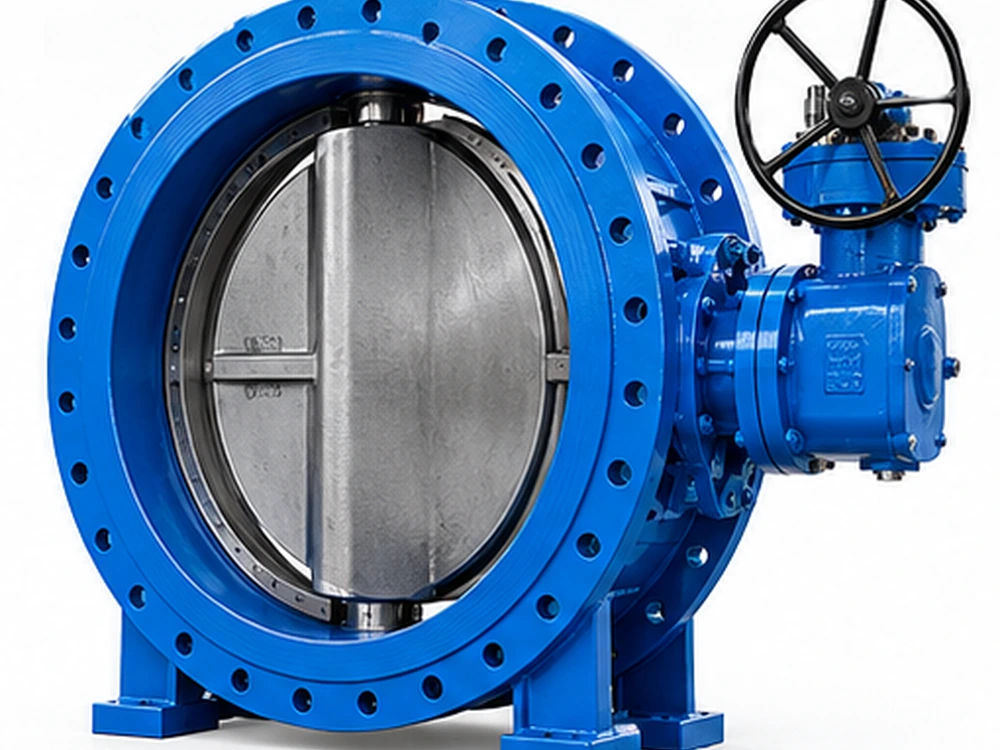
Double Eccentric Butterfly Valves for Seawater Intake and Pump Stations
A seawater intake pump station has a demanding job: moving large volumes of chloride-rich water reliably while accommodating debris, fluctuating levels, pump starts, planned shutdowns and unexpected trips. A double eccentric butterfly valve for seawater can provide compact, motorised isolation on a large suction or discharge line. However, choosing one solely by diameter and PN rating overlooks the conditions that determine whether it will actually close and seal.
This guide focuses on the double-offset mechanism and its implications for pump-station isolation, rather than repeating a general valve-type comparison. For the overall pump arrangement, read Seawater Intake Pump Station Valves: Butterfly, Check and Gate Selection.
1. How Does a Double Eccentric Butterfly Valve Work?
A concentric butterfly valve positions its shaft along the disc’s centreline and typically relies on compression against an elastomeric liner. A double eccentric design moves the shaft away from both the valve bore’s centreline and the disc sealing plane. As the disc opens, this arrangement produces a cam-like movement that separates the sealing surfaces relatively early in the stroke.
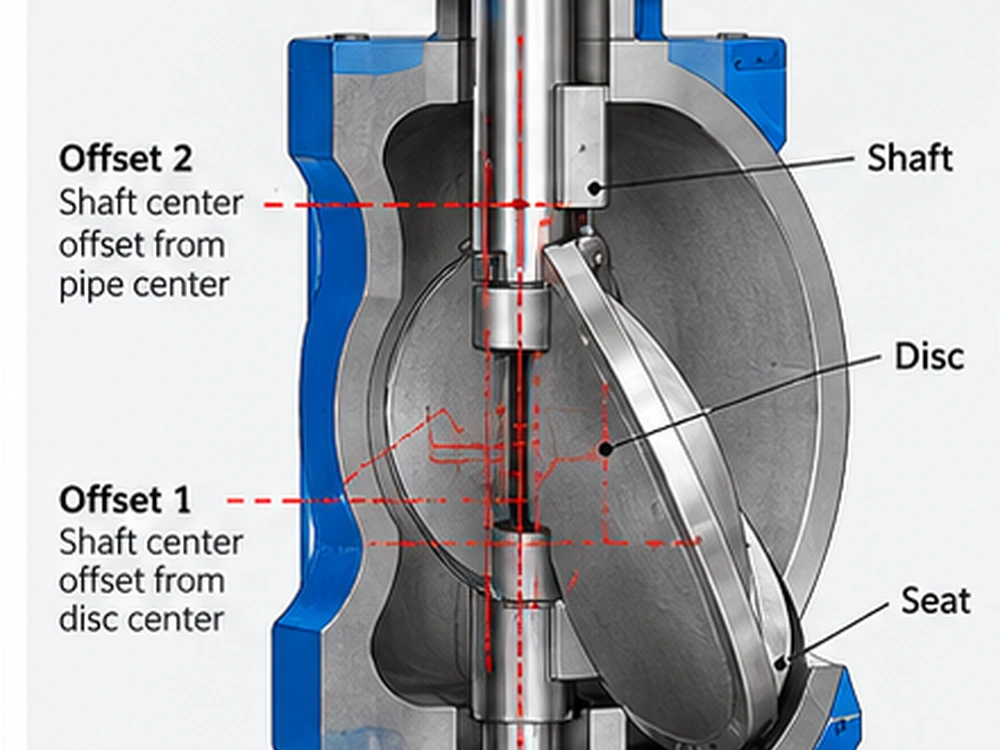
That movement can reduce sliding contact and wear, particularly in larger valves that operate regularly. The benefit depends on the specific geometry, seat construction, bearing alignment and differential pressure. It does not eliminate seating torque or guarantee long life when sand, shells or biological deposits become trapped at the seal.
2. Position in the Pump Station Determines the Duty
Before selecting a body material or actuator, identify the valve tag on the piping and instrumentation diagram (P&ID). The same nominal valve may be exposed to different operating and emergency loads depending on where it is installed.
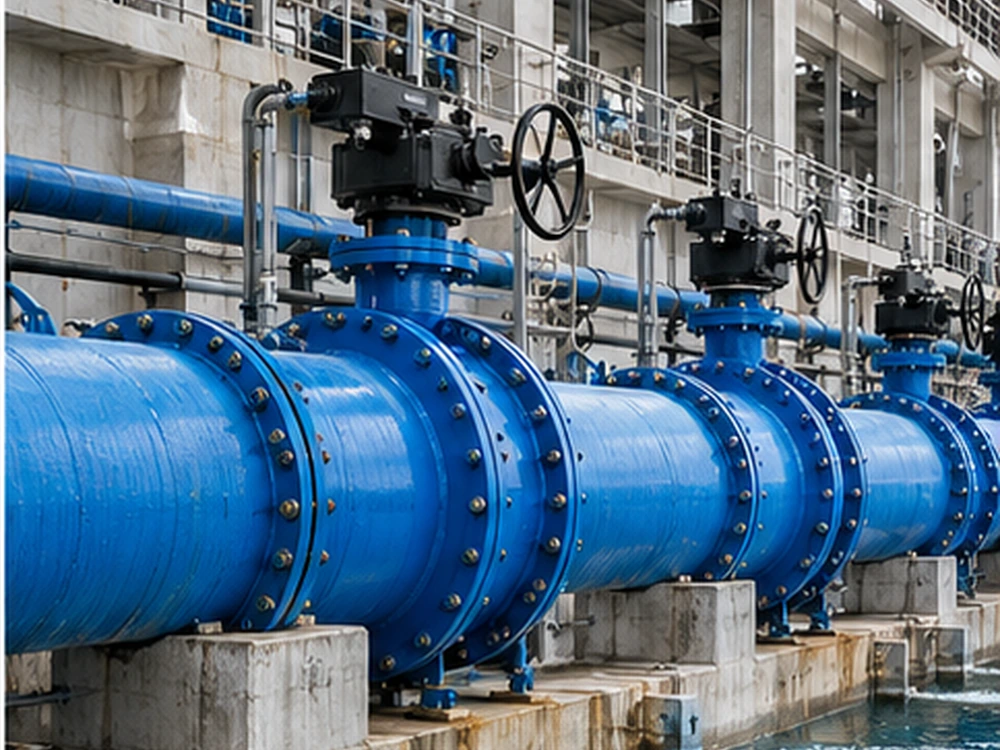
| Position | Primary function | Critical engineering check |
|---|---|---|
| Intake header | Sectional isolation | Sea-level variation, debris and full-line differential pressure |
| Pump suction | Maintenance isolation | Head loss, disc clearance and available NPSH |
| Pump discharge | Isolation for pump or check-valve maintenance | Maximum shut-off ΔP and closure sequencing |
| Common transfer header | Operational isolation | Flow velocity, surge loading and controlled closing time |
3. Pressure Rating Is Not the Same as Shut-Off Differential Pressure
For a large butterfly valve, PN10 or PN16 alone is not an actuator-sizing specification. Nominal pressure designation describes a rating framework; actual allowable conditions depend on the valve design, material, temperature and governing standard. The actuator must operate against the maximum credible pressure difference across the closed or moving disc.
Calculate that pressure difference from realistic conditions: upstream and downstream water levels, maximum pump shut-off head, valve placement, simultaneous pump operation and specified surge cases. At large diameters, even a modest pressure difference generates a substantial net hydraulic force. Disc shape, offset, opening angle and pressure direction determine the resulting torque rather than area alone.
Request torque curves for opening, closing and seating in both pressure directions where relevant. Confirm whether the seat is unidirectional or bidirectional, and record the preferred pressure direction on the drawing and installation instructions. An arrow on the casting should not be interpreted as proof of equivalent shut-off performance in both directions.
4. Material Selection for Chloride-Rich Raw Seawater
Corrosion protection must cover the entire wetted assembly, including small areas exposed when the valve opens. Materials should be selected according to actual salinity, temperature, oxygenation, stagnant periods, fouling, cleaning chemicals and design life. A bare stainless steel designation does not demonstrate suitability for continuous seawater exposure.
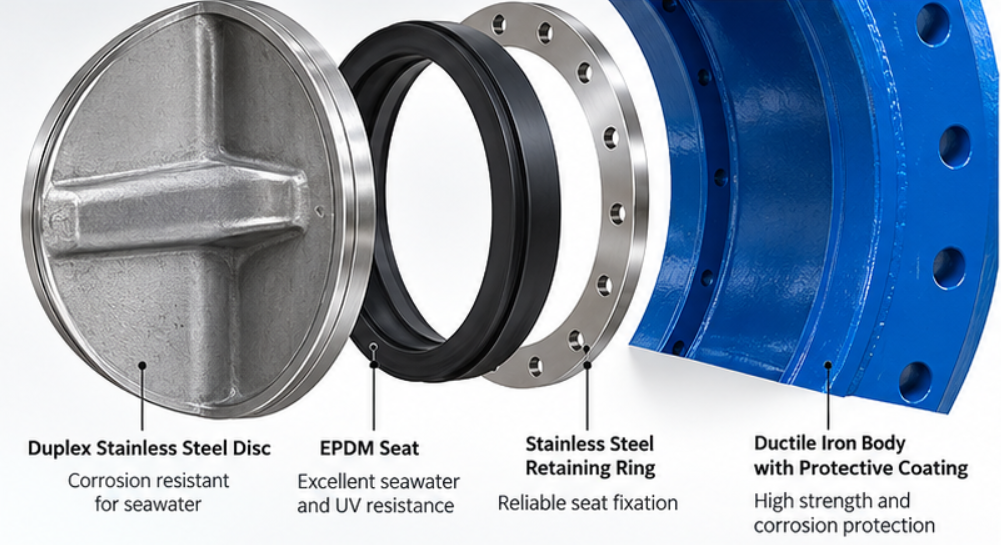
| Component | Candidate specification | What to verify |
|---|---|---|
| Body | Ductile iron with qualified lining/coating; alternative approved alloy | Coating continuity, edge protection, external marine exposure |
| Disc | Coated ductile iron, nickel-aluminium bronze or qualified duplex alloy | Exposed edges, erosion, crevice conditions and galvanic pairing |
| Shaft and pins | Project-qualified duplex or other corrosion-resistant alloy | Pitting, crevice corrosion, strength and galvanic compatibility |
| Resilient seal | Water-grade EPDM or approved alternative | Chemical exposure, temperature, hardness and replaceability |
| Seat ring / retainer | Suitable corrosion-resistant alloy or approved protected assembly | Localised corrosion at fasteners and seal crevices |
| Bearings and bolting | Approved polymer/metal bearing and marine-grade fasteners | Wear, seizure, isolation and accessibility |
For raw seawater, ordinary 304 stainless steel should not be the default disc or shaft recommendation. Grade 316 may also experience localised attack in stagnant, creviced seawater. Duplex or super-duplex stainless steel, nickel-aluminium bronze and coated substrates may be considered subject to detailed engineering. Their suitability cannot be inferred from the alloy name alone. Read Seawater Valve Corrosion: Body, Disc, Shaft and Seat Materials for component-level selection.
5. EPDM Seal, Coating and Marine Maintenance
EPDM is a common starting point for water-service resilient seats, but the exact compound must be approved for the project fluid and temperature. Biofouling, sand, silt and shells can damage a seat even when the elastomer is chemically compatible. For a large valve, a field-replaceable seat can reduce lifecycle costs provided there is sufficient access and a documented replacement procedure.
Where ductile iron is selected, specify a complete internal and external protective coating system. Identify coating type, nominal dry-film thickness, surface preparation, inspection and holiday-test requirements where applicable. Protect flange edges, coating transitions, retaining hardware and shaft penetrations. AWWA C550 provides a useful waterworks coating reference, but suitability for seawater must be expressly confirmed in the project specification.
6. Electric, Hydraulic or Pneumatic Actuation?
The appropriate actuator depends on torque demand, operating frequency, site utilities, emergency action and plant controls. Electric actuators are often convenient for scheduled isolation and integration with SCADA; hydraulic systems may be appropriate where very high torque or managed emergency closure is required. Pneumatic systems can be used where air supply and actuator capacity are sufficient, but a very large bore demands careful feasibility assessment.
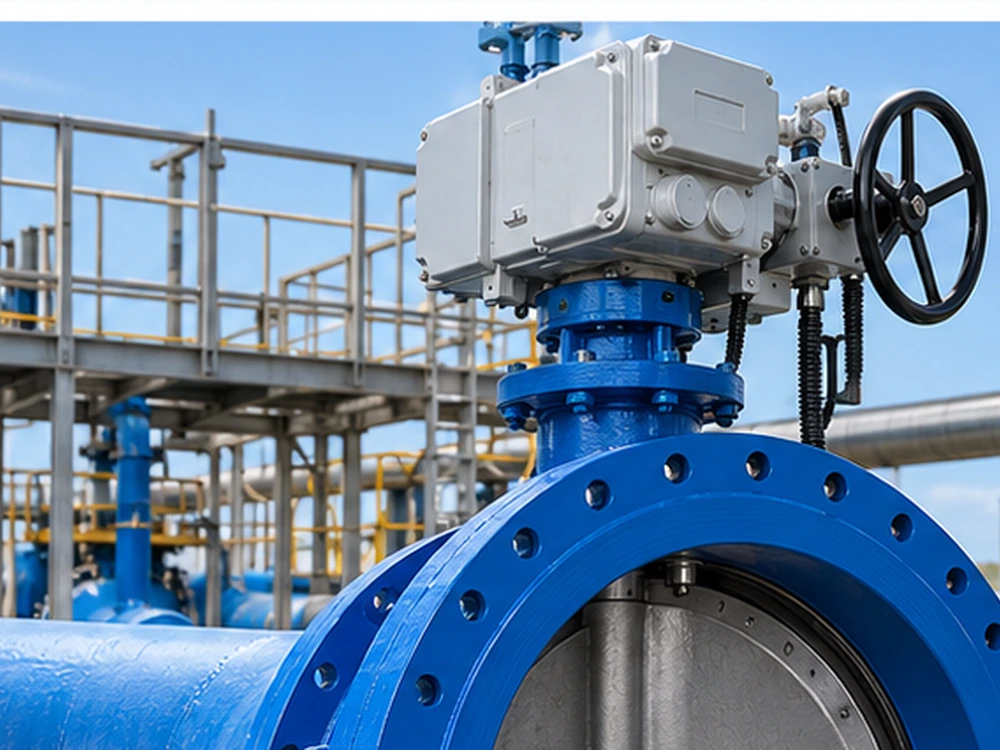
| Drive type | Typical advantage | Design limitation |
|---|---|---|
| Electric with gearbox | Remote operation, local controls and position feedback | Power loss response, torque capacity and closing profile |
| Hydraulic power unit | High-torque capability and configurable operating sequence | Oil management, redundancy, maintenance and leakage risk |
| Pneumatic | Fast response where compressed air is available | Air consumption, actuator size and overspeed risk |
| Manual gearbox | Simple local backup on suitable sizes | Operating time and impracticality for some large loads |
Specify the complete required torque envelope: breakaway, running, hydrodynamic, seating and maximum abnormal-condition torque, with a documented design margin. Include operating voltage or air/oil pressure, enclosure protection, local manual override, open/closed limit switches, torque protection and communications requirements. Do not select an actuator merely from a catalogue’s nominal torque without matching the output torque against valve demand throughout the stroke.
7. Pump Trips, Water Hammer and Emergency Closure
A common misconception is that an emergency isolation valve should always close as fast as possible. Rapid closure of a large seawater main can create unacceptable pressure transients; very slow closure may also conflict with process protection. The correct stroke time and any staged closing profile must follow a system-level transient study.
Assess pump trip, power failure, simultaneous pump shutdown, check-valve behaviour, air entrainment and possible flow reversal. An actuator’s fail-close, fail-open or fail-in-place mode is a project decision, not a universal rule. An electric actuator normally requires a specified backup system to move after total power loss; a hydraulic or spring-return solution also needs a complete energy-storage and control review.
8. Which Standards Apply to a Double Eccentric Butterfly Valve?
The project must identify its governing valve design, dimensional, flange, testing and coating standards. AWWA’s published standards list includes C504 for rubber-seated butterfly valves and C516 for large-diameter rubber-seated valves of 2,000 mm and above. Note that these waterworks standards describe defined water-service conditions; compliance alone does not establish seawater corrosion suitability. Large-bore designs require project-specific interpretation of the applicable standard and explicit additional seawater requirements.
EN 593, EN 558, EN 1092 and EN 12266 may be relevant in European-specification projects, depending on their individual scope and the valve configuration. Check standard size limits and the precise contractual edition. In particular, do not presume that ASME B16.5 covers very large flanges: large-diameter projects may use ASME B16.47 or engineered flange connections where permitted.
9. Factory Testing and Site Acceptance
For a large-diameter, actuated butterfly valve, dimensional and functional checks are as important as the nominal leakage specification. Obtain an approved general arrangement drawing before manufacture, including face-to-face length, flange drilling, disc swing clearance, seat orientation, actuator mounting and maintenance envelope.
A useful inspection and test plan includes material traceability, coating/lining checks, shaft and seat assembly inspection, shell testing, seat leakage testing in the specified pressure direction or directions, full-stroke operation and actuator limit/torque setting verification. Witness and hold points should be agreed before production. Leak-testing pressure, duration and acceptance criteria must come from the selected standard and contract, not be assumed from generic marketing figures.
10. RFQ Checklist for EPC Engineers and Valve Buyers
| RFQ field | Information to provide |
|---|---|
| Duty | Suction, discharge, header isolation; P&ID tag; required fail action |
| Size / connection | DN/NPS, flange standard, facing, drilling, face-to-face and orientation |
| Hydraulics | Flow range, head loss limit, design pressure, shut-off ΔP and surge cases |
| Medium | Salinity/chloride, temperature, suspended solids, biofouling and cleaning agents |
| Valve construction | Double offset, seat location, pressure direction, leakage class and maintenance access |
| Materials | Body, coating, disc, shaft, seat, bearings, bolts and galvanic control |
| Actuator | Power/utility, torque curve, stroke time, duty, controls, override and IP rating |
| Documentation | GA, datasheet, MTC, ITP, coating reports, pressure-test records and manuals |
Suggested enquiry: “Please propose a double eccentric, double-flanged butterfly valve for the seawater intake pump-station duty shown on the attached P&ID. Quote the complete wetted-material schedule, recommended lining and seat construction, allowable sealing direction, maximum operating differential pressure, valve torque curve, actuator sizing basis and test documentation. Confirm all deviations from our flange, face-to-face and emergency closure requirements.”
Conclusion: Specify a Working Assembly, Not Just a Valve Body
Double eccentric butterfly valves can offer efficient large-bore isolation in seawater intake and pump-station service, but successful operation depends on disc geometry, wetted materials, coating quality, differential pressure and actuator behaviour as one system. Confirm the hydraulic and corrosion design before accepting a nominal DN/PN-based quotation. Vcore can review project-specific configurations when supplied with a P&ID, design datasheet and relevant drawings.
Frequently Asked Questions
What is the benefit of a double eccentric butterfly valve in seawater service?
Its offset geometry can reduce sliding contact between the disc and seat during operation, potentially reducing wear. Seawater suitability still depends on the complete wetted materials, protective coating and seat design.
Is a double eccentric butterfly valve bidirectional?
Not necessarily. Bidirectional sealing depends on the particular seat and disc design and its qualified differential-pressure rating. Confirm the allowable sealing direction and leakage requirement with the manufacturer.
Can a ductile iron butterfly valve be used for raw seawater?
It may be suitable when a qualified lining or coating isolates the substrate and all exposed wetted parts are specified for seawater. Inspect flange edges, shaft penetrations, fasteners and coating continuity.
Is EPDM suitable for seawater butterfly valve seats?
EPDM is often considered for water-service seals, but the specific formulation must be checked against seawater chemistry, operating temperature, suspended solids, cleaning agents and service life.
Should a seawater pump-station isolation valve fail closed?
There is no universal fail position. Fail-close, fail-open or fail-in-place must be selected from the plant safety philosophy, pump-trip scenarios and hydraulic transient study.
How should the actuator for a large butterfly valve be sized?
Use the manufacturer’s valve torque curve across the complete stroke under the worst specified differential pressure, including breakaway, running, seating and abnormal loads. Apply the approved engineering margin and verify the actuator’s output torque at the available supply conditions.
Does AWWA C516 approval automatically qualify a valve for seawater?
No. AWWA C516 covers large-diameter rubber-seated waterworks butterfly valves within its defined scope. Seawater corrosion protection, wetted materials and project-specific operating conditions require separate verification.