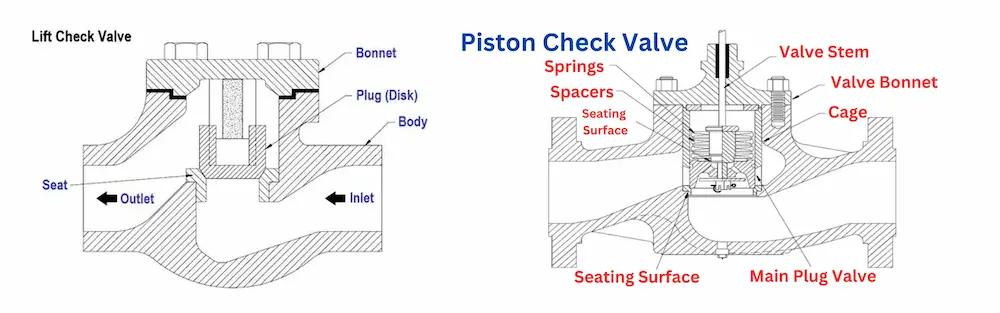
Lift check valve vs piston check valve selection is important in industrial pipelines where backflow prevention, pressure performance, sealing reliability, installation direction, and flow stability matter. Both valves are automatic non-return valves, but their internal structures and application suitability are not identical.
A lift check valve uses a disc that moves vertically away from the seat when forward flow is strong enough. A piston check valve uses a piston-shaped closure element that moves inside a guide. This guided movement can improve stability in selected high-pressure or high-temperature services, but it also requires clean media and suitable flow conditions.
For industrial buyers, the correct choice depends on pressure, temperature, medium cleanliness, flow velocity, installation direction, pressure drop, sealing requirement, maintenance access, and project standard. For a broader overview of check valve types and selection logic, read our main guide on industrial check valves.
What Is a Lift Check Valve?
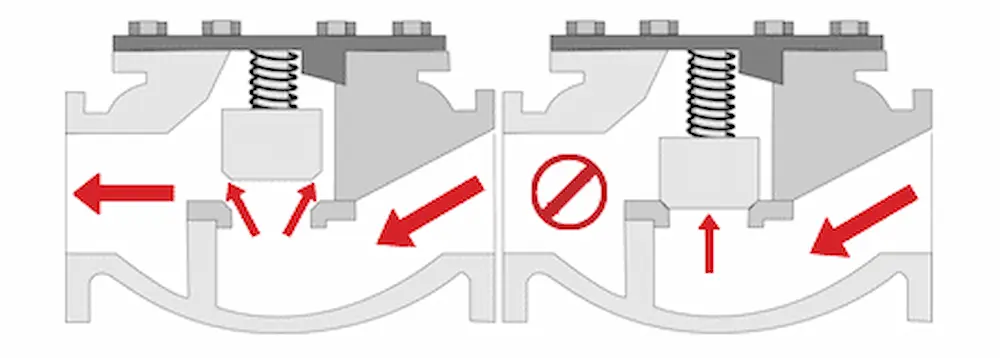
A lift check valve is a non-return valve that prevents reverse flow by using a disc that lifts from the seat under forward flow. When the medium flows in the correct direction, the disc moves upward and allows flow to pass. When flow stops or reverses, the disc returns to the seat and blocks backflow.
Lift check valves are commonly used in clean liquid, gas, steam, and high-pressure industrial applications. They are often selected where good sealing and compact internal movement are required. However, they usually need sufficient flow velocity to lift the disc properly and should be installed according to the manufacturer’s recommended direction.
For compact industrial backflow prevention, buyers may review a wafer lift type check valve. For high-pressure service, a lift and vertical lift check valve may be considered depending on pressure, temperature, and installation conditions.
Key Features of Lift Check Valves
- Disc lifts vertically from the seat under forward flow
- Compact internal movement
- Suitable for clean liquid, gas, and selected steam service
- Can provide reliable seating when correctly selected
- Often used in high-pressure or high-temperature pipelines
- Requires suitable flow velocity to open fully
- Not ideal for dirty media, slurry, or heavy solids unless specially designed
What Is a Piston Check Valve?
A piston check valve is a check valve that uses a piston-like closure element guided inside the valve body. When forward flow is sufficient, the piston lifts away from the seat. When flow decreases or reverses, the piston returns to the seat and prevents backflow.
The main characteristic of a piston check valve is guided closure movement. Compared with a simple lift disc, the piston structure can provide more controlled movement in selected high-pressure, high-temperature, steam, gas, and clean fluid systems. However, because the piston moves inside a guide, the valve is more sensitive to dirt, scale, sticky media, and suspended solids.
Key Features of Piston Check Valves
- Piston-type closure element guided inside the valve body
- Stable guided movement when media is clean
- Suitable for selected high-pressure and high-temperature applications
- Common in steam, gas, oil, and clean process fluid systems
- Good seating performance when properly machined and maintained
- More sensitive to dirt, scale, and deposits than many open-disc designs
- Requires careful material and clearance selection
Lift Check Valve vs Piston Check Valve: Core Difference Table
| Comparison Factor | Lift Check Valve | Piston Check Valve |
|---|---|---|
| Closure Element | Disc lifts from the seat | Piston-like closure element moves inside a guide |
| Movement Style | Vertical lift movement | Guided piston movement |
| Best Media | Clean liquids, gas, steam, selected process fluids | Clean gas, steam, oil, and high-pressure fluids |
| Pressure Suitability | Suitable for selected medium and high-pressure applications | Often used where guided closure is preferred in high-pressure service |
| Dirty Media Tolerance | Limited; depends on design | Usually more sensitive to dirt, scale, and sticky media |
| Pressure Drop | Can be higher than swing check valves due to flow path | Can also be higher because of guided internal structure |
| Installation Direction | Must follow valve design and flow direction requirements | Must follow design; horizontal and vertical suitability must be confirmed |
| Main Buyer Risk | Disc chatter, incomplete opening, wrong installation direction | Piston sticking, fouling, excessive pressure drop, wrong clearance/material |
How a Lift Check Valve Works
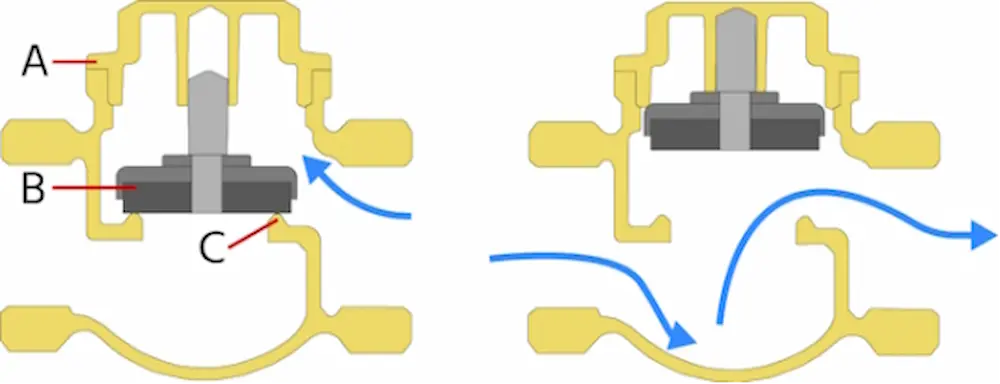
A lift check valve operates through pressure difference. When forward flow pressure is greater than the disc weight and any spring force, the disc lifts from the seat. The medium passes through the valve body. When forward flow weakens, stops, or reverses, the disc returns to the seat and prevents backflow.
This simple movement can provide reliable backflow prevention in clean service. However, if flow velocity is too low, the disc may not fully lift. A partially lifted disc can cause noise, vibration, pressure loss, and seat wear.
Lift check valves are often more sensitive to flow velocity than swing check valves. Buyers should confirm minimum flow rate, pressure drop, and installation direction before ordering.
How a Piston Check Valve Works
A piston check valve works in a similar non-return principle, but the closure element is piston-shaped and guided by the valve body or guide structure. Forward flow lifts the piston away from the seat. When flow decreases or reverses, the piston moves back to the seat.
The guided piston movement can help maintain alignment between the closure element and the seat. This is useful in selected high-pressure or high-temperature applications where stable seating and controlled movement are important.
However, the guide clearance must remain clean and free-moving. If the medium contains rust, scale, solids, crystallized chemicals, sticky deposits, or heavy contamination, the piston may stick or move slowly. This can cause leakage, delayed closing, or operational failure.
Pressure and Temperature Performance
Lift check valves and piston check valves are both commonly used in pressure services, but their actual pressure and temperature suitability depends on body material, pressure class, seat design, trim material, gasket material, and applicable valve standard.
Piston check valves are often selected in systems where guided closure movement is preferred, especially in high-pressure steam, gas, oil, or clean industrial services. Lift check valves can also be used in high-pressure pipelines when the design, material, and installation are suitable.
Buyers should not choose by name alone. A valve called “lift check valve” or “piston check valve” may be supplied in different materials, pressure classes, end connections, and internal designs. Always confirm datasheet, drawing, pressure rating, test standard, and material certificate.
Pressure Drop and Flow Resistance
Compared with some swing check valves, lift and piston check valves may create higher pressure drop because the flow path changes direction or passes through a more restricted internal area. The actual pressure drop depends on valve size, body pattern, disc or piston geometry, flow velocity, and whether the closure element is fully open.
If flow is too low, the disc or piston may not lift fully. This can increase pressure loss and cause vibration or noise. For pump systems, excessive pressure drop can reduce efficiency. For gas and steam systems, flow restriction may affect process performance.
Before selecting either valve, buyers should provide normal, minimum, and maximum flow rates. The supplier can then review whether the valve will open fully and operate stably.
Installation Direction
Installation direction is very important for both lift check valves and piston check valves. Some designs are intended for horizontal pipelines. Some may be used in vertical upward flow. Vertical downward flow is usually more difficult and must be confirmed carefully.
A lift check valve depends on proper disc movement relative to the seat. If installed incorrectly, the disc may not return properly or may not open fully. A piston check valve also requires correct orientation so the piston can move freely inside the guide.
For general check valve installation guidance, read our guide on whether a check valve can be installed vertically.
Sealing Performance
Sealing performance depends on seat design, machining quality, closure alignment, material, pressure differential, and medium condition. Lift check valves can provide good sealing when the disc and seat are properly machined and the medium is clean.
Piston check valves may also provide stable seating because the piston is guided. However, if particles or deposits enter the guide or seat area, leakage or sticking may occur. Clean media is especially important for reliable piston check valve operation.
Seat Material Options
- Metal seat for high-temperature and severe service
- Stainless steel seat for corrosion resistance and durability
- PTFE seat for selected chemical resistance and tighter sealing
- EPDM or NBR soft seat for selected water or utility applications
- Hardfaced seat for high-wear or high-temperature applications
Application Comparison
| Application | Recommended Direction | Reason |
|---|---|---|
| High-pressure clean liquid pipeline | Lift check valve or piston check valve | Selection depends on pressure, flow rate, and seating requirement |
| Steam service | Often piston or lift check valve | High temperature and stable seating must be reviewed |
| Gas service | Piston or lift check valve | Clean gas and pressure conditions may suit guided closure designs |
| Dirty wastewater or slurry | Usually not preferred | Solids may cause sticking, wear, or leakage |
| Compact high-pressure piping | Lift check valve | Compact body and vertical disc movement can be useful |
| Oil or clean process fluid | Piston check valve may be considered | Guided piston movement can support stable operation if media is clean |
| Low-flow pipeline | Careful review required | Disc or piston may not fully open, causing chatter and pressure loss |
Material and Trim Selection
Material selection is critical because lift and piston check valves often operate in demanding pressure or temperature conditions. Buyers should confirm not only body material, but also disc, piston, guide, seat, gasket, spring if any, and bolting materials.
| Component | Common Options | Buyer Notes |
|---|---|---|
| Body | Carbon steel, stainless steel, alloy steel, forged steel | Select by pressure, temperature, corrosion risk, and project standard |
| Disc / Piston | Stainless steel, alloy steel, hardfaced trim | Must resist impact, wear, corrosion, and temperature |
| Guide | Stainless steel, alloy, hardfaced surfaces | Important for piston movement and anti-sticking performance |
| Seat | Metal, hardfaced metal, PTFE, soft seat in selected conditions | Affects leakage performance and temperature suitability |
| Gasket | Graphite, PTFE, spiral wound, metal gasket | Must match pressure, temperature, and flange standard |
| Bolting | Carbon steel, stainless steel, alloy bolting | Must match pressure class, temperature, and corrosion environment |
Common Selection Mistakes
Mistake 1: Using Piston Check Valves in Dirty Media Without Review
Piston check valves need free movement inside the guide. Dirty media, rust, scale, slurry, or sticky fluids may cause the piston to stick or close slowly.
Mistake 2: Ignoring Minimum Flow Rate
Lift and piston check valves require enough forward flow to lift the closure element fully. Low flow can cause chatter, vibration, pressure loss, and seat wear.
Mistake 3: Assuming Vertical Installation Is Always Acceptable
Installation direction must be confirmed by valve design. Incorrect orientation can prevent proper opening or closing.
Mistake 4: Selecting Only by Pressure Class
Pressure class is important, but it is not enough. Medium, temperature, flow velocity, seat material, trim design, and installation direction also matter.
Mistake 5: Ignoring Pressure Drop
Lift and piston check valves may create higher flow resistance than some other check valve types. Buyers should confirm pressure drop before selection.
Mistake 6: Ignoring Maintenance Access
Piston and lift check valves may require inspection of disc, piston, guide, seat, and gasket surfaces. Maintenance access should be planned before installation.
How to Choose Between Lift and Piston Check Valves
| Selection Question | If Yes | Likely Direction |
|---|---|---|
| Is the medium clean? | No solids, scale, or sticky deposits | Lift or piston check valve may be suitable |
| Is guided closure important? | Stable piston movement and seating are required | Piston check valve |
| Is the system high-pressure or high-temperature? | Steam, gas, oil, or power service | Lift or piston design review |
| Is the flow rate low or unstable? | Closure element may not fully open | Careful review required |
| Is the medium dirty or contains solids? | Sticking or clogging risk exists | Consider other check valve types |
| Is pressure drop sensitive? | Energy efficiency or process flow is important | Compare Cv / flow coefficient data |
Information Buyers Should Provide Before Quotation
- Valve size and pipeline size
- Required valve type: lift check valve, vertical lift check valve, or piston check valve
- Medium name and cleanliness condition
- Whether the medium contains solids, scale, or sticky deposits
- Operating pressure and design pressure
- Operating temperature and maximum temperature
- Normal, minimum, and maximum flow rate
- Installation direction: horizontal, vertical upward, or vertical downward
- Connection type: flanged, welded, threaded, or wafer
- Body material and trim material requirements
- Seat material and leakage requirement
- Pressure drop or Cv requirement if available
- Required testing standard, drawing, datasheet, certificates, and documentation
Related Check Valve Guides
For broader check valve selection and installation details, these related guides may help:
- Industrial Check Valves: Types, Applications and Selection Guide — main guide for check valve types, backflow prevention, materials, and selection logic.
- Wafer Check Valve vs Flanged Check Valve — compares connection style, face-to-face length, installation space, and maintenance access.
- Can a Check Valve Be Installed Vertically? — explains vertical installation, flow direction, and valve type suitability.
- Check Valve Product Range — compare lift, vertical lift, swing, spring, wafer, dual plate, nozzle, and other industrial check valve options.
Final Recommendations for Industrial Buyers
A lift check valve is usually suitable for clean fluid, gas, steam, and selected high-pressure pipelines where vertical disc movement and reliable seating are required. It can be a practical choice when the flow condition is stable and the installation direction is correct.
A piston check valve is usually selected when guided closure movement is important, especially in selected high-pressure, high-temperature, steam, gas, oil, and clean process fluid systems. However, it should not be used casually in dirty, sticky, scaling, or slurry service because the piston may stick or wear.
If you need help choosing between lift check valves and piston check valves for steam, gas, oil, clean liquid, high-pressure pipelines, power plants, chemical utility systems, or industrial process service, Vcore Valve can review your working conditions and recommend a suitable check valve configuration. Buyers can also compare available options in our check valve category.
For industrial sourcing, the key question is not only “lift or piston?” The better question is: “Which check valve structure can open fully, close reliably, seal properly, and avoid sticking under this exact pressure, temperature, medium, and flow condition?”
FAQ
1. What is the difference between a lift check valve and a piston check valve?
A lift check valve uses a disc that lifts from the seat under forward flow. A piston check valve uses a piston-like closure element guided inside the valve body for more controlled movement.
2. When should I choose a lift check valve?
Choose a lift check valve for clean liquids, gas, steam, and selected pressure applications where the flow is stable and the valve can be installed in the correct direction.
3. When should I choose a piston check valve?
Choose a piston check valve when guided closure movement is required in clean high-pressure, high-temperature, steam, gas, oil, or process fluid service.
4. Can piston check valves be used for dirty media?
Piston check valves are generally not preferred for dirty media, slurry, scaling service, or sticky fluids because particles and deposits may cause the piston to stick.
5. Which valve has lower pressure drop?
Pressure drop depends on valve size, body design, flow rate, and internal geometry. Buyers should compare actual pressure drop or Cv data instead of assuming one type is always lower.