Quick Summary
Choosing between a wafer vs lug butterfly valves may seem straightforward, but the wrong choice can lead to installation issues, maintenance difficulties, or even system downtime. In this guide, Vcore Valve explains the structural differences, working principles, advantages, and ideal applications of each type—helping engineers and buyers make confident, cost-effective decisions.
Opening Scenario: A Common Site Question
“Can we isolate one side of the pipeline without shutting down the whole system?”
This is often the moment when engineers realise that the butterfly valve style matters just as much as its size or pressure rating. Wafer and lug designs may look similar, but their real-world behaviour is very different.
User Pain Points
Pain Point 1: Confusion Between Wafer and Lug Designs
Many buyers assume both styles are interchangeable, which is not always true.
Pain Point 2: Installation and Maintenance Limitations
Choosing the wrong style can complicate pipeline disassembly or maintenance.
Pain Point 3: Cost vs Function Trade-Off
Paying for features that are not required—or worse, lacking critical ones.
Solutions & Recommendations
Solution 1: Understand Structural Differences
Design determines how the valve interacts with the pipeline.
Solution 2: Match Valve Style to System Requirements
Isolation needs, pressure, and maintenance access should guide selection.
Solution 3: Consult Experienced Valve Manufacturers
At Vcore Valve, valve type selection is aligned with application, not guesswork.
What Is a Wafer Style Butterfly Valve?
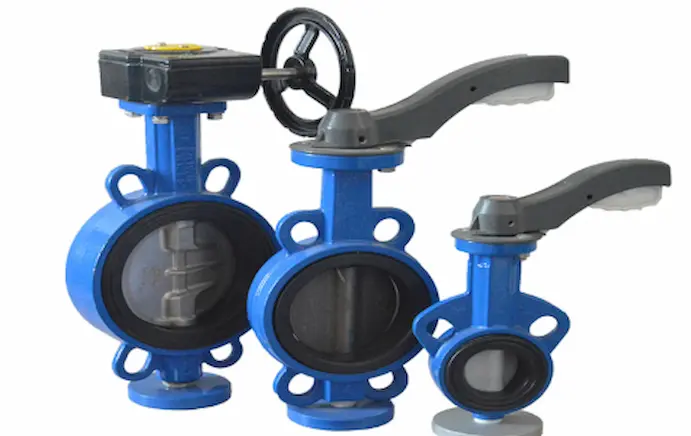
A wafer type butterfly valve is designed to fit snugly between two pipe flanges. It is held in place by bolts passing through the flanges, compressing the valve body in between.
Key Characteristics:
-
Lightweight and compact
-
Cost-effective
-
Simple installation
-
Cannot isolate one side of the pipeline
Typical Applications:
-
Water treatment
-
HVAC systems
-
Low to medium pressure services
What Is a Lug Style Butterfly Valve?
A lug type butterfly valve features threaded lugs around the valve body. Bolts screw directly into these lugs, allowing the valve to be mounted without nuts.
Key Characteristics:
-
Stronger body support
-
Allows end-of-line service
-
Easier pipeline isolation
-
Slightly higher cost
Typical Applications:
-
Industrial process lines
-
Systems requiring frequent maintenance
-
Dead-end service conditions

Wafer vs Lug Butterfly Valves: Technical Comparison
| Feature | Wafer Style | Lug Style |
|---|---|---|
| Installation | Between flanges | Bolted to flanges |
| Pipeline Isolation | No | Yes |
| Weight | Lighter | Heavier |
| Cost | Lower | Higher |
| Maintenance Flexibility | Limited | Excellent |
| End-of-Line Service | Not recommended | Suitable |

Case Studies & Practical Examples
Case 1: HVAC System Optimisation
A wafer butterfly valve was selected for a closed-loop HVAC system, reducing installation cost without compromising performance.
Case 2: Industrial Process Line
A lug butterfly valve enabled one side of the pipeline to be serviced while the rest of the system remained operational—minimising downtime.
Data, Performance & Engineering Considerations
From an engineering standpoint, lug-style valves distribute mechanical loads more evenly across the body. This reduces flange stress and improves long-term sealing reliability, especially in larger diameters.
Wafer valves, however, remain highly efficient where isolation is not required.
Market Trends & Industry Insights
-
Increasing use of lug valves in modular process plants
-
Continued demand for wafer valves in cost-sensitive projects
-
Growth in resilient-seated butterfly valves for water applications
Manufacturers are also focusing on lighter, stronger body designs to improve handling and installation efficiency.
Style & Usage Recommendations
Choose a wafer butterfly valve if:
-
Cost efficiency is critical
-
System shutdown is acceptable
-
Space and weight matter
Choose a lug butterfly valve if:
-
Pipeline isolation is required
-
Maintenance access is frequent
-
End-of-line service is needed
Conclusion
Both wafer and lug style butterfly valves have their place—but only when used correctly. Understanding their differences ensures safer systems, easier maintenance, and better long-term performance.
👉 Contact Vcore Valve to discuss the right butterfly valve solution for your application.
FAQs
Q1: What is the main difference between wafer and lug butterfly valves?
Wafer valves are clamped between flanges, while lug valves are bolted directly using threaded lugs.
Q2: Can a wafer butterfly valve be used for end-of-line service?
No, wafer valves are not designed for end-of-line isolation.
Q3: Are lug butterfly valves more expensive?
Yes, due to additional material and machining.
Q4: Which type is easier to maintain?
Lug style butterfly valves offer better maintenance flexibility.
Q5: Do both types offer the same sealing performance?
Sealing depends more on seat design than valve style, assuming correct installation.