The Decision in Brief
A valve needs immediate replacement when it can no longer provide safe pressure containment, dependable isolation, or controlled movement, and a normal repair cannot restore those functions with confidence. Packing, gaskets, soft seats, and actuator accessories may still be repairable. Cracked pressure parts, severe wall loss, repeated shutoff failure, unavailable spares, and recurring downtime usually make replacement the more defensible decision.
Repair or Replace: Read the Evidence
The same symptom can lead to different decisions. A small packing leak on a low-risk water line may justify a planned repair. Leakage from a body casting on hot, corrosive, or hazardous service can justify immediate isolation and replacement. The useful question is not simply, “Is the valve leaking?” It is, “Can this valve be returned to a trustworthy condition for its actual duty?”
| Evidence | Repair remains credible when | Replacement is stronger when |
|---|---|---|
| External leakage | The source is confirmed at accessible packing or a replaceable gasket | Leakage comes from the body, bonnet, weld end, flange damage, or a cracked pressure part |
| Seat leakage | Soft seats or trim are available and the body and closure parts remain serviceable | The valve repeatedly fails isolation tests or damaged sealing surfaces cannot be restored economically |
| Corrosion or erosion | Measured wall thickness remains acceptable and damage is limited to replaceable trim | Deep pitting, uncertain wall thickness, cavitation, or erosion affects the pressure boundary |
| Torque or travel | Calibration, lubrication, packing adjustment, or an actuator accessory resolves the problem | Torque continues to rise, the stem or shaft is damaged, or the valve cannot complete a safe stroke |
| Repair history | The failure is isolated and the service condition has not changed | The same tag repeatedly consumes seats, packing, gaskets, labor, and shutdown time |
| Parts and traceability | Correct parts and material records are available | Obsolete parts, uncertain metallurgy, or missing records prevent a controlled repair |
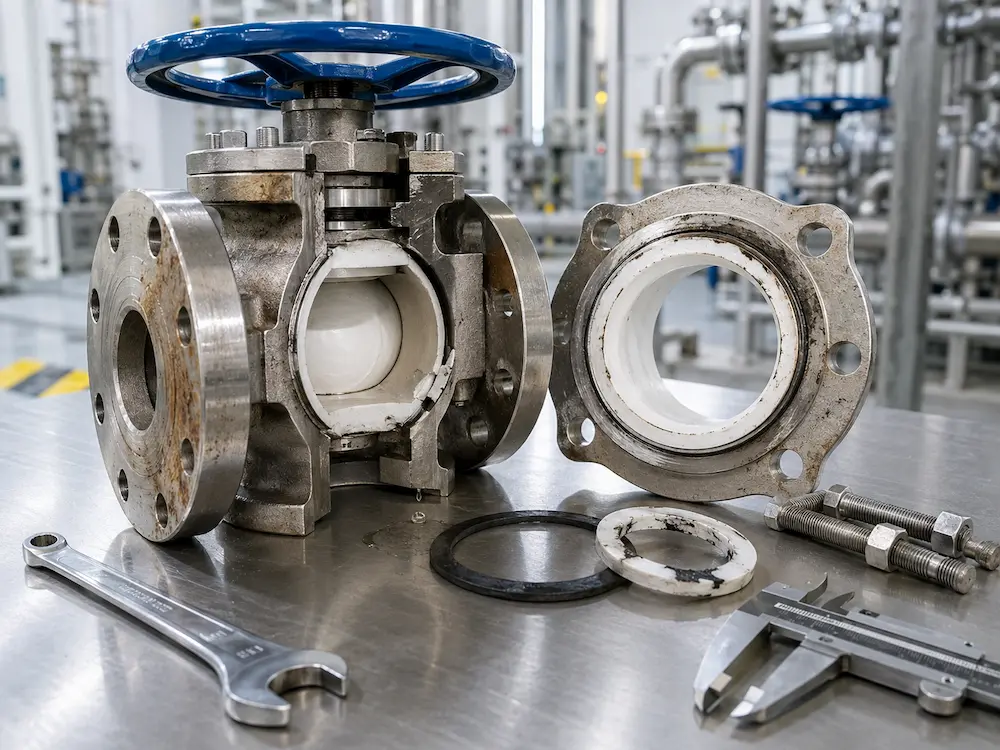
When a valve needs immediate replacement, preserve the failed parts, test results, and close photos before disposal; this evidence helps the supplier correct the root cause. If the failure mode is still uncertain, begin with valve problem analysis. For leakage, compare the observed symptom with valve sealing performance, because external pressure-boundary leakage and internal seat leakage carry different risks.
Failure Consequence Changes the Answer
A repair decision must reflect what the valve protects. Failure on a cooling-water bypass may reduce efficiency. Failure on a steam isolation valve can expose people to stored energy. Failure on a chemical drain can create an environmental release. Failure on an emergency shutdown valve can defeat a safety function even when the valve looks acceptable from outside.
When a valve needs immediate replacement, the urgency should come from the consequence of failure rather than from a generic age limit. Before choosing repair, record the consequence of three events: failure to close, failure to open, and loss of pressure containment. Then consider whether a wider shutdown, temporary bypass, or standby valve can control the risk. This consequence-based view prevents both premature replacement and false economy.
For plants operating formal safety programs, inspection records and management of change should support the decision. The OSHA guidance on process safety management explains why equipment condition and documented changes matter in high-hazard service.
What Each Failure Pattern Means
Leakage that returns after a correct repair
Recurring leakage is more important than one maintenance event. If new packing, gaskets, or seats fail again under the same operating conditions, investigate stem finish, gland alignment, flange distortion, thermal cycling, vibration, pressure differential, and media compatibility. Repeating the same repair without correcting the cause only moves cost into the next shutdown.
Wall loss, cracking, and pressure-boundary damage
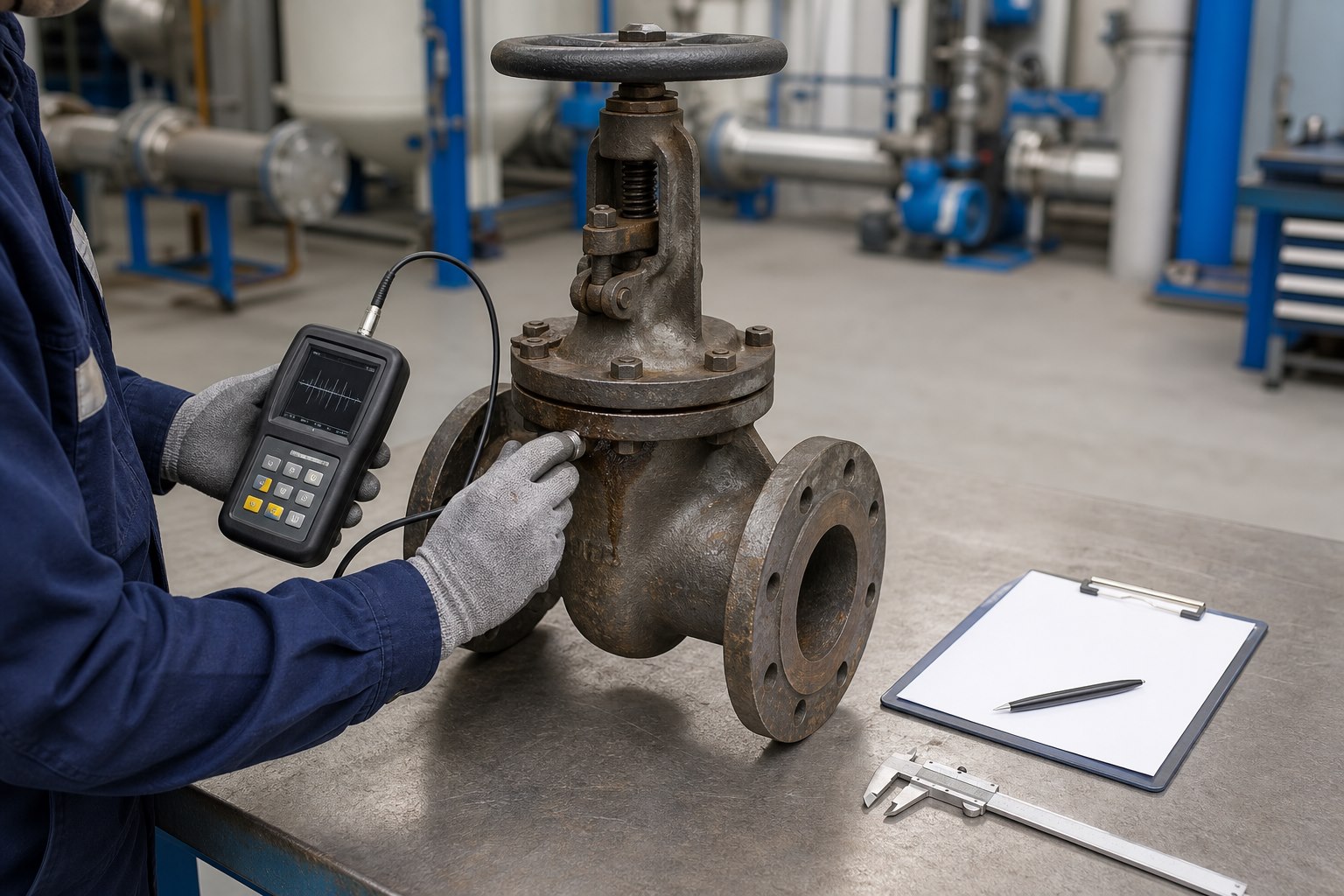
A valve needs immediate replacement when cracking or unacceptable wall loss removes confidence in the pressure boundary. Body, bonnet, flange, weld-end, and threaded-end damage require measured evidence. Visual corrosion can understate internal erosion, while surface staining can overstate actual wall loss. Use thickness readings, crack testing where appropriate, and inspection history. When a pressure-retaining part is cracked or remaining thickness cannot be justified, replacement is usually more defensible than an improvised repair.
High torque, incomplete travel, or sticking
A difficult valve is not automatically an actuator problem. Deposits, galling, bent stems, damaged bearings, swollen soft parts, wrong packing compression, or excessive differential pressure can all increase torque. Review valve sticking problems before replacing an actuator or ordering an identical valve.
A service condition that no longer matches the original valve
Process pressure, temperature, concentration, solids, cycling frequency, cleaning chemicals, and flow direction may have changed since the valve was installed. In that case, copying the old nameplate can repeat the original selection error. Check the replacement against the valve pressure-temperature rating guide and review body, trim, seat, gasket, and bolting as one materials system through the valve material selection guide.
Turn the Failure Into a Better Specification
If a valve needs immediate replacement, its failure evidence should become part of the new specification. A replacement should solve the failure mechanism, not merely fit the old pipe gap. The table below converts common evidence into useful RFQ decisions.
| Observed problem | Specification question for the replacement | Evidence to send |
|---|---|---|
| Repeated seat leakage | Is the valve type, seat design, shutoff class, and differential pressure suitable? | Leak test result, flow direction, pressure differential, medium, and cycling frequency |
| Corrosion or pitting | Do body, trim, seat, gasket, bolting, coating, or corrosion allowance need revision? | Fluid composition, concentration, temperature, photos, and failed material grade |
| Cavitation or erosion | Should velocity, trim geometry, valve size, or installation arrangement change? | Upstream and downstream pressure, flow rate, operating position, and damage location |
| High operating torque | Is the actuator sized for breakaway torque and maximum differential pressure? | Torque records, actuator data, stroke time, alarms, and packing condition |
| Installation mismatch | Are end connection, face-to-face, bore, flange standard, and actuator orientation confirmed? | GA drawing, nameplate, dimensions, piping photos, and available installation envelope |
| Missing quality records | Which material, pressure-test, inspection, coating, and compliance documents are required? | Project specification, test standard, inspection level, and certificate list |
Document requirements should be explicit. Use the valve certificates and quality documents guide to define MTCs, pressure-test reports, inspection photos, coating records, and compliance documents before the order is placed.
Application Notes
Steam and power-plant isolation
If inspection confirms that a valve needs immediate replacement in steam service, isolate it within the approved outage plan. A valve that leaks through during an outage may expand the isolation boundary and expose maintenance teams to hot water or steam. Pressure class alone is not enough; temperature rating, bonnet design, trim, stem sealing, actuation, and test acceptance must match the duty. See power plant valve reliability for the wider system context.
Corrosive, slurry, and dirty-water service
The failure surface often shows whether the problem is chemistry, solids, velocity, or an unsuitable sealing design. A more corrosion-resistant body will not solve seat abrasion, and a harder trim will not correct damaging flow velocity. Send close photos of the exact damage location and current process data so material and geometry can be reviewed together.
Automated and control service
For actuated valves, keep the valve and actuator evidence together. Record supply pressure or voltage, fail position, cycle rate, stroke time, control signal, torque alarms, and any manual override difficulty. In ball-valve applications, ball valve flow-control problems may reveal that the valve has been throttling in a service better suited to another configuration.
What to Send With the RFQ
A fast quotation is useful only when it is technically comparable. Send the valve tag, type, nominal size, pressure class, body and trim material, end connection, face-to-face dimension, medium, concentration, design and operating pressure, design and operating temperature, normal valve position, differential pressure, operation method, required fail position, photos, nameplate, failure history, and required test documents.
When a valve needs immediate replacement, also state the shutdown window and whether an exact dimensional replacement is mandatory. Vcore Valve can review the old valve data, inspection evidence, and service conditions to recommend a repair-or-replace route and prepare a replacement specification that addresses the failure cause.
Practical Conclusion
The clearest evidence that a valve needs immediate replacement is loss of safe, verifiable function, not age by itself. Age alone does not decide whether a valve should be replaced. The decision becomes clear when pressure integrity, shutoff performance, operating reliability, repair history, spare-part availability, and failure consequence are considered together. Repair normal wear when the valve can be restored and verified. Replace the valve when evidence shows that continued repair cannot provide a safe, traceable, and economical result.
FAQ
Can every leaking industrial valve be repaired?
No. A valve needs immediate replacement when pressure-boundary damage or unsafe isolation cannot be restored through a controlled repair. Accessible packing or gasket leakage may still be repairable.
Should a replacement valve always match the original?
No. Match dimensions where the piping requires it, but recheck material, pressure-temperature rating, seat design, actuator sizing, tests, and documents against the current service.
What evidence helps a supplier recommend the correct replacement?
Clear photos, the nameplate, valve and actuator data, pressure and temperature, medium composition, failure location, repair history, test results, and installation dimensions allow a supplier to address the cause instead of repeating the old specification.