Full port vs reduced port ball valve selection is a common decision in industrial pipeline projects. Both valve types use a rotating ball to open or close flow, but the internal bore size is different. This difference affects flow capacity, pressure drop, valve weight, body size, cost, cleaning ability, and long-term system performance.
For B2B buyers, the choice should not be based only on price. A reduced port ball valve can be practical and economical when full flow is not required. A full port ball valve is usually better when the system needs low pressure drop, high flow capacity, pipeline pigging, easy flushing, or minimal flow restriction.
This guide explains the difference between full port and reduced port ball valves from a practical industrial buyer’s perspective. It covers structure, bore size, flow behavior, pressure drop, applications, cost, common mistakes, and selection requirements. For a broader overview of ball valve types, materials, seats, port designs, and applications, read our main guide on industrial ball valves.
What Is a Full Port Ball Valve?
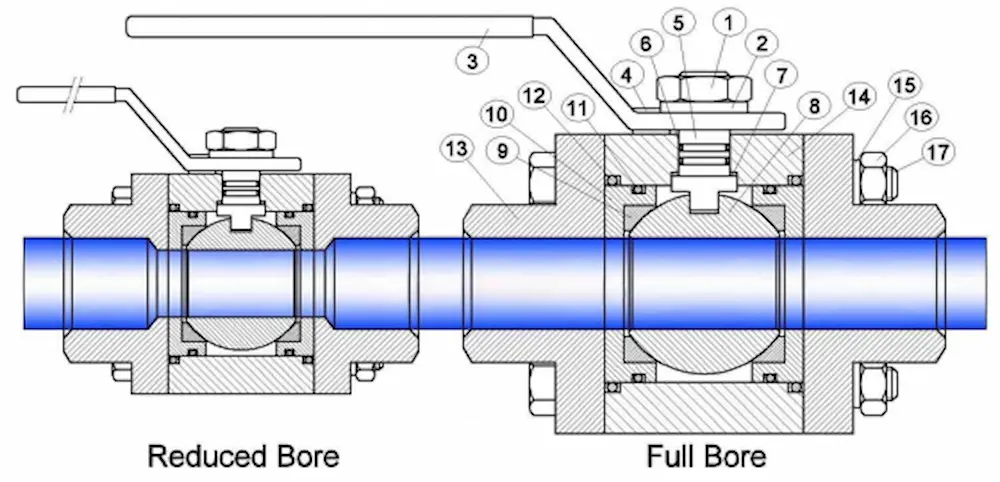
A full port ball valve, also called a full bore ball valve, has a ball bore that is close to the same diameter as the pipeline inner diameter. When the valve is fully open, the flow path is nearly straight through with minimal restriction.
This design helps reduce pressure drop and maintain high flow capacity. Full port ball valves are often selected when the process requires maximum flow, easy cleaning, pigging, or low resistance through the valve.
Main Features of Full Port Ball Valves
- Bore size is close to pipe inner diameter
- Lower pressure drop than reduced port designs
- Higher flow capacity
- Better for pigging or pipeline cleaning when required
- Larger and heavier valve body
- Usually higher cost than reduced port valves
Typical Applications
- Oil and gas pipelines
- High-flow process lines
- Piggable pipelines
- Water transmission systems
- Chemical transfer lines requiring low restriction
- Systems where pressure drop must be minimized
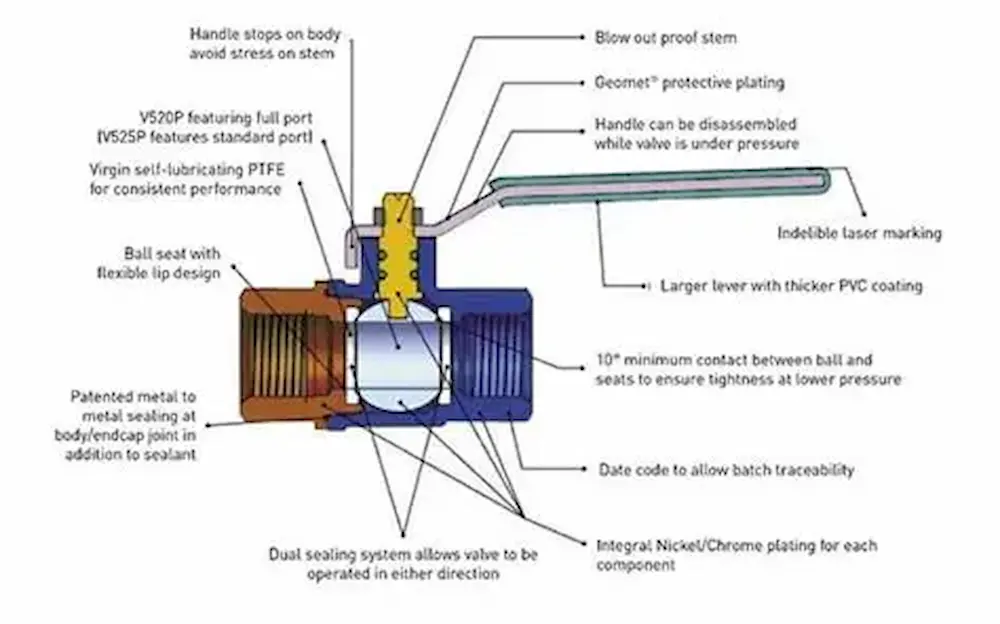
What Is a Reduced Port Ball Valve?
A reduced port ball valve, also called a reduced bore ball valve, has a smaller internal bore than the pipeline inner diameter. When the valve is open, the flow passes through a narrower opening inside the ball.
This creates more flow restriction than a full port valve, but it also allows a more compact and economical valve design. Reduced port ball valves are widely used in general industrial shutoff applications where maximum flow capacity is not required.
Main Features of Reduced Port Ball Valves
- Bore size is smaller than the pipe inner diameter
- More compact valve body
- Lower cost in many sizes
- Lower weight compared with full port designs
- Higher pressure drop than full port valves
- Not suitable for pigging applications
Typical Applications
- General utility pipelines
- Water and air lines where full flow is not critical
- Small and medium industrial isolation points
- Cost-sensitive projects
- Systems where minor pressure drop is acceptable
- Non-piggable process lines
Buyers can compare available industrial ball valve structures in Vcore Valve’s ball valve category.
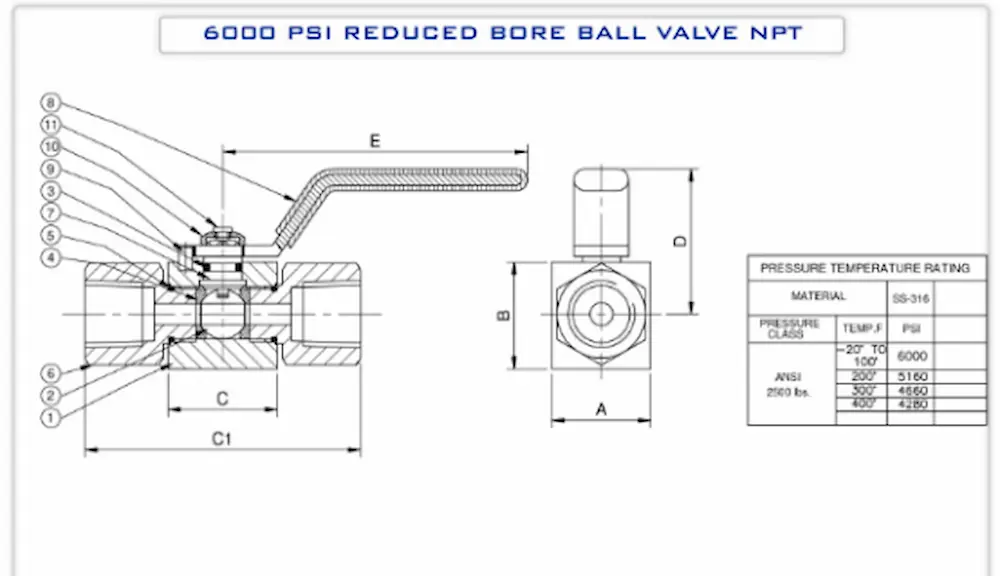
Full Port vs Reduced Port Ball Valve: Core Difference Table
| Comparison Factor | Full Port Ball Valve | Reduced Port Ball Valve |
|---|---|---|
| Bore Size | Close to pipe inner diameter | Smaller than pipe inner diameter |
| Flow Capacity | Higher flow capacity | Lower flow capacity |
| Pressure Drop | Lower pressure drop | Higher pressure drop |
| Valve Body Size | Larger body design | More compact body design |
| Weight | Usually heavier | Usually lighter |
| Cost | Usually higher | Usually lower |
| Pigging | Can be suitable when design allows | Usually not suitable |
| Best Use | High-flow, low pressure drop, piggable, critical flow systems | General shutoff, utility service, cost-sensitive applications |
How Bore Size Affects Flow Capacity
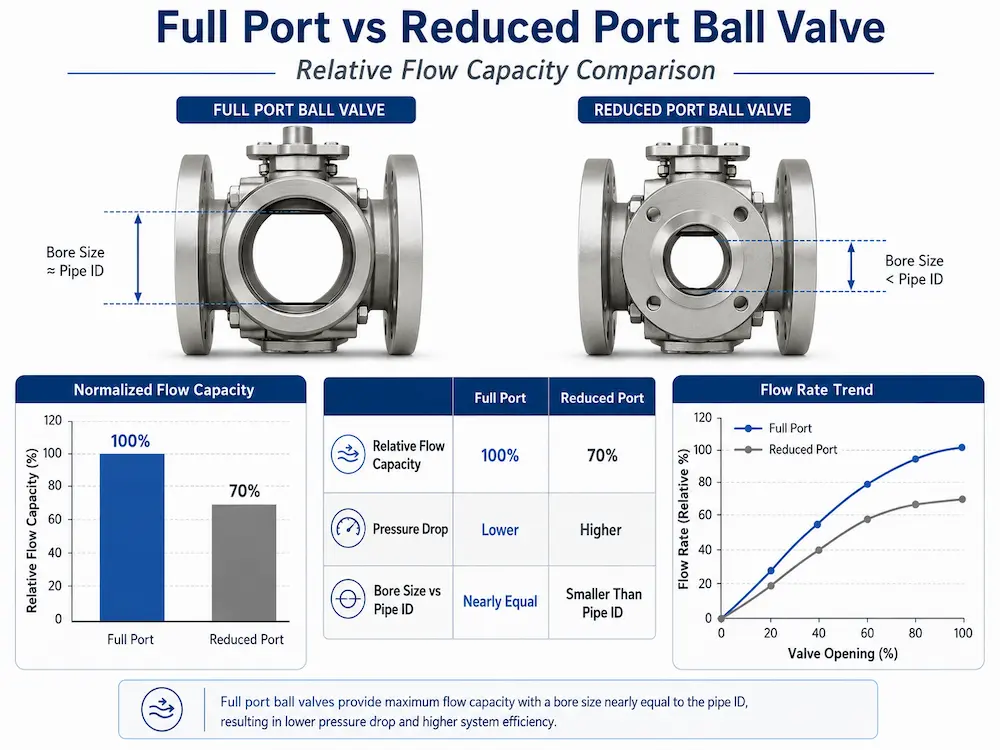
The bore size inside the ball directly affects how much fluid can pass through the valve when it is open. In a full port valve, the bore is close to the same size as the pipe. This allows the flow path to remain wide and reduces restriction.
In a reduced port valve, the bore is smaller. The flow must pass through a narrower opening, which increases velocity through the valve and creates more pressure loss. For many general applications, this pressure loss is acceptable. For high-flow or energy-sensitive systems, it may become a problem.
Why Flow Capacity Matters
- It affects pump energy consumption
- It affects process flow rate
- It affects system pressure balance
- It affects pipeline efficiency
- It may affect whether the valve can be used in piggable lines
If the system requires maximum flow or low pressure drop, a full port ball valve is usually the safer direction. If the valve is only used for simple isolation and the flow loss is acceptable, a reduced port ball valve may be more economical.
Pressure Drop Comparison
Pressure drop is one of the most important differences between full port and reduced port ball valves. A full port ball valve creates less restriction because the open bore is close to the pipe size. A reduced port ball valve creates more restriction because the bore is smaller.
In long pipelines, pump systems, water transmission, oil and gas service, and high-flow process lines, pressure drop can affect system efficiency. In these cases, a full port design may be worth the higher initial cost.
In short utility lines, low-flow services, or systems where pressure loss is not critical, a reduced port design can reduce valve cost and weight while still providing reliable shutoff.
Full Bore vs Reduced Bore: Are They the Same Terms?
Yes. In many industrial valve specifications, full port and full bore are used in a similar way. They both describe a valve with an internal bore close to the pipe bore. Similarly, reduced port and reduced bore usually describe a valve with a smaller flow opening than the pipe.
However, buyers should not rely only on the terms. It is better to confirm the actual bore diameter, valve standard, drawing, and flow coefficient if flow capacity is important.
When Should You Choose a Full Port Ball Valve?
Choose a full port ball valve when the application requires high flow capacity, low pressure drop, or a flow path that is close to the pipeline size.
- Use it when pressure drop must be minimized.
- Use it when the system requires maximum flow capacity.
- Use it when pipeline pigging or cleaning may be required.
- Use it in critical process lines where flow restriction can affect production.
- Use it in high-flow water, oil, gas, or chemical transfer pipelines.
- Use it when system efficiency matters more than lowest valve cost.
For robust industrial pipeline connections, buyers may also evaluate a flanged welded ball valve depending on pressure, connection standard, and project requirements.
When Should You Choose a Reduced Port Ball Valve?
Choose a reduced port ball valve when the system does not require maximum flow and a moderate pressure drop is acceptable. Reduced port valves are common in general industrial systems because they are compact, economical, and reliable for shutoff service.
- Use it for general pipeline isolation.
- Use it when flow capacity is not the main concern.
- Use it when compact size and lower cost are important.
- Use it in utility lines, water lines, air lines, and many process support systems.
- Use it where pigging is not required.
- Use it when the system design already allows for the pressure loss.
For simple open-close pipeline service, buyers can also compare an on-off ball valve where manual or automated shutoff is required.
Application Comparison Table
| Application | Recommended Direction | Reason |
|---|---|---|
| Piggable oil and gas pipeline | Full port ball valve | Allows near-straight-through bore for pigging or cleaning |
| High-flow water transmission | Full port ball valve | Reduces pressure drop and improves flow efficiency |
| General utility shutoff | Reduced port ball valve | Compact and cost-effective when full flow is not required |
| Chemical transfer line | Depends on flow and media | Material, seat, pressure drop, and flow capacity must be reviewed |
| Compressed air line | Often reduced port | Acceptable when pressure loss is within system limits |
| Process line with strict flow requirement | Often full port | Lower restriction helps maintain required flow rate |
| Cost-sensitive small pipeline | Often reduced port | Lower cost and smaller body may be practical |
Cost and Space Considerations
Full port ball valves usually have larger bodies and larger balls because the bore must be close to pipe size. This often increases material usage, machining cost, valve weight, and installation space.
Reduced port ball valves usually require less material and can be more compact. This can make them attractive for cost-sensitive projects, smaller pipelines, or applications where flow restriction is not a major concern.
For procurement, the best choice is not always the cheaper valve. If a reduced port valve causes pressure loss, pump inefficiency, or process flow limitations, the lower purchase price may create higher operating cost. If full flow is not needed, a full port valve may be unnecessary over-specification.
Material and Seat Selection Still Matter
The port type is only one part of ball valve selection. Buyers also need to confirm body material, ball material, stem material, seat material, seal material, pressure rating, and temperature range.
Common Body Materials
- Stainless steel for corrosion resistance and clean industrial service
- Carbon steel for oil, gas, steam, fuel, and selected non-corrosive service
- Alloy steel for special pressure or temperature requirements
- Titanium or special alloys for severe corrosive service
Common Seat Materials
- PTFE for broad chemical resistance and low friction
- Reinforced PTFE for improved mechanical strength
- PEEK for higher-performance selected services
- Metal seats for high temperature, abrasive, or severe service
For corrosion-sensitive or high-pressure applications, buyers can also review our guide on stainless steel valves for high-pressure applications. For chemical service, material and seat compatibility should be checked carefully before selecting either full port or reduced port designs.
Full Port vs Reduced Port in Floating and Trunnion Ball Valves
Full port and reduced port designs can exist in both floating ball valves and trunnion mounted ball valves. This means buyers should not confuse port type with ball support structure.
A floating ball valve may be full port or reduced port. A trunnion mounted ball valve may also be full port or reduced port. The port type affects flow capacity and pressure drop, while the floating or trunnion structure affects ball support, sealing behavior, torque, and pressure suitability.
For a detailed comparison of support structure and operating torque, read our guide on floating vs trunnion ball valve.
Manual, Electric, and Pneumatic Operation
Manual Operation
Manual full port and reduced port ball valves are operated by a lever, gearbox, or handwheel. Smaller valves often use lever handles. Larger valves or higher-torque valves may require gear operation.
Electric Operation
Electric ball valves use an actuator for remote open-close or modulating operation. Full port valves may require larger actuators if the valve size and torque are higher. Reduced port valves may be more compact, but actuator sizing should still be based on actual torque data.
For automation projects, buyers can read our guide on electric ball valves.
Pneumatic Operation
Pneumatic ball valves are used where fast operation, high cycle frequency, or fail-safe spring return is required. The selected actuator should match valve torque, operating pressure, seat material, cycle frequency, and safety requirements.
Common Selection Mistakes
Mistake 1: Choosing Reduced Port Only to Save Cost
A reduced port ball valve can reduce valve cost, but it may also restrict flow. If the system requires high flow or low pressure drop, the reduced port design may create performance problems.
Mistake 2: Choosing Full Port When It Is Not Needed
A full port ball valve is not automatically better for every system. If the pipeline does not require maximum flow, pigging, or low pressure drop, a reduced port valve may be more economical and practical.
Mistake 3: Ignoring Actual Bore Diameter
Terms such as full port, full bore, reduced port, and reduced bore can vary by manufacturer and standard. Buyers should confirm the actual bore diameter or valve drawing when flow capacity matters.
Mistake 4: Ignoring Pressure Drop in Pump Systems
Pressure drop can increase pump load and reduce system efficiency. In long pipelines or high-flow systems, port selection should be reviewed carefully.
Mistake 5: Confusing Port Type with Valve Type
Full port and reduced port describe bore size. Floating and trunnion describe ball support structure. A complete ball valve specification should include both.
Selection Checklist for B2B Buyers
Before requesting a quotation, buyers should prepare the following information:
| Selection Item | What to Confirm | Why It Matters |
|---|---|---|
| Flow Requirement | Normal and maximum flow rate | Determines whether full port is necessary |
| Pressure Drop Limit | Allowed pressure loss across the valve | Reduced port may not be suitable if pressure loss is critical |
| Pipeline Pigging | Whether pigging or cleaning is required | Usually requires full port design |
| Valve Size | DN/NPS and pipe schedule | Impacts bore size, flow area, torque, and cost |
| Medium | Water, gas, oil, steam, chemical, slurry, or solvent | Determines body, ball, seat, and seal material |
| Pressure | Operating pressure and design pressure | Determines pressure class and valve structure |
| Temperature | Normal and maximum temperature | Affects seat and seal material selection |
| Operation Method | Manual, electric, pneumatic, or gearbox | Determines torque and actuator requirements |
| Documentation | Drawing, datasheet, test report, material certificate | Supports project approval and correct procurement |
Information Buyers Should Provide Before Quotation
- Valve size and connection standard
- Required full port or reduced port design
- Medium name and composition
- Operating pressure and design pressure
- Operating temperature and maximum temperature
- Normal and maximum flow rate
- Allowable pressure drop if known
- Whether pigging or cleaning is required
- Body material requirement
- Ball and stem material requirement
- Seat and seal material requirement
- Manual, electric, or pneumatic operation
- Required standards, testing, and documentation
Final Recommendations for Industrial Buyers
A full port ball valve is usually the better choice when the pipeline requires maximum flow capacity, low pressure drop, pigging, cleaning, or minimal flow restriction. It usually costs more and has a larger body, but it can protect system efficiency in demanding flow applications.
A reduced port ball valve is usually the practical choice for general shutoff, utility service, compact installation, and cost-sensitive applications where some pressure drop is acceptable. It is not automatically lower quality; it is simply designed for applications where full bore flow is not necessary.
If you need help choosing between full port and reduced port ball valves, Vcore Valve can review your flow rate, pressure, temperature, medium, pipe size, pressure drop limit, and operation method. Buyers can also compare options in our ball valve category.
For industrial sourcing, the key question is not only “full port or reduced port?” The better question is: “How much flow capacity does this pipeline actually need, and how much pressure drop can the system accept?”
FAQs
1. What is the difference between full port and reduced port ball valves?
A full port ball valve has a bore close to the pipe inner diameter, allowing higher flow and lower pressure drop. A reduced port ball valve has a smaller bore, making it more compact and economical but more restrictive.
2. When should I use a full port ball valve?
Use a full port ball valve when the system requires high flow capacity, low pressure drop, pigging, cleaning, or minimal flow restriction.
3. When should I use a reduced port ball valve?
Use a reduced port ball valve when the application is general shutoff, the flow rate is not critical, and moderate pressure drop is acceptable.
4. Is a full port ball valve always better?
No. A full port ball valve provides better flow capacity, but it is usually larger, heavier, and more expensive. If full flow is not required, a reduced port valve may be more practical.
5. Can reduced port ball valves be used for gas or water?
Yes. Reduced port ball valves can be used for many gas, water, air, oil, and utility services when the pressure drop and flow capacity are acceptable for the system.