Bellows Seal Valve Cycle Life: How to Review Supplier Test Data
A quotation stating “tested for thousands of cycles” may sound reassuring, yet leave the buyer unable to judge suitability. Was a loose bellows tested or a complete valve? Were the movements full stroke? Was pressure applied while cycling? Was the bellows checked independently of backup packing?
For the basic product configuration, see the bellows globe valve and bellows seal gate valve pages. This guide addresses the next procurement question: what does the supplier’s endurance evidence actually demonstrate?
1. Identify the Claim Before Reviewing the Number
Ask the supplier to classify its statement. “Passed 10,000 cycles,” “average failure at 10,000 cycles” and “recommended replacement at 10,000 cycles” describe different things. None can be substituted for another without supporting evidence.
| Claim | What it may establish | What still needs review |
|---|---|---|
| Completed a specified count | The tested specimens met the stated criteria through that point | Conditions, sample count, failures and applicability |
| Tested until failure | Observed failure outcomes under the test conditions | Failure definition, individual results and statistical treatment |
| Calculated fatigue life | A design prediction using stated assumptions | Model basis, inputs, validation and uncertainty |
| Recommended service interval | A maintenance recommendation for specified duty | Field evidence, inspection strategy and operating restrictions |
For perspective, Swagelok’s HB series technical report publishes laboratory conditions, a leakage-based failure definition and statistical results, while explicitly distinguishing those results from a minimum service-life guarantee. It is an example of report structure, not transferable qualification for another valve family.
2. Match the Tested Sample to the Quoted Assembly
Start with identification rather than the conclusion page. Obtain the valve model, size, pressure class, drawing revision, bellows part number and sample serial numbers. Confirm the material, bellows construction and manufacturing route represented by the test.
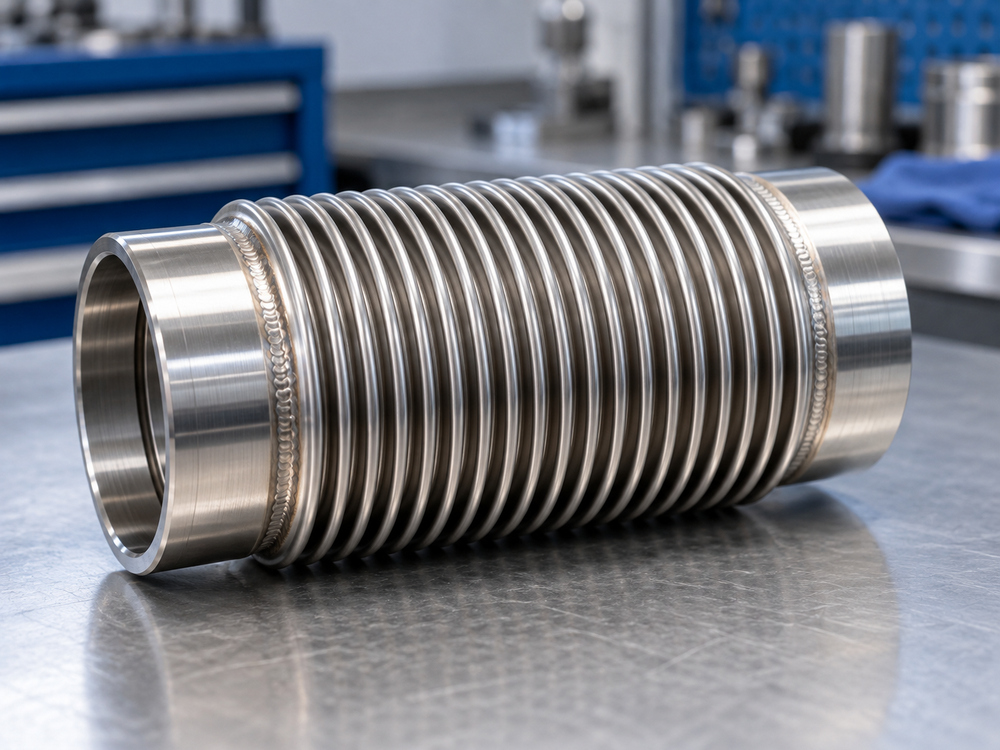
The comparison should cover the bellows geometry, attachment welds, end connections, stem guidance, anti-rotation arrangement where applicable, and permitted movement. A different stroke or attachment arrangement may change the loading even when the nominal valve size looks similar.
A component fatigue test can be valuable, but its fixture may not reproduce assembly alignment, operating thrust and seating loads. Ask what additional evidence connects that component test to the complete valve.
3. Define One Cycle and the Actual Movement
The report should define its counter. For example, does one cycle mean closed–open–closed, or does the equipment count each stroke separately? Obtain the endpoint positions and measured axial travel, not only the description “full cycling.”
Record operating speed, dwell at each endpoint and whether the valve seats under the specified load. Partial-stroke tests should be identified as partial stroke. They should not be presented as equivalent full-stroke endurance without an accepted technical basis.
Mechanical cycles and thermal cycles also need separate counts. Repeated movement at steady temperature does not reproduce every heating-and-cooling sequence. A rapid laboratory test may omit long hot dwell periods, corrosion exposure or process deposits that influence field performance.
Ask how the rig confirms actual motion. A command counter can continue increasing even when travel is incomplete; the report should explain travel verification and how interrupted or invalid cycles were handled.
4. Compare Pressure, Temperature and Actuation Conditions
A pressure rating is not a description of the pressure used during endurance testing. Likewise, the fluid temperature setpoint is not necessarily the measured temperature of the bellows assembly.
| Test variable | Evidence to request | Review concern |
|---|---|---|
| Pressure | Pressure history, relevant differential and pressure direction across the bellows | Was the assembly loaded during movement? |
| Temperature | Measurement locations, actual readings and heating/cooling sequence | Does the test represent the claimed temperature duty? |
| Medium | Gas or liquid, composition and cleanliness | What service chemistry or contamination is absent? |
| Actuation | Actuator type, settings, thrust or torque limits and stroke stops | Are end loads and overtravel controlled? |
| Rate and dwell | Cycles per unit time and endpoint hold periods | What changes when laboratory time is compressed? |
| Installation | Orientation, alignment and fixture arrangement | Does the sample represent the installed loading? |
Do not assume higher temperature, pressure or cycle speed automatically makes one report conservatively equivalent to another. Different loading combinations can change the failure mechanism. Any accelerated-test extrapolation needs a stated model and justification.

5. Check What Was Measured and What Counted as Failure
Separate bellows integrity, external valve leakage, seat leakage and operating function. A valve may fail one criterion while still meeting another. The report should identify each monitored boundary and the specific reason for termination.
Where backup packing is fitted, ask how the method detects a bellows breach. A low external leakage reading alone may not isolate the condition of the primary bellows barrier. The approved test arrangement should make its detection scope clear.
- Method: test gas or liquid, pressure, temperature and measurement arrangement.
- Acceptance limit: numerical threshold with units and any reference conditions.
- Instrument capability: detection limit, calibration status and relevant background checks.
- Timing: baseline, interim checkpoints, final measurement and any post-test examination.
- Functional criteria: incomplete travel, excessive operating load, seizure or visible damage where specified.
“No visible leakage” and an instrumented gas-leak result are not equivalent statements. Likewise, concentration readings and volumetric leak rates cannot be compared without the applicable test-method basis. If measurements occur only at intervals, the exact onset of leakage may lie between the last passing and first failing checkpoints.
6. Read Individual Results, Not Only an Average
Request the number of specimens started, completed, failed, withdrawn and repaired. A summary average can hide an early failure, while a “best result” says little about the remainder of the test group.
A specimen that reaches the planned stopping count without failure is a runout: its failure cycle remains unknown. Record it as surviving to the stopping point, not as failing there. A reliability analysis must treat such observations appropriately.
Where a supplier claims a reliability percentage, percentile life or confidence level, ask for the statistical method, population definition and underlying specimen data. A mean is not a guaranteed minimum. A small no-failure demonstration also does not prove that every production valve will reach the same count.
Maintenance during the test belongs in the record. Bellows replacement, packing adjustment, lubrication, seat work and actuator-setting changes may affect what can be claimed. The report should explain whether each intervention was permitted and how results before and after it were treated.

7. Keep Endurance, Pressure Testing and Emissions Qualification Separate
A shell test evaluates the pressure boundary under its specified conditions. A seat test evaluates shut-off leakage. An endurance program examines performance after repeated operation. Passing one does not establish the others; our valve pressure testing guide provides the broader inspection context.
ISO 15848-1 addresses external leakage evaluation and type qualification for valve stem or shaft seals and body joints. If it is specified, review the applicable edition, classification, test conditions and qualification scope. A general statement that a bellows was cycle-tested does not establish whole-valve compliance with that standard.
Also distinguish design qualification from production inspection. Endurance testing commonly supports a design or selected sample group; the supplied valves still need the agreed manufacturing traceability and routine acceptance records. Do not assume every delivered valve should undergo a life-consuming endurance test.
8. Example: Why the Higher Cycle Count May Not Be the Better Evidence
The following comparison is hypothetical, not Vcore or supplier test data. Its purpose is to show how missing information changes a purchasing decision.
| Review field | Report A | Report B |
|---|---|---|
| Headline | 20,000 cycles completed | 10,000 cycles completed |
| Sample description | One loose bellows; revision missing | Three identified complete valve assemblies |
| Movement and conditions | Stroke and pressure history unspecified | Travel, pressure and temperature documented |
| Acceptance evidence | Visual inspection only | Defined leakage and functional checkpoints |
| Buyer disposition | Request missing evidence before using the claim | Review applicability to the actual duty and required count |
Report B is more reviewable, but is not automatically sufficient. If the project requires a different loading sequence or a higher demonstrated count, additional evidence remains necessary. Compare coverage of the requirement before ranking headline numbers.
9. RFQ Checklist and Suggested Supplier Request
Provide the operating medium, pressure and temperature envelope, expected full-stroke frequency, partial movements, thermal cycles and anticipated dwell periods. Ask the supplier to identify gaps between those conditions and its existing evidence.
Suggested Request
Please submit bellows endurance evidence applicable to the quoted valve configuration. Identify the tested samples, assembly and bellows drawing revisions, material and construction, cycle definition, stroke, pressure, temperature, medium, operating rate and actuator settings.
Include individual specimen outcomes, leakage methods and limits, inspection intervals, instrument calibration, interruptions and maintenance, termination reasons and any statistical basis. State the qualification range, differences from the proposed service, and additional testing or restrictions required. Separate design qualification from production acceptance documentation.
Send Vcore your duty profile and required test scope for review with the proposed bellows-sealed valve configuration.
Agree on the procedure and acceptance criteria before testing begins. Define document review, witness or hold points, the required report package and the process for resolving deviations. A witnessed counter reading cannot compensate for an unsuitable test method.

10. Frequently Asked Questions
How many cycles should a bellows seal valve last?
There is no universal count for every design and service. Evaluate the applicable valve configuration and test conditions against the project duty and acceptance requirement.
Can I divide tested cycles by daily operations to predict years of life?
That arithmetic can estimate cycle demand, but it does not predict service life. Temperature exposure, corrosion, loading, operating history and statistical uncertainty still matter.
Does a helium leak test prove fatigue life?
It establishes leakage performance at the test condition and checkpoint. Fatigue evidence also requires a defined loading sequence and traceable cycle history.
Can globe-valve results qualify a bellows seal gate valve?
Not automatically. Travel, geometry, assembly loads and construction may differ. Require an accepted qualification basis for any transfer.
Does third-party witnessing make a report sufficient?
It adds evidence about the witnessed activity. You still need representative samples, suitable conditions, defined criteria and a clear link to the supplied configuration.
What if the supplier provides only a certificate?
Request the supporting test report or an agreed technical summary covering conditions, specimen outcomes and applicability. Keep the requirement open until the evidence supports the purchasing decision.