Quick Overview
Choosing between an angle valve and a gate valve may seem straightforward, but the wrong decision can lead to flow issues, maintenance headaches, or premature valve failure. While both are used to control fluid flow, they serve very different purposes. In this guide, Vcore Valve explains the real differences, applications, advantages, and limitations of angle valves and gate valves—helping engineers, buyers, and installers make the right choice.
A Real Installation Scenario
Picture a residential plumbing system where a valve must be installed close to a wall corner, or an industrial pipeline that needs straight-through, low-resistance flow. An angle valve fits neatly in the first case, while a gate valve excels in the second. Selecting the wrong valve here could mean leaks, restricted flow, or costly rework.
Common User Pain Points
Confusion Between Valve Functions
Many users assume all shut-off valves work the same, leading to incorrect selection and poor system performance.
Space and Installation Constraints
Limited space often dictates valve choice, but not all users understand which valve designs are truly space-efficient.
Maintenance and Longevity Issues
Improper valve selection can result in frequent repairs, sealing problems, or reduced service life.
Vcore Valve Solutions & Recommendations
Clear Functional Separation
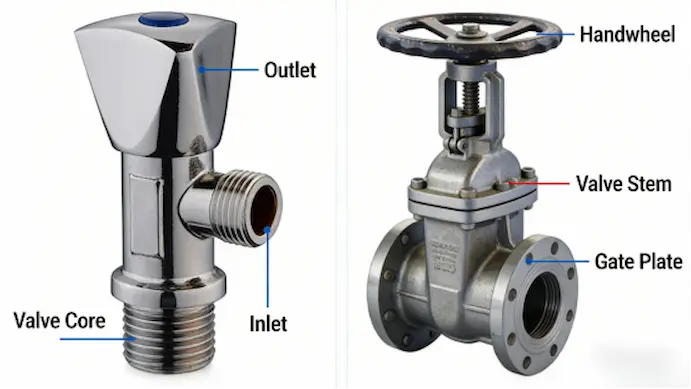
At Vcore Valve, we clearly define angle valves for directional flow change and local isolation, while gate valves are recommended for full open or fully closed pipeline control.
Application-Based Selection Support
We guide customers based on media type, pressure rating, installation orientation, and operation frequency.
Quality Manufacturing Standards
Both our angle valves and gate valves are produced with strict material control and tested sealing performance to ensure reliability.
Case Studies & Practical Examples
Residential Plumbing Systems
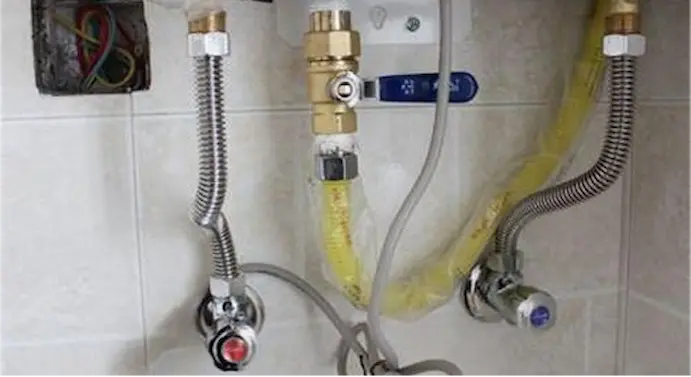
Angle valves are widely used under sinks and behind toilets, allowing quick shut-off without disturbing the main pipeline.
Industrial Water Supply Lines
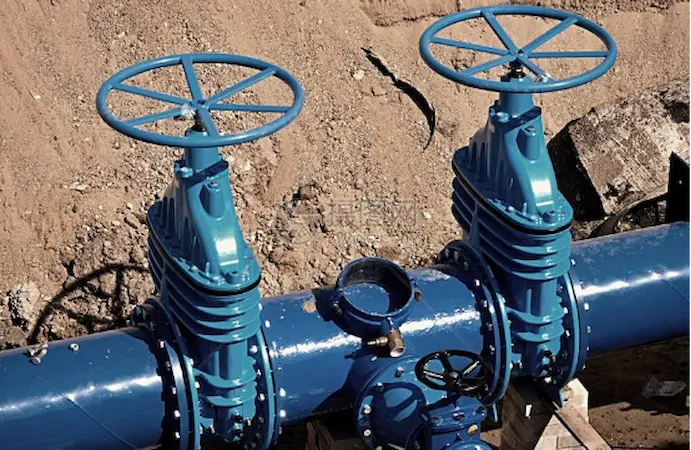
Gate valves are commonly installed in main pipelines where full-bore flow and minimal pressure loss are required.
Technical Comparison & Performance Analysis
| Technical Parameter | Angle Valve | Gate Valve |
|---|---|---|
| Valve Function | Changes flow direction (90°) and isolates flow | Fully opens or closes straight-through flow |
| Flow Path | Angled flow path | Straight-through flow path |
| Pressure Drop | Moderate due to flow redirection | Very low when fully open |
| Flow Control Capability | Limited throttling possible (application-dependent) | Not suitable for throttling |
| Installation Space | Compact, ideal for confined spaces | Requires more linear installation space |
| Typical Operation | Frequent local shut-off | Infrequent on/off operation |
| Sealing Mechanism | Disc or plug against angled seat | Gate moves vertically between seats |
| Maintenance Frequency | Moderate | Low in low-cycle applications |
| Common Materials | Brass, bronze, stainless steel | Cast iron, ductile iron, carbon steel |
| Typical Applications | Plumbing fixtures, appliances, branch lines | Main pipelines, isolation points, water supply systems |
Market Trends & Industry Insights
With increasing demand for modular plumbing and compact installations, angle valves are seeing growth in residential and commercial buildings. Meanwhile, gate valves remain essential in industrial pipelines, water treatment plants, and infrastructure projects due to their durability and low flow resistance.
Style & Usage Recommendations
Choose an angle valve when:
-
Space is limited
-
Flow direction needs to change
-
Frequent local shut-off is required
Choose a gate valve when:
-
Full flow capacity is critical
-
The valve remains mostly open or closed
-
Installed in main pipelines or isolation points
Conclusion
Both angle valves and gate valves play vital roles in fluid control systems—but they are not interchangeable. Understanding their structural differences and application strengths is key to system reliability.
At Vcore Valve, we manufacture and supply both valve types with consistent quality and global export standards.
👉 Contact Vcore Valve today to get expert advice or request customised valve solutions for your project.
FAQ
Q1: What is the main difference between an angle valve and a gate valve?
An angle valve changes flow direction and is compact, while a gate valve allows straight-through flow with minimal pressure loss.
Q2: Can a gate valve be used for flow regulation?
No, gate valves are designed for fully open or fully closed operation and are not suitable for throttling.
Q3: Where are angle valves commonly used?
Angle valves are commonly used in residential plumbing, appliances, and tight installation spaces.
Q4: Which valve has a longer service life?
Service life depends on application and usage, but gate valves generally last longer in low-cycle industrial systems.
Q5: Are angle valves suitable for high-pressure systems?
Some industrial angle valves are pressure-rated, but gate valves are more commonly used for high-pressure pipelines.