Quick Overview
Understanding valve pressure units is critical when selecting, specifying, or operating industrial valves. MPa, bar, PSI, and kg/cm² are often used interchangeably, yet incorrect conversion can lead to undersized valves, safety risks, or compliance failures. This guide from Vcore Valve clearly explains how these pressure units relate, how to convert them accurately, and how to apply them correctly in real valve engineering scenarios.
Opening Scenario
You receive a valve datasheet rated at 1.6 MPa, while the project specification asks for 16 bar. Another client mentions 232 PSI. Same pressure—or not?
This confusion happens daily in international valve projects, and it’s one of the most common causes of wrong valve selection.
User Pain Points
Mixed pressure standards across regions
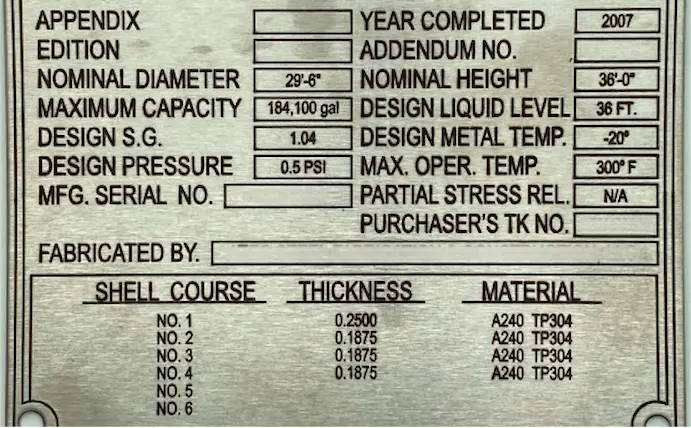
Engineering drawings, valve nameplates, and client documents often use different pressure units, creating interpretation errors.
Risk of incorrect valve selection
Misunderstanding pressure units can result in choosing a valve with insufficient pressure rating, increasing leakage or failure risk.
Lack of practical conversion guidance
Many conversion tables exist, but few explain how pressure units apply to real-world valve design and testing.
Solutions and Recommendations
Understand the origin of each pressure unit
MPa and bar are metric-based, while PSI originates from imperial systems. Knowing this helps avoid mental conversion mistakes.
Always convert using engineering-safe values
For valve selection, rounding pressure values upward ensures safety margins are preserved.
Match pressure units to valve standards
Valve standards such as EN, ISO, and API define pressure classes differently—conversion alone is not enough without standard alignment.
Case Studies and Examples
Export butterfly valve project
A customer specified 10 bar operating pressure. Converted correctly, this equals 1.0 MPa. Vcore Valve selected PN16-rated valves to allow safety margin and comply with EN standards.
Oil & gas valve tender
A datasheet requested 300 PSI valves. By converting to 20.7 bar, engineers avoided selecting a borderline PN20 valve and instead recommended Class 150 equivalents.
Data / Scientific Analysis / Comparison
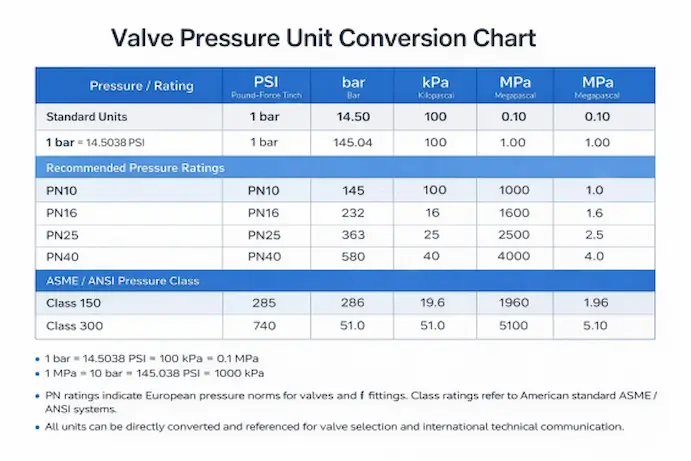
Pressure Unit Conversion Table
| Unit | Equivalent Value |
|---|---|
| 1 MPa | 10 bar |
| 1 bar | 0.1 MPa |
| 1 bar | 14.5 PSI |
| 1 kg/cm² | 0.98 bar |
| 1 PSI | 0.0689 bar |
From a valve engineering perspective, MPa vs bar vs PSI differences are numerical—not functional. However, test pressure, design pressure, and allowable stress calculations depend heavily on precise conversion.
Trends / Market Insights
Global valve sourcing has increased cross-standard confusion. European projects favour MPa and bar, while North American buyers rely on PSI and class ratings. As international procurement grows, engineers increasingly demand clear pressure unit conversion references built directly into valve documentation.
Style / Usage Recommendations
-
Always confirm whether pressure refers to design pressure or working pressure
-
Avoid mixing PSI and bar in the same technical document
-
When in doubt, select the next higher pressure rating
-
For valves, pressure class matters more than unit value alone
Conclusion
Pressure units are simple in theory—but costly when misunderstood. Correctly converting MPa, bar, PSI, and kg/cm² ensures valve safety, regulatory compliance, and long-term reliability.
If you’re unsure about pressure ratings for your application, Vcore Valve can help verify specifications and recommend the right valve pressure class for your system.
FAQs
Is MPa the same as bar?
No, but they are directly related. 1 MPa equals 10 bar.
Why do valves show both bar and PSI?
To support international standards and simplify cross-border engineering communication.
Is kg/cm² still used in valve specifications?
Yes, particularly in older Asian standards and legacy drawings.
Should I round pressure values up or down?
Always round up when selecting valve pressure ratings.
Does pressure unit affect valve performance?
The unit itself does not, but incorrect conversion can lead to under-rated valves.
What pressure unit does EN 593 use?
EN standards typically use bar or MPa.
Reference
-
ISO 15649 – Valves: Pressure-Temperature Ratings
-
EN 1092 – Flanges and Pressure Ratings
-
API 6D – Pipeline Valves