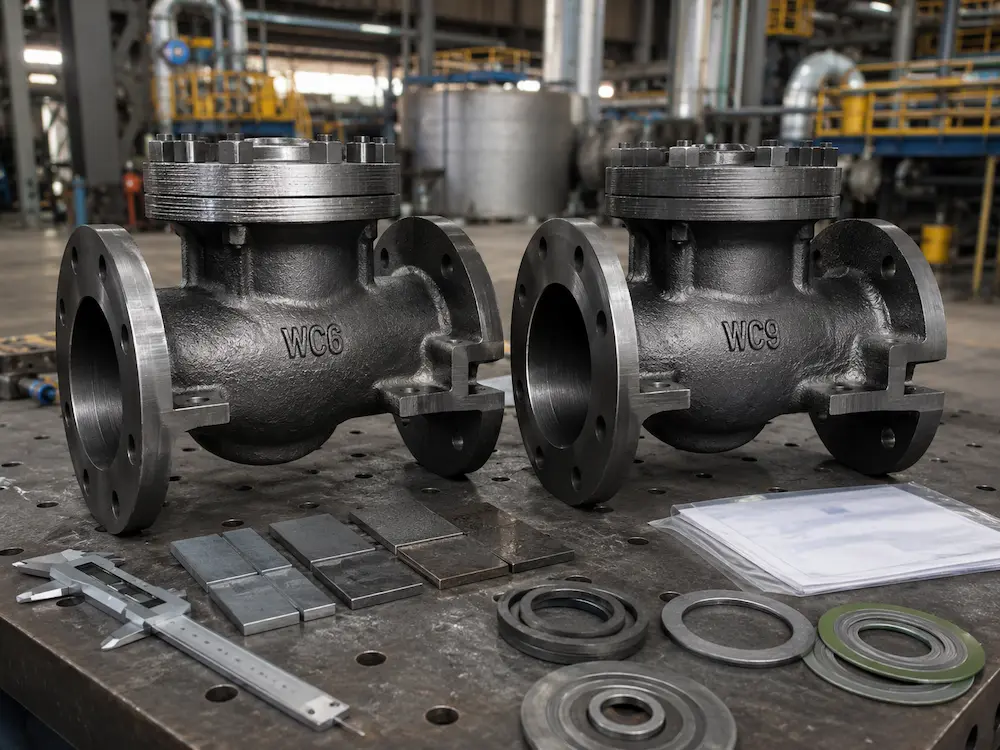
WC6 vs WC9 valve material is an important comparison for high-temperature industrial valve selection. Both WC6 and WC9 are cast alloy steel materials used for valve bodies, bonnets, covers, and other pressure-containing parts in steam, power plant, refinery, petrochemical, and thermal process systems.
Compared with common carbon steel materials such as WCB, WC6 and WC9 are selected when higher temperature strength is required. They are not usually selected for ordinary water or mild-temperature service. Their main value is high-temperature performance, especially in steam and process systems where standard carbon steel may not be enough.
This guide explains the difference between WC6 and WC9 valve materials, when to choose each one, how they compare in high-temperature applications, and what buyers should check before ordering. For a broader material overview, read our valve material selection guide.
What Is WC6 Valve Material?
WC6 is a cast alloy steel valve material commonly used for high-temperature pressure service. In valve specifications, WC6 is often associated with ASTM A217 WC6.
WC6 is commonly selected for steam, power plant utility systems, refinery service, petrochemical lines, and other high-temperature industrial systems where carbon steel may not provide sufficient long-term high-temperature strength.
Typical WC6 valve applications include:
- Steam pipelines
- Power plant auxiliary systems
- Refinery and petrochemical process lines
- Thermal oil systems
- High-temperature utility service
- Boiler-related systems
- Moderate high-temperature pressure service
WC6 is not selected only because it is stronger than WCB. It is selected when the temperature, pressure, and project specification require alloy steel performance.
What Is WC9 Valve Material?
WC9 is also a cast alloy steel valve material used for high-temperature pressure service. In valve specifications, WC9 is often associated with ASTM A217 WC9.
Compared with WC6, WC9 is generally selected for higher-temperature service conditions where better high-temperature strength and creep resistance are required. It is commonly used in demanding steam, power generation, refinery, and petrochemical applications.
Typical WC9 valve applications include:
- Higher-temperature steam service
- Power plant main steam and high-temperature utility systems
- Refinery high-temperature process lines
- Petrochemical thermal process service
- High-pressure and high-temperature alloy steel valve applications
- Systems requiring stronger high-temperature performance than WC6
WC9 is usually more expensive than WC6 and should be selected according to actual temperature, pressure, standard, and project requirements.
WC6 vs WC9: Main Difference
| Item | WC6 | WC9 |
|---|---|---|
| Common Standard | ASTM A217 WC6 | ASTM A217 WC9 |
| Material Type | Cast alloy steel | Cast alloy steel |
| Main Purpose | Moderate high-temperature pressure service | Higher-temperature pressure service |
| Common Service | Steam, power utilities, refinery, thermal process systems | Higher-temperature steam, power plant, refinery, petrochemical systems |
| High-Temperature Strength | Good for many high-temperature services | Generally stronger for higher-temperature service |
| Cost | Usually lower than WC9 | Usually higher than WC6 |
| Main Buyer Risk | May be insufficient for higher-temperature requirements | May be unnecessary if WC6 already meets the project condition |
ASTM A217 WC6 vs ASTM A217 WC9
WC6 and WC9 are often specified under ASTM A217 for cast alloy steel pressure parts. For industrial valve buyers, the ASTM material grade should be clearly stated in the purchase order, datasheet, and material certificate.
ASTM A217 WC6
ASTM A217 WC6 is a cast alloy steel grade used for pressure-containing parts in elevated temperature service. It is commonly selected for high-temperature valves where carbon steel is not sufficient but the service does not require the higher alloy level of WC9.
ASTM A217 WC9
ASTM A217 WC9 is a cast alloy steel grade used for higher-temperature pressure service. It is selected when the operating condition, project specification, or temperature requirement needs stronger high-temperature alloy performance.
Buyers should not substitute WC6 and WC9 without engineering approval. Even if the valve size and pressure class are the same, the material grade affects high-temperature performance and project compliance.
Temperature and Pressure Considerations
Temperature is the most important reason for choosing WC6 or WC9. Carbon steel materials may be suitable for many general services, but high-temperature steam or thermal process service may require alloy steel materials to maintain strength over time.
The final temperature limit depends on the design standard, pressure class, wall thickness, valve type, pressure-temperature rating, project specification, and material certificate. Buyers should not select WC6 or WC9 only from a simple catalog temperature number.
Buyers should confirm:
- Operating temperature
- Design temperature
- Operating pressure
- Design pressure
- Pressure class
- Applicable pressure-temperature rating
- Valve design standard
- Material certificate requirement
- Whether high-temperature bolting, gasket, and packing materials are required
When Should You Choose WC6 Valves?
WC6 valves are suitable for many elevated-temperature industrial applications where alloy steel is required but WC9 is not necessary.
Choose WC6 when:
- The service condition requires cast alloy steel instead of carbon steel
- The temperature is high but does not require WC9-level material
- The project specification allows ASTM A217 WC6
- The application involves steam, thermal oil, refinery, or power utility service
- The buyer needs a balance between high-temperature performance and cost
- The pressure-temperature rating supports the working condition
WC6 may be used in gate valves, globe valves, check valves, and control valves for elevated-temperature industrial applications.
When Should You Choose WC9 Valves?
WC9 valves should be selected when the service condition requires stronger high-temperature alloy steel performance than WC6 can provide.
Choose WC9 when:
- The project specification requires ASTM A217 WC9
- The operating temperature is higher and requires stronger high-temperature strength
- The valve is used in demanding steam, power plant, refinery, or petrochemical service
- Creep resistance and long-term high-temperature performance are important
- The pressure-temperature rating requires WC9-level material
- The buyer needs a higher alloy steel casting for severe thermal service
For high-temperature valves, buyers should also confirm trim material, seat material, gasket, packing, bolting, and actuator accessories. The body material alone does not complete the valve selection.
Can WC6 Replace WC9?
WC6 should not replace WC9 when the project specification, pressure-temperature rating, or operating condition requires WC9. Although both are cast alloy steel materials, they are not automatic substitutes.
If the working condition is only moderate high-temperature service and WC6 meets the standard, WC6 may be acceptable. But if the datasheet or purchase order specifies WC9, the supplier should follow that requirement unless the buyer or project engineer approves a formal material deviation.
Can WC9 Replace WC6?
WC9 may sometimes be technically acceptable in applications where WC6 is used, but it usually costs more and may not be necessary. Buyers should not choose WC9 only because it sounds stronger.
The correct choice should follow actual operating temperature, design pressure, valve standard, and project specification. If WC6 meets the service requirement, WC9 may only increase cost without practical benefit.
WC6 vs WC9 for Different Valve Types
| Valve Type | WC6 Use | WC9 Use |
|---|---|---|
| Gate Valve | Steam isolation, power utility, refinery service | Higher-temperature steam and severe thermal isolation |
| Globe Valve | High-temperature shut-off and flow regulation | More demanding high-temperature throttling and process service |
| Check Valve | High-temperature backflow prevention | Higher-temperature steam and process backflow prevention |
| Ball Valve | Selected high-temperature on-off service with suitable seats | Higher-temperature alloy steel service where suitable design is available |
| Control Valve | Elevated-temperature process control with suitable trim | Severe high-temperature process control with high-performance trim |
WC6 vs WC9 by Application
Steam Systems
Steam service is one of the most common reasons to select alloy steel valve materials. WC6 may be suitable for many elevated-temperature steam applications, while WC9 is reviewed for higher-temperature steam service and more demanding pressure-temperature conditions.
Power Plants
Power plants may use WC6 or WC9 valves in steam lines, boiler-related systems, turbine auxiliary systems, feedwater systems, and high-temperature utility services. The final choice depends on temperature, pressure, cycle condition, and project specification.
Refinery and Petrochemical Service
Refinery and petrochemical systems may involve high-temperature hydrocarbons, thermal processes, and severe operating conditions. WC6 or WC9 may be selected depending on the process temperature, pressure class, and material specification.
Thermal Oil Systems
Thermal oil systems may require alloy steel valves depending on operating temperature and pressure. Buyers should also check seat, packing, gasket, and fire-safe or leakage requirements where applicable.
High-Temperature Process Control
Control valves in high-temperature service require careful body and trim material selection. WC6 or WC9 body materials may be combined with stainless steel, Stellite, or other trim materials depending on erosion, throttling, and temperature conditions.
For control valve material options, buyers can review Vcore Valve’s control valve solutions.
Seat, Gasket, Packing and Bolting Materials Are Critical
Choosing WC6 or WC9 body material does not complete high-temperature valve selection. High-temperature service can damage unsuitable seats, gaskets, packing, bolting, and actuator accessories.
Buyers should check:
- Seat material: soft seat, metal seat, hardfaced seat, or special trim
- Gasket material: graphite gasket, spiral wound gasket, or project-specified gasket
- Packing material: graphite packing is common in high-temperature service
- Bolting material: must match pressure class and temperature requirement
- Trim material: erosion, throttling, and corrosion resistance should be reviewed
- Actuator accessories: temperature protection may be required near hot pipelines
For high-temperature steam service, soft seats and elastomer seals may not be suitable. Metal seats, graphite sealing materials, and alloy steel construction are often more appropriate.
WC6 vs WC9 Material Certificate: What Buyers Should Check
For alloy steel valve orders, material certificates are important. Buyers should confirm the material grade, heat number traceability, chemical composition, mechanical properties, heat treatment condition, and project specification consistency.
For WC6 material certificates, check:
- Material grade: ASTM A217 WC6 or approved equivalent
- Heat number traceability
- Chemical composition
- Mechanical properties
- Heat treatment information if required
- Connection between certificate and supplied valve pressure-containing parts
For WC9 material certificates, check:
- Material grade: ASTM A217 WC9 or approved equivalent
- Heat number traceability
- Chemical composition
- Mechanical properties
- Heat treatment information if required
- Project specification and pressure-temperature rating consistency
For more details about documentation, read our article on valve certificates and quality documents.
Common Mistakes When Selecting WC6 or WC9 Valves
Mistake 1: Using WCB for High-Temperature Service Without Review
WCB is widely used for general industrial service, but high-temperature steam or process service may require WC6, WC9, or other alloy materials.
Mistake 2: Choosing WC9 When WC6 Is Enough
WC9 may provide stronger high-temperature performance, but it is not always necessary. If WC6 meets the pressure-temperature and project requirements, WC9 may only increase cost.
Mistake 3: Ignoring Gasket and Packing Temperature Limits
High-temperature service requires suitable gasket and packing materials. A WC9 valve body can still leak if the gasket or packing is not suitable for the operating temperature.
Mistake 4: Ignoring Trim Material
For globe valves and control valves, trim material may be more important than body material because throttling can create erosion, cavitation, and high local velocity.
Mistake 5: Not Checking the MTC
For alloy steel valves, buyers should check the material certificate carefully. The certificate should match the required ASTM grade and supplied pressure-containing parts.
How to Choose Between WC6 and WC9
| Question | Choose WC6 If | Choose WC9 If |
|---|---|---|
| What is the temperature level? | Moderate high-temperature service | Higher-temperature service requiring stronger alloy steel |
| What does the project specification say? | ASTM A217 WC6 is allowed | ASTM A217 WC9 is specified |
| Is creep resistance important? | Normal elevated-temperature requirement | Higher long-term high-temperature performance is required |
| Is cost a major concern? | Usually more economical | Higher cost but stronger high-temperature capability |
| What is the application? | Steam, power utility, refinery, thermal process service | Higher-temperature steam, severe refinery, petrochemical, power plant service |
Information Buyers Should Provide Before Quotation
- Valve type: gate, globe, check, ball, plug, or control valve
- Valve size and pressure class
- Required body material: WC6, WC9, or project-specified material
- Medium: steam, thermal oil, hydrocarbon, process fluid, or other medium
- Operating pressure and design pressure
- Operating temperature and design temperature
- Required design standard and test standard
- Required ASTM material standard
- Required trim, seat, gasket, packing, and bolting materials
- Whether high-temperature service or thermal cycling is involved
- Required material certificate and inspection documents
- Project specification or datasheet if available
Related Valve Material Guides
- Valve Material Selection Guide — main guide for valve body, trim, seat, seal, gasket, and bolting materials.
- WCB vs LCB Valve Material — compares carbon steel and low-temperature carbon steel valve materials.
- 304 vs 316 Stainless Steel Valves — explains CF8, CF8M, and stainless steel valve material selection.
- Valve Certificates and Quality Documents — explains material certificates, test reports, inspection documents, and project documentation.
Final Recommendations for Industrial Buyers
WC6 and WC9 are both cast alloy steel valve materials for high-temperature pressure service, but they should not be selected only by name. WC6 is commonly used for many elevated-temperature steam, power, refinery, and thermal process applications. WC9 is generally selected for higher-temperature service where stronger high-temperature performance is required.
For moderate high-temperature applications, WC6 may provide a practical balance between performance and cost. For higher-temperature steam, severe refinery, petrochemical, or power plant service, WC9 may be required by pressure-temperature rating or project specification.
If you need help selecting WC6, WC9, WCB, LCB, stainless steel, alloy steel, trim, seat, gasket, packing, or bolting materials for high-temperature industrial valves, Vcore Valve can review your working conditions and recommend a suitable valve material configuration.
For industrial sourcing, the key question is not only “Is this valve alloy steel?” The better question is: “Does this alloy steel material match the required temperature, pressure, ASTM standard, trim material, gasket, packing, bolting, and project documentation?”
FAQ
1. What is WC6 valve material?
WC6 is a cast alloy steel valve material commonly associated with ASTM A217 WC6. It is used for elevated-temperature pressure service such as steam, power plant, refinery, and thermal process applications.
2. What is WC9 valve material?
WC9 is a cast alloy steel valve material commonly associated with ASTM A217 WC9. It is selected for higher-temperature pressure service where stronger high-temperature performance is required.
3. What is the main difference between WC6 and WC9?
The main difference is high-temperature capability. WC6 is commonly used for many elevated-temperature services, while WC9 is generally selected for higher-temperature service and stronger long-term high-temperature performance.
4. Can WC6 replace WC9?
WC6 should not replace WC9 when the project specification, pressure-temperature rating, or operating condition requires WC9. Any material substitution should be approved by the buyer or project engineer.
5. Is WC9 better than WC6?
WC9 can provide stronger high-temperature performance than WC6 in many applications, but it is not always necessary. WC6 may be more economical when it already meets the service and project requirements.