Quick Summary
Key Product Features
- Project-confirmed selection: Conformal Three Way Ball Valve configuration is reviewed against the actual datasheet.
- Application-focused design: The valve type, sealing method, material and operation method are selected around the service condition.
- Clear documentation path: Drawings, inspection records and certificates can be prepared when listed in the order.
- Practical engineering review: Vcore Valve checks installation details that affect field operation, not only the product name.
Product Overview
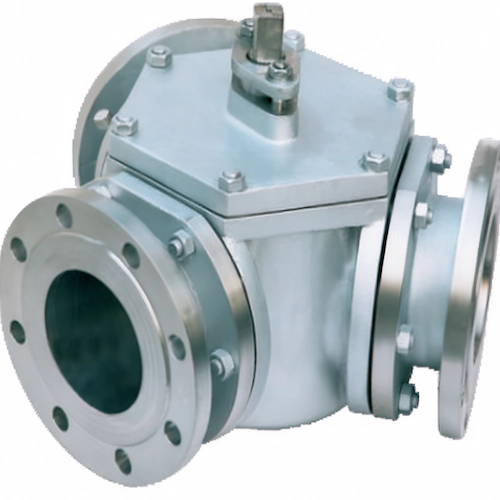
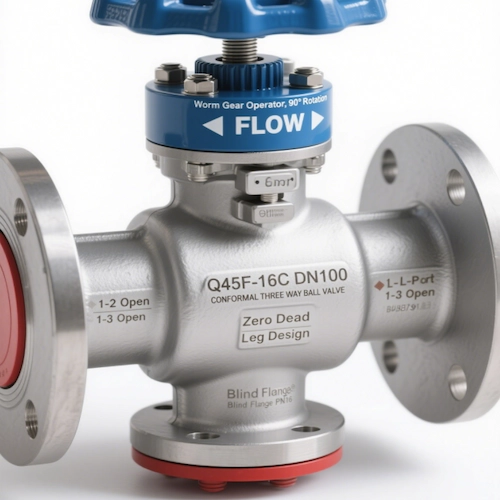
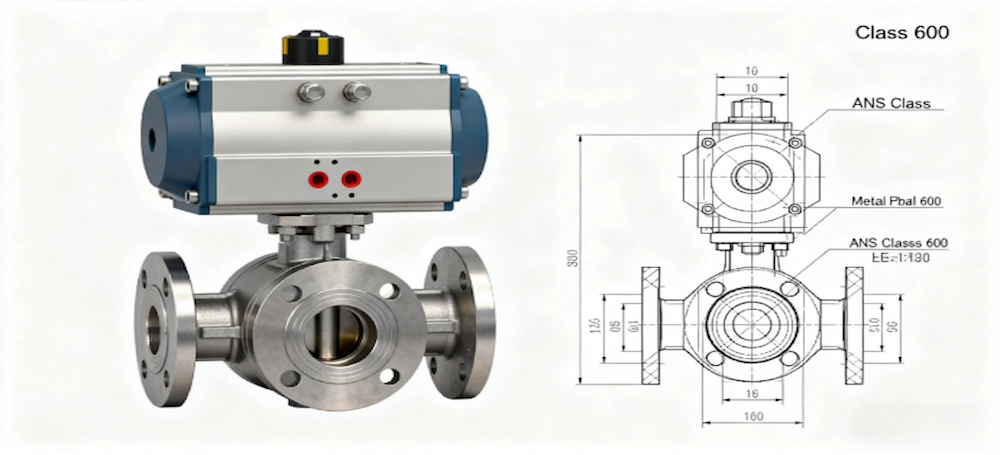
A three way ball valve is not selected only by nominal size. The most important question is how the flow should move through the valve: L-port diversion, T-port mixing, common port selection or another project-specific pattern. The conformal design should be confirmed by the process requirement, actuator position feedback, seal material, end connection and maintenance access.
The recommended Conformal Three Way Ball Valve should be confirmed with medium, pressure-temperature condition, connection requirement, operating method, inspection requirement and site installation details. Vcore Valve uses that information to avoid unsupported assumptions about size range, pressure class, temperature limit, leakage class or standard compliance.
Product Configuration
| Item | Selection note |
|---|---|
| Valve type | Conformal Three Way Ball Valve for multi-port flow control |
| Port arrangement | L-port, T-port or project-defined flow path confirmed by process logic |
| Body construction | Three-port body selected according to pressure, material and connection needs |
| Seat design | Soft seat or selected reinforced seat based on medium and temperature |
| Operation method | Lever, gear, pneumatic or electric actuation with position logic review |
| Flow direction | Mixing, diverting or switching function confirmed by piping diagram |
Technical Specifications
| Parameter | Project confirmation requirement |
|---|---|
| Size range | Confirmed by selected model and process connection |
| Pressure class | Confirmed by body design, end connection and datasheet |
| Temperature range | Confirmed by body, seat and seal materials |
| Leakage requirement | Confirmed by selected seat design and inspection standard |
| Port pattern | L-port or T-port must be confirmed before quotation |
| Documentation | Datasheet, drawing, test report and material documents available when specified |
How the Design Works
The Conformal Three Way Ball Valve should be specified with a flow diagram. A wrong port pattern can route the medium incorrectly even if the valve body fits the pipeline. Vcore Valve checks the common port, shut-off positions, actuator rotation, fail position and handle indication so the valve logic matches the system requirement.
For quotation, Vcore Valve treats the Conformal Three Way Ball Valve as part of a system. The same product name can require different body materials, sealing materials, connection dimensions, operation methods and inspection documents when the medium, temperature, pressure, cycling frequency or installation position changes.
Product Comparison
| Valve option | Main selection point | Typical review scenario |
|---|---|---|
| Conformal three way ball valve | One valve body with multiple flow path options | Mixing, diverting and flow switching duties |
| Two-way ball valve | Single inlet and outlet for simple isolation | Straight pipeline shut-off service |
| Three way globe valve | Linear valve style for selected mixing or diverting control | Applications needing throttling or control characteristic review |
| Manifold assembly | Multiple valves and fittings arranged together | Complex systems requiring isolation plus bypass or drain functions |
Selection Checklist
| Checklist item | Why it matters |
|---|---|
| Flow diagram supplied | Port function and common port must be clear before selection |
| L-port or T-port confirmed | Port pattern determines mixing, diverting and shut-off behavior |
| Actuation logic reviewed | Open-close positions, feedback and fail position should match control system |
| Seat material selected | Medium, temperature and cycling frequency determine seat choice |
| Maintenance access checked | Handle, actuator and port orientation should remain accessible after installation |
Typical Applications
- Mixing or diverting flow in water, chemical and utility systems after material review
- Switching between two lines or two process paths with one valve body
- Skid packages and compact piping layouts requiring multi-port routing
- Automated flow path selection with pneumatic or electric actuation
Application Limits
- Not a substitute for a control valve when precise throttling characteristic is required
- Wrong port pattern can cause incorrect flow routing, so drawings must be confirmed
- Viscous, crystallizing or abrasive media may require special seat and cavity review
Engineering Notes
Do not select a Conformal Three Way Ball Valve only from a copied size or pressure range. Old product pages often contain generic ranges that may not match the actual valve model. Vcore Valve confirms the final design from the selected product drawing and customer datasheet before publishing or committing to technical values.
Ordering Workflow
| Step | Action |
|---|---|
| 1 | Send medium, pressure-temperature data, pipe size and connection requirement |
| 2 | Confirm valve type, material, seat design and operation method |
| 3 | Review drawing, datasheet and inspection requirement |
| 4 | Confirm commercial terms, production schedule and document package |
| 5 | Inspect, pack and ship according to confirmed order requirements |
Why Work With Vcore Valve
Vcore Valve helps industrial buyers turn a product name into a confirmed valve specification. The team reviews the application, checks whether the selected Conformal Three Way Ball Valve is suitable, and prepares a quotation around the confirmed construction rather than unsupported generic claims.
Inspection and Documentation
| Document or check | Availability |
|---|---|
| Material certificate | Available when specified in the purchase order |
| Pressure test record | Prepared according to confirmed inspection requirement |
| Dimensional drawing | Provided for review when the selected model is confirmed |
| Packing photos | Available before shipment when requested |
| Nameplate and marking | Prepared according to order and applicable document requirements |
Information Required for Quotation
- Valve size or pipe size and connection standard
- Medium composition, temperature and pressure data
- Operation method: manual, gear, pneumatic or electric where applicable
- Material preference and corrosion concerns
- Inspection, documentation and packing requirements
Related Valve Resources
Review related valve pages that are technically closer to this product family:
For general valve design reference, see ASME B16.34 valve standards information. Final compliance must be confirmed by the selected product model and project datasheet.
FAQ
What is a Conformal Three Way Ball Valve used for?
It is used for multi-port flow routing, such as mixing, diverting or switching flow paths in suitable piping systems.
What is the difference between L-port and T-port?
An L-port usually diverts flow between two paths, while a T-port can support different mixing or distribution functions depending on design.
What information is needed before selection?
A flow diagram, port function, medium, pressure-temperature data, connection type, seat material and actuation method are needed.
Can it be automated?
Yes. Pneumatic or electric actuation can be reviewed after torque, port position and control logic are confirmed.
Does it replace a throttling control valve?
Not always. If precise modulation is required, Vcore Valve should review whether a control valve or special trim is more appropriate.
Practical Takeaway
A reliable Conformal Three Way Ball Valve selection starts with the service data. Send Vcore Valve the project datasheet, and the team will review materials, sealing design, connection details, operation method and inspection documents before confirming the final offer.