Quick Summary: Valve OEM projects generally manufacture to buyer-controlled requirements, while ODM projects may include supplier-led design or engineering. However, responsibility, approval authority and intellectual-property ownership must be defined by contract. A controlled project connects the RFQ, approved drawings, material traceability, manufacturing checkpoints, inspection, pressure testing, documentation, private labelling and change control before shipment.
This valve OEM and ODM process guide explains how custom industrial valve projects require more control than buying a standard catalogue valve. A distributor may need a private-label product range, an EPC buyer may need project-specific drawings and test records, and an engineering team may need a non-standard material, actuator, coating or documentation package. In each case, the commercial label “OEM” or “ODM” is less important than the approved technical requirements and the responsibility boundary between the buyer, supplier and any qualified subcontractors.
This guide explains how a practical valve OEM and ODM project should be controlled from RFQ to delivery. It focuses on buyer inputs, engineering review, document approval, material traceability, inspection, testing, private labelling and supplier evaluation. For a separate overview of shop-floor production stages, see the industrial valve manufacturing process.
Valve OEM vs ODM: What Is the Practical Difference?
In valve procurement, OEM normally refers to manufacturing against buyer-controlled requirements, an existing design, a private-label specification or a drawing package supplied or approved by the buyer. ODM may include manufacturer-led design, configuration development or engineering support, but that does not automatically transfer approval authority or intellectual-property ownership. The exact scope must be defined by the contract, approved technical documents and any IP or confidentiality agreement.
Neither OEM nor ODM is a quality grade. A valve is acceptable only when it meets the purchase order, approved datasheet, drawings, applicable standards, inspection and test plan, and agreed documentation requirements.
| Item | Typical OEM Arrangement | Typical ODM Arrangement | Control Note |
|---|---|---|---|
| Starting information | Buyer specification, drawing or sample | Buyer service requirements and supplier proposal | Subject to contract |
| Design input | Often buyer-controlled | Often supplier-developed for review | Approval authority must be written |
| Approval authority | Buyer approves deviations and release | Buyer approves final technical basis unless agreed otherwise | Do not rely on terminology alone |
| Drawing control | Buyer or supplier drawings under revision control | Supplier drawings submitted for approval | Latest approved revision governs production |
| Tooling | May be buyer-owned or supplier-owned | Often supplier-controlled unless purchased by buyer | Ownership and reuse rights need agreement |
| Prototype or first article | Project-dependent | Common for new designs but not universal | Define acceptance before production |
| Manufacturing | Against approved buyer requirements | Against approved supplier design and buyer scope | Subcontracted processes should be transparent |
| Inspection and testing | Per PO, ITP and standards | Per approved test plan and development scope | OEM/ODM label does not replace acceptance criteria |
| Private labelling | Common | Common | Mandatory markings and traceability remain |
| Documentation | Buyer-defined package | Supplier package reviewed against PO | Certificates must match verified scope |
| Intellectual property | Often buyer-owned, but not automatic | May be supplier-owned, shared or buyer-owned | Define in contract, not in assumptions |
| Change control | Buyer approval for drawing or material changes | Buyer approval for agreed critical changes | All concessions should be documented |
Information Required Before an OEM or ODM Valve RFQ
A useful RFQ should give the supplier enough information to check feasibility, standards, materials, testing and documentation before price is confirmed. At minimum, the buyer should define valve type, size, quantity, design pressure and temperature, operating pressure and temperature, media, concentration, pressure class or PN designation, end connections and face-to-face requirements.
Material requirements should separate body, trim, seat, seal, packing, gasket and bolting materials. Operating method should identify manual, pneumatic, electric or hydraulic actuation, including fail position, accessories and power supply when applicable. Special requirements such as leakage class, fire-safe design, fugitive-emission control, NACE/ISO 15156 sour-service suitability, coating, corrosion protection, inspection points, certification, marking, branding, packing and delivery milestones should be stated before quotation.
The RFQ should also cover confidentiality, drawing ownership, tooling ownership, approval milestones and the process for approving technical deviations. Without those inputs, a supplier may quote a product that is commercially attractive but technically incomplete.
Valve OEM and ODM Process: Controlled Stages From RFQ to Delivery
- Requirements and responsibility definition. The buyer provides the intended service, commercial scope and required documents. The supplier confirms what it can manufacture, coordinate, inspect or outsource under the project scope.
- Feasibility and compliance review. The supplier checks valve type, pressure rating, material, end connection, applicable standards, testing, certification and schedule. Any uncertainty should be clarified before order acceptance.
- Datasheet, drawing and document approval. Approved datasheets, drawings, ITPs and documentation lists become the working basis. The buyer should mark whether documents are for review, approval, information or manufacturing release.
- Prototype or first-article stage when required. New designs, new tooling, unusual materials or private-label product ranges may require a prototype or first-article inspection. It is not mandatory for every repeat or standard configuration.
- Material procurement and traceability. Materials should match the approved specification. Heat numbers, material certificates and substitutions need documented control.
- Manufacturing and in-process inspection. Production follows approved drawings and procedures. Machining, assembly, welding, coating or subcontracted processes should be controlled according to the agreed plan.
- Pressure, functional and project-specific testing. Shell, seat, functional, actuator, coating, fugitive-emission, fire-safe or other tests are performed only when required by the PO, standard or ITP.
- Final document review, marking, packing and release. The buyer or inspection party reviews release documents, markings, packing and shipment readiness before dispatch when the project requires it.
Design Review and Applicable Valve Standards
Applicable standards depend on valve type, pressure class, material, end connection, industry, location and project specification. A ball valve, gate valve, butterfly valve and check valve may be controlled by different design and test standards. Standards such as ASME B16.34, API 6D, API 600, API 608, API 609, API 598, ISO 5208 and relevant EN standards may be relevant, but no single list applies to every valve.
Buyers should separate design standards, test standards, material standards and certification requirements. For example, a valve may use one standard for design, another for end connections, another for testing, and a project-specific specification for documentation and inspection.
| Requirement Type | Typical Question | Buyer Control Point |
|---|---|---|
| Design standard | Which valve design code governs pressure boundary and construction? | Confirm valve type and edition where required |
| End-connection standard | Which flange, thread, weld end or wafer interface is required? | Check mating pipe and flange specification |
| Face-to-face standard | Will the valve fit the existing pipe layout? | Approve GA drawing dimensions |
| Material standard | Which cast, forged, trim, seat and bolting grades are acceptable? | Reject unapproved substitutions |
| Inspection and testing standard | Which shell, seat and functional tests apply? | Review ITP and test report format |
| Quality-system requirement | Is ISO 9001, API Spec Q1 or another system required? | Check certificate scope, not only the logo |
| Project-specific specification | Are there additional client, EPC or end-user requirements? | Resolve conflicts before production |
Material Traceability and Manufacturing Control
Material control begins with approved material specifications. The supplier should confirm body, bonnet, closure, stem, trim, seat, seal, gasket and bolting requirements before procurement. Material test reports or material certificates should be reviewed against the PO and datasheet. EN 10204 3.1 or 3.2 documents should only be promised when they are included in the agreed scope and available from the relevant supply chain.
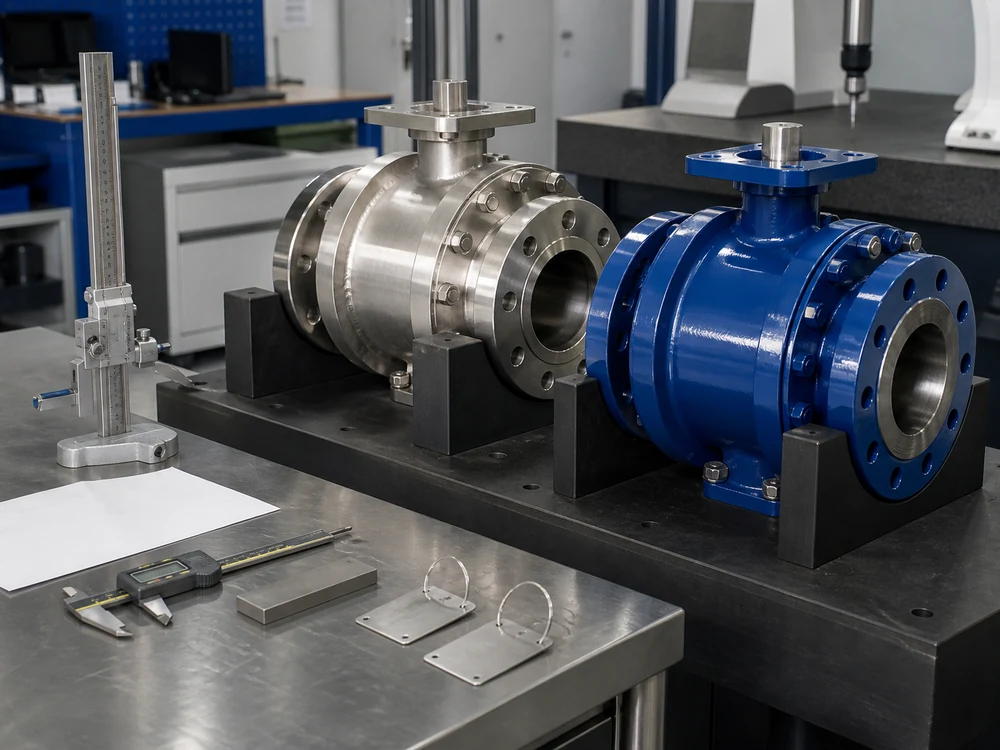
Heat-number traceability, positive material identification, casting or forging supplier control, machining checks, welding records, NDE reports, assembly control, nonconformance records and corrective actions may be required depending on the valve type and project risk. Material substitution requires documented buyer approval before use, even when the proposed grade appears equivalent.
Inspection, Pressure Testing and Final Acceptance
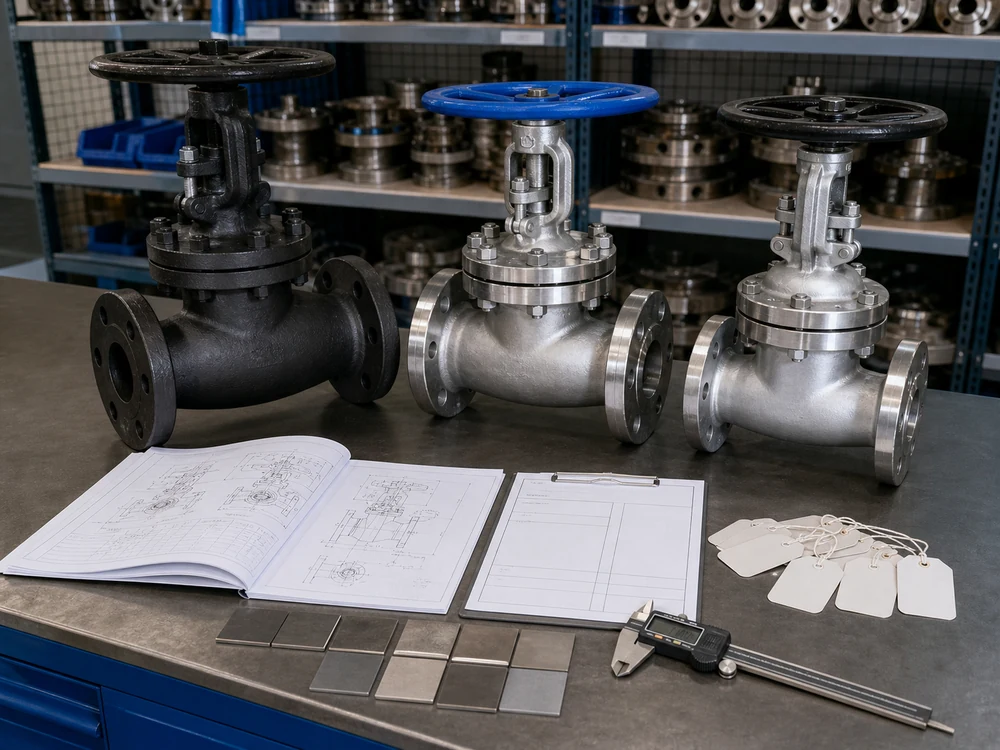
In a valve OEM and ODM process, the inspection plan should translate project requirements into hold, witness, review and surveillance points. A valve inspection and test plan helps define who reviews documents, who witnesses tests, and which records are required before shipment.
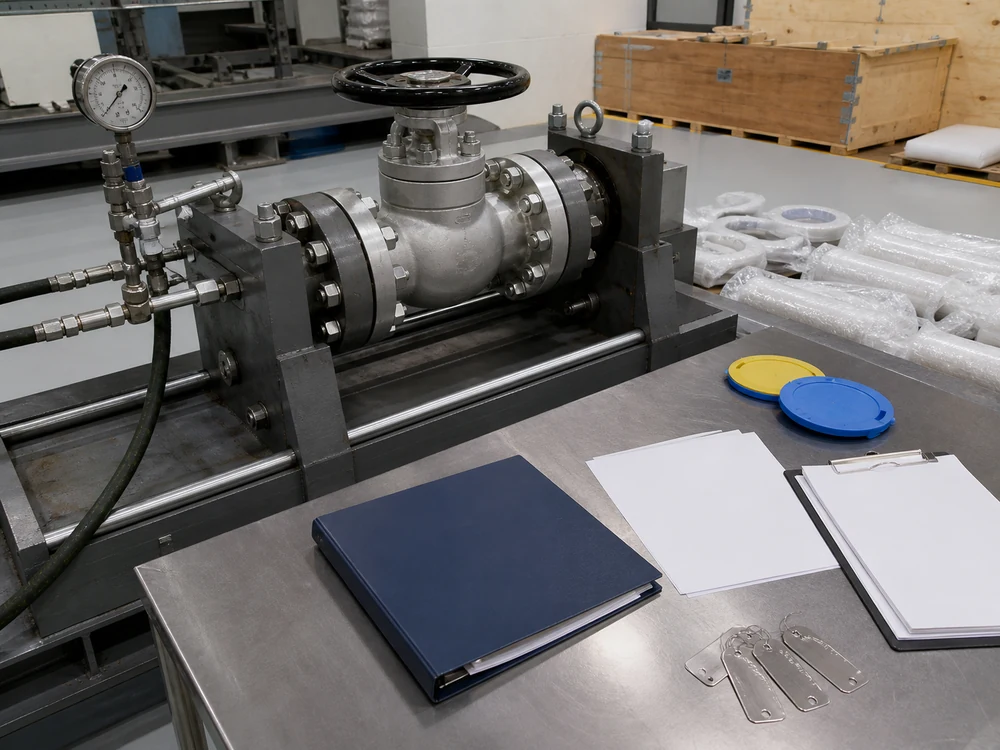
Typical acceptance activities may include incoming material inspection, in-process dimensional checks, shell testing, seat testing, functional testing, actuator testing, coating inspection, marking review, packing inspection and final release documentation. A factory acceptance test should be specified when the buyer requires a formal witnessed release event or an integrated valve-and-actuator package check.
Documentation Buyers Should Define in the Purchase Order
Documentation should be agreed before order placement, not requested only at shipment. Depending on project scope, the document package may include approved datasheets, general arrangement drawings, bill of materials when contractually required, material certificates, ITP, inspection reports, pressure-test reports, NDE reports, coating reports, operation and maintenance manuals, packing lists and certificates of conformity.
Certification language should be precise. API Monogram claims are permitted only when the manufacturing location, product and applicable specification fall within a valid licence scope. CE, PED, SIL, fire-safe, fugitive-emission or NACE-related statements should be made only when the certificate, test report or compliance basis is verified for the relevant product and project.
For more detail on how buyers should review MTCs, test reports and release packages, see valve certificates and quality documents.
Private Labelling, Marking and Intellectual Property
Private labelling can include brand name, packaging, nameplate layout, colour scheme or customer part numbers. It does not replace mandatory valve markings, pressure class markings, material traceability, heat numbers, flow direction, size, rating or other markings required by the applicable standard and purchase order.
Drawing ownership, tooling ownership, confidential information, permission to reuse designs and change-control approval should be addressed in the contract. A buyer may own the brand and some drawings, while the supplier may own process know-how, standard patterns or manufacturing data. This article is not legal advice; commercial and IP terms should be reviewed contractually before development starts.
Common OEM and ODM Project Risks
Most problems are not caused by the words OEM or ODM. They come from incomplete service conditions, unclear responsibility boundaries, unapproved material substitution, conflicting standards, uncontrolled drawing revisions, missed inspection points, unsupported certification claims, weak document control or inadequate export packing.
A controlled project makes each risk visible early. The supplier should communicate limitations before production, and the buyer should approve or reject changes in writing.
Valve OEM and ODM RFQ Checklist
| RFQ Item | What to Provide | Why It Matters |
|---|---|---|
| Service conditions | Media, concentration, pressure, temperature and cycling | Drives material, seal and pressure rating review |
| Valve configuration | Type, size, bore, end connection, operation and accessories | Prevents quotation for the wrong construction |
| Standards | Design, dimension, material, testing and documentation standards | Avoids conflicts between codes and project specs |
| Materials | Body, trim, seat, seals, gaskets, bolting and coating | Controls corrosion, temperature and compatibility risks |
| Inspection scope | ITP points, witness requirements and third-party inspection | Defines acceptance and release process |
| Documentation | Datasheets, drawings, certificates, reports and manuals | Avoids shipment delays and incomplete handover |
| Branding and packing | Nameplate, colour, label, packing and export requirements | Keeps private label separate from mandatory marking |
| Commercial controls | Schedule, milestones, approval timing, IP and confidentiality | Clarifies responsibility before production starts |
How to Evaluate a Valve OEM or ODM Supplier
A capable supplier should be able to review engineering requirements before confirming price, identify standards that apply to the valve type, explain its manufacturing and subcontracting scope, control material traceability, maintain calibrated inspection and test equipment, manage document revisions, record nonconformances and communicate approval points clearly.
Buyers should ask how the supplier controls casting or forging sources, machining inspection, assembly checks, pressure testing, actuator integration, packing and export release. Certification scope should be checked against the exact product and manufacturing location.
Discuss Your Custom Valve Project
Vcore Valve can review custom valve requirements, private-label needs, material requests, inspection expectations and documentation packages according to project scope. Availability depends on valve type, standard, material and approval requirements.
To discuss a valve OEM and ODM process, an RFQ or an OEM/ODM responsibility boundary, contact Vcore Valve with the valve datasheet, service conditions, required standards and expected documentation package.
Frequently Asked Questions
What is the difference between valve OEM and ODM?
Valve OEM usually means manufacturing to buyer-controlled requirements or an approved existing design. Valve ODM may include supplier-led design or engineering development. In both cases, the exact responsibility, approval authority and ownership depend on the contract and approved documents.
Who owns the valve drawings and intellectual property?
Drawing and intellectual-property ownership are not automatically determined by OEM or ODM terminology. They should be defined in the purchase contract, drawing approval terms, tooling agreement and confidentiality agreement.
What information is required for a valve OEM RFQ?
A useful RFQ should include valve type, size, quantity, pressure and temperature conditions, media, materials, end connections, operation method, applicable standards, inspection scope, documentation requirements, marking, packing, schedule and any IP or confidentiality requirements.
Is a prototype or first-article inspection always required?
No. A prototype or first-article inspection is project-dependent. It is often useful for new designs, new tooling, private-label ranges or unusual materials, but may not be necessary for repeat orders or approved standard configurations.
Which standards apply to an OEM or ODM valve project?
The applicable standards depend on valve type, pressure class, connection, material, industry and project specification. Design, end-connection, material, testing and documentation standards should be listed separately in the RFQ or purchase order.
What quality documents should a valve buyer request?
Common documents include approved datasheets, general arrangement drawings, material certificates, ITP, inspection reports, pressure-test reports, applicable NDE or coating reports, operation manuals, packing lists and certificates of conformity when required by the project.
Can a customer’s private brand be applied to the valve?
Yes, private branding can be applied when agreed, but it must not remove mandatory valve markings, nameplate information or traceability requirements required by the applicable standards and purchase order.
How should design changes be controlled after approval?
Design changes should be recorded through revision-controlled drawings, updated datasheets or documented concessions. Material substitutions, dimensional changes and functional changes should receive buyer approval before implementation.
Technical References
The following official pages are useful references for quality-system and valve-standard context. They should be checked against the purchase order and current project requirements before use:
- ISO 9001:2015 is the ISO quality management systems requirements standard. ISO’s page shows the 2015 edition as current, with Amendment 1:2024 and revision activity noted.
- API Specification Q1 is published by API for quality management system requirements for organizations providing products for the petroleum and natural gas industry.
- ASME B16.34 covers new-construction valves, including pressure-temperature ratings, materials, examination, testing and marking within its stated scope. The official ASME product page currently displays B16.34-2025.