Valve pressure units can be converted mathematically, but a conversion does not determine the correct valve rating. 1 MPa equals 10 bar and approximately 145.038 PSI. Keep the original specified value, identify whether pressure is gauge or absolute, and distinguish operating, design, differential and test pressure. PN and ASME Class are rating designations rather than pressure units; final valve selection must follow the governing standard, material, temperature and complete valve construction.
Valve pressure units such as MPa, bar, PSI, kPa and kgf/cm² appear in datasheets, RFQs, test reports and nameplate reviews. This guide has two separate purposes. First, it gives accurate pressure-unit conversions. Second, it helps buyers avoid a common specification mistake: treating a converted pressure number as if it automatically determines the valve rating.
For example, converting 1.6 MPa to 16 bar is a mathematical operation. Selecting PN16, ASME Class 150, Class 300 or another rating is an engineering decision. That decision depends on design pressure, design temperature, body material, end connection, valve construction and the governing standard. For detailed rating selection, use this page together with our valve pressure-temperature rating guide.
Quick Valve Pressure Unit Conversion Table
The table below converts numerical pressure values only. It does not convert PN or ASME Class ratings, and it must not be used to match PN numbers with ASME pressure classes.
| Starting value | MPa | bar | PSI | kPa | kgf/cm² |
|---|---|---|---|---|---|
| 1 MPa | 1 | 10 | 145.038 | 1,000 | 10.1972 |
| 1 bar | 0.1 | 1 | 14.5038 | 100 | 1.01972 |
| 1 PSI | 0.00689476 | 0.0689476 | 1 | 6.89476 | 0.070307 |
| 1 kPa | 0.001 | 0.01 | 0.145038 | 1 | 0.0101972 |
| 1 kgf/cm² | 0.0980665 | 0.980665 | 14.2233 | 98.0665 | 1 |
Exact calculated values may be rounded for display, but the original specified pressure and unit should remain in engineering documents. If a datasheet says 1.6 MPa(g), do not replace it with only 16 bar or 232 PSI. Preserve the original value and add conversions as reference values.
What MPa, Bar, PSI, kPa and kgf/cm² Mean
Pascal and kilopascal. The pascal (Pa) is the SI unit of pressure. One kilopascal (kPa) equals 1,000 Pa. In valve documents, kPa is common for lower-pressure instruments, HVAC systems and some process data.
Megapascal. One megapascal (MPa) equals 1,000 kPa or 1,000,000 Pa. MPa is common in metric engineering documents, pressure equipment specifications and some valve datasheets.
Bar. One bar equals 100 kPa or 0.1 MPa. Bar is not an SI unit, but it remains widely used for industrial pressure values, valve testing and piping component documents.
PSI. PSI means pound-force per square inch. It is common in North American specifications and ASME-related project documents. In valve RFQs, use ASME pressure class rather than the loose phrase “ANSI pressure” when referring to Class-rated valves.
Kilogram-force per square centimetre. The correct technical notation is kgf/cm². Some legacy documents write kg/cm² informally, but that shorthand can be misleading because pressure is based on force per area, not mass per area.
Pressure Conversion Formulas
Use the following formulas for pressure-unit conversion. They are useful for checking datasheets, RFQs and drawings, but they do not select the final valve rating.
MPa to bar and bar to MPa
MPa to bar: multiply MPa by 10. Bar to MPa: multiply bar by 0.1.
Bar to PSI and PSI to bar
Bar to PSI: multiply bar by 14.5038. PSI to bar: multiply PSI by 0.0689476.
MPa to PSI and PSI to MPa
MPa to PSI: multiply MPa by 145.038. PSI to MPa: multiply PSI by 0.00689476.
kgf/cm² conversions
1 kgf/cm² is approximately 0.980665 bar, 0.0980665 MPa and 14.2233 PSI. When an old drawing uses kg/cm², confirm whether the intended pressure unit is kgf/cm² before converting.
kPa conversions
1 MPa equals 1,000 kPa. 1 bar equals 100 kPa. 1 PSI equals approximately 6.89476 kPa.
Worked Pressure Conversion Examples
The following are calculation examples only. They are not customer cases and they do not imply that a particular valve rating has been selected.
| Example | Calculation | Result | Engineering note |
|---|---|---|---|
| 1.6 MPa to bar and PSI | 1.6 x 10; 1.6 x 145.038 | 16 bar; 232.061 PSI | Keep the source value as 1.6 MPa if that is the specified design pressure. |
| 25 bar to MPa and PSI | 25 x 0.1; 25 x 14.5038 | 2.5 MPa; 362.595 PSI | Do not infer ASME Class from this number alone. |
| 300 PSI to bar and MPa | 300 x 0.0689476; 300 x 0.00689476 | 20.6843 bar; 2.06843 MPa | PSI is a unit; ASME Class is a rating designation. |
| 10 kgf/cm² to bar and MPa | 10 x 0.980665; 10 x 0.0980665 | 9.80665 bar; 0.980665 MPa | Confirm whether legacy kg/cm² notation means kgf/cm². |
Pressure Units vs PN and ASME Class
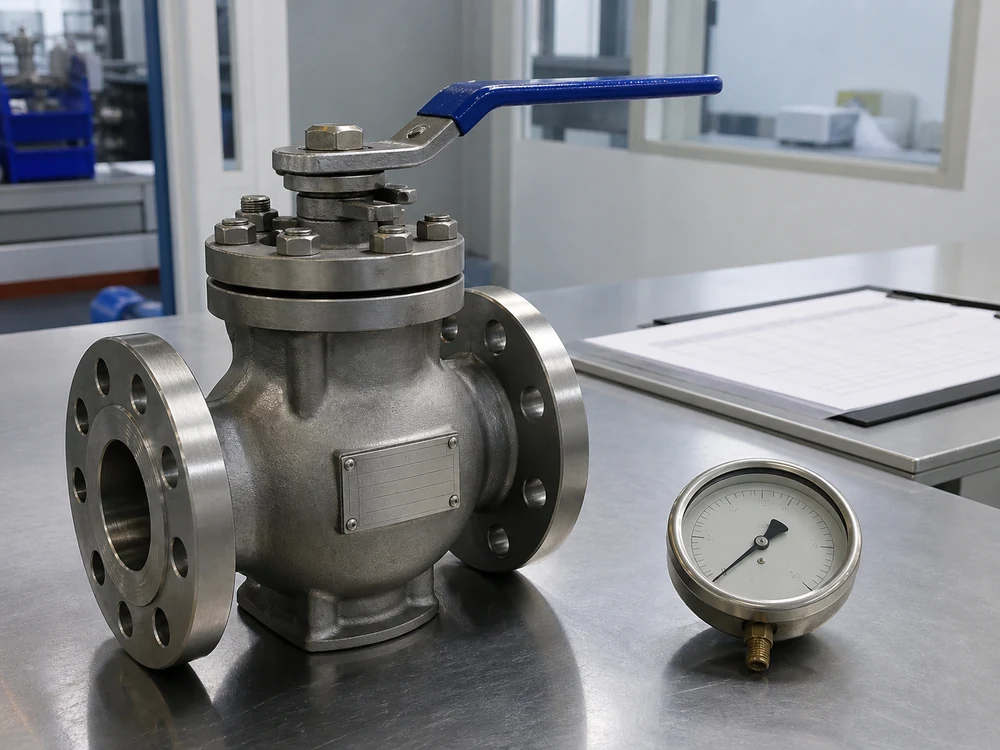
MPa, bar, PSI and kPa are pressure units. PN and ASME Class are rating designations. They are related to pressure engineering, but they are not the same type of information.
PN is a nominal pressure designation, not a universal allowable working pressure for every valve material and temperature. ISO 7268 describes PN as a numerical designation used as a convenient round number for reference purposes and mating compatibility. For a deeper explanation, see DN and PN meaning in valves.
ASME Class is also a pressure-class designation. Class 150 does not mean a universal 150-PSI working-pressure limit. ASME B16.34 covers pressure-temperature ratings, materials, testing and marking for applicable valve constructions. The allowable pressure depends on the class, material group, design temperature and complete valve construction.
Do not convert PN to ASME Class through a single fixed mathematical factor. When a project specification gives only a converted pressure value, ask for the required rating system, valve standard, flange standard and design temperature before confirming the valve.
Gauge Pressure vs Absolute Pressure
Pressure values may be stated as gauge pressure or absolute pressure. Gauge pressure is referenced to local atmospheric pressure. Absolute pressure is referenced to absolute vacuum.
In inch-pound documents, psig means pounds per square inch gauge and psia means pounds per square inch absolute. In metric documents, barg means bar gauge and bara means bar absolute. MPa(g), kPa(g), MPa(a) and kPa(a) follow the same logic.
A datasheet must state the pressure reference when ambiguity could affect engineering decisions. Do not apply one assumed atmospheric correction as a universal field rule without knowing the reference condition and the intended calculation.
Operating, Design, Differential, Test and Set Pressure
Different pressure terms answer different engineering questions. They must not be interchanged in a valve RFQ.
| Pressure term | Meaning | Why it matters | Common clarification |
|---|---|---|---|
| Normal operating pressure | Typical pressure during regular service | Shows daily process condition | Is it stable, cycling or intermittent? |
| Maximum operating pressure | Highest expected service pressure | Helps define process envelope | Is it sustained or short-duration? |
| Design pressure | Engineering pressure used for design selection | Usually central to rating review | State unit, gauge/absolute reference and temperature. |
| Maximum differential pressure | Maximum pressure difference across the valve | Affects torque, actuator sizing, trim and seat load | Provide inlet and outlet pressures. |
| Shell test pressure | Controlled test pressure for pressure-containing parts | Verifies body and bonnet integrity | Must follow the specified valve type, rating and test standard. |
| Seat test pressure | Controlled test pressure for closure sealing | Verifies seat leakage performance | Depends on valve type and leakage requirement. |
| Set pressure | Pressure at which a relief or safety device is intended to open | Relevant for pressure-relief and safety devices | Do not confuse set pressure with line design pressure. |
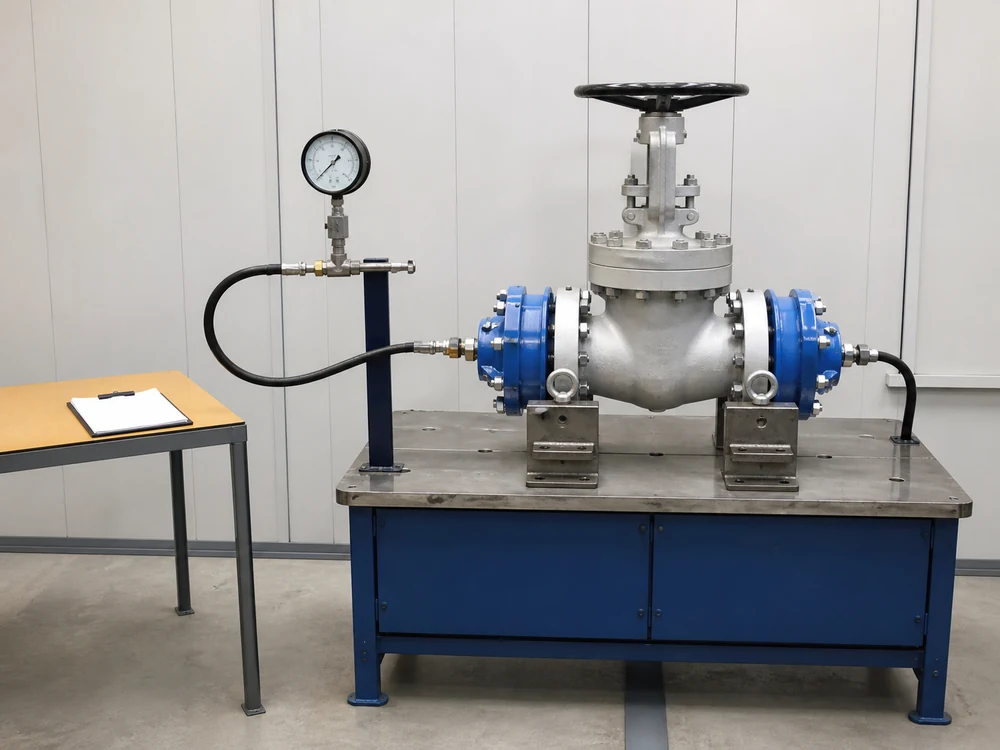
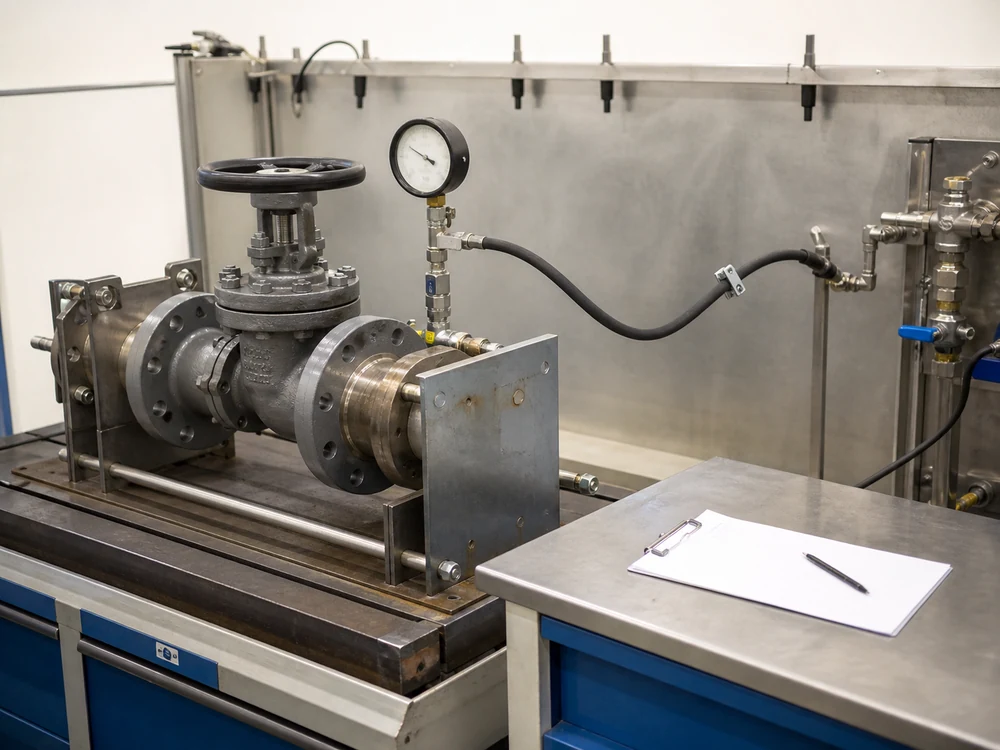
Test pressure is a controlled verification condition and must not be used as the continuous working pressure. For more detail on shell and seat testing terminology, see our valve pressure test methods.
Common Pressure Conversion and Specification Errors
The most damaging errors are often not complex calculations. They are simple specification mistakes that hide the original engineering intent.
- Moving the decimal incorrectly between MPa and bar, such as reading 1.6 MPa as 1.6 bar instead of 16 bar.
- Treating kg/cm² shorthand as a mass unit instead of confirming kgf/cm² pressure.
- Losing the original unit after conversion and leaving only a rounded reference value.
- Mixing gauge and absolute pressure without stating psig, psia, barg or bara.
- Treating ASME Class as PSI.
- Treating PN as an unrestricted working-pressure value at every temperature and material.
- Using shell or seat test pressure as if it were continuous working pressure.
- Selecting a valve class from converted operating pressure without checking design temperature and material.
- Rounding a converted value and treating the rounding as an engineering safety margin.
How to State Pressure Correctly in a Valve RFQ
A good RFQ preserves the original value and adds a converted value only for reference. A clear line might read: “Design pressure: 1.6 MPa(g), approximately 16 bar(g), at the specified design temperature.”
For reliable quotation, state operating pressure, design pressure, inlet pressure, outlet pressure, maximum differential pressure, design temperature, pressure reference, required PN or ASME Class system, valve and flange standard, test standard, medium and service condition. If the application combines high pressure and high temperature, review high-temperature and high-pressure valve selection before finalizing the specification.
Valve Pressure Information Checklist
| Required field | Why it matters | Typical clarification needed |
|---|---|---|
| Original pressure value and unit | Prevents conversion drift | Was the source value MPa, bar, PSI, kPa or kgf/cm²? |
| Gauge or absolute reference | Affects engineering interpretation | Use psig/psia, barg/bara or MPa(g)/MPa(a). |
| Operating and design pressure | Separates service condition from design basis | Which value should be used for rating review? |
| Design temperature | Allowable pressure changes with temperature | Provide maximum and minimum design temperatures. |
| Maximum differential pressure | Affects operation, torque and sealing load | Provide inlet and outlet pressure cases. |
| Rating system | Prevents PN/Class confusion | Confirm PN, ASME Class or another project system. |
| Valve and test standard | Defines construction and verification basis | State the required valve standard and inspection/test standard. |
| Medium and service condition | Material and sealing selection depend on service | Include fluid, concentration, phase, corrosion and solids if relevant. |
Need Help Confirming a Valve Pressure Specification?
Vcore Valve can review pressure units, pressure type, temperature, material, valve type, rating system and test requirements before quotation. If your datasheet uses mixed MPa, bar, PSI, PN or Class terminology, you can request a valve specification review and send the original pressure values for checking.
Frequently Asked Questions
How many bar are in 1 MPa?
1 MPa equals 10 bar.
How many PSI are in 1 bar?
1 bar equals approximately 14.5038 PSI.
How many PSI are in 1 MPa?
1 MPa equals approximately 145.038 PSI.
Is PN16 always equal to 16 bar working pressure?
No. PN16 is a nominal pressure designation, not a universal 16-bar allowable working pressure under every material and temperature condition.
Does Class 150 mean 150 PSI?
No. ASME Class 150 is a pressure-class designation. The allowable pressure depends on the applicable standard, material and temperature.
Should pressure values always be rounded up when selecting a valve?
No. Rounded conversion values are for display only. Valve selection must be based on design pressure, design temperature, material, standard and complete valve construction.
What is the difference between psig and psia?
psig is gauge pressure referenced to local atmospheric pressure. psia is absolute pressure referenced to absolute vacuum.
What pressure information is required for a valve quotation?
Provide operating pressure, design pressure, inlet and outlet pressure, maximum differential pressure, pressure reference, design temperature, rating system, valve standard, test standard and service medium.