PTFE Lined Check Valve for Corrosive Chemical Service
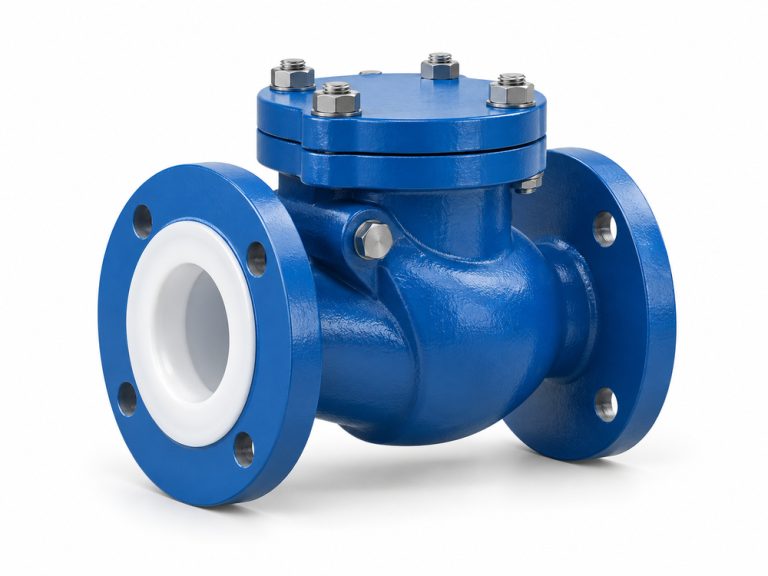
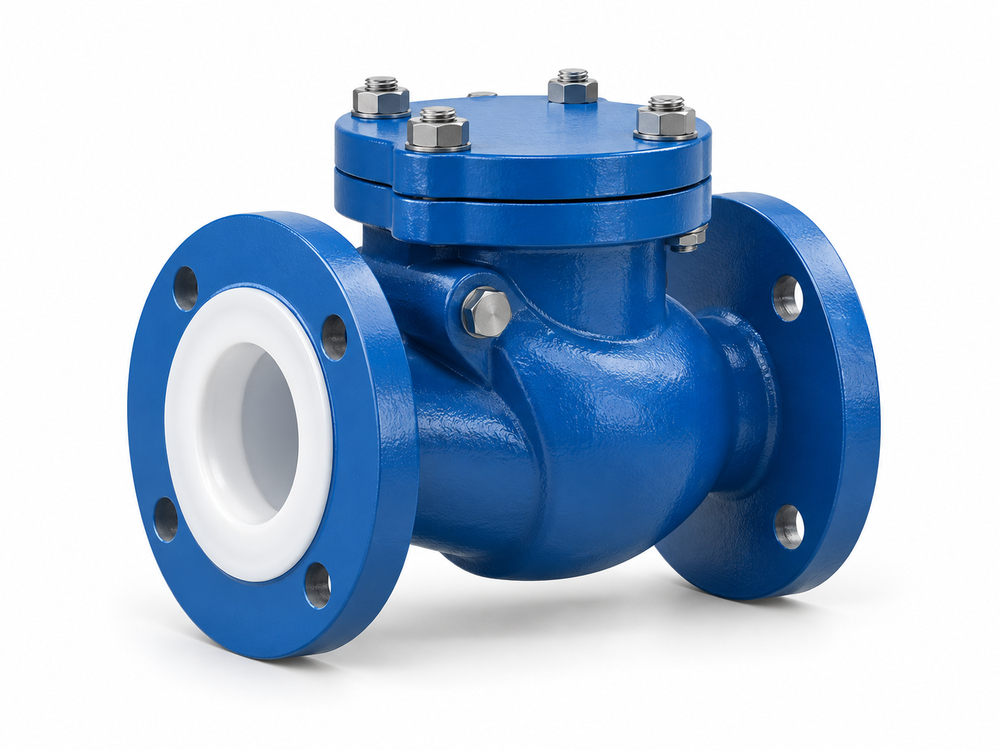
A PTFE lined check valve, also called a lined non-return valve, helps prevent reverse flow in chemical transfer and process pipelines. Unlike a manually operated isolation valve, it responds to hydraulic conditions without a routine external control signal.
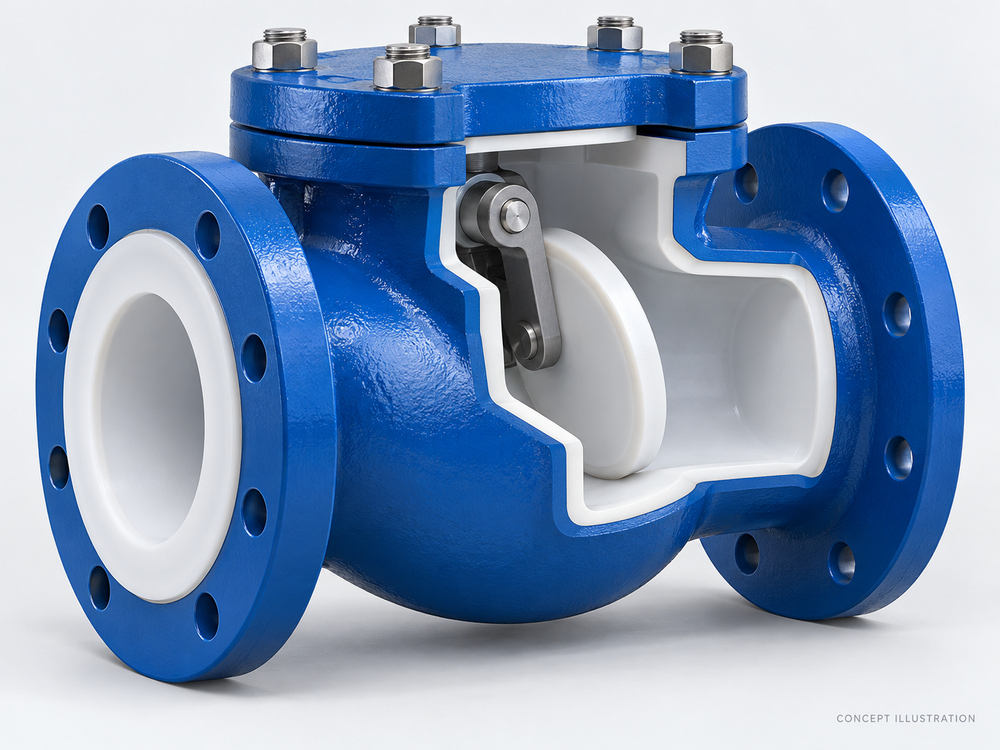
The lining provides a barrier between the process fluid and the metal body. Corrosion protection also depends on the closure element, seat, guides, hinge components and any spring exposed to the medium. A valve with a PTFE seat alone is not equivalent to a valve with a lined body passage.
For a complete chemical line, combine automatic non-return duty with a separate isolation valve where required. Our PTFE Lined Ball Valve covers quarter-turn shut-off, while the check valve addresses reverse flow. Review the wider system through our Chemical Processing Valve Solutions.
How the Lined Construction Protects the Flow Passage
The metal shell carries mechanical loads while the internal lining separates specified wetted surfaces from the chemical. The approved sectional drawing should identify where the lining starts and ends, how it is retained and which components remain exposed.
- Body and flange faces: check the continuity of the barrier through the internal passage and sealing interfaces.
- Moving components: identify whether the closure element is solid fluoropolymer, encapsulated or another compatible construction.
- Small wetted parts: verify guides, pins, springs and seals individually; a lined body cannot protect an incompatible exposed component.
Automatic Non-Return Function
Responds to the direction and strength of flow without a handwheel, air supply or electric actuator for routine operation.
Protected Wetted Passage
Fluoropolymer lining separates specified metal surfaces from compatible corrosive liquids.
Chemical Duty Selection
Selection considers chemical composition, concentration, contaminants and cleaning conditions as well as the process temperature.
Flow-Based Sizing
Minimum and maximum flow, allowable pressure loss and closure stability guide selection alongside pipe size.
Defined Installation Orientation
The mounting direction follows the selected closure mechanism and the approved installation instructions.
Inspection-Focused Procurement
Lining inspection, dimensional checks and agreed pressure and leakage tests provide a clear basis for acceptance.
Technical Specifications
The following schedule defines the information needed to select and quote a configuration. Size limits, materials and ratings are established for the selected model in the quotation and approved datasheet.
| Item | Selection / Specification Basis |
|---|---|
| Product Type | PTFE lined check valve / lined non-return valve |
| Primary Function | Automatic prevention of reverse flow; not a regulating valve or maintenance isolation device |
| Subtype / Design | Closure mechanism to be identified on the approved drawing; ball, lift or swing principles have different installation and flow requirements |
| Nominal Size | Specify DN / NPS, actual flow range and pipe internal diameter; confirm available model size |
| Connection | Flanged configuration to be reviewed against the piping class; other arrangements require model confirmation |
| Flange Standard | Specify required ASME B16.5, EN 1092-1 or other mating standard; verify drilling and facing compatibility |
| Face-to-Face | Approved manufacturer drawing or agreed dimensional standard; do not assume interchangeability with an unlined valve |
| Pressure Rating | Confirmed for the complete body, lining, closure and connection assembly at design temperature |
| Operating Temperature | Confirm normal, minimum, maximum and cleaning temperatures against the selected assembly rating |
| Body Material | Pressure-containing grade to be specified; carbon steel, ductile iron or stainless steel construction requires model and duty review |
| Lining | PTFE as specified; any proposed PFA or other fluoropolymer alternative must be identified and approved separately |
| Closure / Seat | Confirm closure material, encapsulation and seat construction; specify reverse-pressure leakage acceptance |
| Other Wetted Components | List guides, hinges, pins, springs and seals where present, including their exact materials |
| Operation | Self-acting; gravity, spring and hydraulic closing contributions depend on the selected design |
| Flow Requirements | Minimum / normal / maximum flow, viscosity, density, allowable pressure loss and required opening differential |
| Installation | Flow arrow and permitted horizontal or vertical orientation according to selected model |
| Vacuum Duty | Separate verification of absolute pressure, temperature and liner support; positive-pressure rating does not establish vacuum suitability |
| Design / Test Standards | Applicable design standard and inspection plan agreed for the model; API 598 or EN 12266-1 only where specified and applicable |
| Inspection / Documents | 】 |
How a PTFE Lined Check Valve Works
When upstream pressure and flow provide sufficient opening force, the ball, disc or other closure member moves away from its seat. The medium passes through the protected internal passage. The differential needed to start opening is distinct from the flow needed to hold the valve steadily open.
As forward flow decreases, the closure member moves toward the seat under the forces present in that design. Reverse differential pressure can then help maintain seating. Stable closure and low-pressure sealing depend on orientation, component weight, any spring force and seat condition.
An oversized check valve may operate with its closure only partly open, leading to repeated movement and wear. Pump shutdown behavior also matters: a corrosion-resistant lining does not itself make a valve non-slam or eliminate water hammer.
Body Style and Connection Selection
| Selection Point | Why It Matters | Buyer Check |
|---|---|---|
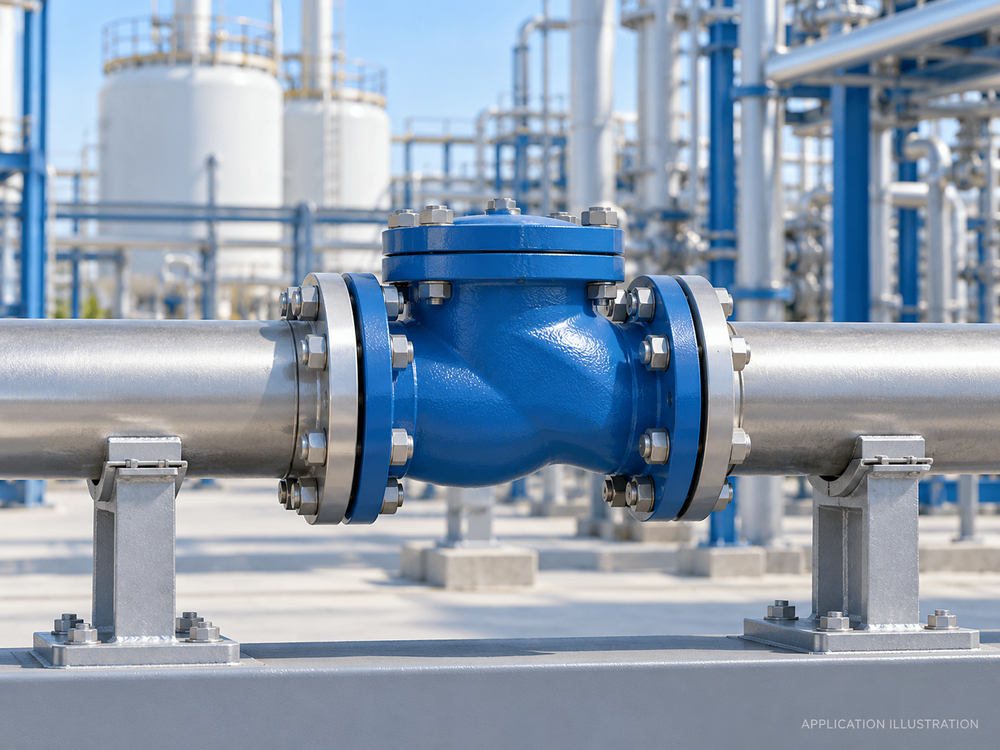
| Flanged ends | Lined sealing faces need compatible mating surfaces and controlled assembly loads. | Provide flange standard, facing, bolt arrangement and the installation torque procedure. |
| Face-to-face length | A replacement valve may not match an existing unlined or rubber-lined unit. | Submit the available installation length and mating pipe drawing. |
| Closure clearance | Internal moving parts must travel freely in the assembled piping. | Verify mating bore, any protruding parts and unobstructed movement. |
| Maintenance access | Chemical residues may remain inside the valve after shutdown. | Plan isolation, depressurization, drainage, decontamination and access for removal. |
Lining and Wetted Material Selection
Specify the chemical name, mixture composition and concentration rather than using only “acid” or “alkali.” Temperature, permeation, solids and cleaning cycles can change whether a lining system is appropriate. PTFE and PFA are distinct materials; an alternative lining should appear explicitly in the quotation and bill of materials.
Where metal parts remain exposed, check their compatibility separately. Crystals or hard particles can obstruct closure or damage a soft sealing surface even when the chemistry is compatible. For the broader selection differences, read PTFE Lined Valve vs Rubber Lined Valve.
Installation and Operating Conditions
- Follow the flow arrow: verify the intended forward direction before bolting the valve into the line.
- Confirm orientation: vertical upward-flow approval does not imply vertical downward-flow suitability. Horizontal installation also requires model confirmation.
- Protect lined faces: keep covers in place until assembly, align the piping and use the specified gasket arrangement and bolt-tightening sequence.
- Control pipe loads: support adjacent equipment and piping so alignment is not forced through the valve.
- Check hydraulic stability: review low flow, pump pulsation, turbulence and shutdown transients. Required straight lengths are design-specific.
- Prepare for maintenance: install the isolation and drain provisions needed to make removal safe; the check valve is not a substitute for positive isolation.
Typical Industrial Applications
- Chemical transfer pump discharge: non-return duty where reverse flow could disrupt pumping or return liquid to upstream equipment.
- Acid and alkali handling: compatible transfer liquids with confirmed concentration, temperature and wetted materials.
- Pickling and surface treatment: chemical circulation lines after reviewing solids, deposits and cleaning cycles.
- Tank and process skid piping: selected non-return duties between interconnected process sections.
- Corrosive wastewater: compatible liquid streams where particle loading and fouling do not prevent reliable seating.
PTFE Lined vs Rubber Lined vs Unlined Metal Check Valve
| Comparison | PTFE Lined | Rubber Lined | Unlined Metal |
|---|---|---|---|
| Corrosion barrier | Specified fluoropolymer lining and protected closure components | Selected elastomer lining and compatible internal parts | Corrosion resistance depends on the wetted metal alloys |
| Selection priority | Chemical compatibility, lining integrity, permeation and operating limits | Elastomer compatibility, swelling, abrasion and temperature | Alloy compatibility, corrosion allowance where applicable and seat design |
| Solids and deposits | Can damage lining or obstruct seating | Suitability depends on elastomer and closure geometry | Wear and fouling still require review |
| Backflow performance | Depends on closure mechanism, flow and reverse differential | Depends on closure mechanism, flow and reverse differential | Depends on closure mechanism, flow and reverse differential |
| Procurement evidence | Lining scope plus assembly pressure and leakage requirements | Lining compound plus assembly pressure and leakage requirements | Material grades plus assembly pressure and leakage requirements |
Compare elastomer-lined service with our Rubber Lined Swing Check Valve. For the wider product family, browse Vcore Check Valves. Material selection and closure design should be evaluated separately.
Manufacturing, Inspection and Testing
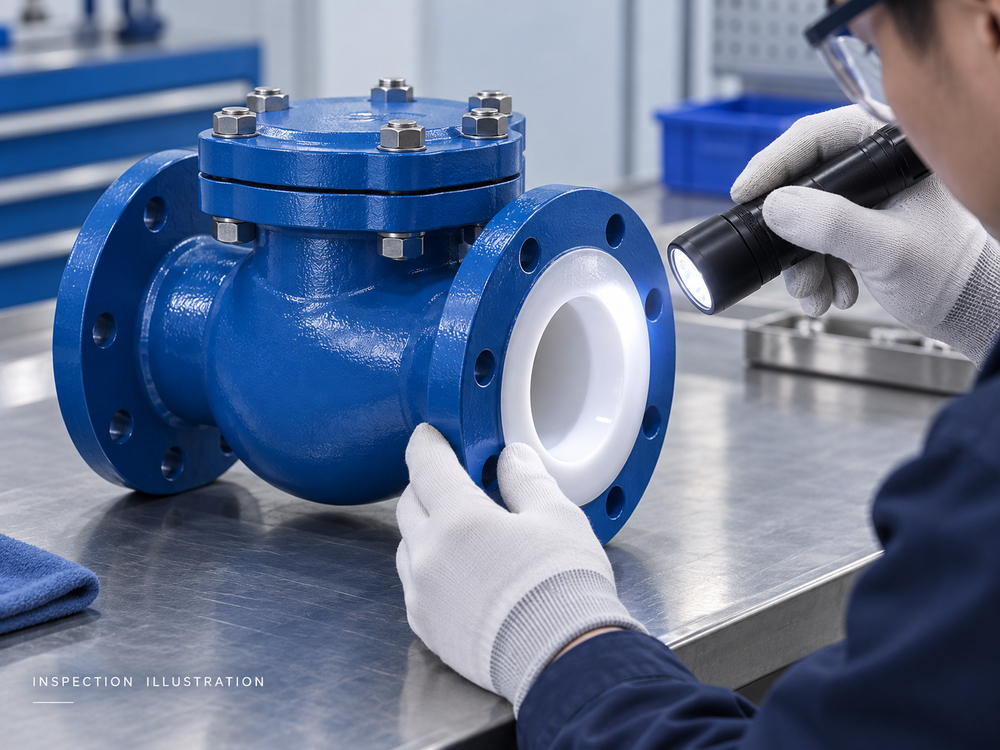
Agree the inspection and test plan before production so that the acceptance evidence matches the actual chemical and hydraulic duty. Useful inspection points include:
- Body and internal component material identification against the approved bill of materials.
- Flange dimensions, face-to-face length, flow-direction marking and assembly clearances.
- Visual examination of lining surfaces, edges and protected interfaces for defects.
- Lining integrity testing where specified, using a qualified method and a voltage appropriate to the material and thickness.
- Free movement and seating of the closure member in its approved orientation.
- Shell and reverse-direction seat testing at agreed pressures, duration and leakage criteria.
- Opening differential or low reverse-pressure sealing checks when important to the application.
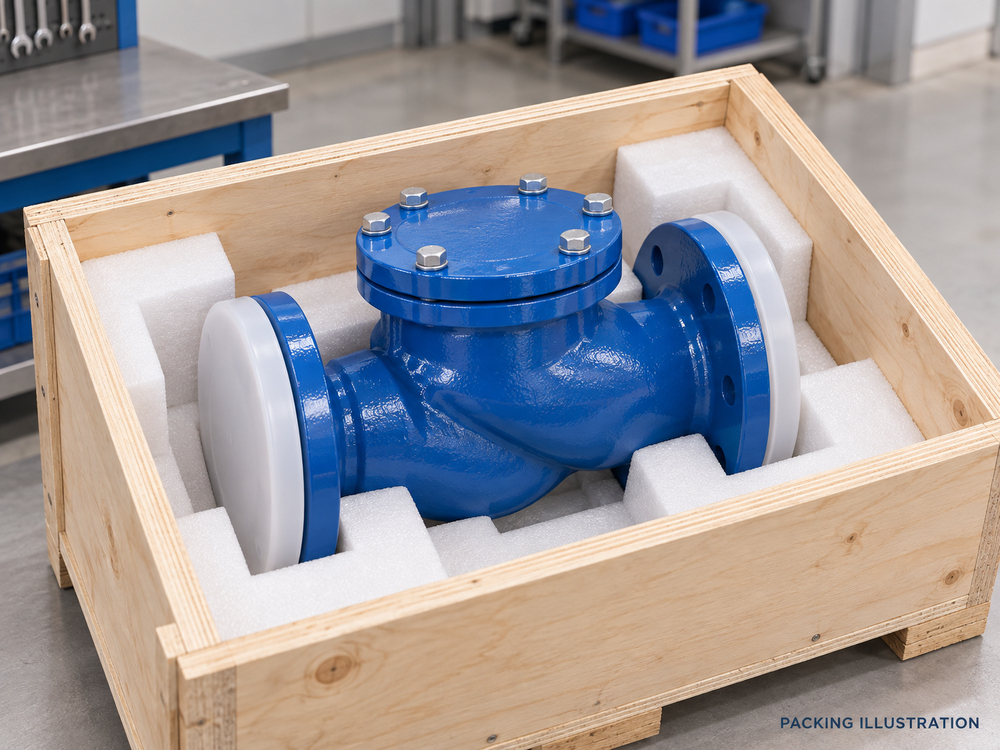
- Final cleanliness, protection of lined faces and review of the shipment documents.
Lining-integrity examination and pressure testing answer different questions. Neither replaces the other, and neither alone proves long-term compatibility with the process chemical.
Why Choose Vcore Valve
Bring the piping specification and operating conditions to Vcore Valve for a configuration review. The quotation should connect the selected construction to the application, with clear scope for materials, dimensions, inspection and documentation.
- Review the complete wetted-parts list alongside the chemical duty.
- Resolve connection dimensions and installation constraints before ordering.
- Define the required pressure, leakage and lining inspection records.
- Coordinate non-return and isolation valve requirements within the same chemical piping system.
For complementary isolation duties, review the PTFE Lined Diaphragm Valve and PTFE Lined Plug Valve. Our diaphragm-versus-plug selection guide explains their different isolation roles; neither performs the automatic check function described here.
Information Required for Quotation
- Size and quantity: DN / NPS, pipe bore and required number of valves.
- Chemical duty: medium, concentration, mixture, solids, density and viscosity.
- Pressure and temperature: normal and design conditions, cleaning cycles, surge and any vacuum.
- Flow data: minimum, normal and maximum flow plus allowable pressure loss.
- Closing conditions: minimum reverse differential, pump shutdown behavior and leakage requirement.
- Installation: horizontal or vertical line, forward-flow direction and available space.
- Materials: lining requirement, body grade and restrictions on exposed metallic components.
- Connections: flange standard, facing, face-to-face length and mating drawings.
- Acceptance: applicable standards, inspection plan, witness points and required documents.
PTFE Lined Check Valve FAQ
What is a PTFE lined check valve used for?
It is used for automatic backflow prevention in compatible corrosive chemical pipelines. The lining protects specified wetted metal surfaces, while the check mechanism responds to flow and pressure changes.
Is a PTFE seated check valve the same as a PTFE lined check valve?
No. A PTFE seat describes the sealing component. A lined check valve also has a protective lining in the body passage. Confirm the complete wetted-parts list to establish which surfaces are protected.
Can the valve be installed vertically?
Only in an orientation approved for the selected model. Closure weight, guides and any spring influence operation. Approval for vertical upward flow does not establish suitability for downward flow.
Does it seal at very low reverse pressure?
This depends on the seat, closure mechanism and installation orientation. Specify the minimum reverse differential pressure and required leakage acceptance so low-pressure sealing can be evaluated or tested.
Can it prevent water hammer?
A PTFE lining provides corrosion protection, not a guarantee against water hammer. Closure dynamics, flow deceleration and the piping system must be assessed when valve slam or surge is a concern.
Is it suitable for vacuum service?
Vacuum suitability must be confirmed for the complete lined design at the specified absolute pressure and temperature. Liner support, permeation and thermal cycling require review; a positive-pressure rating is insufficient.
What should be supplied with an inquiry?
Provide the chemical composition, flow range, pressures, temperatures, installation direction, valve size, connection details, material requirements, leakage criteria and quantity. Include the piping specification or drawing when available.
Need a PTFE Lined Check Valve for Your Project?
Send Vcore Valve your chemical composition, flow range, operating conditions, installation direction and connection details. Request a configuration review with clearly defined materials, inspection requirements and quotation scope.