Quick Overview
A lug butterfly valve can be suitable for dead-end service, but its body style alone does not confirm this capability. Before ordering, obtain written confirmation of the allowable differential pressure, service temperature, pressure direction and mounting requirements with the downstream flange removed. Check seat retention, upstream bolting, leakage acceptance criteria and the site isolation requirements separately.
A maintenance team plans to remove a downstream pump whilst the upstream water main remains pressurised. A lug butterfly valve is proposed as the isolation valve. Can it remain attached to the upstream flange and retain pressure after the downstream pipe and flange are removed?
The answer depends on the exact valve design and its documented operating limits. Some lug butterfly valves are approved for full-rated dead-end service. Others require a reduced pressure or have restrictions on pressure direction and installation.
This guide explains what industrial valve buyers, engineers and project customers should confirm before specifying a lug butterfly valve for dead-end service.
What Is Dead-End Service?
In this article, dead-end service means the valve is closed, one side remains pressurised, and the downstream pipe and mating flange have been removed. The valve must retain pressure through its remaining upstream connection without support from a downstream flange.
This differs from normal in-line service, where both mating flanges remain connected. Removing one flange changes the mechanical support and may affect seat retention, sealing performance and allowable pressure.
Because suppliers may use “dead-end service” and “end-of-line service” differently, an enquiry should describe the actual arrangement rather than rely on either term alone.
| Installation Condition | What Remains Connected? | Required Confirmation |
|---|---|---|
| Normal in-line service | Upstream and downstream mating flanges | Allowable shut-off differential pressure at the specified temperature and pressure direction |
| Dead-end service with downstream flange removed | Upstream mating flange and its independent attachment to the valve | Explicit approval for pressure retention without downstream flange support |
| End-of-line installation with a blind flange | Upstream connection and a downstream blind flange | Approved blind flange arrangement, bolting, disc clearance and applicable pressure limits |
How Does a Lug Butterfly Valve Connect to the Pipeline?
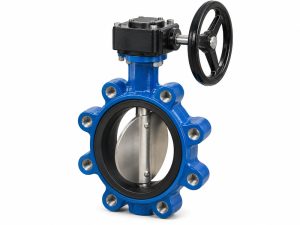
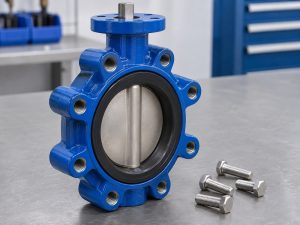
A typical tapped-lug butterfly valve has threaded mounting holes in projecting lugs around its body. The pipe still requires a mating flange. Bolts pass through that pipe flange and screw directly into the threaded lugs.
Separate bolts normally secure each side of this arrangement. This allows the upstream attachment to remain assembled when the downstream flange and its bolts are removed, provided the valve is designed and approved for that condition.
This is different from a conventional wafer installation, where long bolts usually clamp the valve between two pipe flanges. It also differs from a double-flanged valve, which has a complete integral flange at each end.
Descriptions such as “full lug” and “semi-lug” are not sufficient to establish the connection details. Check the approved drawing for threaded holes, thread depth and the independent attachment arrangement.
1. Confirm the Dead-End Pressure Rating Separately
The first selection question is whether the offered valve can retain the required differential pressure with the downstream flange removed.
Do not substitute the body pressure rating, flange drilling designation or normal in-line shut-off rating for a documented dead-end rating. These values describe different aspects of valve capability.
Full-Rated and Reduced-Rated Designs Both Exist
Some lug butterfly valves are approved for the same shut-off differential pressure in dead-end and normal in-line service. Others require a lower pressure when the downstream flange is absent.
The permitted value may vary with size, seat construction, temperature and pressure direction. There is no universal rule that all lug valves retain full pressure or that all must be derated by a fixed percentage.
Ask for written confirmation covering each size and configuration in the order.
Include Temperature and Maximum Differential Pressure
Confirm the allowable dead-end differential pressure at the temperature that will occur during the intended isolation condition. The review should include relevant pump shut-off pressure and transient conditions identified by the system designer.
When the downstream side is open to atmosphere, upstream gauge pressure is approximately the differential pressure across the closed disc. Normal running pressure alone may therefore be insufficient for selection.
For example, a valve approved for a maximum dead-end differential pressure of 6 bar would not meet a requirement to retain 10 bar under the same temperature conditions, even if its normal in-line rating were higher. These figures illustrate the selection principle and are not a Vcore product rating.
2. Check the Permitted Pressure Direction
A valve described as bidirectional in normal service should not automatically be treated as bidirectional in dead-end service.
Confirm whether the declared dead-end rating applies:
- With pressure applied from either side.
- Only with a specified valve face connected upstream.
- At different allowable pressures depending on direction.
For designs with directional sealing or a seat-retaining arrangement, orientation can be especially important. The approved drawing and installation manual should identify the pressure side. Interpret any body arrow according to those instructions rather than assuming it always indicates normal flow.
3. Verify Seat Retention and Material Suitability
The seat and its retaining components must remain secured when the downstream flange is removed. Seat material alone does not establish this capability.
Two valves with the same elastomer may have different dead-end limits because their body and seat-retention arrangements differ. Likewise, changing to a metal seat does not automatically establish a higher dead-end rating.
| Selection Item | What to Check | Conditions and Limitations |
|---|---|---|
| Seat retention | How the seat and retaining components are secured without the downstream flange | Confirm against the exact construction; do not infer capability from the material name |
| Resilient seat options | Compatibility of the proposed elastomer with the medium and cleaning chemicals | Suitability depends on compound, fluid composition, temperature and service conditions |
| PTFE-based or metal sealing options | Applicable valve design, seat retention and required leakage performance | These options are design-dependent and are not interchangeable with resilient seats without review |
| Body, disc and stem | Corrosion resistance, mechanical suitability and exposure to the medium | Check all wetted components rather than selecting from body material alone |
| Replacement components | Whether replacement seats or retainers preserve the approved configuration | Unapproved substitutions may change torque, sealing performance and pressure limits |
These are selection considerations, not confirmation that every material or construction is available for every Vcore valve. The offered configuration must be established in the quotation and approved technical documents.
Where service conditions require a different sealing design, a triple offset butterfly valve may be considered during selection. Its dead-end capability still requires separate confirmation.
Field Insight: Describe the Removed Components in Your Enquiry
When sending a dead-end service enquiry to Vcore Valve, include a simple installation sketch showing which components will remain connected. “Downstream pipe removed” does not explain whether the mating flange, a short spool or a blind will remain in place.
What to Check:
- Will the downstream mating flange and all downstream bolts be removed?
- What maximum differential pressure and temperature must the closed valve withstand?
- Which face remains connected upstream, and can pressure reverse?
- What isolation arrangement does the site require for the planned maintenance?
Ask for the quotation and approved drawing to state the same installation condition. This makes technical comparisons clearer and helps prevent a normal in-line rating from being accepted as a dead-end rating.
4. Confirm Flange Compatibility and Bolting
The remaining upstream attachment must retain the valve in the manner intended by the manufacturer. The surrounding pipework must also have appropriate support; the valve should not be used to correct misalignment or carry unassessed pipe loads.
Bolt Length and Thread Engagement
- Confirm bolt diameter, thread form, material and quantity.
- Obtain the required thread engagement and permitted insertion depth.
- Check that bolts cannot bottom out before clamping the flange.
- Check for interference between bolts inserted from opposite sides.
- Use the approved tightening sequence and torque for the supplied assembly.
A bolt that bottoms in a tapped hole can feel tight without producing the intended clamping force. Excessive tightening can damage threads, distort components or affect seat compression.
The butterfly valve bolt installation guide provides related installation context. Final bolt dimensions and torque values must come from the documentation for the actual valve and flange assembly.
Flange Standard, Gaskets and Disc Clearance
Specify the mating flange standard, facing, bore and material. Similar nominal sizes or pressure designations do not guarantee compatible joints. See PN16 vs ANSI Class 150 flange compatibility for the checks required before substitution.
Follow the valve installation manual on gasket use. Some resilient seats provide the flange sealing function, whilst other constructions require separate gaskets. Adding an unapproved gasket can alter seat compression and operating torque.
Check disc clearance against the connected pipe bore, any lining and any proposed blind flange. A blind fitted close to the valve can obstruct disc travel unless the approved arrangement provides sufficient clearance.
5. Check the Gearbox, Actuator and Isolation Requirements
The gearbox or actuator must close the valve against the specified differential pressure and maintain the required position. Confirm the torque basis, mechanical stops, position indication and means of preventing unintended operation.
For pneumatic operation, provide the minimum available air pressure and required fail position. For electric operation, define the power supply, control mode and behaviour on power loss.
Position indication does not prove that downstream pressure has been released or that the seat is leak-free. Before opening downstream equipment, apply the site’s approved isolation, depressurisation, draining and verification procedure.
A dead-end rating describes a valve capability. It does not establish that a single closed butterfly valve provides acceptable isolation for every maintenance task. Where positive isolation is required, an approved physical isolation arrangement must be provided.
6. Agree the Inspection and Documentation Scope
A standard seat test report may not demonstrate performance with the downstream flange removed. Establish what evidence supports the declared dead-end rating and whether the project requires a specific witnessed test.
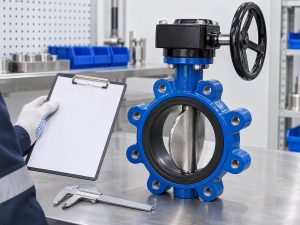
The inspection agreement should identify:
- The valve model, size, materials and seat configuration.
- The declared dead-end pressure and temperature limits.
- The permitted pressure direction.
- The mounting arrangement for any specified dead-end test.
- The test medium, pressure, duration and leakage acceptance criteria.
- The required reports, witness points and release documents.
Standards such as API 598 or EN 12266-1 may form part of the inspection requirements, depending on the valve and purchase specification. Naming a test standard alone does not fully describe a project-specific dead-end installation or prove that the test fixture reproduces it.
Likewise, a general design-standard statement should not replace an explicit declaration of dead-end suitability. For related test terminology, read the valve pressure testing guide.
Should Buyers Choose a Double-Flanged Butterfly Valve Instead?
A double-flanged butterfly valve is a valid alternative when its dimensions, connection arrangement and service limits meet the project requirements. It may be preferred where the piping specification calls for integral flanges or where connection rigidity is an important selection factor.
A lug butterfly valve may be attractive where compact installation and independent attachment to each pipe flange are priorities. Neither body style should be selected solely from a photograph or a general description.
| Selection Factor | Tapped-Lug Butterfly Valve | Double-Flanged Butterfly Valve |
|---|---|---|
| Connection arrangement | Pipe flange bolts screw into threaded body lugs | Integral valve flanges connect to the pipe flanges |
| Installation space | Often compact; verify actual face-to-face and operating envelope | Dimensions and weight depend on the selected design and standard |
| Downstream removal | Independent upstream attachment can remain, subject to design approval | Upstream flange connection can remain, subject to design approval |
| Dead-end capability | Requires model-specific pressure, temperature and direction confirmation | Requires the same model-specific confirmation; full pressure is not automatic |
Lug Butterfly Valve Dead-End Service: RFQ Checklist
| RFQ Item | Information to Provide |
|---|---|
| Size and quantity | DN or NPS, quantity and equipment tags |
| Medium | Composition, concentration, solids and relevant cleaning fluids |
| Pressure and temperature | Operating and design conditions, plus required dead-end differential pressure and coincident temperature |
| Physical arrangement | Identify whether the downstream pipe, mating flange and downstream bolts will all be removed |
| Pressure direction | One specified direction or both directions |
| Construction | Body, disc, stem, seat and seat-retention requirements |
| Connections | Flange standard, facing, bore, face-to-face dimension and lug thread details |
| Operation | Lever, gearbox or actuator, including locking and fail-position requirements |
| Inspection | Test standard, leakage acceptance criteria, special test conditions and witness requirements |
| Documents | Rating confirmation, approved drawing, installation manual and agreed certificates or reports |
Suggested Purchase Specification
The supplied lug butterfly valve shall be suitable for closed-valve dead-end service with the downstream pipe, mating flange and downstream bolting completely removed. The manufacturer shall confirm the allowable differential pressure at the specified service temperature, permitted pressure direction, seat-retention arrangement, upstream flange requirements and bolting details for the exact size and configuration offered. Any reduced rating or installation restriction shall be stated in the quotation. Leakage acceptance criteria and any project-specific dead-end testing shall be agreed before manufacture.
Common Purchasing Mistakes
- Accepting “lug type” as proof of suitability: obtain a written rating for the actual installation condition.
- Using flange drilling as a pressure guarantee: verify the complete valve’s allowable pressure at temperature.
- Assuming bidirectional capability covers every arrangement: check the permitted pressure side with one flange removed.
- Applying one rating to every size: confirm all sizes and configurations in the order.
- Changing seats without review: confirm that substitutions preserve the required capability.
- Leaving bolting until installation: obtain the approved connection details before shipment.
- Confusing pressure retention with maintenance isolation: establish the site isolation requirements separately.
Frequently Asked Questions
Can every lug butterfly valve be used for dead-end service?
No. Suitability depends on the exact design, size, seat construction, temperature, pressure direction and mounting arrangement. Obtain written confirmation for the supplied configuration with the downstream flange removed.
Is the dead-end pressure always lower than the in-line rating?
No. Some designs have a reduced dead-end rating, while others are approved for full-rated service under stated conditions. There is no universal derating percentage.
Does a PN16 lug butterfly valve automatically hold 16 bar with one flange removed?
No. The PN designation alone does not establish dead-end capability. Confirm the allowable differential pressure at the required temperature for the exact valve configuration.
Can a double-flanged butterfly valve be used instead?
Yes, provided the selected model meets the installation and service requirements. A double-flanged body does not automatically establish full-pressure dead-end capability; the rating and permitted pressure direction still require confirmation.
Is a blind flange always required?
The requirement depends on the valve design and the project isolation procedure. Some valves are approved to retain pressure without a downstream flange, but the planned maintenance task may still require a blind or another physical isolation arrangement.
Does a standard seat leakage test prove dead-end performance?
Not necessarily. Check the test mounting arrangement and the evidence supporting the declared dead-end rating. Specify any additional test conditions and acceptance criteria in the purchase agreement.
Prepare Your Enquiry for Vcore Valve
When enquiring about the Vcore industrial valve range, provide the medium, size, required dead-end differential pressure, service temperature, flange details and operating method. Include a sketch showing the components that will remain connected during isolation.
Request a quotation that identifies the offered configuration, its confirmed service limits and any technical deviations. This provides a clearer basis for reviewing price, installation suitability and documentation before placing an order.