Globe Valve Flow Direction for Steam Service: Under-Seat vs Over-Seat Installation
On a steam-piping drawing, a globe valve may look symmetrical from the outside, yet its disc and seat are not necessarily symmetrical in operation. The direction in which upstream pressure acts on the disc changes the force that the handwheel or actuator must overcome. This article focuses on globe valve flow direction for steam isolation and throttling, rather than repeating general globe-valve selection advice.
1. What Do Under-Seat and Over-Seat Mean?
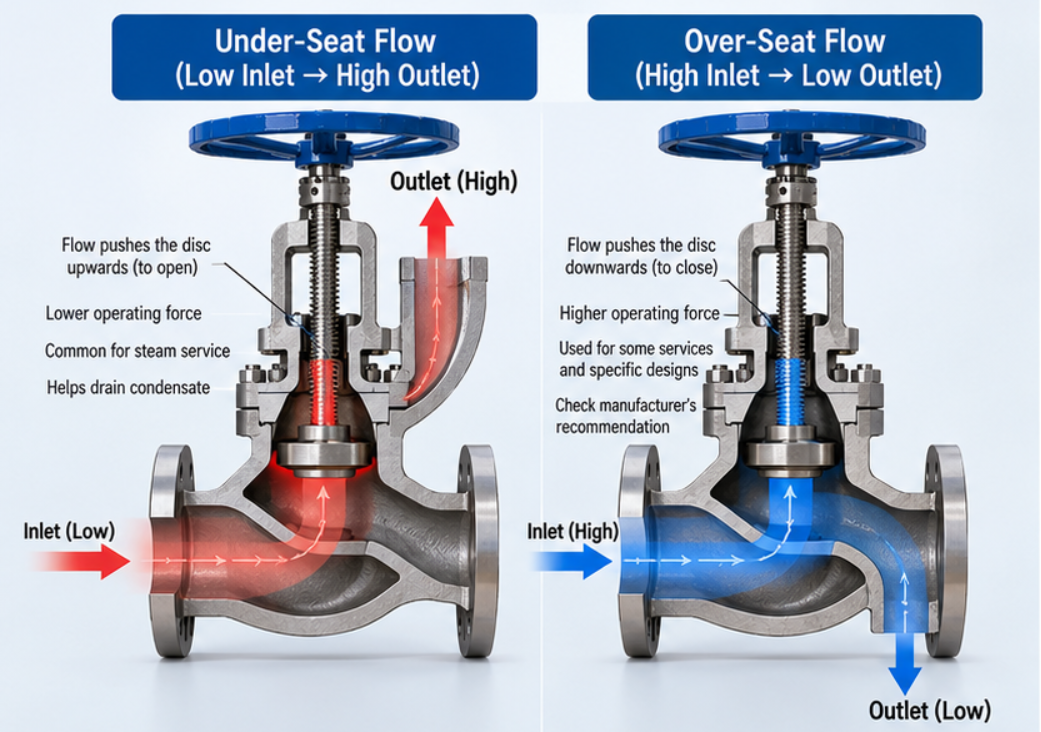
Under-seat flow means that the upstream fluid approaches the underside of the disc through the seat opening. This is often called flow-to-open: with the valve shut, the upstream-to-downstream pressure difference tends to push the disc away from its seat. The common Chinese installation description is “低进高出,” but the term describes the internal seat geometry, not a universal requirement for the pipe to rise vertically.
Over-seat flow means that the upstream fluid approaches the top side of the disc and passes downward through the seat opening. This is often called flow-to-close: upstream pressure tends to press the disc toward the seat. It is sometimes described as “高进低出.” The direction must be identified from the internal flow path, not from the height of the external pipe nozzles alone.
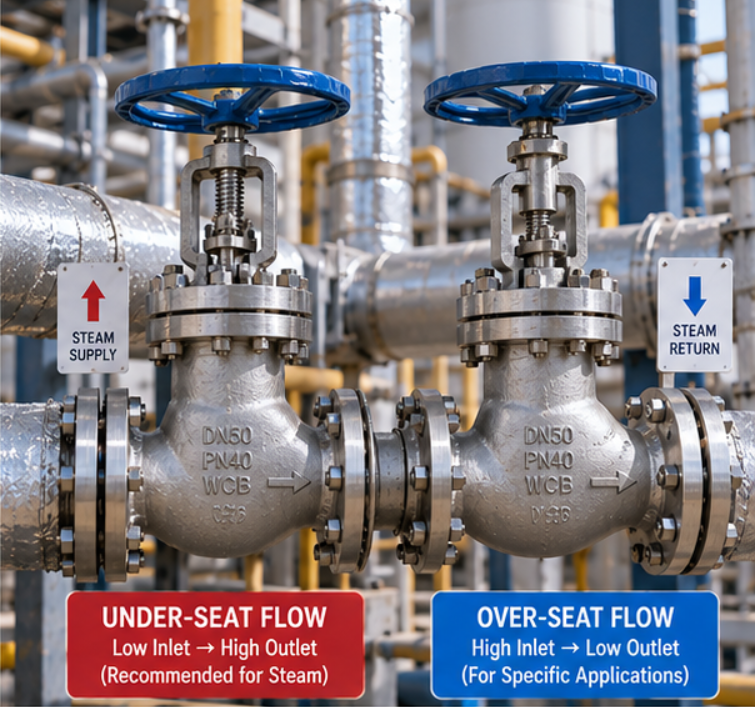
2. Disc Force: Why the Direction Changes Operating Effort
For a simplified unbalanced disc, the pressure-related load is approximately F ≈ ΔP × Aeff, where ΔP is the pressure difference across the closed disc and Aeff is the effective pressure area. This is a first-order explanation, not an actuator-sizing formula: actual stem force also depends on stem area, balancing features, seat geometry, packing friction, flow forces, thermal effects and the required sealing load.
| Question | Under-seat / Flow-to-open | Over-seat / Flow-to-close |
|---|---|---|
| Pressure force on closed disc | Tends to lift disc off seat | Tends to press disc onto seat |
| Opening against high ΔP | Pressure may assist initial lift | Operator may need to overcome pressure-assisted seating |
| Final closure | Stem must overcome opening force and provide seat load | Pressure can assist seating; excessive loading must still be evaluated |
| Stem / bonnet exposure | Depends on internal passages and downstream pressure | Depends on internal passages and upstream pressure |
| Selection rule | Verify closing thrust and shutoff differential | Verify opening thrust and allowable shutoff differential |
In particular, a large unbalanced valve can be easy to start opening in one flow direction yet difficult to close tightly; reversing it can trade that difficulty for high opening effort. For automated steam service, the actuator must be sized for the worst credible differential pressure in the required travel direction, not merely the normal running pressure drop. See Vcore’s Valve Actuator Torque Sizing Guide for broader actuator-selection context; globe-valve linear stem thrust must be calculated for its own mechanism.
3. Why Under-Seat Flow Is Common—but Not Mandatory
Under-seat flow is common on many conventional globe valves. The pressure can assist opening, and certain piping conditions may leave the stem-packing area exposed to a lower pressure when the valve is closed. However, high differential pressure increases the force needed to drive the disc onto the seat and maintain tight closure. Manufacturer-specific construction and operating limits therefore matter.
For a general industrial flanged configuration, start with the approved drawing and flow arrow on Vcore’s Flanged Globe Valve for Industrial Pipeline Flow Control; do not infer the permitted direction solely from the product category or handwheel orientation.
4. When Over-Seat Flow May Be Specified
Over-seat flow can use pressure to assist disc seating. It may be selected for a particular shutoff duty or valve construction, including some high-pressure or special steam applications. The trade-off is that opening the valve against a high upstream pressure can require substantial stem thrust; seat, disc, stem and actuator loads must be checked. Pressure-assisted closure is not proof of a guaranteed leakage class or an automatic fail-safe function.

5. Steam-Specific Checks Beyond the Flow Arrow
Maximum differential pressure, including start-up and isolation
Specify the maximum differential pressure across the valve when it must open and when it must close. Normal flowing ΔP may be far below the closed-valve differential encountered during start-up, depressurization or a blocked downstream line. For high-pressure steam, ask whether a bypass/equalization procedure or balanced-trim design is required.
Temperature, thermal expansion and stem packing
High steam temperature changes allowable body pressure rating, trim clearances, packing performance and operating force. Confirm body/bonnet alloy, seat hardfacing, stem and packing against the maximum design temperature and pressure-temperature rating. Material choice should follow the service specification, not an assumed universal “steam trim.” For corrosion-sensitive steam or condensate systems, review the project-specific material options on Vcore’s Stainless Steel Globe Valve for Steam, Water and Corrosive Media.
Throttling, velocity and erosion
At partial opening, steam velocity and pressure recovery can produce noise, vibration and seat/trim erosion. Flow direction alone does not establish suitability for sustained throttling. Provide operating pressure, downstream pressure, steam temperature, mass flow and minimum opening; a purpose-designed control valve or severe-service trim may be needed for demanding duty. For broader control-duty selection, see Vcore’s Control Valve Selection Guide.
Condensate, debris and commissioning
Condensate accumulation and debris can affect the disc and seat, especially during start-up. Provide suitable drainage, steam-line warm-up and upstream cleaning/straining as required by the system design. Avoid treating a globe valve as a substitute for a steam trap, drain or pressure-relief device.
6. What If the Body Arrow and P&ID Disagree?
Do not install the valve based on a generic “low-in/high-out” rule when the supplied body arrow points the other way. Hold installation and ask the manufacturer to confirm the correct orientation for the exact model, size, pressure class, disc/seat arrangement and service conditions. A cast arrow, drawing revision, installation manual and project valve datasheet should be reconciled before commissioning.

7. Steam Globe Valve Installation and RFQ Checklist
| RFQ / Site Item | Required Confirmation |
|---|---|
| Valve identity | Model, size, pressure class, body/bonnet construction and drawing revision |
| Service | Steam type, normal/max temperature, inlet and outlet pressures |
| ΔP | Maximum differential for opening, closing and normal throttling |
| Flow direction | Under-seat, over-seat or bidirectional only if manufacturer approves; body arrow orientation |
| Duty | Isolation, occasional throttling or continuous control; required seat leakage |
| Operator | Handwheel/gear/electric/pneumatic; required stem thrust and available supply |
| Trim and seals | Disc/seat material, hardfacing, stem, packing, gasket and temperature limits |
| Installation | Pipe orientation, drain, access, bypass if required, flange/F-F dimensions |
| Evidence | GA/sectional drawing, installation instruction, pressure/leakage test records and marking |
Suggested RFQ wording: “Please confirm the required flow direction (under-seat or over-seat) for the offered steam globe valve, including the body arrow, maximum differential pressure for opening and closing, permissible mounting orientation, and required operating thrust. Provide the approved sectional drawing and installation instructions before production or shipment.”
8. Factory Verification Before Shipment
Inspect the cast or stamped flow arrow against the approved drawing and purchase specification. Confirm valve identity, seat/trim configuration, operator travel and applicable pressure and seat-leakage test results. A factory pressure test does not, by itself, demonstrate that the handwheel or actuator can open against the site’s maximum steam differential pressure. Where required, request a documented operating-force or differential-pressure verification.

Frequently Asked Questions
Must every steam globe valve be installed with under-seat flow?
No. Under-seat flow is common, but some valve designs or duties specify over-seat flow. Follow the manufacturer’s approved direction and differential-pressure limits for the exact valve.
Does under-seat flow make a globe valve easier to open?
For a conventional unbalanced disc, upstream pressure under the seat can assist initial lifting. Actual operating force also depends on stem area, friction, seat geometry and the pressure differential.
Does over-seat flow guarantee tighter sealing?
No. Pressure can assist seating, but leakage performance depends on seat design, trim condition, closing force, temperature and the tested leakage requirement.
Can a globe valve be installed opposite to its cast arrow?
Not without manufacturer confirmation. The reverse direction may exceed the permitted opening thrust, closing load, seat limit or other design constraints.
What information should I send when the steam valve arrow is unclear?
Send the valve tag, model, size, pressure class, photos of body markings, sectional drawing, P&ID, steam temperatures and maximum inlet/outlet pressures. Ask the manufacturer to confirm the correct installation direction in writing.
For project-specific steam valve selection, browse Vcore’s Globe Valve product range or send the project datasheet for technical review.