Butterfly Valves for Desalination Plants: Low-Pressure Intake vs High-Pressure RO Service
Seawater reverse osmosis (SWRO) plants contain several pressure zones. A butterfly valve that works well on a large raw-seawater intake main may face entirely different mechanical loads at the high-pressure pump discharge or membrane feed manifold. The buyer’s question is not simply whether the valve is a butterfly valve: it is whether its complete pressure boundary, disc, shaft, seat, end connection and actuator are approved for the particular service.
This article compares two specific purchasing decisions: low-pressure intake isolation versus high-pressure RO isolation. For the wider pump-train layout, suction losses and pump-trip scenarios, read Seawater Intake Pump Station Valves: Butterfly, Check and Gate Selection.
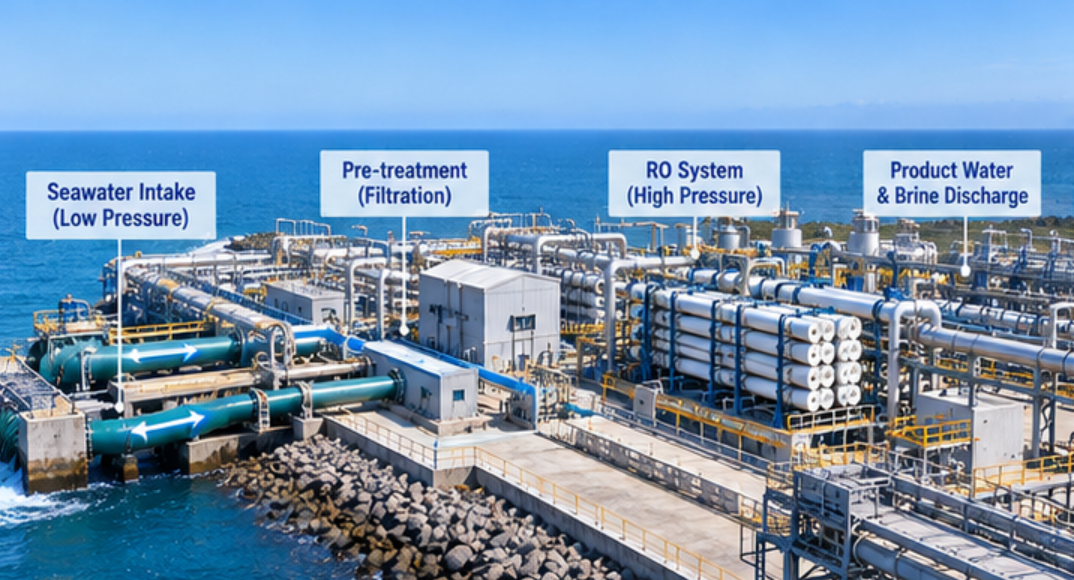
1. Identify the valve’s exact position before choosing its design
| Plant position | Typical duty | Selection concern |
|---|---|---|
| Seawater intake / low-pressure transfer | Large-bore isolation; often PN10/PN16 or project-specified Class 150 | Flow loss, solids, marine fouling, lining and large-valve actuation |
| Pretreatment and filter headers | Isolation and automated sequencing | Cycle count, chemicals, differential pressure and shutoff |
| High-pressure pump discharge / RO feed | High-pressure isolation in selected approved locations | Design and transient pressure, full differential-pressure shutoff, shaft/disc stress, leakage and torque |
| High-pressure concentrate / energy recovery circuit | Isolation or specialist switching/control duty | Concentrated brine, rapid cycling, pressure fluctuations and process-specific valve type |
| Permeate / product water | Lower-pressure treated-water isolation | Water quality, wetted-material cleanliness and applicable potable-water approvals |
These are application categories, not universal pressure specifications. A typical SWRO feed system may operate around 55–80 bar, but actual pressures vary with salinity, temperature, recovery, membrane condition and process design. Do not assign a pressure class from a generic RO pressure figure; use the project design basis and line class.
2. Low-pressure intake: why resilient-seated butterfly valves are common
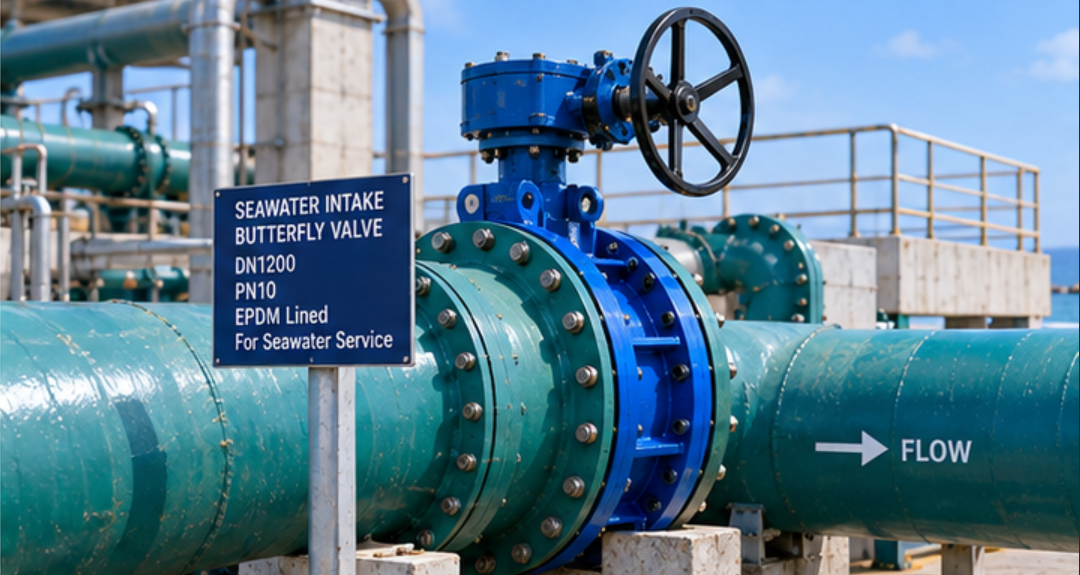
At the intake, large diameter, compact face-to-face length and economical quarter-turn operation make a butterfly valve attractive. A concentric resilient-seated or suitable double-offset design may be evaluated with an approved EPDM or other compatible seat, corrosion-protected body and seawater-qualified disc, shaft, bearings and fasteners. Select wafer, lug or double-flanged construction according to pipe class, end-load requirements and maintenance arrangement; they are not interchangeable merely because the nominal size matches.
At pump suction, evaluate the manufacturer’s loss coefficient at the operating opening and design flow. The disc remains in the flow path, and its proximity to the pump can affect inlet flow quality. A normal isolation butterfly valve should not be used to throttle pump suction without explicit hydraulic approval.
For a relevant product concept, review Vcore’s Double Offset Butterfly Valve and the Butterfly Valve product range. The final seawater material schedule and pressure rating must be confirmed for the offered model.
3. High-pressure RO: a stronger body alone is not enough
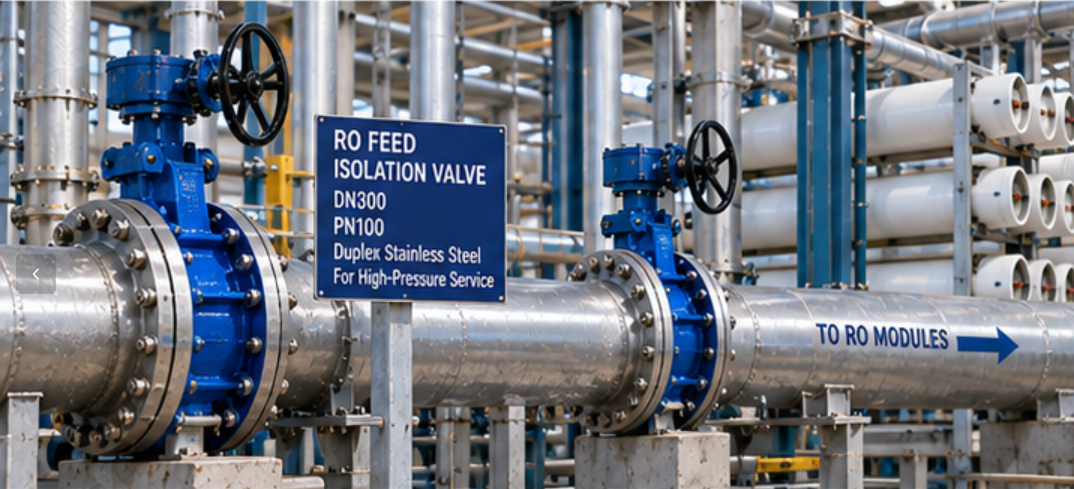
A butterfly valve intended for high-pressure RO duty must be engineered as a complete assembly. Increased differential pressure raises disc load, shaft bending, bearing loads and seating/unseating torque. Seat extrusion, seal retention, flange/end-load integrity and actuator capacity may become limiting factors even when the body material has adequate strength.
Some purpose-designed high-pressure butterfly valves, including qualified high-performance or triple-offset constructions, can be used in selected RO isolation positions. But triple-offset geometry does not automatically provide zero leakage or seawater corrosion resistance; the actual metal sealing pair, coating, material combination and tested leakage limit govern performance. Compare Vcore’s Triple Offset Butterfly Valve with its Double Offset Butterfly Valve and the offset-geometry guide.
For smaller high-pressure membrane-train isolation points, a suitably engineered high-pressure ball valve may be evaluated as an alternative. Compare bore, allowable pressure loss, shutoff integrity, corrosion resistance, maintainability and the project piping specification rather than assuming one valve family is always preferable.
4. Pressure class, shutoff differential pressure and transients are separate checks
Record the normal operating pressure, maximum design pressure, minimum pressure or vacuum where relevant, design temperature, credible surge pressure and maximum differential pressure across the closed disc. The valve’s body rating, seat shutoff rating and actuator capability can differ. A valve may withstand full line pressure yet be unable to close or seal against the maximum specified differential pressure.
RO pumps, fast-acting valves, energy-recovery devices and emergency shutdown sequences may create transients. Obtain the approved hydraulic transient study and closing-time requirements where applicable; do not select actuator speed by guesswork. For a broader rating framework, see Vcore’s Valve Pressure-Temperature Rating Guide and Actuator Torque Sizing Guide.
5. Seawater and concentrate: specify every wetted component
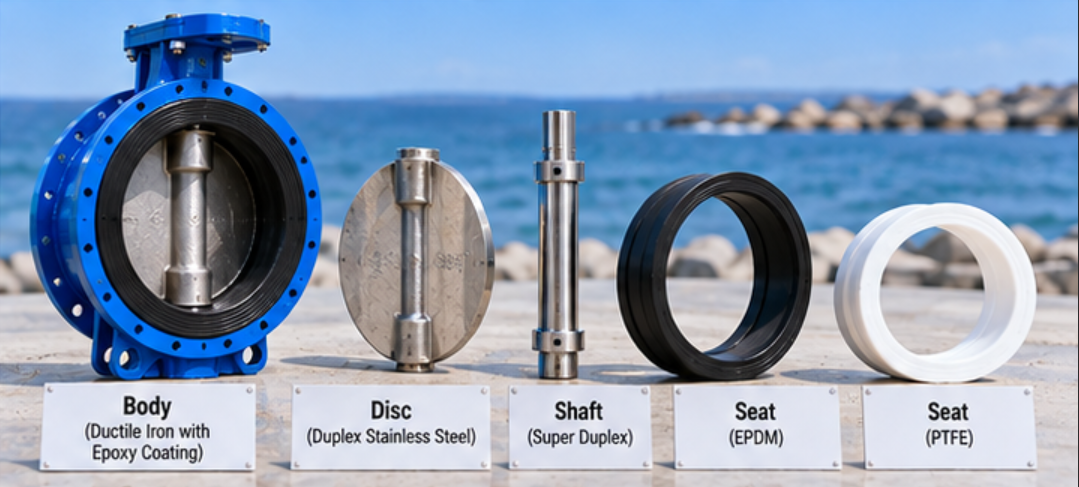
A coated ductile-iron body with compatible elastomer lining may be an approved intake solution, while selected high-pressure RO or concentrate duties can require corrosion-resistant alloy pressure boundaries and internals. This is a project-specific decision, not a blanket rule that all RO valves must use one alloy. Check chloride content, temperature, stagnation, dissolved oxygen, residual disinfectant, solids, velocity and crevice geometry.
| Component | Low-pressure intake checks | High-pressure RO checks |
|---|---|---|
| Body | Approved lining/coating and end-connection integrity | Pressure-boundary alloy, corrosion allowance if specified, and pressure-temperature rating |
| Disc | Seawater-compatible exposed surface and edge protection | Pressure-induced deflection, corrosion and seal-contact geometry |
| Shaft / bearings | Crevice corrosion, bearing wear, marine growth | Combined torque/bending loads, galling, crevice corrosion and bearing pressure |
| Seat / seal | EPDM or other approved elastomer for actual water chemistry | Seal retention, extrusion resistance, leakage rating and compatibility with high-pressure brine |
| Fasteners / interfaces | Galvanic pairing and coating discontinuities | Wetted and external fasteners, galvanic interfaces and traceability |
For a component-by-component corrosion assessment, read Seawater Valve Corrosion: Body, Disc, Shaft and Seat Materials. For a lined alternative in selected compatible services, see the PTFE Lined Butterfly Valve; a lined valve’s allowable pressure and liner retention must still be confirmed for the exact model.
6. Isolation versus throttling: define the control duty
A butterfly valve selected for occasional full-open/full-closed isolation is not automatically suitable for continuous throttling. Partial opening changes local velocity, cavitation risk, disc vibration, seat wear and torque. In an RO system, membrane-feed pressure and recovery are controlled by the process design; a generic intake butterfly valve should not be assigned a high-pressure control duty without a valve-specific flow/torque assessment and process approval.
For automatic valves, state on/off or modulating service, cycle frequency, fail position, available air/electrical supply, required closure time, feedback, environmental enclosure and manual override. The actuator must be sized for the worst credible differential pressure and the required seating/unseating torque.
7. Factory acceptance: what the buyer should request
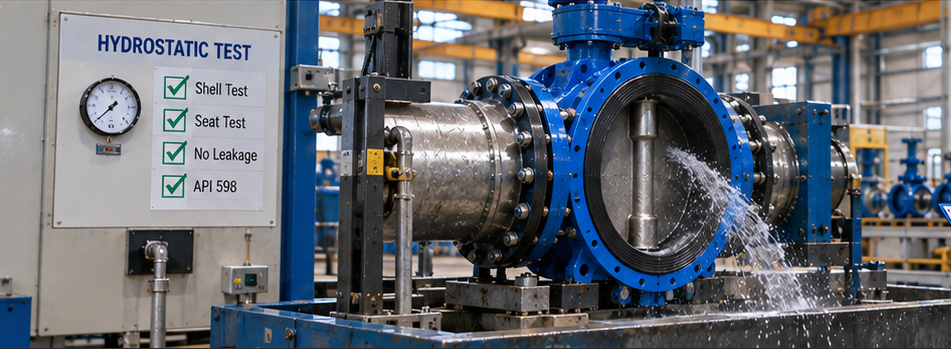
For low-pressure intake and high-pressure RO valves alike, request the approved datasheet, GA drawing, full wetted-material schedule, coating/lining specification, actuator calculation and inspection-and-test plan. The higher-pressure package may additionally need documented pressure-boundary material traceability, relevant NDE, seat leakage acceptance in the required direction(s), actuator functional testing under representative load and project-specific witness points.
Specify the applicable design and test standards for the selected valve model and line class; do not assume that a general-purpose butterfly-valve standard alone establishes suitability for the complete RO duty. See Vcore’s Valve Pressure Test Methods for the distinction between shell and seat testing.
8. RFQ template: do not quote the two zones as one valve
Sample RFQ — Tag A, Intake: Butterfly valve for screened raw seawater intake isolation; DN [size]; design/working pressure [values]; design temperature [range]; PN/Class [specified]; wafer/lug/double-flanged [select]; body/disc/shaft/seat materials [schedule]; allowable pressure loss [if required]; gearbox/actuator [specify]; flange and F/F standards [specify]; bidirectional shutoff and test requirements [specify].
Sample RFQ — Tag B, RO Feed: High-pressure isolation valve for pretreated seawater upstream/downstream of RO membrane train [exact location]; DN [size]; operating/design/transient pressure [values]; maximum closed-valve differential pressure [value]; temperature and chloride concentration [values]; full wetted-material schedule; leakage class and direction(s); actuator torque, closing time and fail position; applicable design/test standards; material certificates, GA, calculations and ITP. Supplier to confirm whether the proposed butterfly-valve model is qualified for this duty or propose a compliant alternative.
FAQ
Can a PN16 butterfly valve be used on the high-pressure RO feed line?
Not where the line design and credible pressure conditions exceed that valve’s approved rating. A low-pressure intake specification cannot be carried into a high-pressure RO section without a separate engineering review.
Are triple-offset butterfly valves always required for high-pressure RO?
No. A qualified high-performance butterfly design may be considered in selected positions, while a ball valve or other approved valve may be more appropriate elsewhere. Verify the exact pressure, corrosion, leakage, flow and actuator requirements.
Does a metal seat guarantee zero leakage in seawater?
No. Leakage performance is design- and test-specific. State the acceptance criterion and pressure direction; assess corrosion, particles and seat condition.
Can the same EPDM seat be used in intake and RO service?
Not by material name alone. Confirm the exact compound, temperature, chemical exposure, pressure differential, seal retention and valve manufacturer’s approved pressure envelope.
What is the main procurement difference between intake and RO butterfly valves?
Intake procurement emphasizes large-bore hydraulic loss, marine corrosion, debris and maintainability. High-pressure RO procurement adds much greater disc/shaft loads, pressure-boundary qualification, shutoff differential pressure, seal retention, actuator torque and transient performance.
Need a project-specific review? Send Vcore the P&ID valve tags, line classes, operating/design pressure, water chemistry, size, connection, leakage requirements and actuator duty through the contact page.