
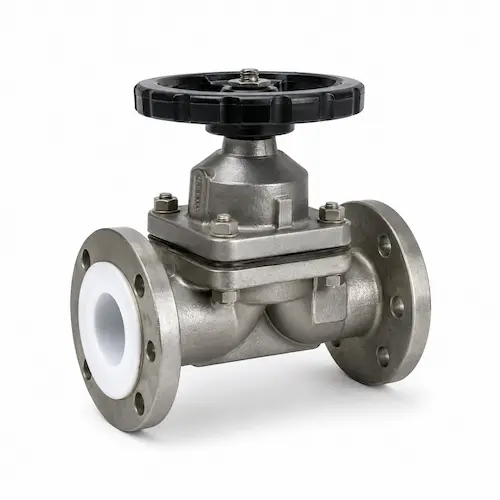
This product should be selected as a chemical isolation valve, not as a general water valve or a universal slurry valve. The correct choice depends on the actual medium name, concentration, pressure, temperature, vacuum condition, crystallization risk, cycling frequency, diaphragm material and lining material.
Built for Corrosive Chemical Isolation, Not General Water Service
A PTFE lined diaphragm valve is not simply a diaphragm valve with a different color lining. Its value is in corrosive chemical service where direct contact between the medium and the metal body should be minimized.
In suitable applications, the process medium mainly contacts the fluoropolymer-lined flow path and the diaphragm surface. This makes the valve useful for acid, alkali, chemical dosing, chemical transfer, contaminated liquid and selected clean chemical service where corrosion resistance and stem isolation are more important than high-pressure throttling performance.
For ordinary water systems, a conventional valve may be more economical. For heavy abrasive slurry, a rubber lined valve or slurry valve may be more suitable. For compact quarter-turn chemical isolation, a PTFE lined ball valve or plug valve may be a better option. The PTFE lined diaphragm valve should be selected when the process condition really needs a lined body plus diaphragm isolation structure.
 What Parts Actually Touch the Media?
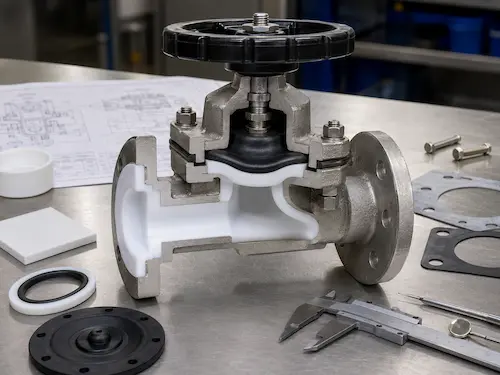 What Parts Actually Touch the Media?
For chemical service, the most important question is not only “what is the valve body material?” The more important question is: which parts are wetted by the medium?
- Lined body flow path: the internal wetted surface is protected by PTFE, FEP, PFA or project-specified fluoropolymer lining.
- Diaphragm surface: the diaphragm contacts the medium and closes against the weir or flow passage.
- Flange lining face: the lined flange surface helps protect the end connection area from chemical exposure.
- Compressor and stem: these parts normally stay behind the diaphragm and are not directly exposed to the process fluid.
- Bonnet and handwheel / actuator: these are operating components and should be isolated from the medium by the diaphragm structure.
This wetted-parts structure is the main reason chemical users choose diaphragm valves. If the diaphragm fails, if the lining is damaged, or if the flange face is scratched during installation, the protection concept may be compromised. Therefore, lining inspection and diaphragm selection are not secondary details; they are part of the core product selection.
Why Diaphragm Isolation Matters in Acid and Alkali Lines
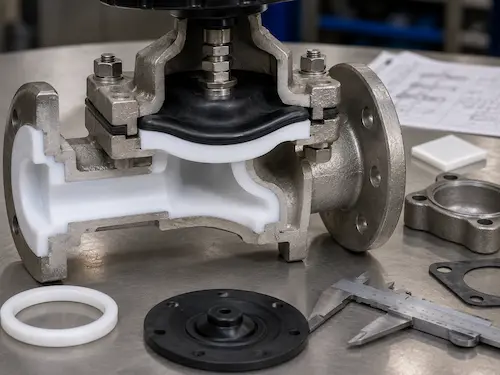 Why Diaphragm Isolation Matters in Acid and Alkali Lines
In many valve types, the stem sealing area is one of the sensitive points in corrosive service. If corrosive media reaches the packing area, external leakage, stem corrosion or maintenance problems may occur.
A diaphragm valve separates the stem and operating mechanism from the process medium. The stem movement is transferred through a compressor to the diaphragm, and the diaphragm moves against the lined body to close the flow passage. This structure helps reduce direct chemical exposure to the stem area.
This does not mean the valve is maintenance-free. The diaphragm is a working sealing component. It can be affected by pressure, temperature, chemical attack, mechanical fatigue, over-compression, crystallization or frequent cycling. For this reason, diaphragm material and replacement planning should be reviewed for demanding chemical service.
PTFE Lining Is Not the Same as a PTFE Seat
One common selection mistake is confusing a PTFE lined valve with a valve that only has a PTFE seat.
A PTFE seated valve uses PTFE mainly as the seat or sealing element. The valve body wetted surface may still be metal unless another lining or coating is used. A PTFE lined valve is different: the internal wetted flow path is lined to help isolate the metal body from corrosive media.
For strongly corrosive chemical service, this difference is important. A PTFE seat alone may not protect the body cavity, flange transition area or wetted internal surfaces. If the buyer requires full wetted-surface protection, the valve should be specified as a PTFE lined, FEP lined or PFA lined valve according to the actual service condition.
For quarter-turn lined isolation options, review our PTFE Lined Ball Valve, PTFE Lined Plug Valve and PTFE Lined Butterfly Valve.
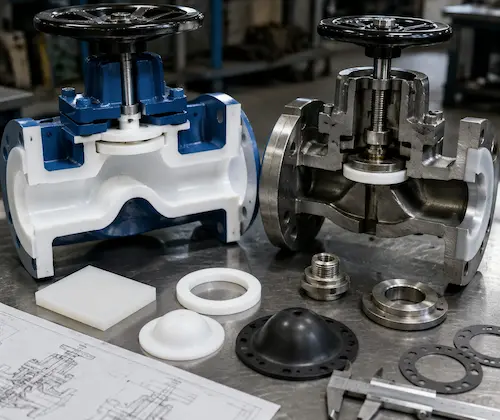
PTFE, FEP or PFA: Lining Material Should Be Selected by Service Data
PTFE is widely used for chemical resistance, but it should not be chosen blindly. In some projects, FEP or PFA may be reviewed according to the chemical, temperature, lining method, permeation concern and project specification.
| Lining Option | Why It May Be Selected | What Must Be Checked |
|---|---|---|
| PTFE | Common choice for many acid, alkali and corrosive chemical applications | Chemical concentration, temperature, pressure, vacuum condition and mechanical damage risk |
| FEP | Can be reviewed for selected fluoropolymer-lined chemical valve applications | Chemical compatibility, service temperature and project lining requirement |
| PFA | Can be reviewed for demanding chemical service and selected higher-temperature requirements | Temperature, permeation risk, lining quality, manufacturing method and cost requirement |
The medium name alone is not enough. For example, “acid service” is not a complete specification. The concentration, temperature, pressure, contaminants, solids, operating cycle and cleaning method can all affect the lining and diaphragm selection.
Weir Type or Straight-Through Type?
PTFE lined diaphragm valves can be supplied as weir type or straight-through type designs. The correct choice depends on the fluid condition and what the buyer wants to prioritize.
- Weir type: commonly reviewed for chemical dosing, acid / alkali service and clean corrosive liquid isolation. It usually requires shorter diaphragm travel and can provide practical shut-off performance in many chemical services.
- Straight-through type: may be reviewed where a smoother flow path is preferred or where the medium contains selected particles or contamination. The diaphragm movement, shut-off requirement and lining wear risk still need review.
If the medium contains crystals, deposits or particles, the valve type should not be selected only by catalog appearance. The internal flow path, diaphragm movement and cleaning requirement should be confirmed before quotation.
Common Failure Points in PTFE Lined Diaphragm Valves
Most problems in lined diaphragm valves do not come from the valve name itself. They come from wrong material selection, damaged lining, unsuitable service conditions or poor installation practice.
- Damaged flange lining face: scratches or impact damage may expose the body material to chemical attack.
- Uneven bolt tightening: excessive or uneven flange tightening can damage lined sealing surfaces.
- Wrong diaphragm material: chemical incompatibility or temperature mismatch can shorten diaphragm life.
- Vacuum deformation: unsupported or unsuitable lining may deform under vacuum conditions.
- Permeation: some chemicals may permeate lining material under specific temperature and pressure conditions.
- Crystallization: deposits can interfere with diaphragm movement and sealing.
- Abrasive solids: hard particles may wear the lining or diaphragm surface.
- Frequent cycling: repeated operation may cause diaphragm fatigue over time.
For this reason, the quotation stage should not only confirm size and pressure class. It should also confirm the actual chemical condition, operating frequency and whether the valve will see vacuum, solids, crystallization or cleaning cycles.
When This Valve Should Not Be Used Without Review
A PTFE lined diaphragm valve can be useful in corrosive chemical service, but it is not the right answer for every difficult medium. The following conditions need careful review before selection:
- High-temperature service close to the lining or diaphragm material limit
- High-pressure service beyond the selected lined diaphragm valve design
- Full vacuum or frequent vacuum condition
- Heavy abrasive slurry with hard particles
- Crystallizing media that may deposit around the diaphragm sealing area
- Continuous throttling where accurate flow control is required
- Frequent cycling with high diaphragm fatigue concern
- Media with unknown chemical composition or changing concentration
Do not claim universal chemical resistance, zero leakage, full vacuum suitability, unlimited diaphragm life or maintenance-free operation without project confirmation.
PTFE Lined Diaphragm Valve vs Rubber Lined Diaphragm Valve
PTFE lined diaphragm valves and rubber lined diaphragm valves may look similar from the outside, but the selection logic is different.
| Selection Question | PTFE Lined Diaphragm Valve | Rubber Lined Diaphragm Valve |
|---|---|---|
| What is the main reason to choose it? | Corrosive chemical resistance | Abrasion resistance, slurry service or selected wastewater / mild chemical service |
| What media is commonly reviewed? | Acid, alkali, chemical solution, dosing liquid and selected corrosive media | Slurry, wastewater, contaminated water and selected abrasive media |
| What is the main risk? | Lining damage, permeation, vacuum deformation, diaphragm fatigue or temperature limit | Rubber swelling, abrasion wear, chemical incompatibility or diaphragm fatigue |
| What should buyers confirm? | Chemical name, concentration, temperature, pressure, vacuum and lining material | Solids content, particle hardness, flow velocity, rubber compound and abrasion condition |
For abrasion-focused slurry or wastewater service, review our Rubber Lined Diaphragm Valve. For a broader lined valve comparison, see PTFE Lined Valve vs Rubber Lined Valve.
How It Compares with Other PTFE Lined Valves
Different PTFE lined valves solve different problems. The diaphragm valve should not automatically replace every lined ball, plug or butterfly valve.
- PTFE Lined Diaphragm Valve: selected when stem isolation and lined chemical flow path are key concerns.
- PTFE Lined Ball Valve: selected when compact quarter-turn on-off isolation is preferred.
- PTFE Lined Plug Valve: selected when a compact lined plug structure and quarter-turn operation are required.
- PTFE Lined Butterfly Valve: selected for larger lined pipeline isolation where butterfly valve structure is suitable.
If the service requires precise modulation, a control valve should be reviewed instead of treating a diaphragm valve as a universal regulating valve. If the service is heavy abrasive slurry, a rubber lined slurry valve or pinch valve may be more appropriate.
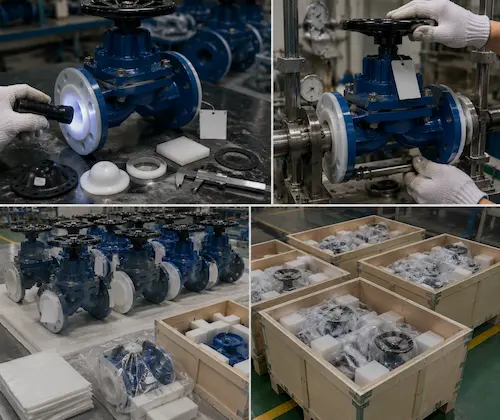
Inspection Focus Before Shipment
For PTFE lined diaphragm valves, inspection should focus on the lining, diaphragm and sealing surfaces, not only on the pressure test.
- Check the lining surface inside the flow path and at the flange faces.
- Check whether the lined sealing face is clean and free from visible damage.
- Check diaphragm material, surface condition and assembly direction.
- Check handwheel or actuator movement through full travel.
- Check shell test and seat leakage test according to the approved inspection plan.
- Check flange protection covers before packing.
- Check nameplate, marking, certificates and final packing condition.
Export packing should protect lined flange faces, diaphragm area, handwheel or actuator parts and external coating. Flange covers, moisture-resistant wrapping, foam separation and reinforced plywood cases can be used according to valve size and shipment method.
What Buyers Should Confirm Before RFQ
For a reliable quotation, buyers should provide more than valve size and quantity. The following details help avoid wrong lining or diaphragm selection:
- Valve size and quantity
- Medium name, chemical composition and concentration
- Operating pressure and design pressure
- Operating temperature and design temperature
- Flow rate if available
- Required valve body type: weir type or straight-through type
- Required lining material: PTFE, FEP, PFA or other fluoropolymer
- Required diaphragm material if specified
- Presence of solids, crystals, particles, slurry or contamination
- Vacuum condition or permeation concern if applicable
- Operating frequency: occasional operation or frequent cycling
- Operation method: manual, pneumatic or electric
- Connection standard and face-to-face requirement
- Testing, documentation and third-party inspection requirement
FAQ
What is a PTFE lined diaphragm valve used for?
A PTFE lined diaphragm valve is used for corrosive chemical, acid, alkali, dosing, transfer and contaminated liquid service where the wetted metal body and stem area need protection from process media.
Why use a diaphragm valve instead of a ball valve?
A diaphragm valve separates the stem and operating mechanism from the process fluid through the diaphragm. A ball valve uses a rotating ball and seat structure. The better choice depends on whether stem isolation, quarter-turn operation, flow passage, pressure, temperature and chemical compatibility are more important for the service.
Is PTFE lining the same as a PTFE seat?
No. A PTFE seat is mainly a sealing component. PTFE lining protects the wetted internal body surfaces from direct contact with corrosive media. For aggressive chemical service, this difference is important.
Can PTFE lined diaphragm valves be used for slurry?
They should be reviewed carefully for slurry. Hard particles, high velocity or abrasive solids may damage the lining or diaphragm surface. For abrasive slurry, a rubber lined diaphragm valve, pinch valve or other slurry valve may be more suitable.
What information is needed for quotation?
For quotation, provide medium name, concentration, pressure, temperature, valve size, quantity, lining material, diaphragm material, operation method, connection standard, solids content, vacuum condition and inspection requirements.