For project buyers, the practical question is not simply “What IP rating is best?” The better question is: “What environmental and electrical protection must this complete electric valve assembly maintain after it is mounted, wired and placed in service?”
This guide explains how to specify enclosure protection for electric ball valves, electric butterfly valves, electric plug valves and electrically actuated control valves. Vcore Valve supplies complete actuated valve packages rather than treating the actuator as an unrelated accessory. Final selection therefore considers valve torque, actuator controls, mounting, enclosure protection and site documentation together.
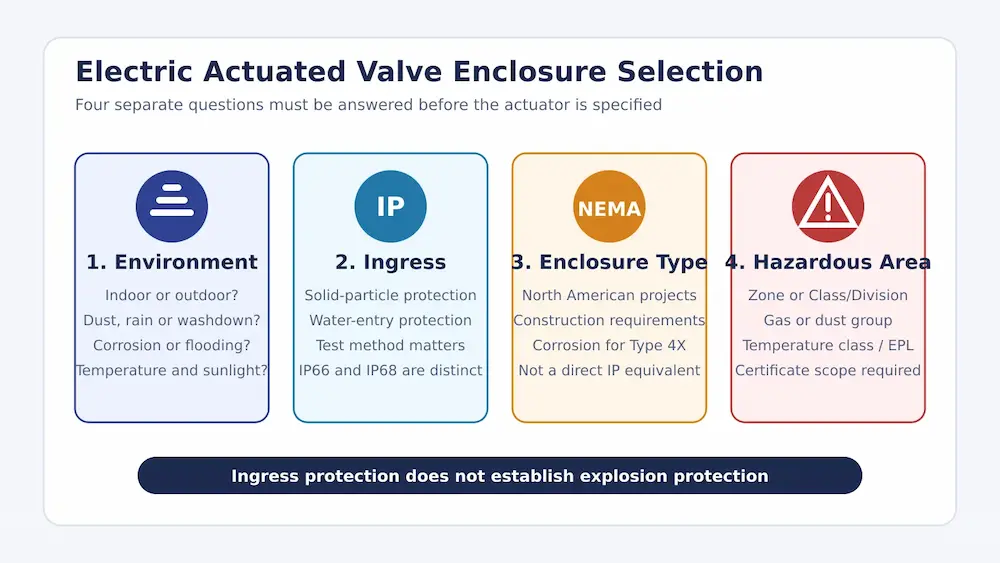
Enclosure Protection and Explosion Protection Are Different
Three terms are often mixed together in valve requests:
- IP rating: an ingress-protection classification under IEC 60529.
- NEMA enclosure Type: an enclosure classification commonly specified in North American projects under NEMA 250.
- Hazardous-area approval: certification and marking for equipment intended for a classified explosive atmosphere.
They answer related but different questions. IP and general NEMA enclosure classifications address environmental protection. Hazardous-area certification addresses whether equipment is designed and assessed so that it will not become an unacceptable ignition source within a defined explosive atmosphere.
An IP68 enclosure may resist dust and immersion under stated conditions, but that does not make it explosion-protected. Likewise, a NEMA 4X enclosure provides environmental and corrosion-related protection, but the words “4X” alone do not establish suitability for gas, vapor or combustible-dust hazardous locations.
How to Read an IP Rating on an Electric Valve Actuator
The IP code normally uses the letters IP followed by two characteristic numerals. The first numeral describes protection against access to hazardous parts and solid foreign objects. The second numeral describes protection against harmful water ingress.
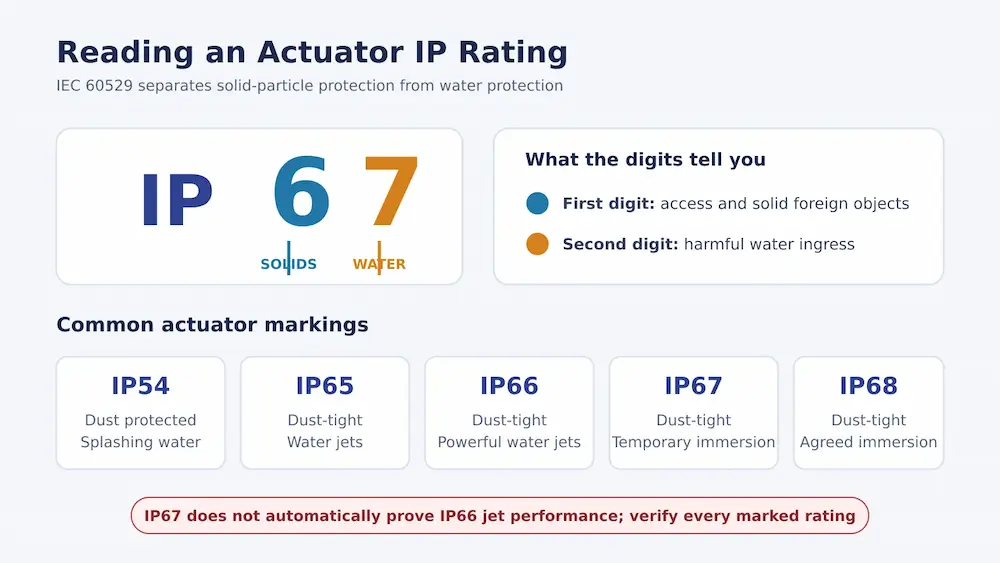
| Common Marking | General Meaning | Practical Electric Valve Use | Important Limitation |
|---|---|---|---|
| IP54 | Dust-protected and protected against splashing water | Selected indoor or sheltered installations | Not the default choice for exposed washdown or flooding |
| IP65 | Dust-tight and protected against water jets | General outdoor or dusty industrial service after site review | Does not cover immersion |
| IP66 | Dust-tight and protected against powerful water jets | Exposed outdoor installations and stronger washdown conditions | Does not automatically establish immersion protection |
| IP67 | Dust-tight and protected against temporary immersion under the specified test | Locations with temporary flooding risk after installation review | IP67 does not automatically prove IP66 jet performance |
| IP68 | Dust-tight and protected for immersion under conditions agreed by the manufacturer and user | Special pits, chambers or flood-prone installations | Depth, duration and test conditions must be confirmed |
| IP69 | Protection against high-pressure, high-temperature water jets under the applicable test | Special high-intensity cleaning environments | Not required merely because a valve is outdoors |
Why a Higher IP Number Is Not Always the Complete Answer
Buyers sometimes assume that IP68 includes every lower water test. That is unsafe. Water-jet and immersion tests represent different exposure mechanisms. If an actuator must withstand both powerful hose-down and immersion, specify the required ratings explicitly and ask for the relevant product documentation.
The published IP rating also depends on the equipment being installed as intended. Covers must be closed, seals must be undamaged, cable glands and stopping plugs must match the cable and entry thread, and unused entries must be sealed correctly. An actuator enclosure marked IP67 can lose its effective protection through one incorrect cable gland.
What NEMA Enclosure Types Mean for Electric Actuated Valves
NEMA enclosure Types are frequently requested for projects in the United States and other markets using North American specifications. They should be stated as Types, such as NEMA Type 4X, rather than treated as a two-digit ingress code.
| NEMA Type | Typical Selection Context | Electric Valve Buyer Note |
|---|---|---|
| Type 1 | General indoor use | Use only where dirt, dripping water and outdoor exposure are not project risks |
| Type 3R | Outdoor rain and sleet exposure | Common for selected outdoor equipment, but not a washdown enclosure |
| Type 4 | Indoor or outdoor service with windblown dust, rain, splashing and hose-directed water | Often considered for industrial outdoor and washdown environments |
| Type 4X | Type 4 environmental protection plus additional corrosion requirements | Useful for chemical plants, coastal sites and corrosive washdown areas after material review |
| Type 6 | Temporary submersion under specified conditions | Confirm water depth, duration, installation and actuator documentation |
| Type 6P | Prolonged submersion under specified conditions | Project conditions and the exact manufacturer rating remain essential |
| Type 12 | Indoor industrial dust, falling dirt and dripping non-corrosive liquids | Common for selected indoor industrial control equipment |
Can an IP Rating Be Converted Directly to a NEMA Type?
No reliable one-to-one conversion should be made from the numbers alone. NEMA publishes comparison guidance showing that certain NEMA enclosure Types meet or exceed particular IEC ingress requirements, but the comparison is one-directional. A product carrying only an IP code has not automatically demonstrated every additional construction or environmental requirement of a corresponding NEMA Type.
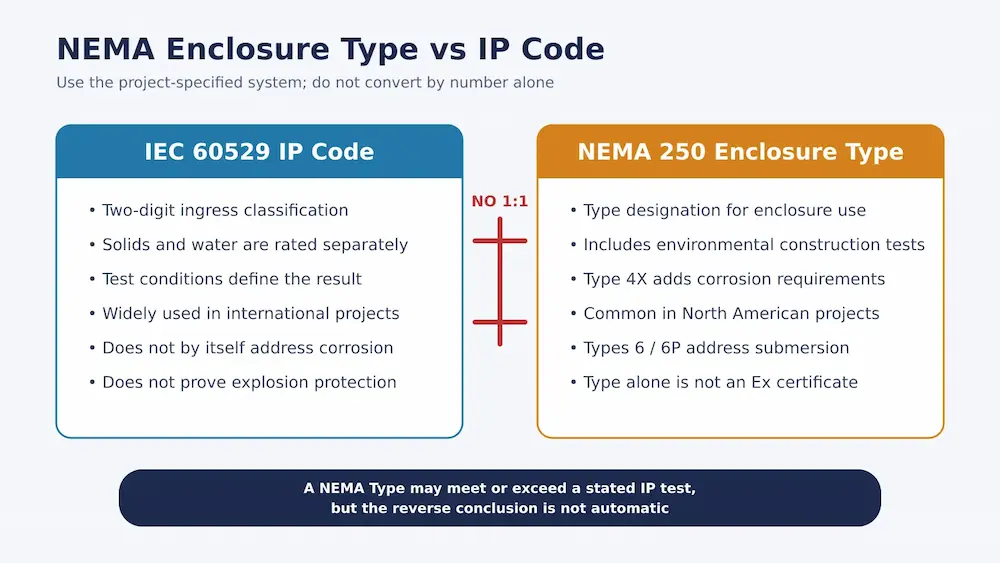
For example, a project that specifies NEMA Type 4X is asking for more than a convenient IP number. Corrosion requirements are part of the Type 4X evaluation. An actuator advertised as IP66 should not be rewritten as NEMA 4X unless the manufacturer supplies the appropriate NEMA Type documentation.
The safest purchasing rule is simple: specify the classification required by the project and verify the actuator documentation in that same system. If both IP66 and NEMA Type 4X are required, list both rather than assuming one proves the other.
Hazardous Areas: Why IP66 Is Not “Explosion-Proof”
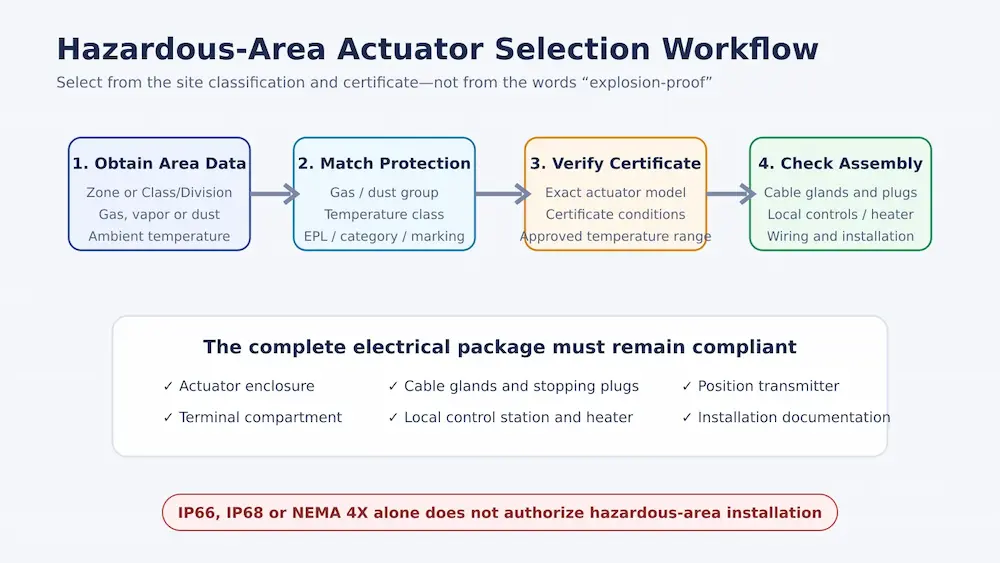
Hazardous-area selection starts with the site classification. Depending on the country and project, this may use IEC Zones, ATEX categories, IECEx equipment protection levels, or North American Class/Division or Zone systems. The location classification reflects the type of flammable gas, vapor, liquid, combustible dust or fiber that may be present and the likelihood of an ignitable concentration.
The buyer should obtain the hazardous-area data from the project owner, engineering contractor or authorized electrical design documentation. A valve supplier should not guess the Zone or Division from an application name such as “chemical plant” or “oil and gas.” Different areas within the same plant can have different classifications, and some may be unclassified.
Data Required for a Hazardous-Area Electric Valve
- Applicable certification system and destination-market requirement
- Zone or Class/Division classification
- Gas, vapor or combustible-dust group
- Required equipment protection level or category, where applicable
- Temperature class or maximum permitted surface temperature
- Minimum and maximum ambient temperature
- Required protection concept and equipment marking
- Actuator power supply, control signal and feedback
- Cable-gland, stopping-plug and wiring requirements
- Certificate number, special conditions and exact model coverage
ATEX Directive 2014/34/EU covers equipment and protective systems intended for use in potentially explosive atmospheres when placed on the EU market. IECEx provides an international conformity-assessment framework based on the IEC 60079 series. In the United States, OSHA 29 CFR 1910.307 addresses electrical equipment and wiring in hazardous classified locations, while the applicable project may use Class/Division or Zone documentation.
A generic declaration such as “ATEX available” is not enough. Confirm that the certificate covers the exact actuator model, construction and ambient range being offered. Review any special conditions of use. The complete supplied assembly—including cable glands, stopping plugs, terminal compartments, local controls and optional electronics—must preserve the required protection.
Outdoor Exposure Is More Than Rain
Outdoor electric valves can fail even when the enclosure carries a suitable rain or jet rating. The site review should also consider:
- Condensation: daily temperature changes can draw humid air into an enclosure or create internal condensation.
- Solar heating: direct sunlight can raise internal electronic temperature above the surrounding ambient value.
- Corrosive atmosphere: salt, chlorine, acid vapor and chemical mist can attack coatings, fasteners, shafts and cable glands.
- Flooding: a pit or chamber can fill with water even if the normal environment is dry.
- Ice and snow: external ice can obstruct manual overrides, indicators or local controls.
- Maintenance access: covers and glands must remain reachable without removing the valve from the pipeline.
Anti-condensation heaters, drain or breather arrangements and protective sunshades may be useful, but they must be approved for the selected actuator and site. Adding an unapproved breather or drilling a field hole can invalidate the enclosure rating or hazardous-area protection.
Cable Entries Are Part of the Enclosure System
The enclosure rating shown on an actuator datasheet assumes suitable entry components and correct installation. Before ordering, confirm:
- Cable-entry thread form and size
- Power, control and communication cable quantities
- Cable outside diameter and gland clamping range
- Armored or unarmored cable construction
- Required ingress and hazardous-area certification of the glands
- Approved stopping plugs for unused entries
- Earthing and bonding provisions
- Minimum bend radius and downward cable routing where practical
Do not leave shipping plugs in unused entries unless they are specifically approved as permanent stopping plugs. A low-cost, incorrectly sized cable gland can compromise a high-specification actuator enclosure.
Recommended Enclosure Selection by Installation Scenario
| Installation Scenario | Starting Review Point | Additional Checks |
|---|---|---|
| Clean indoor utility room | Project-required indoor IP or NEMA Type | Dust, condensation, duty and maintenance access |
| Outdoor water-treatment plant | Outdoor rain and water-jet protection | Flood level, UV, condensation, cable routing and corrosion |
| Food or process washdown area | Specified washdown rating | Water pressure, temperature, chemicals and hygienic installation |
| Coastal or chemical atmosphere | Ingress plus corrosion-resistant enclosure requirement | Coating, fasteners, glands, shaft material and chemical compatibility |
| Valve chamber with flood risk | Specified immersion rating | Depth, duration, repeated exposure and cable sealing |
| Hazardous gas or dust area | Exact area classification and certification system | Marking, certificate scope, temperature, glands and installation rules |
How Enclosure Selection Fits the Complete Electric Valve Package
Enclosure protection should be reviewed alongside the mechanical and electrical design of the actuated valve. A suitable enclosure cannot correct an undersized actuator, an incompatible control signal or a misaligned mounting bracket.
For the complete selection sequence—including actuator power source, motion type, torque or thrust, fail action, duty and mounting—review our industrial valve actuator selection guide.
Before confirming an electric actuated valve, review these connected decisions:
- Calculate the required actuator output from break, running and seating torque. See the valve actuator torque sizing guide.
- Confirm on/off or modulating operation, command signal and position feedback. See the electric actuator control signals guide.
- Confirm the installation environment, IP rating, NEMA Type and hazardous-area requirements.
- Check the mounting flange, drive adapter, bracket alignment and valve travel.
- Verify the final assembled valve through functional testing, limit adjustment and documentation review.
For broader supplier evaluation, read how to choose electric valve actuator brands. For corrosive automation applications, see electric ball valves in chemical plants.
RFQ Checklist for Electric Actuated Valves
- Valve type, size, pressure rating and end connection
- Working medium, pressure, temperature and corrosion conditions
- Required valve torque or complete process data for sizing
- Power supply, frequency and allowable voltage variation
- On/off or modulating control
- Command signal, position feedback and communication protocol
- Operating frequency and required duty
- Indoor, outdoor, washdown, coastal, corrosive or flood-prone location
- Required IP code and/or NEMA enclosure Type
- Minimum and maximum ambient temperature
- Hazardous-area classification and required certification
- Cable type, cable-entry size and gland responsibility
- Required drawings, wiring diagram, certificates and test records
Send these details through the Vcore Valve project inquiry form. We can review the valve and actuator as one assembled package and identify missing enclosure or control information before quotation.
Frequently Asked Questions
What IP rating should an outdoor electric actuated valve have?
There is no universal outdoor rating. Confirm rain, dust, water-jet exposure, flooding, condensation, corrosion, sunlight and the project specification. IP65 or IP66 may be common starting points for many outdoor applications, but the correct rating must follow the actual site conditions.
Is IP68 better than IP66 for every valve actuator?
No. IP68 addresses immersion under manufacturer-agreed conditions, while IP66 addresses powerful water jets. One does not automatically prove the other. Specify every exposure the actuator must withstand.
Is NEMA 4X equivalent to IP66?
They are not direct equivalents. A NEMA Type may meet or exceed certain IEC ingress tests, but NEMA Type 4X also includes corrosion-related requirements. Do not label an IP66 product as NEMA 4X without supporting manufacturer documentation.
Does IP66 mean an electric valve actuator is explosion-proof?
No. IP66 addresses dust and water ingress. Hazardous-area suitability requires the correct certified equipment and marking for the site classification, gas or dust group, temperature requirement and ambient conditions.
Can a standard actuator be installed in a Zone 2 area?
Do not assume so. The project classification, applicable rules and equipment protection requirements must be reviewed. The exact actuator model and installed electrical components must carry suitable certification and marking for the location.
Why does the cable gland matter to the enclosure rating?
The cable gland closes an enclosure entry around the cable. An incorrect thread, sealing method or cable diameter can allow water or dust to enter and may also invalidate hazardous-area protection.