Y-Pattern Globe Valve for Steam and High-Flow Applications
Conventional globe valves are valued for controlled throttling and reliable shut-off, but their internal flow path can impose a significant pressure loss. In applications such as steam distribution, boiler systems and high-flow process lines, that pressure loss can become an important selection factor.
A Y-pattern globe valve, also called an inclined globe valve or Y-type globe valve, changes the geometry of the body, stem and seat. Instead of placing the stem approximately perpendicular to the pipeline, the operating assembly is inclined toward the flow axis. The resulting passage is generally more streamlined than the conventional Z-shaped path of a standard globe valve.
This article explains how the Y-pattern design works, why it is considered for steam and high-flow applications, where its advantages are meaningful, and what engineers and procurement teams should verify before specifying one.
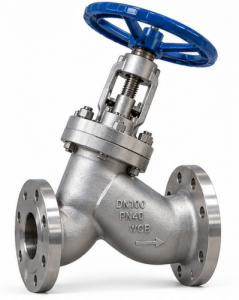
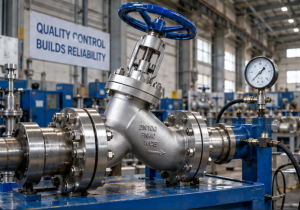
Y-pattern globe valve in an industrial valve workshop, 45-degree product view, clearly showing inclined bonnet and stem
What Is a Y-Pattern Globe Valve?
A Y-pattern globe valve is a linear-motion valve in which the bonnet, stem and seating axis are inclined relative to the main pipeline axis. The exact inclination depends on the manufacturer and design, but the purpose is consistent: reduce the abrupt changes in flow direction that occur inside a conventional globe valve.
The valve still uses the basic globe-valve operating principle. Rotating a handwheel or operating an actuator moves the stem and disc or plug toward or away from the seat. The valve can therefore provide shut-off and controlled throttling, while the inclined internal geometry improves flow passage efficiency.
Vcore already supplies inclined globe valve configurations, and additional globe-valve options can be reviewed in the industrial globe valve product range.
How the Y-Pattern Flow Path Differs from a Standard Globe Valve
The key engineering difference is not simply the external Y-shaped appearance. It is the relationship between the seat plane, stem axis and fluid passage.
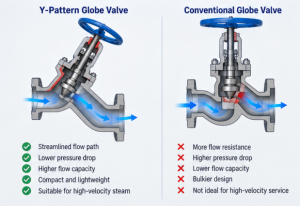
In a conventional straight-pattern or Z-pattern globe valve, the fluid changes direction as it approaches the seat and then changes direction again after passing through the restriction. This geometry supports effective throttling, but it also creates resistance and turbulence.
In a Y-pattern design, the seat and stem are inclined so the fluid follows a less abrupt route through the body. This generally produces a higher flow coefficient for a comparable nominal size and can reduce the pressure loss associated with the valve when it is open.
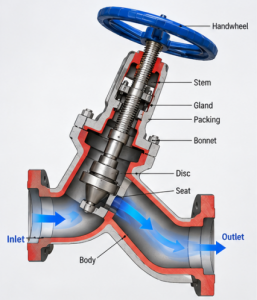
Engineering cutaway comparing a Y-pattern globe valve flow path with a conventional Z-pattern globe valve; show disc, seat, stem and directional arrows.
| Selection Factor | Y-Pattern Globe Valve | Conventional Globe Valve |
|---|---|---|
| Stem / seat orientation | Inclined toward pipeline axis | Typically near perpendicular to pipeline axis |
| Internal flow route | Less tortuous, more gradual change in direction | More pronounced change in flow direction |
| Pressure loss | Generally lower for comparable design and opening | Generally higher |
| Flow capacity | Generally higher for comparable nominal size | Lower relative flow capacity is common |
| Throttling capability | Good, subject to trim and operating conditions | Good |
| Typical selection driver | Steam, higher flow, energy loss or velocity concerns | General throttling and shut-off service |
Why Y-Pattern Globe Valves Are Used in Steam Service
Steam systems can combine high temperature, substantial velocity, thermal cycling and significant differential pressure. These conditions make valve selection more demanding than general water service.
1. Reduced Permanent Pressure Loss
A valve installed in a main or continuously operating steam line creates an ongoing energy penalty if its resistance is excessive. The more direct passage of a Y-pattern globe valve can reduce this loss compared with a conventional globe-valve body of similar duty.
This advantage is particularly relevant where a globe valve is required for its throttling or seating characteristics but the system designer also wants to preserve available steam pressure downstream.
2. Better Suitability for Higher Flow Rates
Higher flow capacity can allow a Y-pattern valve to handle the required steam flow without forcing the same degree of acceleration through a highly restrictive internal passage. However, nominal line size alone is not sufficient for selection. Required flow, upstream and downstream pressure, temperature and permissible velocity should be reviewed together.
3. Trim Protection in Demanding Service
High-velocity steam can cause erosion at the disc, seat and adjacent body surfaces, especially when the valve operates partly open. A less abrupt flow path may reduce some localized turbulence, but severe throttling still requires careful trim selection.
For steam and high-temperature duties, hardfaced seating surfaces may be considered according to the actual operating conditions. See the Valve Trim Materials Selection Guide for 13Cr, stainless steel, Stellite and special-alloy considerations.

Y-pattern globe valve installed on an insulated high-temperature steam pipeline in a power plant or boiler facility; realistic outdoor/industrial application.
Where Y-Pattern Globe Valves Are Commonly Applied
The design is most valuable when the project requires globe-valve throttling or shut-off characteristics but also places greater importance on flow capacity and pressure-loss control.
| Application | Why Y-Pattern May Be Selected | Important Checks |
|---|---|---|
| Main and auxiliary steam lines | High flow with reduced valve pressure loss | Steam pressure, temperature, velocity, body and trim material |
| Power plant piping | Suitable for demanding thermal service and throttling duties | Pressure-temperature rating, bonnet design, hardfacing, end connection |
| Boiler feedwater and hot-water systems | Flow regulation with improved flow capacity | Differential pressure, cavitation risk, flashing conditions, trim |
| High-flow process utilities | Lower resistance than a conventional globe configuration | Cv/Kv, velocity, allowable pressure loss |
| Refinery and petrochemical utilities | Throttling and isolation under elevated pressure/temperature | Medium compatibility, materials, emissions requirements, testing |
| High-temperature thermal systems | Metal-seated construction and controlled flow | Thermal cycling, packing, gasket, body alloy and stem material |
Y-Pattern Globe Valve vs Angle Globe Valve
Y-pattern and angle globe valves are sometimes grouped together because both modify the conventional globe-valve flow path. They are not the same body arrangement.
A Y-pattern valve normally maintains the inlet and outlet on the same general pipeline axis while inclining the bonnet and seat assembly. An angle globe valve normally changes the piping direction through the valve body, commonly by approximately 90 degrees.
If the pipeline itself needs to turn at the valve location, an angle globe valve may eliminate a separate elbow. If the pipeline remains substantially straight but lower globe-valve resistance is desired, a Y-pattern body may be more appropriate. For the angle configuration, see Angle High Pressure Globe Valve & Throttle Valve.
Y-Pattern Globe Valve vs Standard Globe Valve
The Y-pattern design should not automatically replace every conventional globe valve. A standard globe valve remains practical for many general throttling duties, especially when flow capacity and pressure loss are not dominant constraints.
Choose between the designs by evaluating the actual system duty rather than the body shape alone:
- Choose a Y-pattern globe valve when high flow, steam duty or lower valve resistance is an important design objective while globe-valve control characteristics are still required.
- Choose a conventional globe valve when standard throttling and shut-off performance are required and its pressure loss is acceptable to the process.
- Consider a control valve when continuous automatic regulation, defined flow characteristics, high pressure-drop management or process-control accuracy is the primary duty. See the Control Valve Selection Guide.
Pressure Drop, Cv/Kv and Flow Velocity
One of the most common purchasing mistakes is specifying “high-flow Y-pattern globe valve” without defining the actual flow cases. A meaningful engineering review should include minimum, normal and maximum flow where relevant.
The supplier may need:
- Fluid or steam condition
- Upstream pressure
- Downstream pressure or differential pressure
- Operating and design temperature
- Required mass or volumetric flow rate
- Line size and schedule
- Required valve Cv or Kv, if already calculated
- Expected operating travel or throttling range
- Allowable noise, vibration or erosion limits where applicable
A larger Cv is not automatically better. An oversized throttling valve may operate too close to the seat during normal service, which can reduce controllability and concentrate velocity at the trim. The valve should be sized for the operating envelope, not selected only from the pipeline diameter.
Body, Bonnet and End Connection Selection
The Y-pattern body does not determine the pressure capability by itself. Pressure-temperature suitability depends on the complete pressure-containing design, material, wall thickness, applicable standard, pressure class and connection arrangement.
Bolted Bonnet
Bolted-bonnet construction is common across many industrial pressure classes and provides practical access for inspection and maintenance. Gasket and bolting materials must match the process temperature and project specification.
Pressure Seal Bonnet
For high-pressure and high-temperature power-plant service, a pressure-seal bonnet may be considered. The appropriate bonnet style depends on the selected valve design and pressure class. Vcore’s Pressure Seal Globe Valve page provides additional guidance for severe steam applications.
Flanged vs Butt-Weld Ends
Flanged ends simplify removal and replacement, while butt-weld ends reduce the number of external flange joints and are common in high-pressure, high-temperature piping. The correct choice depends on piping class, maintenance philosophy and project specification.
Materials for Steam and High-Temperature Service
Material selection must be based on the actual pressure-temperature combination and applicable project code. Carbon steel may be suitable for many industrial steam duties, while alloy steels are commonly considered as temperature and pressure severity increases.
| Component | Typical Options to Review | Selection Focus |
|---|---|---|
| Body / bonnet | Carbon steel, Cr-Mo alloy steel, stainless steel, project-specified alloy | Pressure-temperature rating, corrosion, code requirements |
| Stem | 13Cr stainless, stainless steel, alloy grades | Strength, corrosion, galling and temperature |
| Disc / plug | Stainless steel, alloy steel, hardfaced construction | Throttling erosion and seating wear |
| Seat | Metal seat, stainless or hardfaced seat | Temperature, leakage and erosion resistance |
| Packing | Graphite or project-specified high-temperature packing | Temperature, emissions and stem friction |
| Gasket | Graphite-based or project-specified gasket | Pressure, temperature and bonnet design |
Flow Direction Matters
Globe valves are directional components. The recommended flow direction can depend on disc design, pressure class, valve orientation, required closing force and manufacturer engineering.
For a Y-pattern valve, the purchaser should not assume the arrow direction from another globe-valve design. The approved drawing and manufacturer instructions should define the required installation direction. This is especially important for high differential pressure and actuated service because process forces affect stem thrust and seating load.
Manual, Electric or Pneumatic Operation
Y-pattern globe valves may be manually operated or automated depending on valve size, differential pressure, operating frequency and control function.
- Handwheel: common for local manual isolation and adjustment.
- Gear or assisted manual operation: may be considered when required operating effort becomes high.
- Electric actuator: useful for remote multi-turn operation and plant automation.
- Pneumatic or linear actuator: may be used for frequent operation or modulating duties when the valve and trim are engineered for control service.
Actuator selection must use actual valve thrust, stroke, seating force and process differential pressure. For automated projects, review the Valve Actuator Selection Guide.
Y-pattern globe valve mounted on a professional hydrostatic test bench with safe blind fixtures, inspection tools and no readable gauge claims
Standards and Testing to Confirm
The applicable standards depend on the valve construction, material, pressure class, end connection and project specification. Rather than placing a generic standards list on every RFQ, buyers should identify which standard governs each design feature.
| Requirement | Typical Reference to Confirm | Procurement Check |
|---|---|---|
| Pressure-containing valve design | ASME B16.34 or project-specified valve standard | Confirm selected design and applicable edition |
| Face-to-face / end-to-end | ASME B16.10 or approved manufacturer/project dimension | Confirm Y-pattern dimensions on GA drawing |
| Flanged ends | ASME B16.5 / B16.47 where applicable | Confirm size, class, facing and drilling |
| Butt-weld ends | ASME B16.25 where specified | Confirm pipe schedule and weld-end preparation |
| Pressure testing | API 598 or project-specified test standard | Confirm shell, seat and required additional tests |
| Materials | Applicable ASTM / ASME material specifications | Verify MTC and project material requirements |
Standards should be confirmed against the exact valve offered. Do not assume every Y-pattern globe valve automatically complies with every globe-valve standard listed in a general catalog.
Factory Inspection for a Y-Pattern Globe Valve
For steam and high-pressure applications, procurement review should go beyond catalog dimensions. Depending on project requirements, inspection may include:
- Material certificate review and traceability
- Body, bonnet, disc, seat and stem material verification
- Dimensional inspection against approved GA drawing
- Flange or butt-weld end verification
- Visual and surface inspection
- Shell pressure test
- Seat leakage test
- Backseat test where applicable
- Operational travel and handwheel/actuator function
- PMI, NDE or additional project tests when specified
- Marking, nameplate and packing inspection
Monochrome Y-pattern globe valve engineering sketch with inclined stem, bonnet, disc, seat, body, flanges and major dimensional callouts; no marketing title.
Common Selection Mistakes
Mistake 1: Assuming Y-Pattern Means “Low Pressure Drop” in Every Case
The geometry generally reduces resistance compared with a conventional globe body, but actual pressure drop must be determined from the specific valve’s Cv/Kv and operating conditions.
Mistake 2: Selecting Only by Nominal Size and Pressure Class
Two valves with the same NPS and Class can behave very differently under high steam flow. Flow rate, differential pressure, temperature, trim and travel matter.
Mistake 3: Ignoring Throttling Erosion
A Y-pattern body improves the flow path but does not eliminate high-velocity trim damage. Severe throttling may require hardfacing, special trim geometry or a dedicated control-valve solution.
Mistake 4: Treating All Steam Service as the Same
Saturated steam, superheated steam, auxiliary steam and turbine-related systems can have very different pressure-temperature conditions and cycling requirements.
Mistake 5: Not Confirming Installation Direction
The manufacturer-approved flow direction should be shown on the drawing and valve body. Incorrect installation can change operating forces and performance.
RFQ Checklist for Y-Pattern Globe Valves
For a meaningful quotation, provide:
- Valve type: Y-pattern / inclined globe valve
- Quantity
- Nominal size: DN / NPS
- Pressure class or PN rating
- Operating and design pressure
- Operating and design temperature
- Medium: saturated steam, superheated steam, water, oil, gas or process fluid
- Required flow rate and allowable pressure drop, where relevant
- Body and bonnet material
- Disc, seat, stem and hardfacing requirements
- Bonnet type: bolted bonnet, pressure seal or project-specific
- End connection: RF, RTJ, butt weld or other
- Flange / weld-end standard
- Operation: handwheel, gear, electric or pneumatic
- Required leakage / shut-off requirement
- Design, dimensional and testing standards
- NDE, PMI, MTC and inspection requirements
- Required drawings and documentation
- Installation orientation and required flow direction if project-defined
- Delivery term and destination
How to Choose a Y-Pattern Globe Valve for Steam and High-Flow Service
The Y-pattern globe valve is best viewed as an engineering compromise between the throttling capability of a globe valve and the desire for a more efficient flow passage. Its inclined seat and stem arrangement can improve flow capacity and reduce resistance compared with a conventional globe valve, which makes the design attractive for steam, power generation and high-flow process systems.
However, body pattern alone does not determine suitability. The final valve must be checked against the complete process envelope: pressure, temperature, flow rate, differential pressure, velocity, body material, trim, hardfacing, bonnet design, packing, connection, flow direction, operation and test requirements.
If the service involves high pressure and temperature, also compare the Y-pattern option with a pressure seal globe valve. If continuous automatic regulation is required, review the control valve range rather than selecting a manual globe valve only from its body geometry.
For a project-specific review, send Vcore Valve the medium, flow rate, pressure, temperature, line size, pressure class, materials, connection, operation method and required standards through the contact page.
Frequently Asked Questions
What is a Y-pattern globe valve?
A Y-pattern globe valve is a linear-motion globe valve with an inclined stem and seat axis. The geometry creates a less tortuous internal flow path than a conventional globe valve while retaining throttling and shut-off capability.
Why are Y-pattern globe valves used for steam?
They are often considered for steam because their flow path can provide higher flow capacity and lower pressure loss than a conventional globe body. Steam applications must still be checked for pressure-temperature rating, velocity, trim erosion, packing, gasket and material suitability.
Does a Y-pattern globe valve always have a lower pressure drop?
It generally has lower resistance than a comparable conventional globe-valve design, but the actual pressure drop depends on the specific valve Cv/Kv, size, opening, internal geometry and process conditions.
Can a Y-pattern globe valve be used for throttling?
Yes. It retains the linear disc-and-seat operating principle of a globe valve and can be used for throttling. Severe pressure-drop service should be reviewed for velocity, erosion, cavitation, flashing, noise and trim requirements.
What materials are used for Y-pattern globe valves in steam service?
Depending on pressure and temperature, options may include carbon steel, Cr-Mo alloy steel, stainless steel and project-specified alloys. Trim may use stainless steel or hardfaced seating surfaces, and high-temperature graphite packing may be considered. Final materials must match the actual design conditions and project specification.
What information is needed to quote a Y-pattern globe valve?
Provide size, pressure class, medium, operating and design pressure, operating and design temperature, flow rate where relevant, body and trim materials, bonnet type, connection, operation method, applicable standards, quantity and required inspection documents.