Pressure Seal Globe Valve vs Bolted Bonnet Globe Valve for High-Pressure Steam
When purchasing a globe valve for a boiler, main steam line or high-pressure steam utility, the bonnet joint is part of the pressure boundary. A generic description such as “high-pressure globe valve, Class 1500” does not tell the manufacturer whether the buyer requires a pressure-seal bonnet or a conventional bolted bonnet. This guide compares the two joints at the component and procurement level rather than repeating a basic product description.
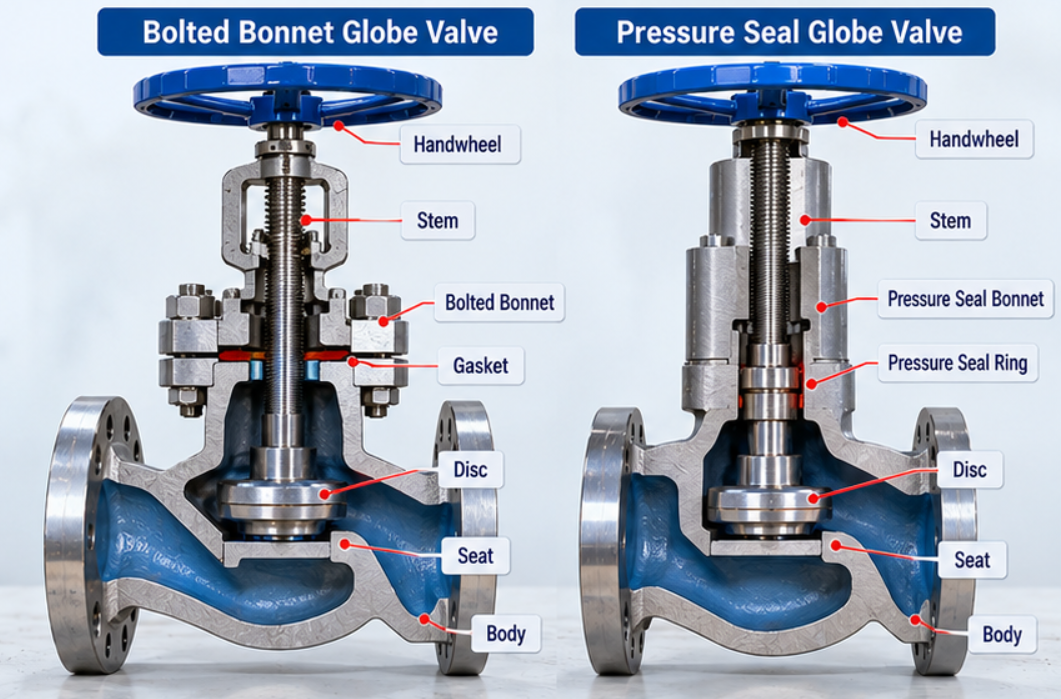
1. Bonnet joint construction: where does sealing load come from?
Pressure-seal bonnet
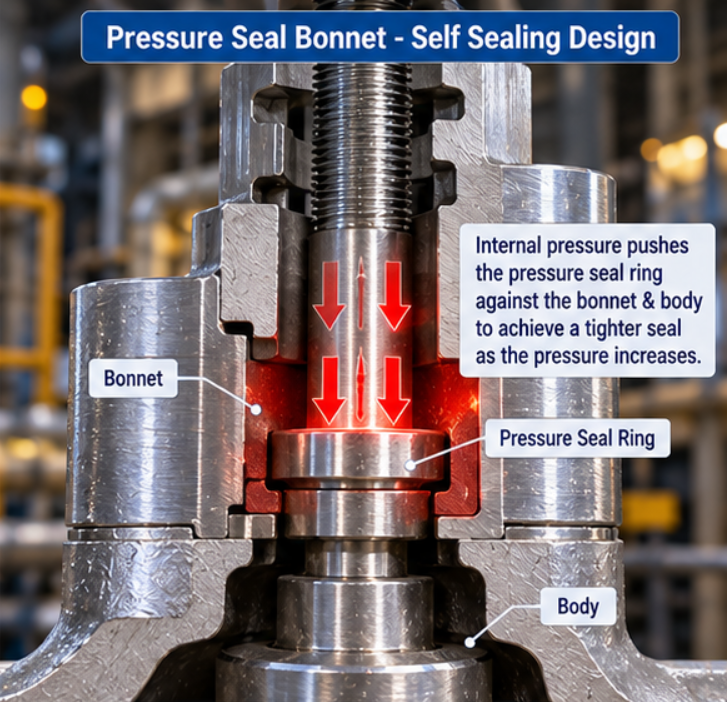
A pressure-seal design uses a bonnet, specially shaped sealing ring or gasket, and a mechanical retaining system. The assembly is preloaded and retained during installation; as internal pressure rises, the geometry transmits an additional load into the sealing interface. Pressure assistance does not eliminate the need for correct initial assembly, gasket compatibility or low-pressure tightness verification. Retaining rings, segmented rings, yokes and anti-extrusion details vary by manufacturer.
Bolted bonnet
A bolted bonnet joins the bonnet and body through a gasketed joint clamped by studs or bolts. Controlled bolt preload provides the gasket seating stress; internal pressure and thermal expansion can alter joint loading. Gasket design, stud material, tightening procedure and flange rigidity therefore matter. A properly engineered bolted bonnet can also serve high-pressure steam: the pressure class alone does not mandate a pressure-seal construction.
| Decision factor | Pressure-seal bonnet | Bolted bonnet |
|---|---|---|
| Joint sealing principle | Assembly preload plus pressure-assisted seal geometry | Gasket compression from bonnet bolting |
| Typical procurement context | Often considered for high-pressure/high-temperature power and steam service | Widely used from general steam through engineered high-pressure duties |
| Critical parts | Seal ring, bonnet contact faces, retaining elements, yoke and stem packing | Gasket, studs/nuts, bonnet/body faces and stem packing |
| Maintenance planning | Manufacturer-specific disassembly sequence and replacement seal parts | Bolting access, controlled tightening and gasket replacement |
| Quotation risk | Nonstandard seal geometry and replacement-part availability | Bolting, gasket grade, joint dimensions and tightening specification |
2. Pressure and temperature: use the rating table, not a class shortcut
ASME Class 600, 900, 1500 and 2500 are pressure-class designations, not fixed allowable operating pressures at every temperature. Check the specified edition of ASME B16.34, the actual body/bonnet material group, the valve manufacturer’s certified pressure-temperature rating, and the weakest applicable connection or component. The allowable rating generally changes as metal temperature rises.
For high-temperature steam, also verify design temperature during startup and upset, sustained metal temperature, thermal cycling, creep-sensitive material selection where applicable, and pressure differential across the closed disc. A pressure-seal bonnet cannot compensate for an underspecified body material, stem packing or trim.
For rating methodology, see the Valve Pressure-Temperature Rating Guide. The Pressure Seal Globe Valve for High Pressure Steam Service product page lists configurable pressure classes and material options; these are product options, not proof that every size/material combination is approved at every design temperature.
3. Material and gasket specification: match each part to the steam duty
| Component | Selection questions | RFQ evidence |
|---|---|---|
| Body / bonnet | Is the proposed carbon steel or Cr-Mo alloy permitted at the design temperature and pressure? | ASTM grade, heat treatment, rating group, MTR |
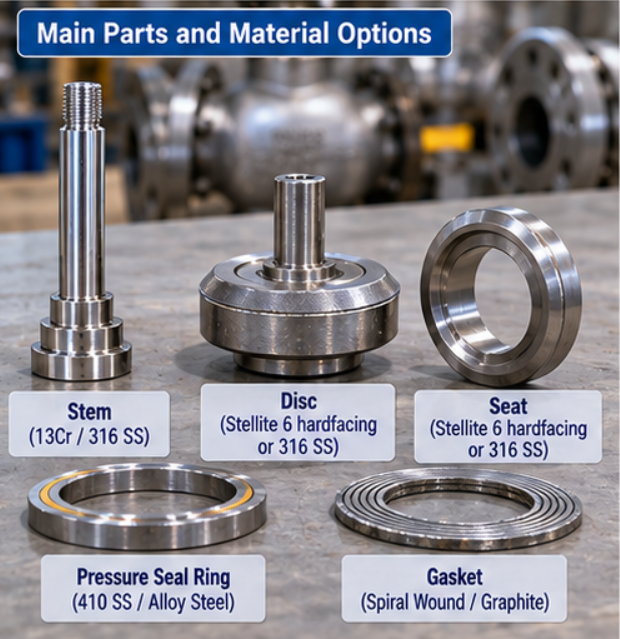
| Pressure-seal ring | What is the approved metal/graphite or other seal construction and contact geometry? | Seal-ring material, drawing, replacement part number |
| Bolted-bonnet gasket | Is the specified spiral-wound, ring-joint or other gasket qualified for the joint and temperature? | Gasket standard, winding/filler or ring material, facing |
| Bonnet bolting / retainer | Are strength, relaxation, expansion and material compatibility addressed? | Stud/nut or retaining-part grades and assembly procedure |
| Stem packing | Can it control external leakage at operating temperature and cycling frequency? | Packing construction and test/acceptance requirement |
| Disc and seat | What are the required shutoff, wear and erosion characteristics? | Trim BOM, hardfacing location and thickness if specified |
For example, ASTM A216 WCB and ASTM A217 WC6/WC9 are different material families; a “higher pressure class” does not automatically justify using one in place of another. Confirm the design-temperature limits, material specification, welding and heat-treatment requirements from the approved piping class and governing code. For disc/seat details, refer to Vcore’s Valve Trim Materials Selection Guide.
4. Thermal cycling, low-pressure startup and external leakage
Steam systems can move through cold startup, warm-up, steady operation and shutdown. These changes alter differential thermal expansion and gasket contact stress. For a pressure-seal design, request evidence of correct initial seal seating and tightness at the relevant low-pressure/startup condition as well as at the specified shell-test condition. For a bolted joint, request the approved tightening method and consider whether thermal cycling calls for a project-specific assembly or maintenance procedure.
Do not confuse bonnet joint leakage with stem packing leakage or seat leakage. Each follows a different leak path and may have different acceptance criteria. A pressure-seal bonnet does not remove the stem packing or guarantee bubble-tight seat shutoff.
5. Maintenance: accessibility is part of valve selection
A bolted bonnet usually provides a familiar route to internal inspection once the valve is safely isolated, depressurized and cooled. However, large high-class bolted joints can require heavy lifting, controlled bolt tensioning and significant radial clearance. A pressure-seal bonnet may reduce reliance on a large conventional bonnet flange, but dismantling and reassembly can involve proprietary seal rings, retaining parts and precise seating procedures.
Before ordering, request a sectional drawing, spare seal/gasket list, disassembly procedure, lifting weight, vertical removal envelope, recommended replacement interval and any special tools. Never loosen bonnet fasteners or retaining elements on a pressurized or hot valve; follow the plant’s isolation and lockout procedures.
6. Factory testing: what the inspection plan should actually prove
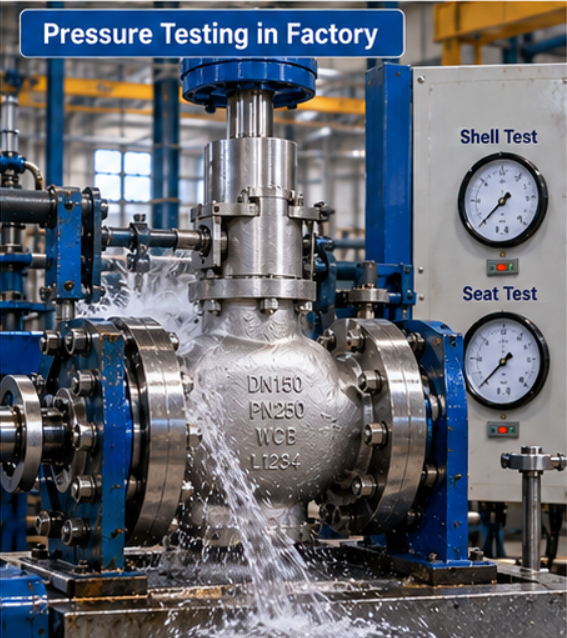
Agree the applicable design and inspection standards in the purchase order. For an ASME B16.34/API 598-based project, identify shell pressure testing, closure/seat leakage testing and backseat testing where applicable, together with duration, test medium, test pressure and acceptance criteria from the specified edition. The shell test addresses pressure-boundary leakage, including the bonnet joint; it is not a substitute for seat leakage or stem-packing verification.
For pressure-seal designs, include inspection of sealing faces, ring identification, assembly records and any project-required additional bonnet-joint checks. For bolted bonnets, verify gasket traceability and approved bolt-tightening records if required. High-temperature steam performance cannot be inferred solely from an ambient-temperature hydrostatic test; request any additional thermal-cycle or qualification evidence the project requires.
See Vcore’s Valve Pressure Test Methods for the distinction between shell and seat tests.
7. Illustrative procurement cases: same valve function, different bonnet decision
Case A — Example only: auxiliary steam isolation. An EPC requests NPS 2, Class 600, 350°C design temperature, flanged ends, manual operation and periodic maintenance access. Both bonnet constructions may be technically considered, subject to the approved piping class and certified pressure-temperature rating. A bolted-bonnet quotation can be compared on gasket, bolting, inspection and lifecycle cost; a pressure-seal option should not be assumed necessary solely from “Class 600.”
Case B — Example only: high-pressure main steam branch. An EPC requests NPS 4, Class 1500, 510°C design temperature, butt-weld ends, high thermal cycling and a specified alloy-steel body. A pressure-seal bonnet may be shortlisted because of its pressure-assisted joint, but an engineered bolted-bonnet alternative cannot be excluded without checking project standards, manufacturer rating, maintenance access and qualification. The alloy grade, allowable pressure at 510°C, trim, seal ring and weld-end dimensions must be confirmed before a firm quotation.
8. What actually changes the purchase price?
| Cost driver | Pressure-seal option | Bolted-bonnet option |
|---|---|---|
| Pressure-boundary forging/casting and machining | Specialized seal cavity and bonnet geometry | Bonnet flange, studs and gasket contact faces |
| Seal consumables | Design-specific seal ring and retaining components | Specified gasket and bolting |
| Assembly and inspection | Seal installation, dimensional control and joint checks | Controlled gasket seating and bolting records |
| Maintenance and spares | Seal-ring lead time, special tools and access | Gasket/bolt replacement, access and labor |
| Shared high-cost items | Body alloy, size, pressure class, trim hardfacing, end connection, actuator, NDE, testing and documentation | |
There is no reliable universal rule that one bonnet type always costs less. Request two technically equivalent offers with the same size, pressure-temperature duty, body material, trim, end connection, testing scope, delivery terms and documentation. Compare the initial price and planned maintenance cost separately.
9. RFQ checklist and a sample inquiry
- Valve size, quantity and line tag.
- Medium, design/normal pressure, design/normal temperature and thermal cycling.
- Pressure class, governing design standard and specified edition.
- Pressure-seal or bolted-bonnet requirement, or permission to quote both.
- Body/bonnet material grade and heat treatment.
- Bonnet seal/gasket and bolting/retaining-part materials.
- Stem, disc, seat, hardfacing and packing BOM.
- Flanged RF/RTJ or butt-weld end details and face-to-face.
- Manufacturer flow arrow, maximum shutoff differential pressure and operating force.
- Manual/gear/electric operation and maintenance clearance.
- Shell, seat, backseat and project-specific testing/acceptance.
- GA and sectional drawings, MTR, PMI/NDE if required, ITP, spare gasket/seal and delivery terms.
“Please quote NPS 4 Class 1500 globe valves for high-pressure steam service. Design pressure: [value]; design temperature: [value]; body/bonnet material: [ASTM grade]; end connection: [BW/flanged specification]. Provide separate pressure-seal and bolted-bonnet options if both comply with the approved piping class. Confirm the certified pressure-temperature rating, bonnet seal/gasket and bolting BOM, sectional/GA drawing, operating differential-pressure limit, shell and seat test standard, inspection documents, spare seal availability, EXW price and delivery time.”
10. Related Vcore products and steam-valve guides
For a pressure-assisted bonnet configuration, review the Pressure Seal Globe Valve for High Pressure Steam Service. For a configurable flanged-end globe valve where bonnet arrangement must be specified separately, see the Flanged Globe Valve for Industrial Pipeline Flow Control. Browse the Globe Valve product category for additional configurations.
Bonnet selection is independent of the under-seat versus over-seat steam flow direction and Trim 6 versus Trim 8 material selection; verify the manufacturer’s actual valve drawings and trim schedule for each project. If those two blog URLs have not yet been published, update the links to their final live URLs before publishing this article.
Frequently Asked Questions
Does Class 1500 automatically require a pressure-seal bonnet?
No. The specified valve design, manufacturer qualification, material pressure-temperature rating, project piping class and maintenance requirements determine the acceptable bonnet construction.
Does a pressure-seal bonnet seal better at zero pressure?
Not automatically. Pressure assistance develops as internal pressure rises, so correct initial assembly and low-pressure tightness must be verified for the actual design.
Can a flanged globe valve have a pressure-seal bonnet?
Yes. Flanged describes the pipe-end connection; pressure-seal or bolted describes the body-to-bonnet joint.
Is a bolted bonnet unsuitable for high-pressure steam?
No. An engineered bolted-bonnet valve may be suitable if its complete design and certified pressure-temperature rating meet the service and project specification.
What test checks the bonnet joint?
The shell pressure test checks pressure-boundary integrity, including the bonnet joint, under the specified test conditions. Seat and stem-seal leakage require separate applicable checks.
Which design costs less?
Cost depends on material, size, pressure class, seal and bolting design, machining, inspection, spares and maintenance. Compare technically equivalent quotations rather than using a universal price rule.