Class 900 Trunnion Ball Valve Procurement Guide: Materials, Seats, Testing and RFQ Checklist
Class 900 trunnion ball valves are specified for demanding oil, gas and industrial pipeline isolation. In an RFQ, the pressure class is only the starting point: a correct offer must identify the precise pressure-containing material, operating temperature, seat design, connection geometry and project-specific test and documentation scope. This guide focuses on the procurement decisions and evidence that separate a technically complete Class 900 quotation from a generic product catalogue entry.
1. Class 900: Verify Pressure at the Actual Design Temperature
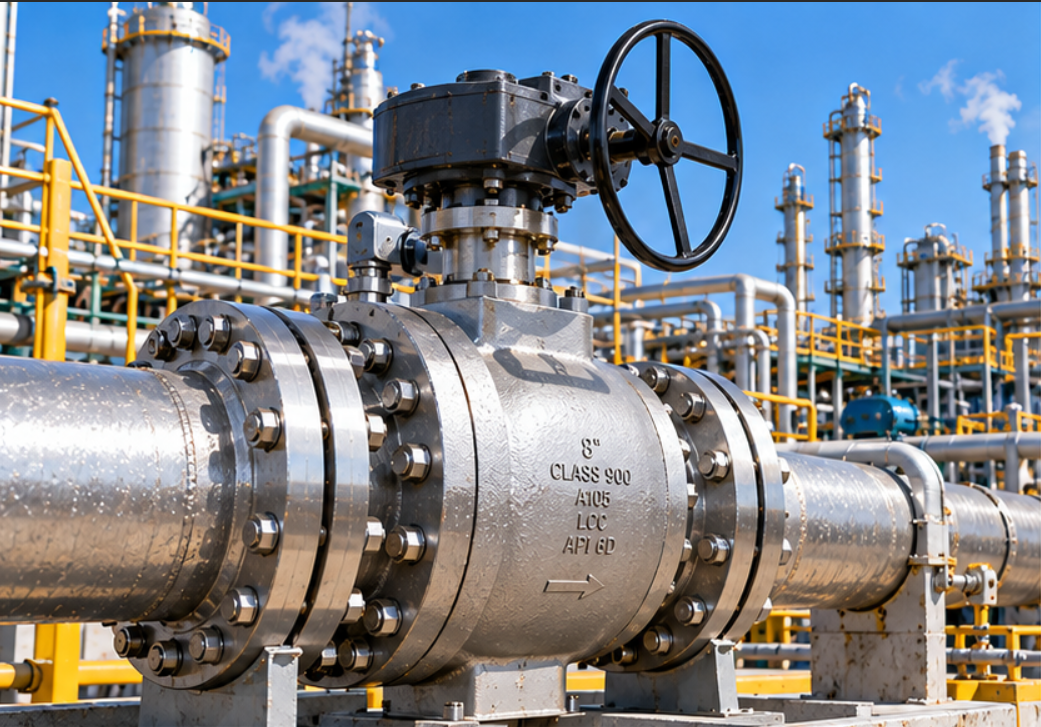
ASME Class 900 is a pressure class, not a fixed allowable working pressure at every temperature. The permissible pressure depends on the applicable pressure–temperature table for the specified body material and material group, the design code and the valve’s approved rating. A nominal Class 900 flange does not establish the temperature capability of the complete valve, particularly its polymer seats, seals, stem packing and actuator accessories.
For every RFQ, state the normal operating pressure, maximum design pressure, minimum and maximum design temperatures, medium and any transient or differential-pressure conditions. Verify the body, bonnet/closure, end connections and sealing system as a complete assembly. For the underlying rating method, consult Vcore’s Valve Pressure–Temperature Rating Guide.
2. Confirm the Trunnion Design, Bore and Body Construction
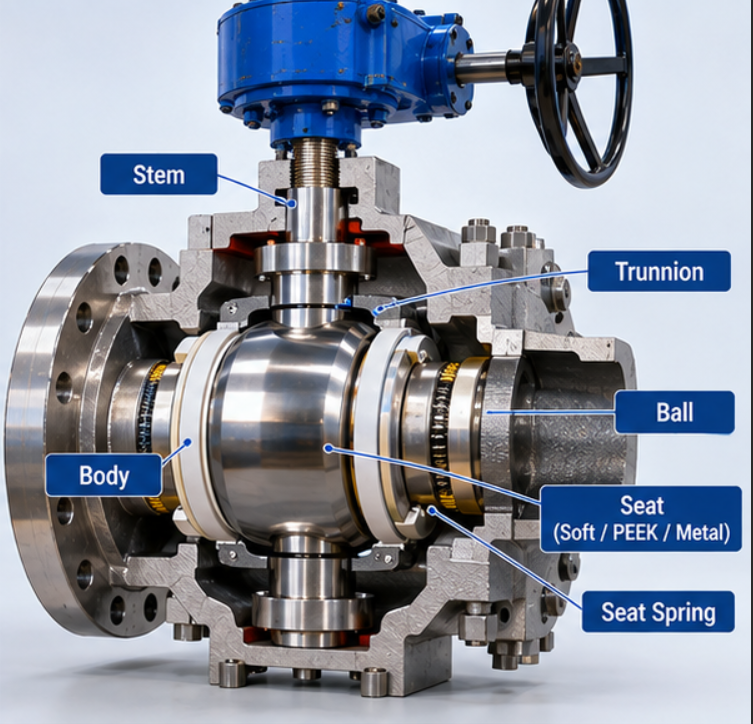
The trunnion supports the ball mechanically, while spring-loaded or pressure-assisted seats provide sealing. For Class 900 service, the RFQ should distinguish two-piece or three-piece split body, top-entry or fully welded construction; full bore or reduced bore; and the required face-to-face dimension. A full-bore requirement may be important for piggable pipelines, but the approved bore and pigging envelope must be confirmed rather than inferred from the product name.
Vcore’s Trunnion Ball Valve product page outlines available configurations. The High Pressure Ball Valve page covers additional construction and seat options; neither catalogue page replaces a Class 900 project-specific GA drawing and datasheet.
3. Specify the Body, Ball, Stem and Bolting Separately
| Component | Common project options (not automatic defaults) | RFQ / inspection check |
|---|---|---|
| Body and closure | ASTM A216 WCB, A105/A105N, LF2, suitable alloy or stainless grade | Rating group, temperature, impact-test requirement, casting/forging route, heat treatment and MTR |
| Ball | Stainless or alloy substrate, corrosion-resistant overlay or specified coating | Substrate grade, overlay/coating specification, thickness, hardness and surface finish |
| Stem / trunnion | Stainless, duplex or approved alloy steel | Strength, corrosion, galling, torque, hardness and sour-service restrictions |
| Bolting | Project-specified ASTM bolting and nuts | Temperature, mechanical properties, sour-service requirements and traceability |
| Body and stem seals | Graphite, elastomer or engineered seal combination | Pressure/temperature compatibility, fire-test configuration and fugitive emissions |
Material labels such as “SS316 ball” or “NACE bolting” are not sufficient by themselves. Request an itemized wetted-parts and pressure-containing-parts bill of materials with ASTM/UNS grades, heat treatment, overlay details and any hardness limits. If the medium contains H₂S, follow the project-defined sour-service envelope rather than assuming that a stainless steel grade is automatically suitable. See Sour Service Valves: NACE MR0175 and Material Selection.
4. Seats, DBB/DIB and Body-Cavity Pressure Relief
Trunnion-mounted valves can use single-piston-effect (SPE) or double-piston-effect (DPE) seat arrangements. Their pressure-assisted sealing and cavity-relief behavior differ. The terms DBB (double block and bleed) and DIB (double isolation and bleed) must be specified and verified using the applicable project/API 6D definitions and test arrangements; a vent port alone does not prove either performance claim.
| Seat option | Procurement consideration | Confirm before quotation |
|---|---|---|
| RPTFE / engineered polymer | Resilient shutoff; extrusion and deformation under differential pressure must be controlled | Grade, pressure–temperature envelope, chemical compatibility, cycling and leakage criteria |
| PEEK or other high-performance polymer | Higher mechanical strength in selected demanding services | Specific grade, design temperature, medium and validated seat design |
| Metal seat / hardfacing | May suit abrasive or elevated-temperature duty | Hardfacing specification, surface finish, torque and acceptance leakage class |
| SPE / DPE seat logic | Determines pressure response and potential trapped-cavity pressure | Upstream/downstream seat arrangement, required isolation and cavity-relief path |
Specify whether thermal expansion of trapped fluid can overpressure the body cavity, and require an approved relief method consistent with the seat design and process safety requirements. Seat injection ports and emergency sealant arrangements, where required, should be identified on the GA drawing. For more on the seat and isolation terminology, read Vcore’s Trunnion Ball Valve Design, Seats and DBB Selection.
5. RF vs RTJ: Do Not Treat Flange Facing as an Optional Detail
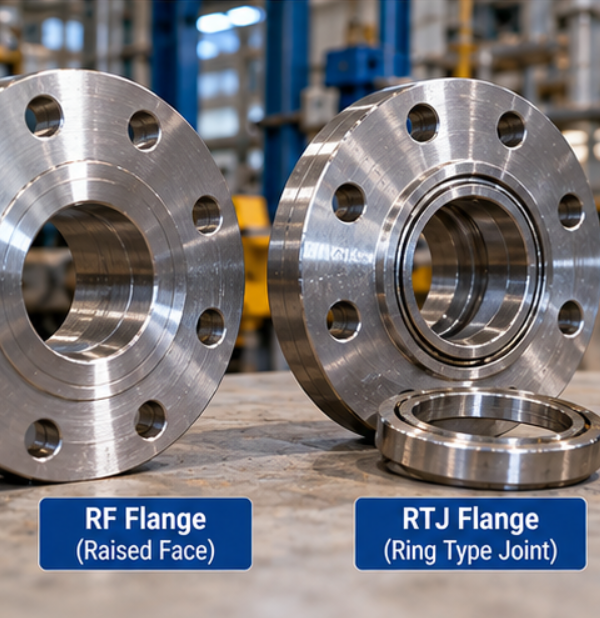
Class 900 valves may be ordered with raised-face (RF) or ring-type-joint (RTJ) flanges when supported by the selected flange standard and valve design. These are different mating-face and gasket systems. An RTJ end requires the correct groove geometry and matching ring gasket designation; an RF end requires the specified gasket and flange-facing finish. The RFQ should identify the applicable ASME B16.5 or B16.47 flange standard as relevant to size, flange facing, nominal size, class, bore and face-to-face dimension under the approved valve dimensional standard.
For RTJ, specify the ring type/material and mating-flange groove details from the piping class. Do not infer a ring number solely from “Class 900.” Confirm bolt material, gasket compatibility, end protection and whether the valve is intended for an existing RF or RTJ pipeline.
6. API 6D, Fire-Safe and Anti-Static: Three Separate Requirements
API 6D concerns pipeline valve design and associated manufacturing/testing requirements when the standard applies to the ordered valve. A claim of API 6D compliance is not itself evidence of a fire-tested design. If fire-safe performance is required, specify the applicable fire-test standard—such as API 607, API 6FA or ISO 10497 as accepted by the project—and request a test report or certificate traceable to the offered valve design, size/pressure/material/seat family within the relevant qualification scope.
Anti-static continuity is a separate design and verification item. The RFQ should state the applicable test/acceptance requirement and request evidence for the offered configuration. Do not use the terms “API 6D,” “fire-safe,” “anti-static” and “NACE” as interchangeable quality labels. Vcore’s API 607 vs API 6D Ball Valves explains the distinction in greater detail.
7. NACE Sour Service: Define the Actual Exposure Envelope
For H₂S-containing oil and gas service, the buyer should state whether NACE MR0175/ISO 15156 or another project-required material standard applies, along with the relevant environment: H₂S partial pressure, pH, chloride concentration, temperature, water phase and other applicable process conditions. The supplier must evaluate the complete materials package, including body, stem, bolting, welds/overlays and heat treatment, rather than issuing an unsupported blanket “NACE compliant” statement.
Where a project specifies a hardness limit such as 22 HRC for certain components, apply it to the materials and locations required by that project/specification; do not assume one universal limit covers every permitted alloy or hardfacing material. Request hardness records, MTRs, heat-treatment records and PMI/NDE as required.
8. Testing and Documents to Request Before Release
| Inspection / document | Purpose | Acceptance basis |
|---|---|---|
| Approved GA and datasheet | Locks in dimensions, bore, seat arrangement, materials and connections | Purchase order and piping class |
| MTRs and traceability map | Links pressure-containing and specified wetted parts to heat numbers | Applicable material standards and project ITP |
| PMI, hardness, heat-treatment / NDE records | Checks alloy identity and specified sour-service controls | Specified methods, locations and acceptance limits |
| Shell and seat leakage tests | Checks pressure integrity and shutoff performance | Specified edition of API 6D / project test procedure |
| DBB/DIB and cavity-relief tests | Verifies claimed isolation and cavity behavior | Specified valve design and approved test plan |
| Fire-test evidence and anti-static results | Verifies separate safety-related requirements | Applicable standard and qualification scope |
| Torque / functional test and actuator datasheet | Checks operation at maximum design differential pressure | Approved torque basis and actuator sizing margin |
| Coating, marking, packing and final dossier | Verifies transport protection and document completeness | Project specification and approved ITP |
Do not promise “zero leakage” without specifying the test medium, direction, pressure, duration and acceptance criterion. The shell test, seat test and functional test serve different purposes. See Vcore’s Valve Pressure Test Methods and Valve Fugitive Emission Testing for related inspection topics.
9. Example RFQ: Class 900 Gas Pipeline Isolation
Illustrative procurement scenario only—not a completed project, fixed Vcore catalogue configuration or guaranteed rating.
| RFQ field | Illustrative buyer entry |
|---|---|
| Service | Natural-gas pipeline isolation; sour-service status to be confirmed from process data |
| Valve | NPS 6, Class 900, trunnion mounted, full bore, two-piece split body |
| Pressure / temperature | Design pressure and temperature: enter project values; verify material-group pressure–temperature rating |
| End connection | ASME B16.5 Class 900 RTJ; matching groove/ring gasket per piping class |
| Materials | Body A105N or approved alternative; ball, stem, bolting and seals per reviewed BOM |
| Seat arrangement | Buyer to define SPE/DPE, DBB/DIB and cavity relief after process review |
| Design / safety | Applicable API 6D edition; fire-test evidence and anti-static test if required |
| Sour service | NACE MR0175/ISO 15156 only if required by documented process environment |
| Operation | Gearbox; maximum differential-pressure torque and operating time to be confirmed |
| Inspection | Approved ITP, shell/seat tests, MTR, PMI/hardness as specified, GA, packing list |
Commercial comparison: two Class 900 offers are not directly comparable if one includes RTJ machining, qualified fire-test evidence, special seats, sour-service material controls and witnessed testing while the other excludes them. Ask suppliers to state all technical deviations and separately identify optional testing, actuator, inspection and freight costs.
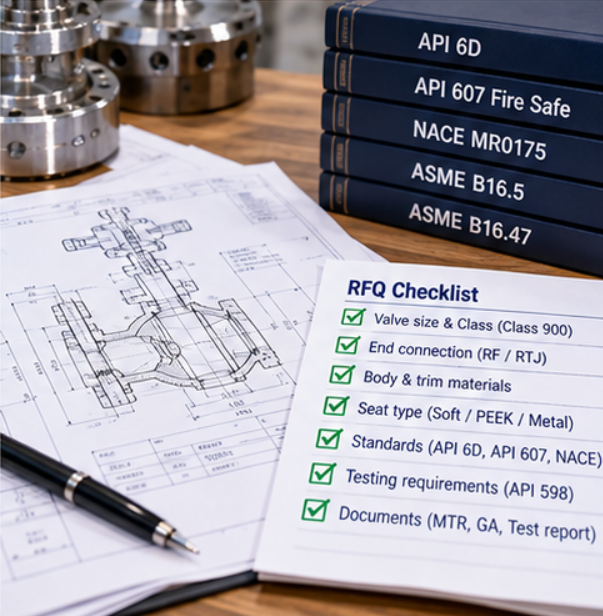
10. Copy-and-Send RFQ Checklist
- Quantity, nominal size and project tag number.
- Fluid composition, phase and sour-service parameters.
- Operating/design pressure, temperature and maximum differential pressure.
- Class 900 material-group rating and applicable design standard/edition.
- Full or reduced bore; pigging requirement.
- Body construction and face-to-face dimension.
- RF/RTJ/BW end, flange standard and gasket/ring details.
- Body, ball, stem, trunnion, seat, seals and bolting BOM.
- SPE/DPE, DBB/DIB, bleed/drain and cavity relief.
- Fire-test evidence, anti-static requirement and any emissions qualification.
- NACE applicability, hardness, heat treatment and NDE/PMI scope.
- Gearbox/actuator, torque basis and fail-position requirements.
- Shell/seat/functional test procedures, ITP and third-party witness points.
- GA, datasheet, MTR, test reports, certificates, net weight, packing dimensions, lead time and Incoterm.

Frequently Asked Questions
Is Class 900 the same as 900 psi?
No. Class 900 is an ASME pressure-class designation. Permissible pressure depends on the specified material-group rating and design temperature, while seats and seals may impose additional limits.
Can Class 900 trunnion ball valves use RF or RTJ flanges?
Either may be specified when the selected design and piping class permit it. RF and RTJ have different facing, gasket and mating-flange requirements; state the required type explicitly.
Does API 6D compliance prove fire-safe certification?
No. Fire-test evidence is a separate requirement and must cover the offered valve design within the applicable qualification scope.
Does a trunnion valve automatically provide DBB or DIB?
No. The seat arrangement, isolation definition, vent/bleed configuration and required tests must be specified and verified.
What should a supplier submit for NACE service?
Request a reviewed material BOM, defined service envelope and the applicable material, heat-treatment, hardness and inspection evidence required by the project.
What causes price differences between two Class 900 quotations?
Differences in body construction, bore, alloy grades, seat design, RF/RTJ ends, fire-test qualification, sour-service controls, actuator, NDE, witness inspection and documentation can all affect price.