Selecting anti-corrosion valve materials is one of the most important decisions in chemical processing projects. In a corrosive pipeline, the valve body, ball, disc, stem, seat, seal, packing, lining, diaphragm, and fasteners may all face different chemical and mechanical risks. A material that works well for the valve body may not be suitable for the seat. A seal material that works in water may fail quickly in solvent, acid, alkali, oil, or high-temperature chemical service.
This is why chemical valve material selection should never be based on material name alone. Stainless steel is not always corrosion-proof. PTFE is not always the best mechanical choice. EPDM is not suitable for every chemical. Rubber lining can be excellent for slurry, but not for all solvents or high temperatures. Titanium and high alloys can solve severe corrosion problems, but they may not be commercially justified for every project.
This article explains how to compare anti-corrosion valve materials for chemical processing from a practical B2B buyer’s perspective. It focuses on stainless steel, PTFE, EPDM, FKM, rubber lining, titanium, duplex stainless steel, nickel alloys, and other materials used in industrial valve applications. For a broader view of chemical valve types and selection logic, start with our main guide on industrial valves for chemical processing.
Why Valve Material Selection Matters in Chemical Processing
In chemical processing, corrosion is not only a surface problem. It can reduce wall thickness, damage sealing surfaces, increase operating torque, weaken stems, destroy soft seats, attack elastomers, separate linings, or create external leakage. In severe service, corrosion can turn a low-cost valve into a costly maintenance problem.
For industrial buyers, the risk is not limited to the valve itself. A wrong material choice can lead to production shutdown, chemical leakage, environmental exposure, flange rework, actuator failure, spare part replacement, and safety risk. This is why valve material selection should be treated as part of process reliability, not only procurement.
Common material-related failures include:
- Pitting corrosion in chloride-containing service
- General corrosion from aggressive acids or alkalis
- Seat swelling caused by chemical incompatibility
- Seal hardening or cracking at elevated temperature
- PTFE lining damage from mechanical stress or abrasion
- Rubber lining swelling in incompatible chemical media
- Stem leakage caused by packing degradation
- High actuator torque caused by deposits, corrosion, or seal damage
If your project specifically involves acid or alkali pipelines, see the related article on corrosion-resistant valves for acid and alkali pipelines. This article goes deeper into the material side of the decision.
Valve Materials Are Not Only Body Materials
One of the most common buyer mistakes is asking only for the valve body material. In chemical service, the body material is important, but it is only one part of the corrosion-resistance system.
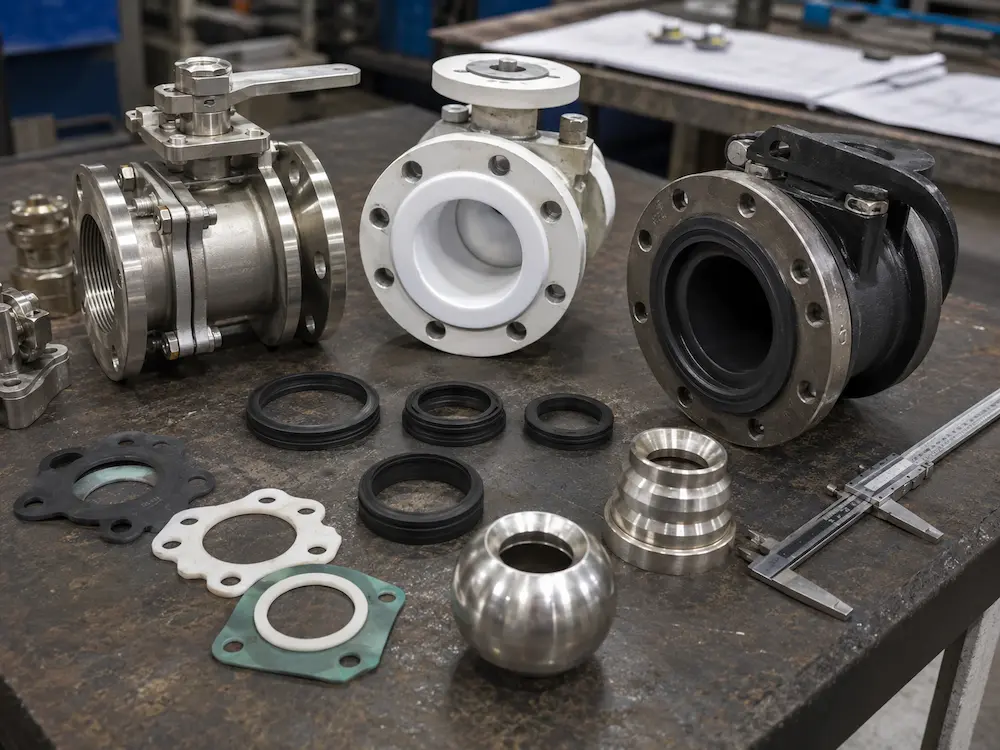
A chemical valve may include several different material zones:
- Body material: cast steel, stainless steel, alloy, plastic, or lined metal body
- Trim material: ball, disc, plug, stem, seat ring, or internal flow-contact parts
- Seat material: PTFE, reinforced PTFE, PEEK, EPDM, rubber, metal, or other materials
- Seal material: EPDM, FKM, NBR, PTFE, graphite, or other compounds
- Lining material: PTFE, PFA, FEP, rubber, or other corrosion barriers
- Packing material: PTFE, graphite, or special packing systems
- Fasteners and accessories: bolts, brackets, actuator couplings, and external parts
A stainless steel valve body does not guarantee chemical compatibility if the seat, seal, packing, or stem material is wrong. Similarly, a lined valve can still fail if the lining is damaged, poorly bonded, unsuitable for temperature, or attacked by abrasion.
Key Factors That Control Material Compatibility
Material compatibility is affected by several variables. A compatibility chart may provide a starting point, but buyers should still review the actual working conditions.
| Selection Factor | Why It Matters | Buyer Recommendation |
|---|---|---|
| Chemical Name | Different chemicals attack different materials. | Provide the exact chemical name or mixture composition. |
| Concentration | Corrosion behavior may change with concentration. | Provide normal and maximum concentration. |
| Temperature | Higher temperature can accelerate corrosion and reduce seal life. | Confirm normal, maximum, and cleaning temperatures. |
| Pressure | Pressure affects body design, lining support, and seal load. | Confirm operating pressure, design pressure, and surge risk. |
| Solids Content | Particles can abrade lining, seats, and sealing surfaces. | Confirm slurry, particle size, and solids concentration. |
| Flow Velocity | High velocity can increase erosion or lining wear. | Review velocity for slurry, acids, and abrasive media. |
| Operation Frequency | Frequent cycling affects seats, seals, and packing. | Confirm whether the valve is manual, electric, or pneumatic. |
| Cleaning Process | Cleaning chemicals may be more aggressive than the normal medium. | Include CIP, flushing, steam, or chemical cleaning details. |
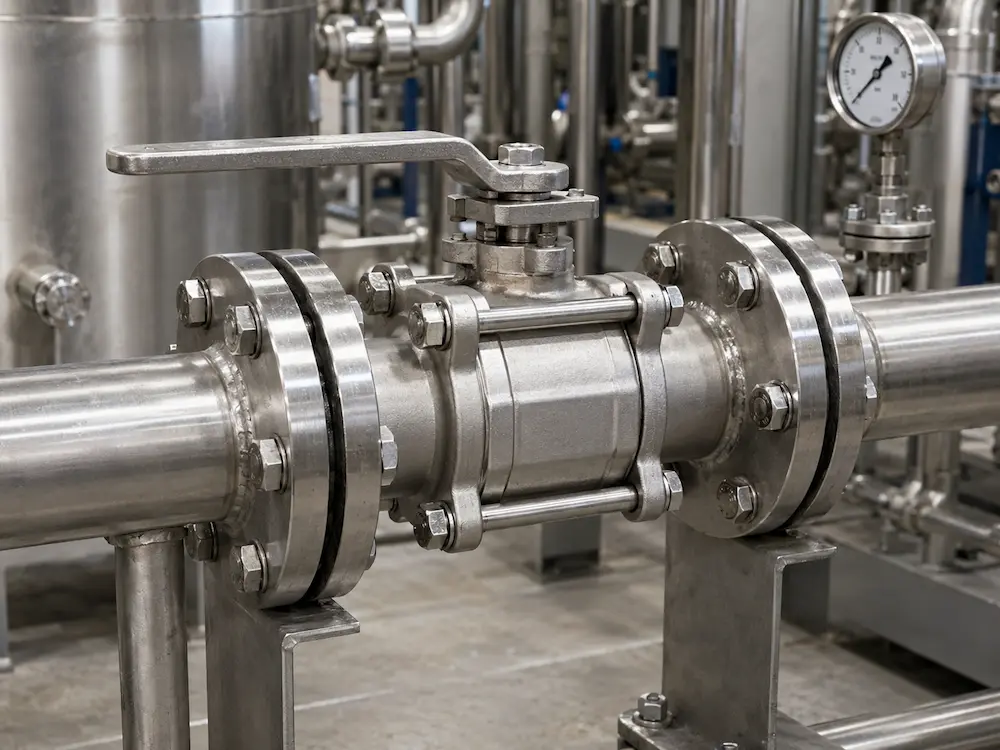
Stainless Steel Valve Materials
Stainless steel is one of the most widely used anti-corrosion valve materials because it offers good strength, clean appearance, and corrosion resistance in many industrial environments. Common grades include 304, 316, and 316L stainless steel.
304 Stainless Steel
304 stainless steel is used in many general industrial applications where the medium is not highly aggressive. It can provide good corrosion resistance in water, mild chemical service, and general process fluids. However, it may not be suitable for chloride-rich, strongly acidic, or high-temperature corrosive environments.
316 and 316L Stainless Steel
316 and 316L stainless steel are commonly selected when better corrosion resistance is needed compared with 304. They are widely used in chemical processing, water treatment, food-related systems, and many industrial fluid applications. 316L may be preferred where welding or lower carbon content is important.
However, 316 stainless steel is not universal. Strong acids, high chlorides, oxidizing chemicals, or severe pitting/crevice corrosion conditions may require lined valves, duplex stainless steel, titanium, nickel alloys, or other materials.
When Stainless Steel Is a Good Direction
- General chemical transfer where compatibility is confirmed
- Water treatment systems with moderate corrosion risk
- Food, beverage, and clean industrial fluids
- Applications requiring mechanical strength and clean surface finish
- Projects where the medium is not too aggressive for the selected grade
When Stainless Steel May Not Be Enough
- Strong acids or highly oxidizing chemicals
- Chloride-rich media with pitting corrosion risk
- High-temperature corrosive service
- Seawater or desalination-related pipelines
- Mixed chemical streams with unknown compatibility
PTFE in Chemical Valve Applications
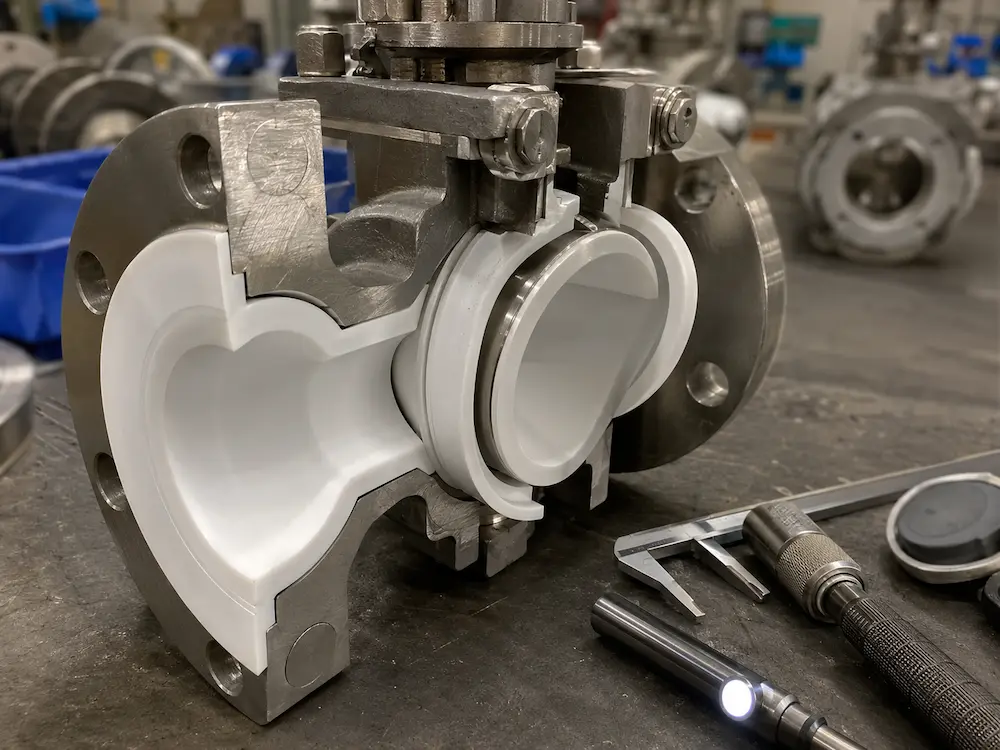
PTFE is widely used in chemical valves because of its broad chemical resistance and low friction. It may appear as a seat material, seal material, lining, diaphragm, or internal corrosion barrier. PTFE is commonly used in ball valves, butterfly valves, plug valves, diaphragm valves, and lined valve designs.
For many corrosive chemical applications, PTFE is one of the first materials buyers consider. However, it should still be reviewed under real pressure, temperature, vacuum, permeation, and mechanical conditions.
Where PTFE Performs Well
- Strong corrosive chemical media
- Acid and alkali transfer lines
- Applications requiring low friction and reliable sealing
- Valve seats and seals for chemical ball valves
- Internal linings for corrosion protection
PTFE Limitations Buyers Should Check
- Heavy abrasive slurry may damage or wear the lining
- Temperature and pressure must stay within valve design limits
- Vacuum conditions may require special lining support
- Poor lining quality can cause pinholes, deformation, or delamination
- Permeation risk should be reviewed in certain chemical services
Buyers comparing PTFE and rubber lining can review the related article on PTFE lined valve vs rubber lined valve. For ball valve structures using PTFE seating and chemical-resistant sealing, a PTFE ball valve may also be evaluated depending on the project conditions.
EPDM Valve Seals, Seats, and Linings
EPDM is an elastomer commonly used in valve seats, seals, diaphragms, and linings. It is often selected for water, some acids, some alkalis, and selected chemical services. EPDM is frequently seen in butterfly valve seats, diaphragm valve components, rubber lined valves, and water treatment valve applications.
Where EPDM Can Be Useful
- Water and wastewater treatment systems
- Some dilute acids and alkalis
- Selected chemical utility applications
- Butterfly valve seats and rubber components
- Diaphragm valves in compatible chemical service
Where EPDM Is Usually Not a Good Direction
- Many oils and hydrocarbons
- Many solvents
- Some high-temperature chemical environments
- Applications requiring broad chemical resistance without compatibility review
EPDM should not be selected simply because it is common. It must be matched to the medium, temperature, and service conditions. In chemical valve procurement, the difference between a correct EPDM selection and an incompatible EPDM selection can be the difference between long service life and early leakage.
FKM, NBR, and Other Elastomer Materials
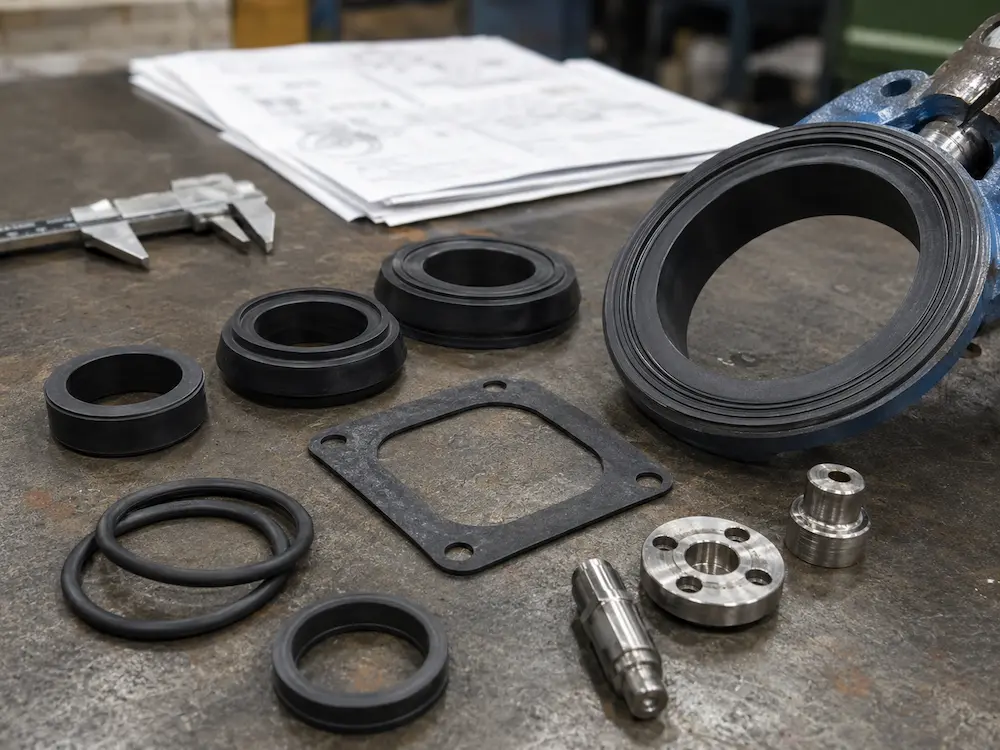
In addition to EPDM, chemical valves may use FKM, NBR, natural rubber, neoprene, or other elastomer materials. These are commonly found in O-rings, seats, seals, diaphragms, and lining systems.
FKM
FKM is often selected where resistance to oils, fuels, and many chemicals is required. It can be useful in selected chemical services, but it is not suitable for every acid, alkali, or high-temperature medium. Buyers should check the exact compound and chemical compatibility.
NBR
NBR is often used for oil-resistant applications, but it may not be suitable for many strong chemicals or high-temperature corrosive services. It is commonly used in general industrial sealing, but chemical compatibility must be reviewed carefully.
Natural Rubber
Natural rubber can provide good abrasion resistance in selected slurry applications. It may be used in rubber lined valves for mining, slurry, and abrasive media, but chemical compatibility and temperature limitations must be considered.
Neoprene and Other Rubber Compounds
Other rubber compounds may be selected for specific chemical, temperature, and mechanical requirements. The key point is that “rubber” is not one material. Each rubber type has different strengths and limitations.
Rubber Lining for Chemical and Slurry Valves
Rubber lining protects the valve body from corrosive or abrasive media. It is often used in butterfly valves, diaphragm valves, slurry valves, and selected chemical processing valves. Rubber lined valves can be useful when the application requires both corrosion protection and abrasion resistance.
For slurry, mining, wastewater, and abrasive chemical media, rubber lining may provide better mechanical wear resistance than PTFE in selected conditions. However, rubber lining must be compatible with the chemical medium. Some solvents, oils, oxidizing chemicals, and high-temperature media can attack rubber materials.
Buyers handling abrasive chemical media or slurry can compare rubber-lined valves when wear resistance and corrosion protection are both important.
Titanium and High-Alloy Valve Materials
For severe corrosive service, standard stainless steel and common linings may not be enough. In these cases, buyers may need titanium, duplex stainless steel, super duplex stainless steel, nickel alloys, or other special alloys.
Titanium
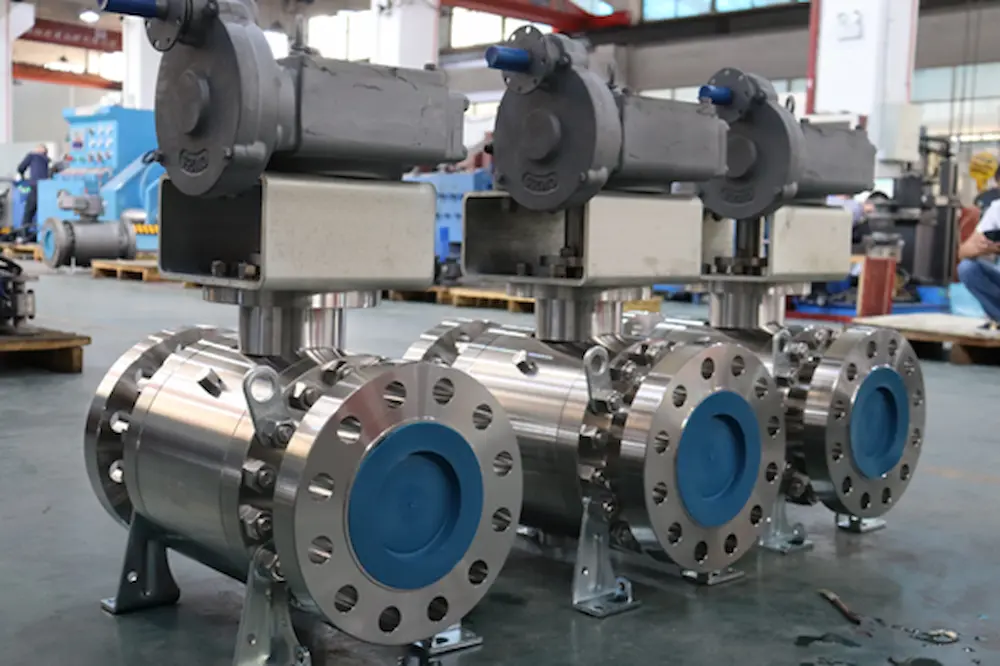
Titanium is often considered for corrosion-critical environments, especially where chloride resistance, seawater compatibility, or oxidizing chemical resistance is important. Titanium valves are usually more expensive than standard stainless steel valves, but they may offer strong long-term value in severe corrosion applications.
For chloride-rich systems, seawater, desalination, marine chemical service, and selected corrosive chemical transfer applications, buyers may evaluate a titanium ball valve when standard stainless steel is not sufficient.
Duplex and Super Duplex Stainless Steel
Duplex and super duplex stainless steels are often considered when higher strength and improved chloride stress corrosion resistance are needed compared with standard austenitic stainless steels. They may be used in chemical, seawater, offshore, and high-chloride applications depending on the service conditions.
Nickel Alloys and Hastelloy-Type Materials
Nickel alloys may be selected for severe chemical corrosion, strong acids, high-temperature corrosion, or aggressive mixed chemical media. These materials are expensive, so they should be justified by service risk, downtime cost, safety requirements, and project specifications.
Anti-Corrosion Valve Material Comparison Table
| Material | Main Strengths | Key Limitations | Common Chemical Processing Uses |
|---|---|---|---|
| 304 Stainless Steel | Good general corrosion resistance and cost-performance | Limited in chloride-rich or strong corrosive service | General chemical utilities and low-risk process fluids |
| 316 / 316L Stainless Steel | Better corrosion resistance than 304 in many environments | Still not universal for strong acids or severe chloride service | Chemical transfer, water treatment, clean industrial fluids |
| PTFE | Broad chemical resistance and low friction | Abrasion, pressure, vacuum, and lining quality must be checked | Seats, seals, linings, corrosive chemical valves |
| EPDM | Useful for water, some acids, and some alkalis | Not suitable for many oils, hydrocarbons, and solvents | Seats, seals, diaphragms, water treatment valves |
| FKM | Useful for many oils, fuels, and selected chemicals | Not suitable for every acid or alkali | O-rings, seals, packing support in selected services |
| Rubber Lining | Good abrasion resistance and cost-performance in selected services | Compatibility depends heavily on rubber compound | Slurry, wastewater, mining, selected chemical services |
| Titanium | Excellent in selected chloride, seawater, and oxidizing environments | Higher cost and application-specific justification needed | Desalination, seawater, chloride-rich chemical systems |
| Nickel Alloys | Strong resistance in severe chemical corrosion | High cost and longer procurement cycle | Strong acids, severe chemical processing, critical service |
How to Match Materials with Chemical Media
The best material choice depends on the dominant failure risk. Some systems fail mainly from corrosion. Others fail from abrasion, swelling, pitting, cracking, temperature, or mechanical cycling. Buyers should identify the likely failure mode before choosing the material.
| Service Condition | Material Direction to Consider | Buyer Notes |
|---|---|---|
| General chemical utility | 304, 316, 316L stainless steel | Confirm chemical compatibility and temperature. |
| Strong corrosive chemicals | PTFE lined valves, PFA lined valves, special alloys | Review lining quality, pressure, and permeation risk. |
| Acid or alkali pipeline | PTFE, stainless steel, EPDM, rubber lining, alloys | Selection depends on chemical, concentration, and temperature. |
| Slurry or abrasive chemical media | Rubber lining, diaphragm valves, selected wear-resistant designs | Particle size and velocity are important. |
| Oil-containing media | FKM, NBR, selected stainless steel or alloy materials | EPDM is often not suitable for oils. |
| Chloride-rich or seawater service | 316L, duplex, super duplex, titanium, special alloys | Check pitting, crevice corrosion, and project requirements. |
| High-temperature corrosive service | High alloys, suitable packing, suitable seat materials | Soft materials may have lower temperature limits. |
Common Buyer Mistakes in Valve Material Selection
Mistake 1: Treating Stainless Steel as Corrosion-Proof
Stainless steel is corrosion-resistant in many environments, but it is not corrosion-proof. Chlorides, strong acids, and high-temperature corrosive conditions can still damage stainless steel valves.
Mistake 2: Choosing Body Material but Ignoring Seats and Seals
A valve with the correct body material may still fail if the seat, seal, packing, or diaphragm material is incompatible with the medium.
Mistake 3: Using PTFE Without Reviewing Mechanical Conditions
PTFE is chemically resistant in many services, but buyers still need to review abrasion, pressure, vacuum, lining quality, and temperature.
Mistake 4: Selecting Rubber Lining Without Checking the Rubber Type
Rubber lining is not one material. EPDM, natural rubber, nitrile, and other rubber materials have different chemical and temperature limitations.
Mistake 5: Over-Specifying Expensive Alloys
High alloys may be necessary for severe service, but they should be justified by actual corrosion risk, project specification, safety requirements, and total cost of ownership.
Mistake 6: Ignoring Cleaning Chemicals
Some valves fail not because of the normal process fluid, but because of cleaning chemicals, flushing cycles, or temporary high-temperature exposure during maintenance.
Material Selection Checklist for B2B Buyers
Before requesting a quotation, buyers should prepare a clear material selection checklist. This helps the supplier recommend a suitable valve and reduces the risk of mismatched materials.
- Chemical name and composition
- Concentration range
- Normal and maximum temperature
- Operating pressure and design pressure
- Valve size and connection type
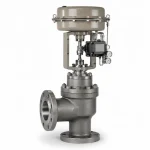
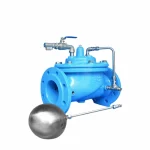
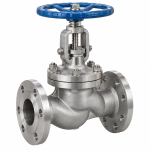
- Valve type: ball, butterfly, diaphragm, plug, check, gate, globe, or control valve
- Flow condition: clean liquid, slurry, gas, vapor, or mixed phase
- Solids content and particle size
- Required body material
- Required trim material
- Seat and seal material
- Lining material if required
- Packing material
- Manual, electric, or pneumatic operation
- Cleaning process and chemical exposure during maintenance
- Required documents, standards, and test reports
Documentation and Quality Control for Valve Materials
For chemical processing projects, material documentation is often as important as product appearance. Buyers should not rely only on product photos or short quotations. A serious industrial valve supplier should be able to provide material and testing documents according to project needs.
Useful documents may include:
- Material certificate for body and trim
- Seat, seal, and lining material confirmation
- Pressure test report
- Seat leakage test report
- Lining inspection information
- Dimensional drawing
- Actuator datasheet if automated
- Installation and maintenance manual
- Packing and marking information
Buyers who want a broader overview of corrosion causes and prevention practices can also read this guide on valve corrosion prevention.
Final Recommendations for Industrial Buyers
The best anti-corrosion valve material is not the same for every chemical processing project. Stainless steel may be practical for many general services. PTFE may be better for broad chemical resistance. EPDM may work well in selected water, acid, and alkali applications. FKM may be useful where oils or selected chemicals are involved. Rubber lining may be preferred for slurry and abrasion. Titanium and high alloys may be necessary for severe chloride, seawater, or highly corrosive chemical services.
The correct decision should begin with the actual process medium, not the material name. Buyers should confirm chemical composition, concentration, temperature, pressure, solids content, valve type, seat and seal compatibility, lining requirements, actuator requirements, and documentation needs before selecting a material.
If you need help comparing anti-corrosion valve materials for a chemical processing project, Vcore Valve can help review your working conditions and recommend a practical valve configuration. Buyers can also browse our industrial valve product range to compare ball valves, butterfly valves, gate valves, globe valves, check valves, lined valves, and automated valve options.
For B2B sourcing, the right question is not “Which material is best?” The better question is: “Which valve material system can resist this specific medium, seal reliably, operate safely, and reduce long-term maintenance risk?”
FAQ
1. What are the most common anti-corrosion valve materials?
The most common anti-corrosion valve materials include stainless steel, PTFE, EPDM, FKM, rubber lining, titanium, duplex stainless steel, and nickel alloys. The best choice depends on the chemical medium, concentration, temperature, pressure, solids content, and valve structure.
2. Is stainless steel always suitable for chemical valves?
No, stainless steel is not always suitable for chemical valves. 304, 316, and 316L stainless steel can perform well in many services, but strong acids, chloride-rich media, high-temperature corrosive chemicals, and certain mixed chemicals may require PTFE lining, titanium, duplex stainless steel, or nickel alloys.
3. When should PTFE be used in chemical valves?
PTFE is often used when broad chemical resistance, low friction, and corrosion protection are important. It may be used as a seat, seal, lining, or diaphragm material. Buyers should still review pressure, temperature, vacuum conditions, abrasion risk, and lining quality before choosing PTFE.
4. What is EPDM used for in valve applications?
EPDM is commonly used in valve seats, seals, diaphragms, and linings for water, wastewater, some acids, some alkalis, and selected chemical services. It is not suitable for many oils, hydrocarbons, and solvents, so chemical compatibility must be checked before selection.
5. When should buyers consider titanium or high-alloy valves?
Buyers should consider titanium or high-alloy valves when standard stainless steel, common elastomers, or lined valves cannot provide enough corrosion resistance or service life. These materials may be used in chloride-rich media, seawater, desalination, severe acids, high-temperature corrosive service, or critical chemical processing applications.