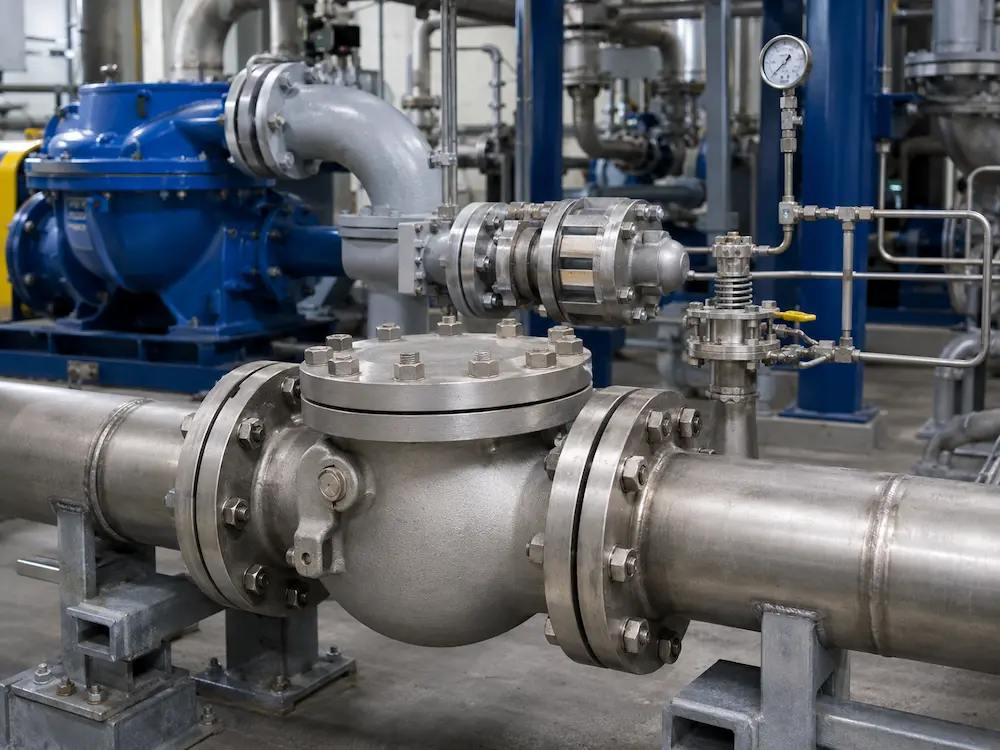
Industrial check valves are used in pipeline systems where fluid or gas must flow in only one direction. Unlike manual valves, check valves operate automatically. When forward flow is sufficient, the valve opens. When flow stops or reverses, the valve closes to prevent backflow.
For B2B buyers, choosing a check valve is not only about size and price. The correct selection depends on flow rate, pressure, temperature, medium, installation direction, valve type, closing speed, water hammer risk, pump arrangement, connection standard, and material compatibility. A check valve that works well in a clean water line may not be suitable for chemical service, high-pressure steam, slurry, compressor discharge, or vertical installation.
This guide explains the main types of industrial check valves, how they work, where they are used, common selection mistakes, and what information buyers should prepare before requesting a quotation. Buyers can also browse Vcore Valve’s check valve product range for industrial backflow prevention applications.
What Is an Industrial Check Valve?
An industrial check valve is a self-acting valve that allows flow in one direction and prevents reverse flow. It is also called a non-return valve, one-way valve, backflow prevention valve, or NRV in some specifications.
The valve does not usually require an actuator or manual operation. It opens when the forward flow force is strong enough and closes when the flow slows, stops, or reverses. This automatic function helps protect pumps, compressors, tanks, heat exchangers, dosing systems, water treatment lines, oil and gas pipelines, and process equipment.
Industrial check valves are commonly used in water treatment, chemical processing, oil and gas, power generation, marine systems, HVAC, compressed air systems, steam utilities, and general industrial pipelines.
How Does a Check Valve Work?
A check valve works by using flow pressure to move a disc, plate, ball, piston, or spring-loaded element away from the seat. When the medium flows in the correct direction, the closure element opens and allows flow to pass. When the flow reverses or drops below the required opening force, the closure element returns to the seat and blocks reverse flow.
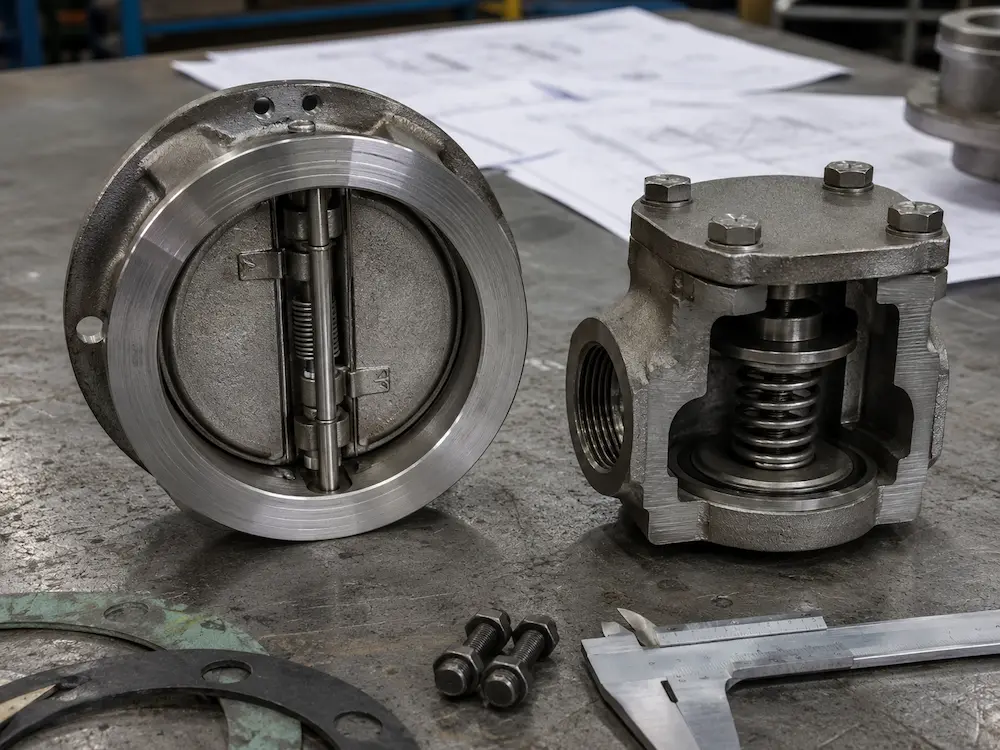
The exact working principle depends on the check valve type. A swing check valve uses a hinged disc. A spring check valve uses a spring-assisted disc. A lift check valve uses vertical disc movement. A dual plate check valve uses two spring-loaded plates. A nozzle check valve is designed for fast non-slam closure.
The most important engineering question is not only “Can the valve prevent backflow?” The better question is: “Can this check valve close at the right speed without creating water hammer, excessive pressure drop, disc chatter, leakage, or pump damage?”
Main Functions of Industrial Check Valves
- Prevent reverse flow in pipelines
- Protect pumps from reverse rotation and back pressure
- Reduce contamination risk between process lines
- Maintain one-way flow in water, gas, oil, steam, and chemical systems
- Protect compressors, tanks, filters, and heat exchangers
- Reduce water hammer risk when properly selected
- Support automatic pipeline safety without manual operation
Main Types of Industrial Check Valves
Swing Check Valves
A swing check valve uses a hinged disc that swings open with forward flow and swings back to the seat when flow stops or reverses. This design is widely used in water, oil, gas, wastewater, HVAC, and general industrial pipelines.
Swing check valves are often selected for larger pipelines and applications where low pressure drop is important. However, they may not be ideal for very low-flow, pulsating-flow, or frequent pump cycling applications because the disc may slam, chatter, or wear if flow conditions are unstable.
For stainless steel flanged pipeline service, buyers may evaluate a stainless steel swing check valve RF when corrosion resistance, raised face flanged connection, and automatic backflow prevention are required.
Spring Check Valves
A spring check valve uses a spring to help close the disc quickly when forward flow decreases. This design can reduce reverse flow and improve response compared with gravity-only closure in some applications.
Spring check valves are commonly used in smaller pipelines, pump discharge lines, vertical installations, compressed air systems, and applications where faster closure is needed. The spring force, cracking pressure, pressure drop, and material compatibility should be checked carefully.
Buyers comparing spring-loaded designs can review a spring check valve when compact automatic backflow prevention is required.
Dual Plate Check Valves
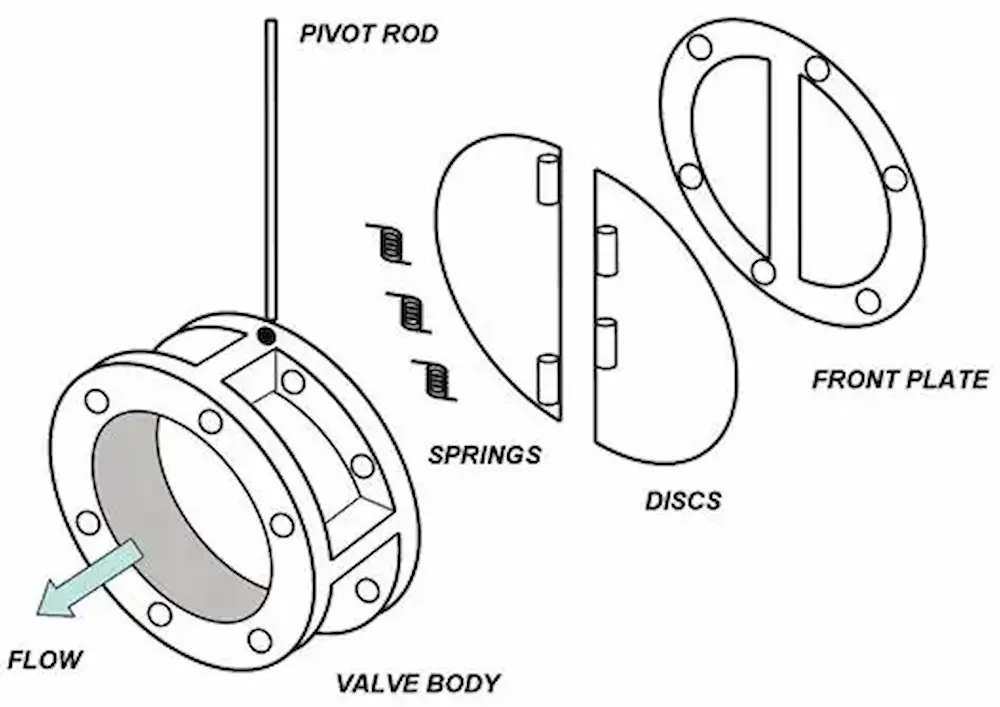
A dual plate check valve, also called a double-door or dual-disc check valve, uses two spring-assisted plates mounted on a central hinge. It is usually installed between flanges and offers a compact structure compared with traditional swing check valves.
Dual plate check valves are commonly used in water treatment, HVAC, marine, fire protection, oil and gas, and industrial pipeline systems where space, weight, and faster closure are important.
For compact wafer-style installation, buyers may evaluate a lug wafer dual-disc swing check valve depending on pipeline size, pressure, and installation conditions.
Lift Check Valves
A lift check valve uses a disc or piston that moves vertically away from the seat under forward flow. When flow decreases or reverses, the disc returns to the seat to stop reverse flow.
Lift check valves are often used in high-pressure, high-temperature, steam, gas, and clean fluid services where flow conditions are stable. They usually require correct installation orientation and sufficient flow velocity to operate properly.
For compact installations, buyers may compare a wafer lift type check valve. For high-pressure service, a lift and vertical lift check valve may be considered depending on pressure, temperature, and installation direction.
Nozzle Check Valves
A nozzle check valve is designed for fast, non-slam closure. It usually has an axial flow path and a spring-assisted disc that closes quickly before significant reverse flow develops.
Nozzle check valves are commonly selected for pump discharge systems, compressor systems, high-pressure pipelines, and applications where water hammer, check valve slam, or pressure surge risk must be reduced.
Buyers concerned about water hammer or fast reverse flow may evaluate a nozzle check valve when standard swing designs are not fast enough.
Foot Valves
A foot valve is a type of check valve installed at the suction end of a pump line. It helps maintain pump prime and prevents liquid from draining back into the source when the pump stops.
Foot valves are commonly used in water pumping, irrigation, wells, and suction systems. Buyers should confirm strainer design, suction conditions, material, clogging risk, and maintenance access.
Industrial Check Valve Type Comparison
| Check Valve Type | Best Use | Main Advantages | Selection Risk |
|---|---|---|---|
| Swing Check Valve | Large pipelines and steady flow | Low pressure drop, simple structure, widely used | May slam or chatter in unstable flow |
| Spring Check Valve | Compact systems and faster closure | Spring-assisted closing, useful in many orientations | Higher pressure drop and cracking pressure must be checked |
| Dual Plate Check Valve | Wafer installation and space-limited pipelines | Compact, lighter weight, faster closure than many swing valves | Disc and spring design must match flow conditions |
| Lift Check Valve | High-pressure or clean fluid service | Good sealing, suitable for stable high-velocity flow | Orientation and minimum flow velocity are important |
| Nozzle Check Valve | Pump discharge and water hammer prevention | Fast non-slam closure and axial flow design | Higher cost and application review required |
| Foot Valve | Pump suction systems | Maintains pump prime and prevents suction line drainage | Strainer clogging and maintenance access must be considered |
Where Industrial Check Valves Are Used
Water Treatment and Wastewater Systems
Check valves are used in water treatment plants, pump stations, filtration systems, dosing lines, backwash systems, and wastewater pipelines. They prevent reverse flow, protect pumps, and help maintain process direction.
For water systems, buyers should confirm flow rate, pump cycling frequency, pressure class, corrosion risk, and whether water hammer may occur when pumps stop.
Pump Discharge Lines
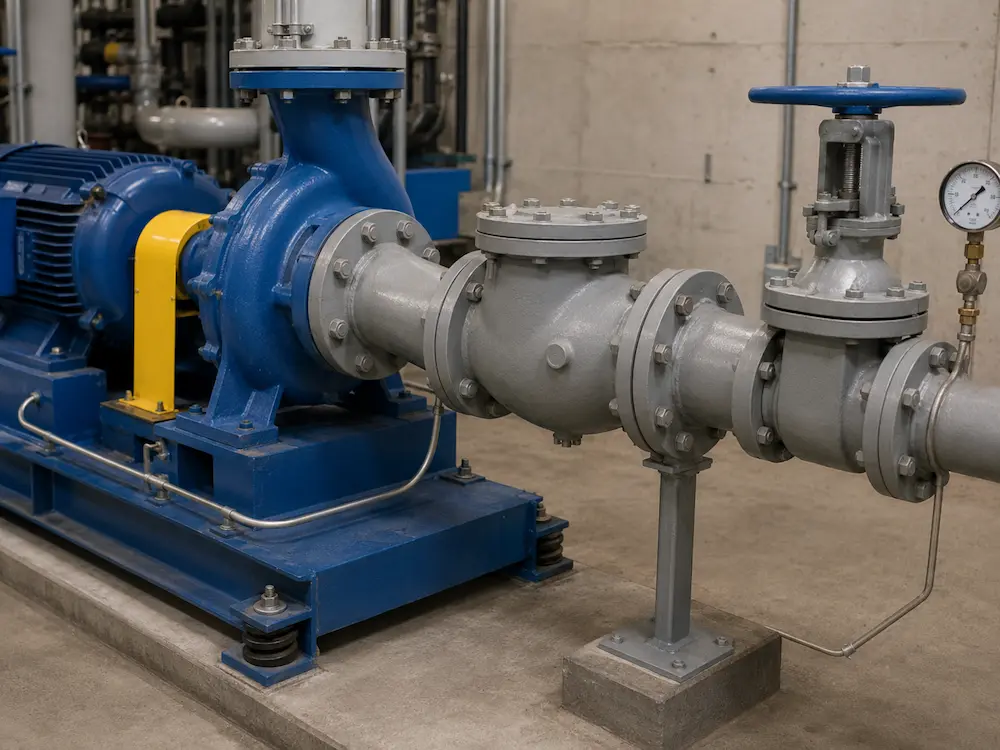
One of the most important applications of industrial check valves is pump discharge protection. When a pump stops, reverse flow can cause reverse rotation, pressure surges, mechanical stress, and equipment damage.
For pump discharge service, the check valve should close quickly enough to limit reverse flow but not so aggressively that it creates additional pressure shock. Nozzle check valves, spring check valves, dual plate check valves, or properly sized swing check valves may be considered depending on system conditions.
Chemical Processing
In chemical plants, check valves prevent reverse flow of acids, alkalis, solvents, dosing chemicals, and process fluids. Material compatibility is critical because the valve body, disc, seat, spring, gasket, and stem area may all contact corrosive media.
For broader chemical valve selection, buyers can read our guide on industrial valves for chemical processing.
Oil and Gas Pipelines
Oil and gas systems use check valves for pipeline protection, compressor discharge, pump stations, fuel handling, and process isolation. Buyers may need to confirm pressure class, fire-safe requirements, anti-static design, material grade, NACE requirements, testing, and documentation.
Power Generation and Steam Systems
Power plants use check valves in feedwater systems, condensate lines, cooling water systems, boiler auxiliary systems, and selected steam services. High temperature, high pressure, thermal cycling, and water hammer risk should be reviewed carefully.
Compressed Air and Gas Systems
Check valves are used in compressed air, nitrogen, oxygen-compatible systems, and industrial gas lines to prevent reverse flow. Leakage performance, seat material, cracking pressure, and compatibility with the gas should be confirmed.
Backflow Prevention and Water Hammer Risk
Backflow prevention is the basic purpose of a check valve, but check valve selection must also consider water hammer. Water hammer can occur when flow stops suddenly and pressure waves travel through the pipeline. If a check valve closes too late, reverse flow can build up and then stop suddenly when the valve shuts. This can create pressure surge, noise, vibration, and pipe stress.
Common Causes of Check Valve Slam
- Oversized check valve
- Low or unstable flow velocity
- Long pump discharge line
- Sudden pump shutdown
- Improper valve type for the application
- Incorrect installation position
- Disc too heavy or closing too slowly
How to Reduce Water Hammer Risk
- Select the correct check valve type for the flow condition
- Avoid oversizing the valve
- Confirm minimum flow velocity
- Use spring-assisted or non-slam designs where needed
- Review pump shutdown behavior and pipeline layout
- Consider nozzle check valves for high-risk pump discharge systems
Horizontal and Vertical Installation
Installation direction is critical for check valves. Some check valves work well in horizontal pipelines. Some can be installed vertically if flow direction is upward. Others may not be suitable for vertical downward flow unless specifically designed and confirmed.
Buyers should never assume a check valve can be installed in any direction. The valve type, disc weight, spring force, flow direction, velocity, and manufacturer design all affect installation suitability.
For a detailed installation discussion, read our guide on whether a check valve can be installed vertically.
Check Valve Materials
Material selection depends on the medium, temperature, pressure, corrosion risk, and project standard. A check valve may fail even if the body material is strong enough, because the disc, seat, spring, gasket, or hinge pin may be incompatible with the service.
| Material | Common Use | Buyer Notes |
|---|---|---|
| Cast Iron / Ductile Iron | Water, HVAC, wastewater, general low-to-medium pressure service | Cost-effective but corrosion and pressure limits must be checked |
| Carbon Steel | Oil, gas, steam, power, and general industrial service | Suitable for many pressure applications when corrosion risk is controlled |
| Stainless Steel | Chemical, water treatment, food, marine, clean fluids | 304, 316, CF8, and CF8M should be selected by corrosion risk |
| Bronze / Brass | Water, marine, small utility systems | Compatibility depends on water quality, temperature, and regulations |
| Duplex / Alloy / Special Materials | Seawater, chloride-rich, acidic, or severe service | Used when standard stainless steel is not sufficient |
Seat and Seal Selection
Seat and seal materials affect leakage, closing performance, temperature capability, and chemical compatibility. Metal seats may be used for high-temperature or severe service. Soft seats such as EPDM, NBR, FKM, or PTFE may be selected for tighter shutoff in suitable conditions.
| Seat / Seal Material | Common Strength | Typical Concern |
|---|---|---|
| Metal Seat | High temperature, durability, severe service | Leakage class and sealing surface quality must be reviewed |
| EPDM | Water and selected chemicals | Not suitable for many oils and hydrocarbons |
| NBR | Oil and water service in selected ranges | Temperature and chemical compatibility limits must be checked |
| FKM | Oils, fuels, and selected chemicals | Not universal for all acids and alkalis |
| PTFE | Chemical resistance and low friction | Pressure, temperature, and mechanical load limits must be reviewed |
How to Choose the Right Industrial Check Valve
Check valve selection should begin with the actual pipeline condition. Buyers should not choose only by valve size or connection type.
| Selection Item | What to Confirm | Why It Matters |
|---|---|---|
| Medium | Water, gas, oil, steam, chemical, slurry, wastewater | Determines body, disc, seat, spring, and seal material |
| Flow Rate | Normal, minimum, and maximum flow | Prevents oversizing, chatter, and incomplete opening |
| Pressure | Operating pressure and design pressure | Determines pressure class and body structure |
| Temperature | Normal and maximum temperature | Affects body, seat, seal, spring, and gasket selection |
| Installation Direction | Horizontal, vertical upward, vertical downward, inclined | Determines whether the selected valve type can operate correctly |
| Water Hammer Risk | Pump shutdown, reverse flow, pressure surge, slam risk | Determines whether non-slam or spring-assisted designs are needed |
| Connection | Flanged, wafer, threaded, welded, lug, clamp | Must match pipeline installation and maintenance needs |
| Valve Type | Swing, spring, lift, dual plate, nozzle, foot valve | Controls closing behavior, pressure drop, and application suitability |
| Documentation | Drawing, datasheet, test report, material certificate | Supports project approval and quality control |
Common Check Valve Selection Mistakes
Mistake 1: Selecting Only by Pipe Size
A check valve selected only by DN/NPS size may be oversized for the actual flow rate. Oversizing can cause disc flutter, noise, vibration, leakage, and early wear.
Mistake 2: Ignoring Flow Velocity
Check valves require enough forward flow to fully open and operate stably. Low flow velocity can cause the disc or plate to remain partially open and create chatter.
Mistake 3: Using Swing Check Valves in Unstable Pump Systems Without Review
Swing check valves are widely used, but they may slam in certain pump discharge systems. If reverse flow develops quickly, a spring-assisted or nozzle check valve may be more suitable.
Mistake 4: Ignoring Vertical Installation Requirements
Not every check valve works in vertical pipelines. Buyers should confirm flow direction, spring assistance, disc movement, and manufacturer recommendation before vertical installation.
Mistake 5: Ignoring Seat and Seal Compatibility
A check valve body may be correct, but the seat, gasket, spring, or seal may fail if it is incompatible with the medium, temperature, or chemical concentration.
Mistake 6: Not Reviewing Water Hammer
Backflow prevention and water hammer control are related but not identical. A valve that prevents backflow may still close too late or too violently if the design is not suitable for the system.
Information Buyers Should Provide Before Quotation
To receive an accurate check valve quotation, buyers should provide:
- Valve size and pipeline size
- Medium name and composition
- Operating pressure and design pressure
- Operating temperature and maximum temperature
- Normal, minimum, and maximum flow rate
- Installation direction: horizontal or vertical
- Flow direction and pump arrangement
- Connection standard: flanged, wafer, threaded, welded, lug, or clamp
- Body material requirement
- Seat and seal material requirement
- Water hammer or non-slam requirement
- Required testing standard and documentation
- Quantity and project delivery schedule
Related Check Valve Guides
This article is the main guide for industrial check valve selection. For more specific decisions, the following supporting pages can help buyers compare valve structures and installation requirements:
- Swing Check Valve vs Spring Check Valve — compares closing behavior, flow condition, pressure drop, and common applications.
- Can a Check Valve Be Installed Vertically? — explains horizontal and vertical installation risks, flow direction, and valve type suitability.
- What Is a Swing Check Valve? — explains swing disc operation, applications, advantages, and limitations.
- Vacuum Breaker vs Check Valve — explains the difference between vacuum protection and backflow prevention.
- Uses of Check Valves in Preventing Backflow — covers common system protection roles for check valves.
Final Recommendations for B2B Buyers
Industrial check valves are essential for backflow prevention, pump protection, and one-way flow control. However, different check valve types behave very differently in real pipelines. Swing check valves, spring check valves, dual plate check valves, lift check valves, nozzle check valves, and foot valves each have suitable applications.
For steady large-diameter pipelines, a swing check valve may be practical. For compact systems or faster closure, a spring check valve or dual plate check valve may be better. For high-pressure clean fluid service, a lift check valve may be suitable. For pump discharge systems with water hammer risk, a nozzle check valve may provide better non-slam performance.
If you need help selecting industrial check valves for water treatment, chemical processing, oil and gas, power generation, pump discharge, compressed air, steam, or wastewater service, Vcore Valve can review your working conditions and recommend a suitable valve configuration. Buyers can also compare available options in our check valve category.
For industrial sourcing, the key question is not only “Which check valve do I need?” The better question is: “Which check valve type can prevent backflow reliably without causing excessive pressure drop, valve slam, water hammer, leakage, or maintenance problems in this exact system?”
FAQs
1. What are industrial check valves used for?
Industrial check valves are used to prevent reverse flow, protect pumps and compressors, maintain one-way flow, reduce backflow contamination, and support pipeline safety in water, gas, oil, steam, chemical, and industrial process systems.
2. What is the difference between a swing check valve and a spring check valve?
A swing check valve uses a hinged disc that swings open and closed with flow direction. A spring check valve uses spring force to help the disc close faster. Swing check valves are common in steady-flow pipelines, while spring check valves may be preferred where faster closure or compact installation is needed.
3. Which check valve is best for pump discharge?
The best check valve for pump discharge depends on flow rate, pressure, pump shutdown behavior, pipeline layout, and water hammer risk. Swing, spring, dual plate, and nozzle check valves may all be considered depending on the system.
4. Can check valves be installed vertically?
Some check valves can be installed vertically if the flow direction and valve design are suitable. Vertical upward flow is often easier to support than vertical downward flow. Buyers should confirm installation direction with the manufacturer before ordering.
5. How do I choose the right check valve?
To choose the right check valve, confirm the medium, pressure, temperature, flow rate, installation direction, water hammer risk, connection standard, valve material, seat material, and required test documentation.