Check valves for pump discharge are critical components in water treatment plants, pump stations, industrial utility systems, cooling water loops, chemical process lines, wastewater systems, and power plant auxiliary pipelines. When a pump stops, the fluid in the discharge line may try to flow backward. Without a suitable check valve, reverse flow can damage the pump, cause reverse rotation, create pressure surge, and disturb the whole pipeline system.
A pump discharge check valve is not only a simple one-way valve. In real industrial systems, it must close at the right time, prevent backflow reliably, avoid excessive pressure drop, reduce valve slam, and withstand repeated pump start-stop operation. Choosing the wrong valve type can lead to water hammer, noise, vibration, leakage, seat damage, pipe movement, and premature pump failure.
This guide explains how to choose check valves for pump discharge lines, including swing check valves, spring check valves, dual plate check valves, nozzle check valves, lift check valves, wafer check valves, and flanged check valves. For a broader overview of check valve types and selection logic, read our main guide on industrial check valves.
Why Pump Discharge Lines Need Check Valves
A pump discharge line usually needs a check valve because the pump only controls forward flow while it is operating. When the pump stops, flow momentum, static head, pressure difference, or parallel pump operation may push fluid backward through the discharge line.
If backflow reaches the pump, it can cause reverse impeller rotation, mechanical stress, seal damage, bearing load, pressure shock, and operational instability. A check valve installed after the pump helps stop reverse flow and protect both the pump and the pipeline.
Main Functions of Pump Discharge Check Valves
- Prevent reverse flow after pump shutdown
- Protect the pump from reverse rotation and backspin
- Reduce backflow into the pump casing
- Prevent pressure disturbance between parallel pumps
- Reduce water hammer and check valve slam risk when properly selected
- Protect seals, bearings, impellers, pipe supports, and downstream equipment
- Maintain one-way flow in water, chemical, oil, wastewater, and process systems
Where Should a Check Valve Be Installed After a Pump?
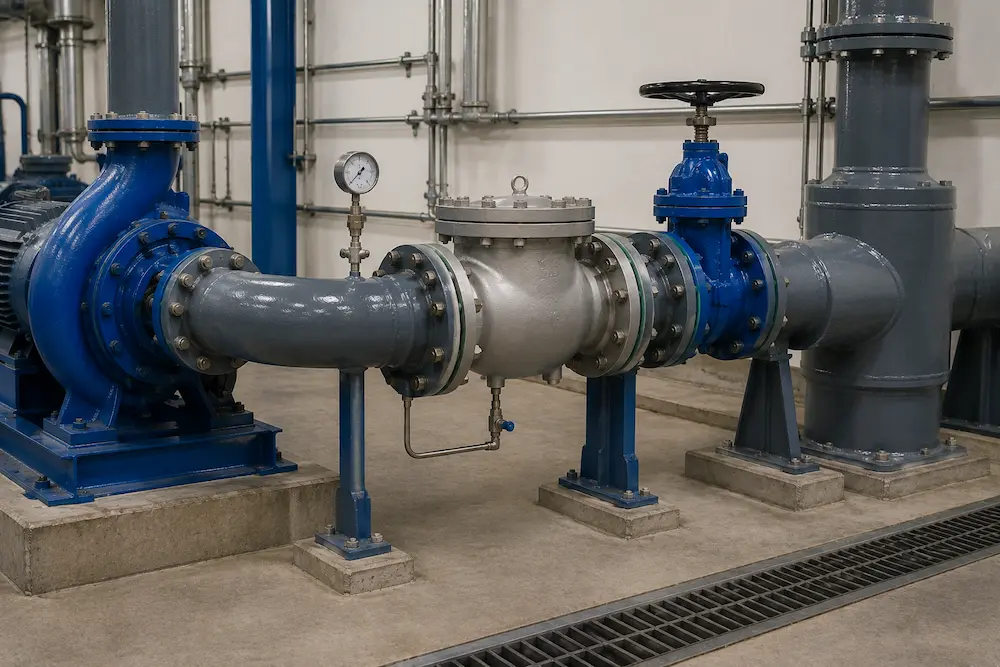
In most pump discharge systems, the check valve is installed on the discharge side of the pump, before or near the isolation valve. A common arrangement is:
Pump → Check Valve → Isolation Valve → Discharge Header
This arrangement helps prevent reverse flow from reaching the pump when the system is shut down or when another pump is operating. The isolation valve allows the check valve or pump to be maintained after the line is isolated and depressurized.
However, the final arrangement depends on project standard, pump type, line size, maintenance access, pressure class, and system layout. In some applications, additional instruments, drain valves, flexible joints, strainers, or bypass lines may be required.
Installation Factors to Confirm
- Distance between pump outlet and check valve
- Available straight pipe length
- Whether the pipeline is horizontal or vertical
- Maintenance access for valve removal and inspection
- Pipe support near the pump and valve
- Flow direction and pump discharge orientation
- Isolation valve location for safe maintenance
What Happens If the Wrong Check Valve Is Used?
The wrong pump discharge check valve can cause serious system problems. A valve that closes too slowly may allow reverse flow to develop before closing. A valve that is oversized may chatter and never open fully. A valve with excessive pressure drop may reduce pump efficiency. A valve with the wrong material may corrode, seize, or leak.
Common Problems Caused by Poor Selection
- Check valve slam after pump shutdown
- Water hammer and pressure surge
- Pump reverse rotation
- Disc or plate chatter during low flow
- Seat damage and leakage
- Excessive noise and vibration
- Flange gasket leakage due to pressure shock
- Shortened pump and valve service life
Main Check Valve Types for Pump Discharge
Swing Check Valve
A swing check valve uses a hinged disc that opens with forward flow and closes when flow stops or reverses. It is widely used in water, wastewater, HVAC, utility, and general industrial pump discharge systems.
Swing check valves can be suitable for steady-flow pump systems where reverse flow develops slowly and low pressure drop is important. However, they may slam in systems with rapid pump shutdown, long discharge pipelines, high static head, or unstable flow.
For more detail about hinged disc closure and spring-assisted closure, read our guide on swing check valve vs spring check valve.
Spring Check Valve
A spring check valve uses spring force to help close the disc, poppet, or closure element when forward flow decreases. This faster response can help reduce reverse flow before full closure.
Spring check valves are often used in compact pump discharge lines, vertical installations, smaller pipelines, dosing systems, and utility services. Buyers should confirm cracking pressure, pressure drop, spring material, and flow capacity before selection.
Dual Plate Check Valve
A dual plate check valve uses two spring-assisted plates mounted on a central hinge. It is often supplied in wafer or lug body design and installed between flanges.
Dual plate check valves are commonly used in pump discharge systems where compact installation, lower weight, and faster closure are important. They can be a practical alternative to larger swing check valves in many water, HVAC, marine, and industrial systems.
For structural comparison, read our guide on dual plate check valve vs swing check valve.
Nozzle Check Valve
A nozzle check valve is designed for fast non-slam closure. It usually has an axial-flow structure, guided closure element, and spring-assisted short-stroke movement. It closes quickly when forward flow decelerates, helping reduce reverse flow before closure.
Nozzle check valves are often selected for pump discharge systems with water hammer risk, long pipelines, high flow velocity, high head, parallel pumps, or previous valve slam problems. Buyers can also review a nozzle check valve when non-slam performance is required.
For more detail, read our article on nozzle check valves for water hammer prevention.
Lift Check Valve
A lift check valve uses a disc that lifts from the seat under forward flow and returns to the seat when flow stops or reverses. It may be used in selected clean fluid, gas, steam, or pressure services.
Lift check valves require suitable flow velocity and correct installation direction. They are generally not the first choice for dirty wastewater, slurry, or solids-containing service unless specifically designed for that condition.
For clean fluid and high-pressure comparison, read our guide on lift check valve vs piston check valve.
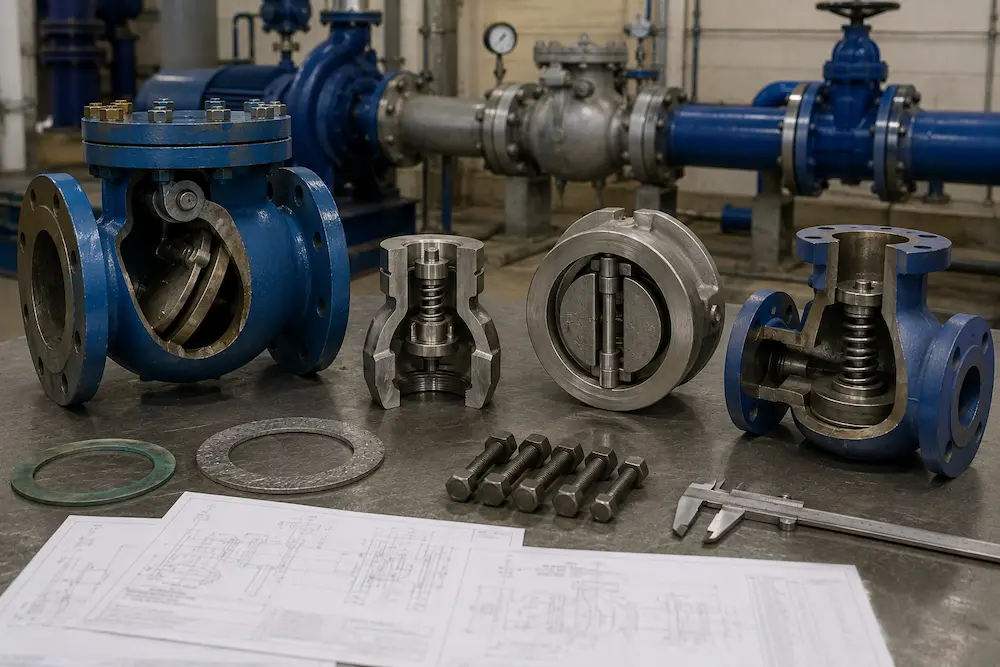
Check Valve Type Comparison for Pump Discharge
| Valve Type | Best Use in Pump Discharge | Main Advantage | Main Risk |
|---|---|---|---|
| Swing Check Valve | Steady-flow water and utility pump systems | Simple structure and low pressure drop | May slam if reverse flow develops quickly |
| Spring Check Valve | Compact lines, vertical discharge, smaller pump systems | Faster closure than gravity-only designs | Cracking pressure and pressure drop must be checked |
| Dual Plate Check Valve | Compact pump rooms, HVAC, water treatment, marine systems | Short face-to-face, lighter weight, spring-assisted plates | Spring and plate design must match flow conditions |
| Nozzle Check Valve | High water hammer risk, long pipelines, high-head pumps | Fast non-slam closure and reverse-flow control | Higher cost and engineering review required |
| Lift Check Valve | Clean fluid, gas, steam, selected high-pressure discharge lines | Good seating when correctly selected | Requires clean media and suitable flow velocity |
Backflow and Reverse Pump Rotation
Reverse flow after pump shutdown can rotate the pump impeller backward. This reverse rotation may damage mechanical seals, bearings, couplings, and motor components, especially if the pump restarts while rotating in the wrong direction.
In parallel pump systems, a failed or leaking check valve can allow one operating pump to push fluid backward through a stopped pump. This can reduce system efficiency, create unstable flow, and increase equipment risk.
A properly selected check valve helps prevent reverse flow before it becomes strong enough to damage the pump. For critical pump systems, leakage performance, closing speed, and valve condition should be checked regularly.
Water Hammer in Pump Discharge Lines
Water hammer occurs when fluid velocity changes suddenly and creates a pressure wave in the pipeline. In pump discharge systems, water hammer often occurs when a pump stops and the check valve closes after reverse flow has already developed.
The severity of water hammer depends on pump shutdown behavior, pipeline length, flow velocity, static head, valve closing speed, pipe material, and system layout. A check valve is important, but it is only one part of water hammer control.
Signs of Water Hammer or Check Valve Slam
- Loud banging noise after pump shutdown
- Pipeline vibration or movement
- Pressure gauge fluctuation
- Repeated flange gasket leakage
- Damaged valve seat or disc
- Loose pipe supports or anchor movement
- Pump seal or bearing problems after repeated starts and stops
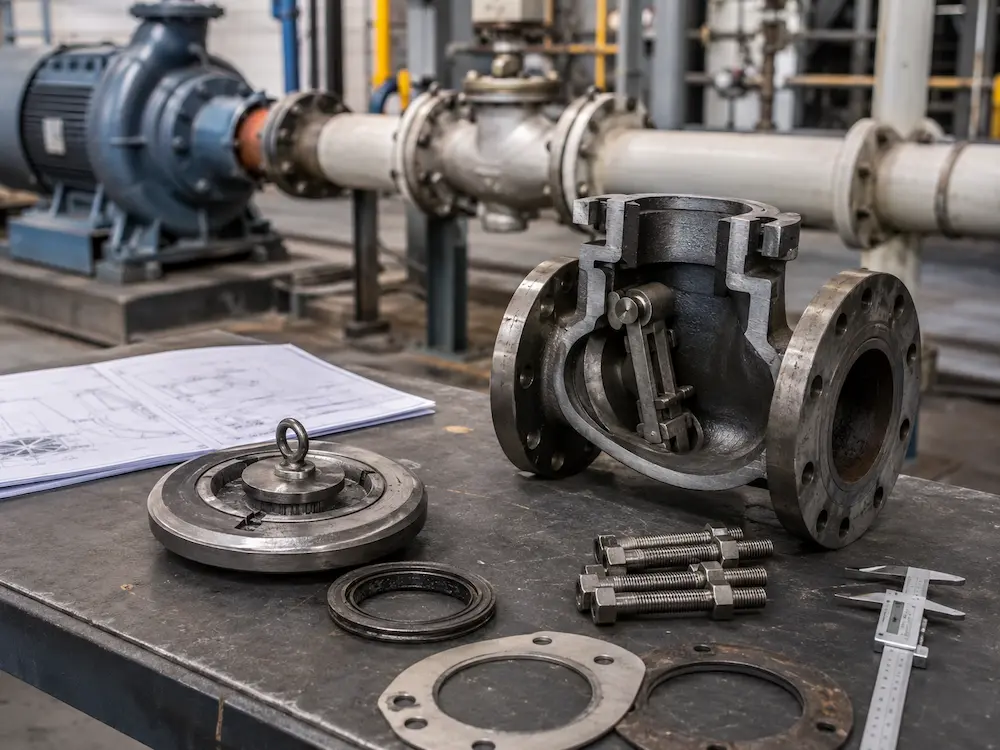
How to Reduce Water Hammer Risk
- Select a check valve with suitable closing speed
- Avoid oversizing the check valve
- Confirm minimum and normal flow velocity
- Use spring-assisted, dual plate, or nozzle check valves where needed
- Review pump shutdown behavior and control method
- Check pipeline length, elevation, and static head
- Provide proper pipe supports near the pump and valve
- Consider surge analysis for critical systems
For high-risk pump discharge systems, a nozzle check valve or non-slam check valve may be more suitable than a traditional swing check valve. However, the correct solution should be based on system data, not only valve type name.
Wafer or Flanged Check Valve for Pump Discharge?
Connection style is another important decision. Wafer check valves are compact and lightweight, making them useful in pump rooms, skids, and space-limited systems. Flanged check valves are heavier and longer, but they may provide easier independent removal and stronger conventional piping support.
For compact pump stations, a wafer dual plate check valve may be practical. For larger or heavy-duty pump discharge pipelines, a flanged swing check valve, flanged nozzle check valve, or flanged lift check valve may be preferred depending on the system.
For detailed connection comparison, read our guide on wafer check valve vs flanged check valve.
Material Selection for Pump Discharge Check Valves
Material selection depends on the pumped medium, pressure, temperature, corrosion risk, and project standard. Buyers should review body material, disc or plate material, spring material, seat material, gasket material, and bolting material.
| Medium / Service | Common Material Direction | Buyer Notes |
|---|---|---|
| Clean water | Ductile iron, carbon steel, stainless steel | Review pressure class, coating, and water quality |
| Wastewater | Ductile iron, stainless steel trim, coated body | Check solids, clogging risk, and maintenance access |
| Seawater | Duplex, super duplex, bronze, coated materials | Chloride corrosion and spring material are critical |
| Chemical dosing | Stainless steel, PTFE, alloy, lined materials | Confirm chemical concentration, temperature, and seal compatibility |
| Oil or fuel | Carbon steel, stainless steel, suitable elastomers | EPDM is usually not suitable for many oil services |
| Steam or hot condensate | Carbon steel, alloy steel, stainless steel, metal seat | Check temperature, gasket, seat, and pressure class carefully |
Seat and Seal Selection
The seat material affects leakage, closing behavior, temperature limit, and maintenance life. Soft seats may provide tighter shutoff in suitable water or utility service. Metal seats may be required for high temperature, steam, abrasive conditions, or severe pressure service.
| Seat Material | Typical Use | Important Concern |
|---|---|---|
| EPDM | Water and selected chemicals | Not suitable for many oils and hydrocarbons |
| NBR | Oil-water mixtures and selected utility service | Temperature and chemical limits must be checked |
| FKM | Oils, fuels, and selected chemicals | Higher cost and chemical compatibility review required |
| PTFE | Chemical service and low-friction sealing | Pressure, temperature, and mechanical loading must be reviewed |
| Metal Seat | Steam, high temperature, severe service | Leakage class and sealing surface quality must be confirmed |
Horizontal and Vertical Pump Discharge Installation
Many pump discharge lines are horizontal, but vertical discharge piping is also common, especially for vertical pumps, compact pump rooms, and space-limited systems. Not every check valve type is suitable for every direction.
Swing check valves are commonly used in horizontal lines and selected vertical upward flow applications. Spring check valves, dual plate check valves, nozzle check valves, and lift check valves may offer more installation flexibility depending on design. Vertical downward flow should always be reviewed carefully.
For a deeper explanation, read our guide on whether a check valve can be installed vertically.
Common Selection Mistakes
Mistake 1: Installing Any Check Valve After the Pump Without Reviewing Closing Speed
Basic backflow prevention is not enough in every pump system. Closing speed must match pump shutdown and reverse-flow behavior.
Mistake 2: Oversizing the Check Valve
An oversized check valve may not open fully at normal flow. This can cause disc chatter, vibration, seat wear, and leakage.
Mistake 3: Ignoring Minimum Flow Rate
Check valves need enough forward flow to remain stable. Minimum flow conditions are important, especially for variable-speed pumps and low-load operation.
Mistake 4: Choosing Only by Valve Price
A cheaper valve can become expensive if it causes water hammer, pump damage, gasket leakage, downtime, or repeated maintenance.
Mistake 5: Ignoring the Isolation Valve Arrangement
A check valve should be installed with maintenance access in mind. The isolation valve and drain arrangement should allow safe inspection and removal.
Mistake 6: Ignoring Spring and Internal Materials
For spring, dual plate, and nozzle check valves, the spring and guide materials are critical. Corrosion or fatigue can cause early failure.
How to Choose a Check Valve for Pump Discharge
| Selection Question | Why It Matters | Likely Direction |
|---|---|---|
| Is the pump system steady and low surge? | Basic backflow prevention may be enough | Swing, spring, or dual plate check valve may work |
| Is there water hammer or valve slam history? | Closing speed is critical | Nozzle or non-slam check valve review |
| Is installation space limited? | Face-to-face length matters | Wafer or dual plate check valve |
| Is the pipeline vertical? | Gravity closure may not work | Spring, lift, dual plate, or nozzle design review |
| Is the medium dirty or contains solids? | Clogging and sticking risk increase | Review disc movement and maintenance access |
| Is pressure drop sensitive? | Pump efficiency may be affected | Compare Cv or pressure drop data |
| Is the system critical? | Failure may cause downtime or equipment damage | Use engineered selection, not only standard stock valve |
Information Buyers Should Provide Before Quotation
- Pump type and discharge line size
- Valve size and required connection type
- Medium name and cleanliness condition
- Operating pressure and design pressure
- Operating temperature and maximum temperature
- Normal, minimum, and maximum flow rate
- Pump head, pump curve, and shutdown behavior if available
- Pipeline length and elevation difference if water hammer is a concern
- Installation direction: horizontal, vertical upward, or vertical downward
- Whether the system has previous slam, vibration, or surge problems
- Required valve type: swing, spring, dual plate, nozzle, lift, wafer, or flanged
- Body, disc, plate, spring, seat, gasket, and bolting material requirements
- Required pressure class, flange standard, test report, material certificate, and datasheet
Related Check Valve Guides
For broader pump discharge and check valve selection details, these related guides may help:
- Industrial Check Valves: Types, Applications and Selection Guide — main guide for check valve types, materials, backflow prevention, and selection logic.
- Nozzle Check Valve for Water Hammer Prevention — explains when fast non-slam closure is needed.
- Dual Plate Check Valve vs Swing Check Valve — compares compact dual plate design with traditional hinged-disc closure.
- Check Valve Product Range — compare swing, spring, lift, dual plate, nozzle, wafer, and flanged check valves for industrial systems.
Final Recommendations for Industrial Buyers
A pump discharge check valve should be selected by system behavior, not only by pipe size. For steady low-risk water or utility systems, a swing check valve, spring check valve, or dual plate check valve may be suitable. For compact pump rooms, wafer and dual plate check valves can save space and reduce weight. For high water hammer risk, long pipelines, high-head pumps, or repeated pump shutdown, a nozzle check valve or non-slam check valve should be reviewed.
Buyers should always confirm flow rate, pump data, pressure, temperature, medium, installation direction, pressure drop, water hammer risk, material, seat design, connection standard, and maintenance access before ordering. A correctly selected check valve protects the pump, improves system reliability, and reduces long-term maintenance risk.
If you need help selecting check valves for pump discharge lines in water treatment, wastewater, cooling water, chemical processing, oil and gas, power plant utilities, HVAC, or industrial process systems, Vcore Valve can review your working conditions and recommend a suitable valve configuration.
For industrial sourcing, the key question is not only “Which check valve goes after the pump?” The better question is: “Which check valve can prevent reverse flow, protect the pump, close at the right speed, and avoid water hammer in this exact discharge system?”
FAQ
1. Why is a check valve installed after a pump?
A check valve is installed after a pump to prevent reverse flow when the pump stops. It helps protect the pump from reverse rotation, backflow, pressure surge, and equipment damage.
2. Should the check valve be before or after the pump?
In most pump discharge systems, the check valve is installed after the pump on the discharge side. A common arrangement is pump, check valve, isolation valve, and then discharge header.
3. Which check valve is best for pump discharge?
The best check valve depends on pump type, flow rate, pressure, installation direction, water hammer risk, and medium. Swing, spring, dual plate, nozzle, lift, wafer, and flanged check valves may all be suitable in different systems.
4. How can a check valve reduce water hammer?
A properly selected check valve closes before strong reverse flow develops. Spring-assisted, dual plate, and nozzle check valves can help reduce valve slam and pressure surge in suitable pump discharge systems.
5. Can a swing check valve be used on a pump discharge line?
Yes, a swing check valve can be used on pump discharge lines with steady flow and low surge risk. However, if pump shutdown creates rapid reverse flow or water hammer, a spring, dual plate, or nozzle check valve may be better.