Globe Valve Trim 6 vs Trim 8: Material Specifications, Hardfacing and Cost Factors
Two globe valves can have the same nominal size, pressure class, WCB body and flanged ends yet receive different prices because the buyer specifies different trim materials. The difference is not merely a label on the datasheet: it can change the alloy procurement, weld-deposit procedure, machining, inspection and suitability for the actual fluid.
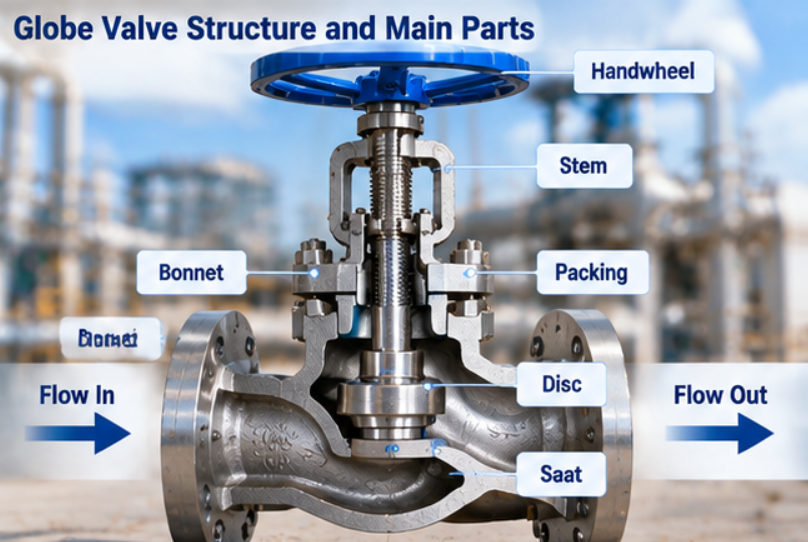
This guide focuses on how to interpret globe valve trim 6 vs trim 8 in an RFQ, rather than repeating general globe-valve operation or installation advice. For basic construction and applications, see Vcore’s Flanged Globe Valve for Industrial Pipeline Flow Control.
1. What Does a Valve Trim Number Actually Specify?
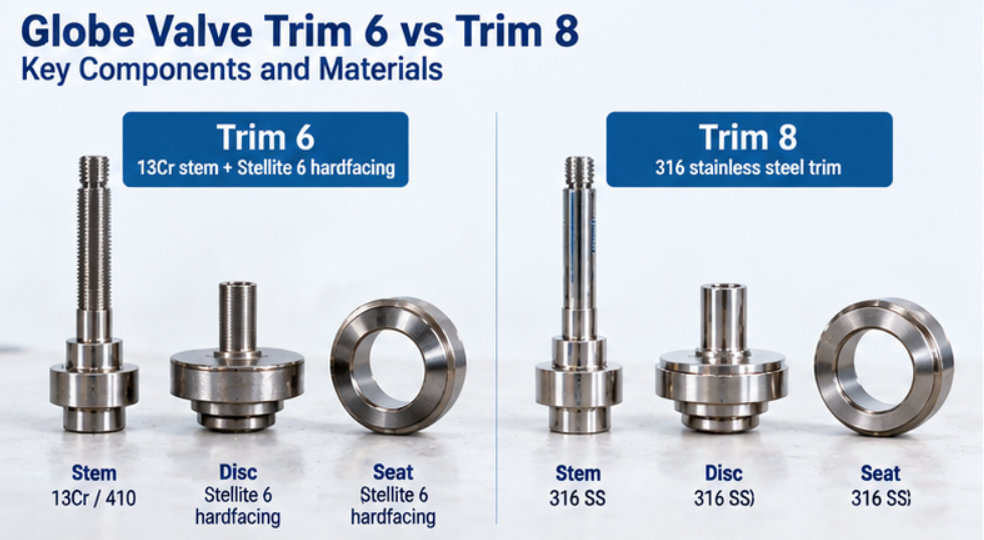
In valve purchasing, “trim” generally refers to selected internal parts exposed to the process or involved in shutoff and movement. For a globe valve, the material schedule should identify the stem, disc or plug seating surface, body seat ring or integral seat, and backseat where applicable. The base metal and the deposited hardfacing layer must be distinguished.
Important standards distinction: API 600 is a steel gate valve standard; its widely reproduced trim-number tables are often used as a purchasing reference for other valve types. A globe-valve RFQ should not silently assume that a reference to “Trim 6” or “Trim 8” invokes one universal API 600 configuration. Identify the applicable globe-valve design standard, the actual trim table and any project deviations.
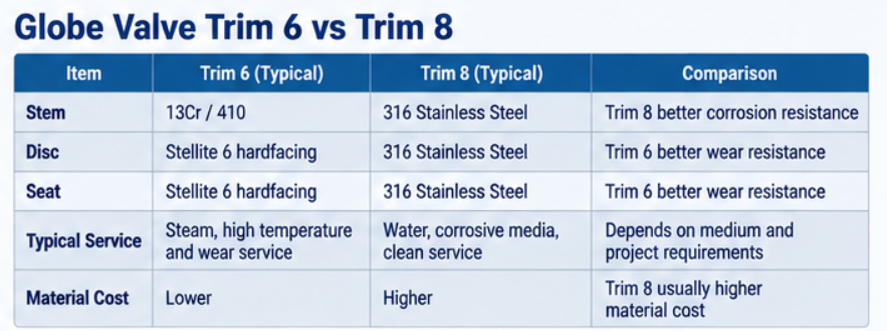
2. Trim 6 vs Trim 8: A Reference Comparison, Not a Universal BOM
The following is an illustrative comparison based on a commonly published API 600-style trim chart. It is useful for identifying the questions to ask; it must not replace the customer’s specified edition, trim schedule or approved valve drawing.
| Component / issue | Illustrative Trim 6 | Illustrative Trim 8 | What the RFQ must confirm |
|---|---|---|---|
| Stem | 13Cr / 410 family | 13Cr / 410 family | Exact ASTM grade, heat treatment and hardness |
| Disc seating face | 410-family face in some charts | 410-family face in some charts | Whether hardfacing is also required on the disc |
| Body seat face | Cu-Ni alloy in some charts | Hardfaced, commonly cobalt-based alloy in some charts | Exact alloy, seat-ring substrate and overlay location |
| Backseat | Often 410 family | Often 410 family | Whether backseat exists and its specified material |
| Manufacturing | Alloy seat manufacture and machining | Hardfacing deposition, finishing and inspection where specified | Approved weld procedure, deposit thickness and test scope |
| Price driver | Cu-Ni procurement, machining and geometry | Hardfacing consumable, labor, dilution control and finishing | Actual component-level BOM and manufacturing route |
Published trim references differ in how they describe the nominal Trim 6 seat and disc arrangement. That inconsistency is precisely why the buyer and manufacturer should exchange the governing trim-material table before agreeing on price or compliance.
3. Stellite Hardfacing: What Is Actually Being Deposited?
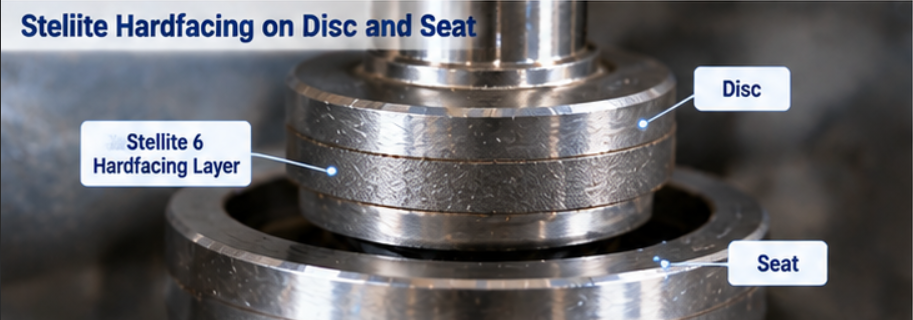
“Stellite” is a family of cobalt-based hardfacing alloys; a requirement for Stellite 6 should identify the grade and the exact surface to be overlaid. Hardfacing is not the same as manufacturing the complete stem or disc from solid cobalt alloy. A valve can have a carbon-steel or stainless substrate with a specified weld-deposited seating layer.
For each hardfaced sealing surface, confirm:
- Whether the body seat, disc face, or both require overlay.
- Specified alloy grade, compatible substrate and approved welding procedure.
- Minimum finished deposit thickness and required finished seating width.
- Hardness requirements, dilution/defect acceptance and surface finish.
- Whether seat-ring replacement, repair welding or future refurbishment is permitted.
A hardfaced body seat with an unhardened or differently hardened disc face is not equivalent to two hardfaced mating faces. The contact pair, differential hardness, loading and operating cycles matter for wear and galling resistance.
4. Wear Resistance Is Not the Same as Corrosion Resistance
Hardfacing may improve resistance to adhesive wear, abrasion or repeated seating contact in suitable service, but it does not automatically make the entire trim corrosion-resistant. The stem, seat-ring substrate, disc base metal and crevice regions remain exposed to the actual medium.
For high-temperature steam, assess temperature, differential pressure, cycling, condensate conditions and erosion at the seating area. For corrosive chemical or chloride-bearing service, separately verify the compatibility of the base alloys, weld deposit and other wetted parts. Consult Vcore’s Valve Trim Materials Selection Guide for the broader material-selection context.
5. Why Two Trim Quotations Can Have Different Costs
The cost comparison between Trim 6 and Trim 8 is not a universal percentage premium. It depends on the actual bill of materials, nominal size, number of hardfaced surfaces, seat geometry, alloy availability, machining and qualification requirements.
| Cost item | Potential effect | Question for supplier |
|---|---|---|
| Seat-ring alloy | Different raw-material and machining costs | Solid alloy ring, clad ring or deposited overlay? |
| Hardfacing | Filler alloy, welding labor, rework and finishing | One seating face or both? Finished thickness? |
| Stem specification | Alloy, heat treatment and dimensional tolerance | Exact grade and material certificate? |
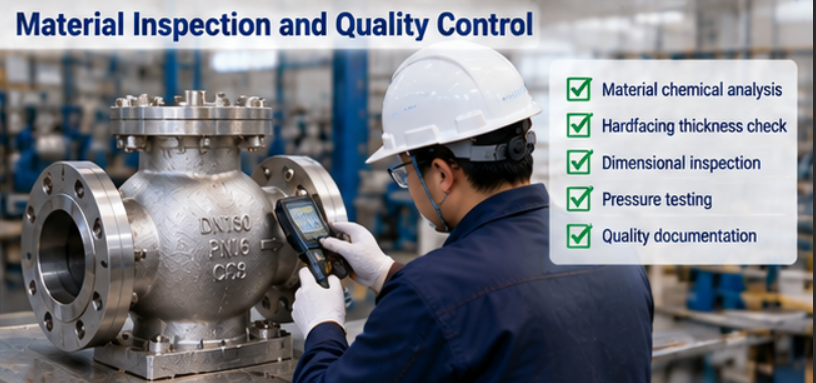
| Inspection | Hardness, visual/NDE and leak testing | Which acceptance criteria and witness points? |
| Quantity / size | Setup and processing time per valve | Same design and quantity in both quotations? |
For a fair price comparison, request two quotations with the same size, class, body, bonnet, connection, face-to-face dimension, testing and documentation. Change only the approved trim BOM, then list the resulting material and process differences. For high-pressure steam construction, see Vcore’s Pressure Seal Globe Valve for High Pressure Steam Service; its bonnet design and pressure-temperature requirements must be evaluated separately from trim selection.
6. High-Temperature Steam: Questions Beyond the Trim Number
A hardfaced seat may be specified for repeated operation or demanding sealing duty, but steam-valve suitability requires more than a trim label. Confirm maximum design temperature, design pressure, differential pressure at opening and closing, operating cycles, required leakage performance, and the manufacturer’s allowable pressure-temperature rating.
For installation direction, do not assume that all globe valves require under-seat flow. Check the valve’s approved drawing and body arrow; see Vcore’s Globe Valve Flow Direction for Steam: Under-Seat vs Over-Seat for the separate flow-direction question. Also review the Valve Pressure-Temperature Rating Guide when selecting body and trim materials for elevated-temperature service.
7. A Component-Level RFQ That Prevents Trim Misquotation
| RFQ field | Information to provide |
|---|---|
| Valve | Globe valve type, size, class, ends, bonnet and operation |
| Trim reference | Exact standard, edition, project trim table or attached BOM |
| Stem | ASTM grade, heat treatment and hardness if required |
| Disc | Base metal, seating-face alloy and hardfacing area |
| Body seat | Ring/integral design, substrate and seating-face alloy |
| Backseat | Material and configuration, if applicable |
| Overlay | Alloy grade, location, finished thickness and inspection |
| Process | Medium, temperature, pressure, differential pressure and cycling |
| Acceptance | Leakage test, MTR, hardness/NDE and approved drawing |
Frequently Asked Questions
Is Trim 8 always more expensive than Trim 6?
No. The actual cost depends on the governing trim table, material quantities, hardfacing scope, manufacturing process and order size. Compare matched quotations with an explicit BOM.
Does Trim 8 mean the entire disc and stem are Stellite 6?
No. A trim schedule may call for hardfacing only on a specified seating surface. Confirm the substrate and deposited area separately.
Is Trim 6 always 13Cr stem and Stellite 6 sealing surfaces?
No. Published API 600-style charts commonly associate Trim 6 with 13Cr and a copper-nickel seat-side material, while other project or manufacturer schedules may use different definitions. The customer’s governing trim table is essential.
Can a trim number alone prove suitability for high-temperature steam?
No. Pressure-temperature rating, seat and stem material, differential pressure, operating duty and the complete valve design must also be checked.