F51 vs F53 valve material is an important comparison for forged duplex and super duplex industrial valves. Both materials are used for corrosion-resistant valve bodies, bonnets, end caps, stems, balls, discs, trim parts and other pressure-containing or wetted components.
F51 and F53 are often discussed in seawater, offshore, desalination, chloride-containing process water, chemical processing and corrosive industrial service. They are both stronger corrosion-resistant options than many common stainless steel materials, but they are not selected for the same severity level.
This article focuses on ASTM A182 F51 and ASTM A182 F53 forged valve materials. For the broader forged material overview, read our Forged Valve Materials Guide. For general duplex valve selection, read our Duplex Stainless Steel Valves for Seawater and Corrosive Service.
What Is ASTM A182 F51 Valve Material?
ASTM A182 F51 is a forged duplex stainless steel material commonly used for valve pressure parts and components. It is often associated with duplex stainless steel grades such as UNS S31803 or UNS S32205, depending on the project specification and supplied material.
F51 is selected when 304 or 316 stainless steel may not provide enough corrosion resistance, especially in chloride-containing environments. It also offers higher strength than many common austenitic stainless steels, which can be useful for forged valve bodies and pressure-containing parts.
Typical F51 valve applications include:
- Seawater service
- Chloride-containing water
- Offshore oil and gas systems
- Desalination plants
- Marine utility pipelines
- Corrosive industrial water systems
- Chemical processing with chloride corrosion risk
- Forged duplex ball valves, gate valves, globe valves and check valves
What Is ASTM A182 F53 Valve Material?
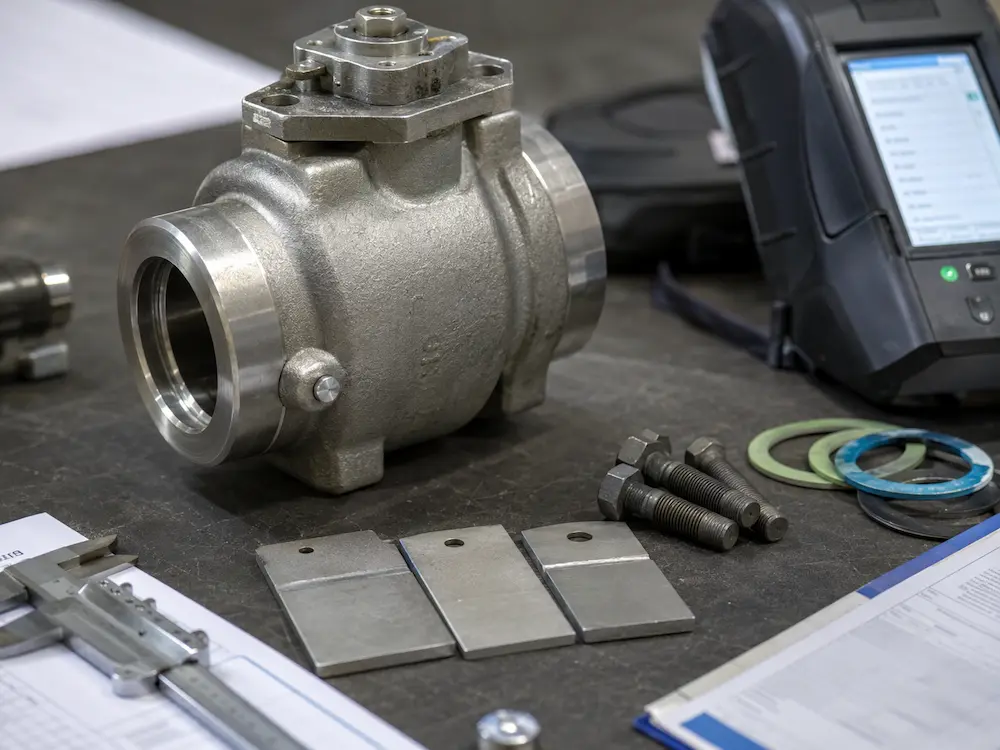
ASTM A182 F53 is a forged super duplex stainless steel material used for more severe corrosion-resistant valve applications. It is often associated with super duplex stainless steel grade UNS S32750.
F53 is selected when standard duplex material such as F51 may not provide enough resistance to severe chloride corrosion, pitting, crevice corrosion or aggressive seawater-related service. It is commonly used in offshore, desalination, marine, chemical and high-chloride industrial systems.
Typical F53 valve applications include:
- Severe seawater service
- High-chloride process systems
- Offshore and marine engineering
- Desalination brine service
- More aggressive chemical processing
- Critical forged valve components requiring super duplex material
- Applications where F51 may not provide enough corrosion resistance
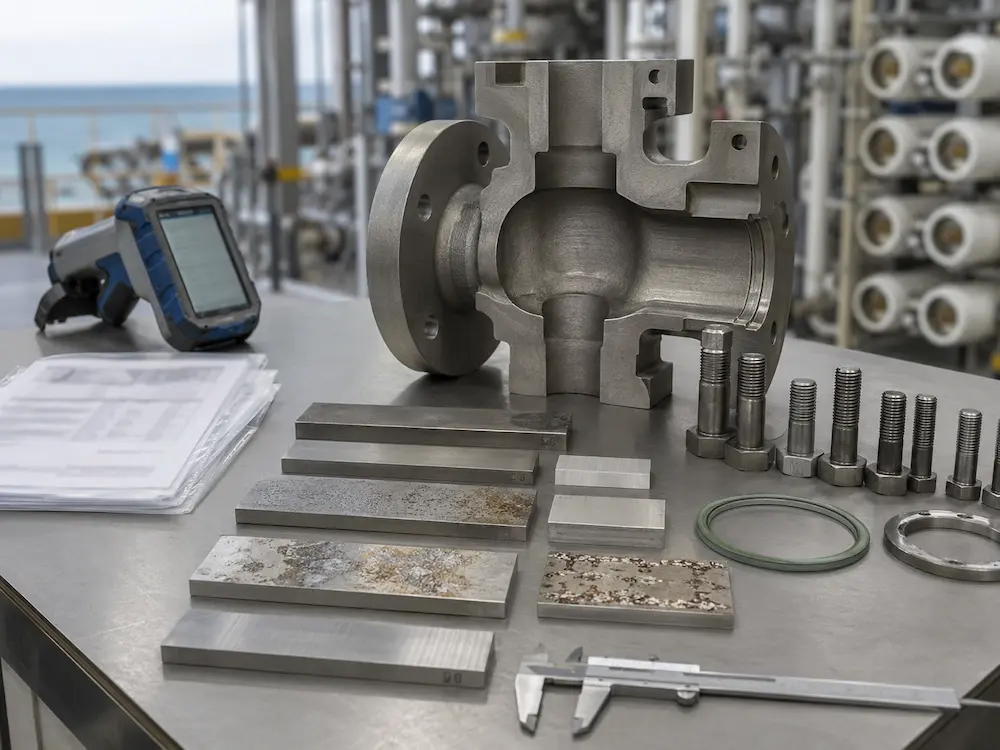
F51 vs F53: Main Difference
| Item | ASTM A182 F51 | ASTM A182 F53 |
|---|---|---|
| Material Family | Forged duplex stainless steel | Forged super duplex stainless steel |
| Common Grade Reference | Duplex, often UNS S31803 / S32205 depending on specification | Super duplex, often UNS S32750 depending on specification |
| Main Purpose | Corrosion-resistant forged valve service | More severe corrosion-resistant forged valve service |
| Chloride Resistance | Better than many common stainless steels | Generally stronger than F51 in severe chloride conditions |
| Common Service | Seawater, offshore, desalination, chloride water, chemical service | Severe seawater, brine, offshore, high-chloride and aggressive corrosive service |
| Cost | Usually lower than F53 | Usually higher than F51 |
| Main Buyer Risk | May be insufficient for severe chloride or brine service | May be over-specified if F51 already meets the condition |
F51 and F53 Are Forged Duplex Materials
F51 and F53 are forged material grades. They are commonly used for forged valve bodies, bonnets, end caps, stems, balls, discs, plugs, seat rings and other components depending on valve design and project requirements.
This is different from cast duplex materials. Buyers should not use forged and cast material names interchangeably in purchase orders, datasheets or MTC review.
| Material | Manufacturing Form | Typical Valve Use |
|---|---|---|
| F51 | Forged duplex stainless steel | Forged duplex valve pressure parts and wetted components |
| F53 | Forged super duplex stainless steel | Forged super duplex valve pressure parts and wetted components |
F51 vs F53 for Seawater Service
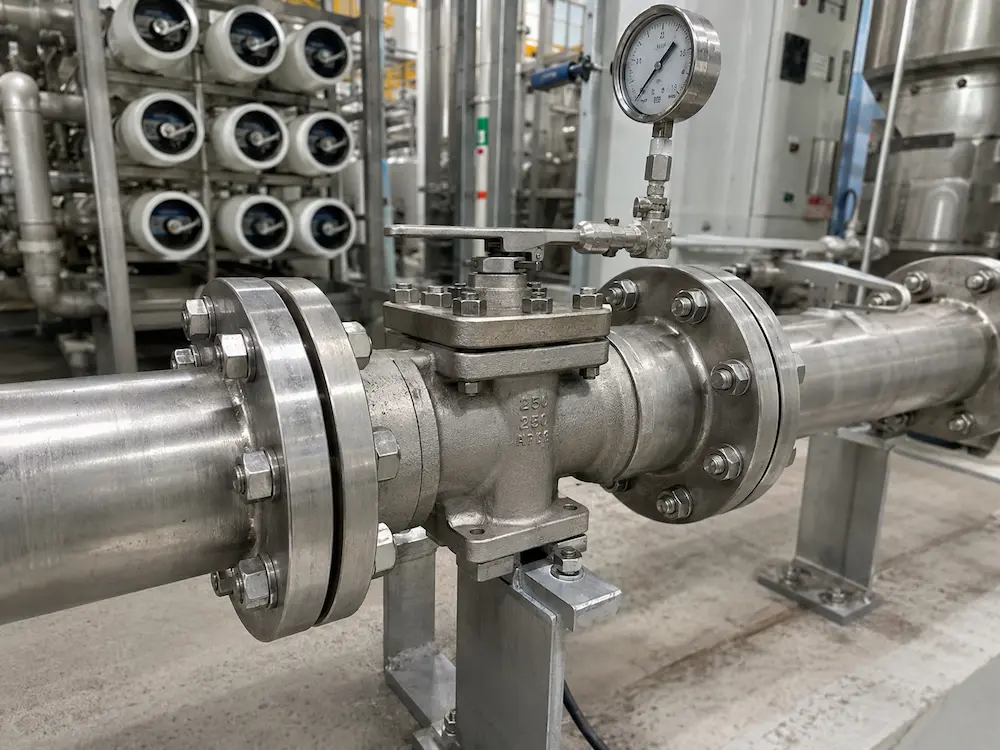
Seawater is one of the main reasons buyers compare F51 and F53. Seawater contains chlorides and can create pitting corrosion, crevice corrosion and stress corrosion risk for unsuitable stainless steel materials.
F51 may be suitable for many seawater and offshore utility services when the chloride level, temperature, flow condition and project specification allow it. F53 is usually reviewed when seawater service is more severe, when stagnant areas or crevice corrosion risk are important, or when the project specification requires super duplex material.
For seawater service, buyers should confirm:
- Chloride level
- Operating temperature
- Flow velocity
- Whether seawater is stagnant or flowing
- Crevice corrosion risk
- Oxygen content and fouling risk
- Valve type and dead zone design
- Seat, gasket, spring and bolting materials
F51 vs F53 for Offshore Applications
Offshore systems often require stronger corrosion-resistant materials because valves may face seawater exposure, salt spray, high humidity, chloride-containing fluids and strict project documentation requirements.
F51 may be selected for many offshore utility and process applications. F53 is reviewed when the service is more severe, when corrosion allowance is limited, or when project specifications require super duplex material for critical components.
Offshore valve buyers should check:
- Whether the valve is internally wetted by seawater or externally exposed to marine atmosphere
- Whether the valve is used in process, utility, firewater, seawater cooling or chemical injection service
- Whether NACE, PMI or third-party inspection is required
- Whether the complete wetted material package matches the project datasheet
- Whether bolting and accessories are also corrosion-resistant
F51 vs F53 for Desalination and Brine Service
Desalination systems can involve seawater intake, high-chloride process water, brine discharge and corrosive operating environments. F51 may be suitable for selected desalination service, while F53 is often reviewed for more aggressive brine or high-chloride conditions.
For desalination valves, buyers should not choose material only by valve body grade. The ball, disc, stem, seat, gasket, packing, spring and bolting materials must also be compatible with the same chloride service.
When Should You Choose F51 Valves?
F51 forged duplex valves are suitable for many applications where standard stainless steel may not be enough, but super duplex material is not required.
Choose F51 when:
- The project requires forged duplex stainless steel material
- 316 stainless steel may not provide enough chloride resistance
- The medium is seawater, chloride water or corrosive industrial water
- The application is offshore, marine, desalination or chemical service
- The corrosion condition is demanding but not severe enough for F53
- The project specification allows ASTM A182 F51
- Cost control is important and F53 is not required
When Should You Choose F53 Valves?
F53 forged super duplex valves should be reviewed when the corrosion condition is more severe and F51 may not provide enough safety margin.
Choose F53 when:
- The project specification requires ASTM A182 F53
- The service involves severe seawater or brine
- High chloride concentration is present
- Crevice corrosion and pitting resistance are critical
- The valve is used in critical offshore or desalination service
- Super duplex material is required for wetted or pressure-containing parts
- Failure cost is high and stronger corrosion resistance is justified
Can F51 Replace F53?
F51 should not replace F53 when the project specification, datasheet or purchase order requires F53. Although both materials belong to the duplex stainless steel family, F53 is a super duplex material used for more severe corrosion conditions.
If the actual service is moderate chloride service and F51 meets the project requirement, F51 may be acceptable. But if F53 is specified, material substitution should only be made with formal buyer or engineering approval.
Can F53 Replace F51?
F53 may sometimes be technically acceptable where F51 is used, but it usually costs more and may require stricter procurement and documentation control. Buyers should not select F53 only because it sounds stronger.
If F51 meets the service condition and project specification, F53 may only increase cost without practical benefit. The correct material should match corrosion severity, temperature, pressure, valve design and project documentation.
F51 vs F53 by Valve Type
Forged Ball Valves
F51 and F53 forged ball valves may be selected for seawater, offshore, desalination, chemical and chloride-containing service. Buyers should check body material, ball material, stem material, seat material, gasket, packing, fire-safe requirement and anti-static design.
Socket Weld Ball Valves
Socket weld forged valves may use F51 or F53 when compact welded-end construction is required in corrosive service. Welding procedure, pipe material compatibility, seat material and MTC requirements should be confirmed before order.
Forged Gate Valves
F51 and F53 forged gate valves may be used for corrosion-resistant isolation service. Wedge material, stem material, seat ring, bolting and gasket materials should be selected together with the body material.
Forged Globe Valves
Forged globe valves can expose trim parts to throttling, velocity and pressure drop. If F51 or F53 is selected for the body, trim material and hardfacing should also be reviewed according to erosion and corrosion risk.
Forged Check Valves
Forged check valves in seawater or offshore service require careful review of disc, spring, hinge pin, seat ring and body material. Spring material is especially important because a wrong spring material can fail earlier than the body.
API 6D Pipeline Valves
For API 6D pipeline valves, F51 or F53 may be reviewed when pipeline service involves chloride corrosion, offshore exposure or project-specified duplex material. Pressure class, temperature, sour service, seat design and inspection documents should be confirmed.
Seat, Seal, Gasket and Bolting Materials Still Matter
Choosing F51 or F53 body material does not make the complete valve automatically suitable for seawater or chemical service. The full wetted material system must be compatible.
Buyers should check:
- Ball, disc, gate, plug or wedge material
- Stem material
- Seat material: PTFE, RPTFE, PEEK, PCTFE or metal seat
- Gasket material: PTFE, graphite, spiral wound gasket or project-specified gasket
- Packing material: PTFE, graphite or low-emission packing
- Spring material in check valves
- Bolting material and external corrosion resistance
- Whether all wetted parts require F51, F53 or equivalent material
For sealing material selection, read our Valve Seat Materials Guide. For internal component selection, read our Valve Trim Materials Guide.
Material Certificate, PMI and Traceability Requirements
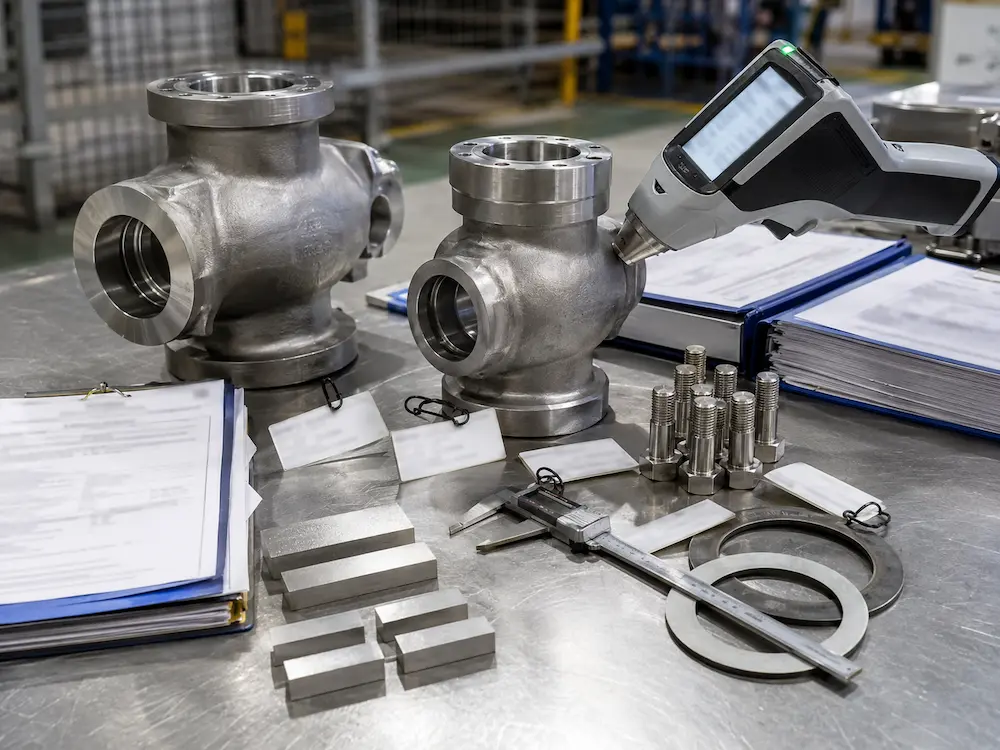
For F51 and F53 valve orders, material documents are very important. Buyers should confirm the exact material grade, applicable standard, heat number traceability, chemical composition, mechanical properties and PMI requirements before production.
For F51 material certificates, check:
- Material grade: ASTM A182 F51 or approved equivalent
- UNS grade if required by the project
- Heat number traceability
- Chemical composition
- Mechanical properties
- Heat treatment information if required
- Component scope: body, bonnet, ball, stem, disc, trim or bolting
- Whether PMI is required
For F53 material certificates, check:
- Material grade: ASTM A182 F53 or approved equivalent
- Super duplex grade reference if required by the project
- Heat number traceability
- Chemical composition and mechanical properties
- PMI requirement
- Component scope and wetted part requirements
- Third-party inspection requirement if applicable
- Consistency with purchase order, datasheet and project specification
For broader documentation requirements, read our Valve Certificates and Quality Documents Guide.
Common Mistakes When Selecting F51 or F53 Valves
Mistake 1: Treating F51 and F53 as the Same Duplex Material
F51 and F53 are not the same grade. F51 is duplex stainless steel, while F53 is super duplex stainless steel for more severe corrosion service.
Mistake 2: Using F51 Where F53 Is Specified
If the project specification requires F53, F51 should not be substituted without formal engineering approval.
Mistake 3: Choosing F53 When F51 Is Enough
F53 may increase cost and procurement complexity. If F51 meets the service condition and project requirement, F53 may not be necessary.
Mistake 4: Ignoring Seat and Spring Materials
A duplex body may still fail if the seat, gasket, packing, spring or bolting material is not suitable for seawater or chloride service.
Mistake 5: Not Checking PMI Requirements
F51 and F53 are high-value corrosion-resistant materials. PMI is often required for project verification and should be confirmed before production.
Mistake 6: Selecting Only by Material Name
“Duplex” and “super duplex” are not enough for project orders. Buyers should specify exact ASTM, UNS or project material grade.
How to Choose Between F51 and F53
| Question | Choose F51 If | Choose F53 If |
|---|---|---|
| Is the service chloride-containing? | Yes, but condition is moderate and F51 is allowed | Yes, and the service is severe or high-chloride |
| Is seawater involved? | Many seawater services where duplex is sufficient | Severe seawater, brine or critical service |
| What does the project specification require? | ASTM A182 F51 is specified or allowed | ASTM A182 F53 is specified |
| Is cost a major concern? | Usually more economical than F53 | Higher cost but stronger corrosion resistance |
| Is failure risk high? | Suitable when service severity is controlled | Preferred when stronger corrosion margin is required |
Information Buyers Should Provide Before Quotation
- Valve type: ball, gate, globe, check, plug or control valve
- Valve size and pressure class
- Required material: F51, F53 or project-specified duplex grade
- Whether F51 / F53 is required for body only or all wetted parts
- Medium name and chemical composition
- Chloride content if known
- Operating pressure and design pressure
- Operating temperature and maximum temperature
- Flow velocity and whether stagnant service exists
- Whether seawater, brine, offshore or desalination service is involved
- Required seat, gasket, packing, spring and bolting materials
- Whether PMI, MTC or third-party inspection is required
- Project specification or approved datasheet if available
Related Valve Material Guides
- Forged Valve Materials Guide — main hub for A105, LF2, F304, F316, F51, F53, F11 and F22 forged valve materials.
- Duplex Stainless Steel Valves — broader duplex and super duplex valve guide for seawater and corrosive service.
- 304 vs 316 Stainless Steel Valves — explains stainless steel, CF8 and CF8M material selection.
- Valve Seat Materials Guide — explains EPDM, NBR, FKM, PTFE, PEEK, graphite and metal seat selection.
- Valve Certificates and Quality Documents — explains MTC, PMI, pressure test reports and project documentation.
Final Recommendations for Industrial Buyers
F51 and F53 are both forged duplex-family valve materials, but they should not be selected in the same way. F51 is suitable for many seawater, chloride, offshore, desalination and corrosive services where duplex stainless steel performance is enough. F53 is selected for more severe chloride, brine, offshore and corrosive applications where super duplex material is required.
For moderate chloride service, F51 may provide a good balance between corrosion resistance and cost. For severe seawater, high-chloride brine, critical offshore service or project-specified super duplex applications, F53 should be reviewed.
If you need help selecting F51, F53, F304, F316, A105, LF2, Monel, Inconel, Hastelloy, titanium, PTFE lined or rubber lined valves, Vcore Valve can review your medium, chloride level, pressure, temperature, valve type and documentation requirements.
FAQ
1. What is ASTM A182 F51 valve material?
ASTM A182 F51 is a forged duplex stainless steel material used for corrosion-resistant valve bodies, bonnets, stems, balls, discs, trim parts and pressure-containing components.
2. What is ASTM A182 F53 valve material?
ASTM A182 F53 is a forged super duplex stainless steel material used for more severe chloride, seawater, offshore, brine and corrosive service applications.
3. What is the main difference between F51 and F53?
The main difference is corrosion resistance level. F51 is a duplex stainless steel material, while F53 is a super duplex stainless steel material for more severe corrosive service.
4. Can F51 replace F53?
F51 should not replace F53 when the project specification requires F53 or when the service condition needs super duplex corrosion resistance. Any substitution should be approved by the buyer or project engineer.
5. Is F53 better than F51?
F53 generally provides stronger corrosion resistance than F51 in severe chloride and seawater-related conditions, but it is more expensive and not always necessary.
6. Do F51 and F53 valves need PMI?
PMI is often required for F51 and F53 valve orders, especially for project valves, offshore valves, seawater valves and critical corrosion-resistant service. Buyers should confirm PMI and MTC requirements before production.