Selecting a cryogenic ball valve for LNG requires more than specifying stainless steel and a low-temperature rating. LNG valve procurement should verify minimum design temperature, low-temperature material toughness, extended bonnet geometry, cryogenic seat materials, cavity pressure relief, installation direction, cryogenic testing and project documentation. For EPC and LNG terminal projects, buyers should confirm the datasheet, GA drawing, MTC, impact-test requirements, cryogenic test procedure and inspection plan before production.
A standard industrial ball valve may perform reliably at ambient temperature but still be unsuitable for LNG service.
Liquefied natural gas is handled at extremely low temperatures, typically near -162°C. Under these conditions, valve-body materials, seats, seals, packing systems and dimensional clearances can behave very differently from the same components at room temperature.
For this reason, selecting a
cryogenic ball valve for LNG
requires the complete valve to be evaluated as a low-temperature pressure-containing system rather than treating it as a conventional ball valve with a longer stem.
For LNG valve procurement, buyers and EPC contractors should review low-temperature material toughness, extended bonnet design, cryogenic seat materials, cavity pressure relief, operating torque, valve orientation and the required low-temperature test procedure before issuing a purchase order.
This article focuses specifically on LNG ball valve selection and procurement. For a wider overview of cryogenic valve structures and standards, see
Cryogenic Valves for LNG: Design & Standards.
1. Why LNG Ball Valves Require a Dedicated Cryogenic Design
The basic operating principle remains familiar: the ball rotates approximately 90 degrees between the open and closed positions.
However, the design requirements change significantly when the valve is used as an LNG isolation valve.
| Selection Factor | General Industrial Ball Valve | Cryogenic Ball Valve for LNG |
|---|---|---|
| Temperature | Designed for normal industrial process conditions. | Must be qualified for the specified minimum design temperature. |
| Body material | Strength and corrosion resistance are primary considerations. | Low-temperature toughness and impact performance are critical. |
| Stem / bonnet | Standard bonnet and stem arrangement may be sufficient. | An extended bonnet cryogenic ball valve design is commonly required. |
| Seat system | Selected mainly according to pressure, temperature and medium. | Must accommodate thermal contraction and cold-condition sealing. |
| Body cavity | Thermal expansion may be less critical depending on service. | Trapped LNG can create dangerous cavity overpressure if not relieved. |
| Testing | Ambient shell and seat tests may be adequate. | Cryogenic testing may be required in addition to normal pressure tests. |
| Procurement documents | Standard MTC and inspection reports. | May require MTC, PMI, impact-test reports, cryogenic test report, GA and ITP. |
A cryogenic ball valve manufacturer should confirm the low-temperature suitability of the complete valve assembly, not only the material grade of the body.
2. Low-Temperature Material Toughness Comes Before Material Name
For LNG service, the first material question should not simply be whether the valve is stainless steel.
The pressure-containing components must retain adequate toughness at the specified minimum design temperature.
Some metallic materials become significantly less ductile when temperature decreases. If a valve-body material does not retain sufficient low-temperature toughness, impact loading, piping stress or local stress concentration can increase the risk of brittle failure.
Austenitic Stainless Steel for LNG Ball Valves
Austenitic stainless steels such as 304, 304L, 316 and 316L are commonly considered in low-temperature systems because they generally retain useful toughness under cryogenic conditions.
However, a cryogenic ball valve supplier should still confirm the exact ASTM casting or forging grade, minimum design temperature, pressure rating and project material requirements.
Low-Temperature Carbon Steel
Low-temperature carbon steels can be suitable for selected low-temperature applications when their certified impact properties and allowable temperature range meet the project requirements.
They should not automatically be treated as equivalent to austenitic stainless steel for LNG service.
Ball, Stem, Bonnet and Bolting
The valve body is only one part of the low-temperature system.
The ball, stem, gland, bonnet components, bolting and other pressure-related parts must also accommodate thermal contraction.
Because different materials may contract at different rates, cold service can change seat preload, stem clearances and operating torque.
A quotation stating only “SS316 cryogenic ball valve” is not sufficiently detailed for a major LNG project. Buyers should request exact ASTM grades, minimum design temperature, impact-test requirements and the required EN 10204 material certification.
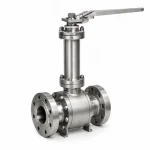
3. Why an Extended Bonnet Cryogenic Ball Valve Is Used
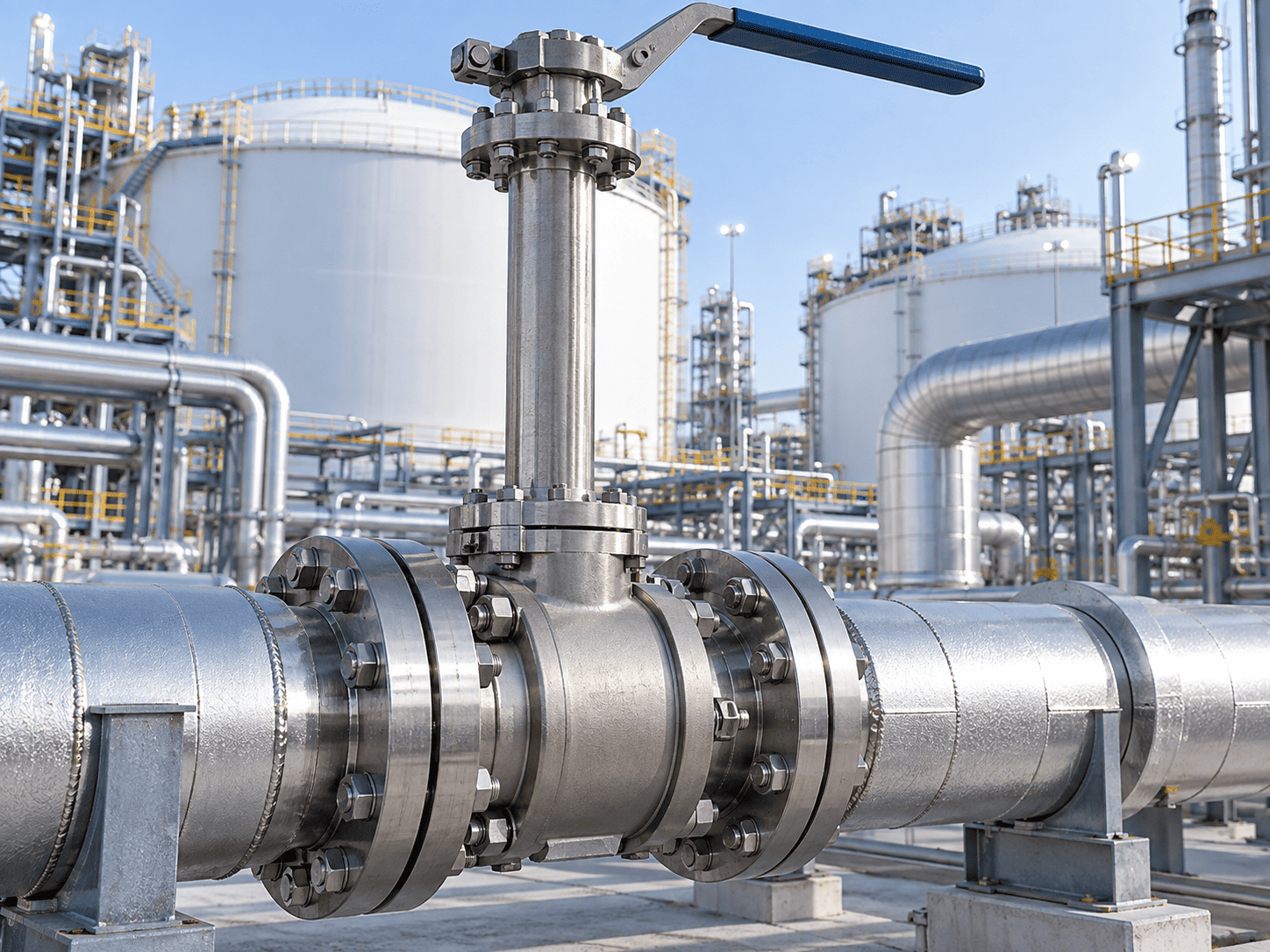
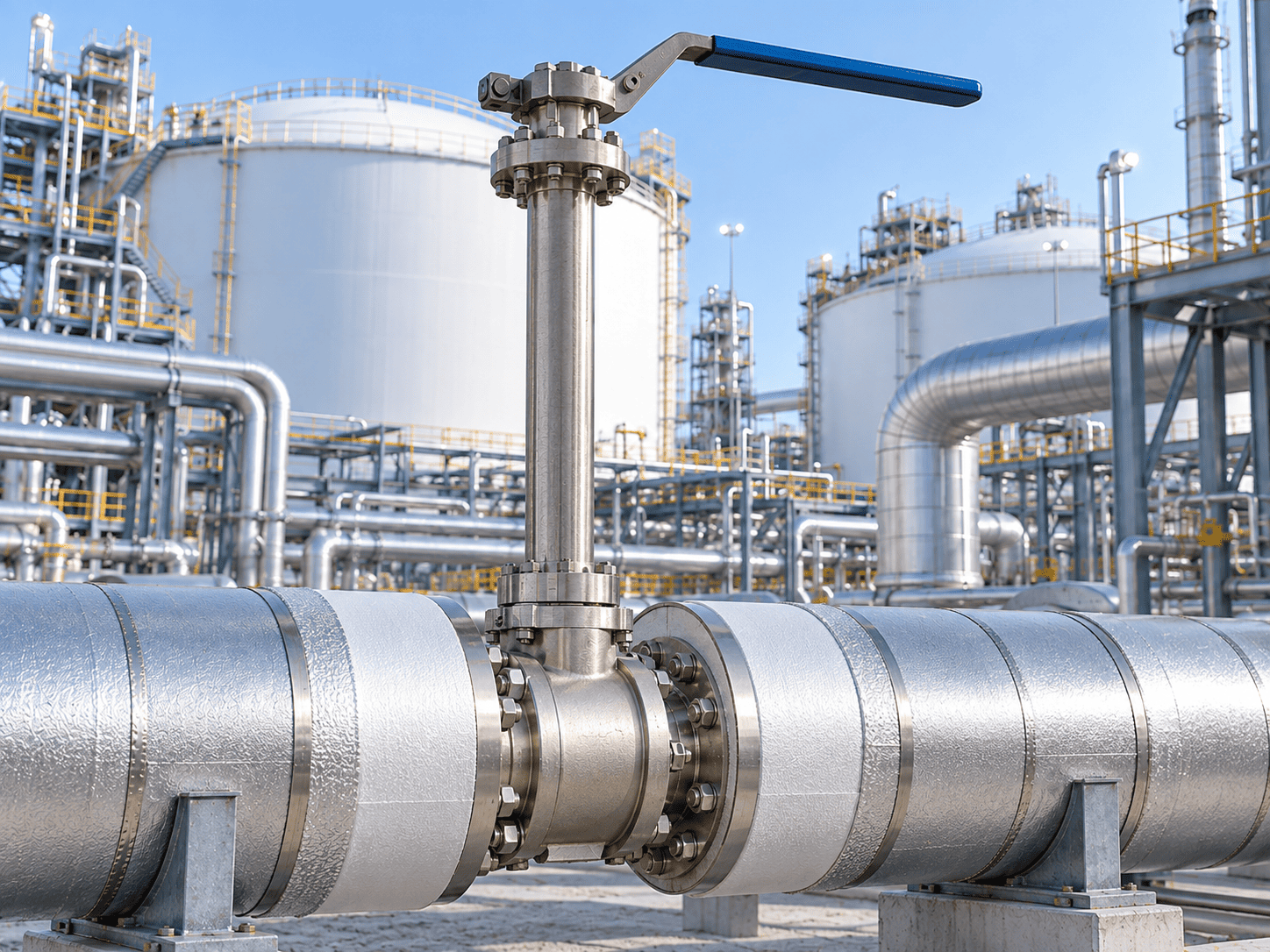
The extended bonnet is one of the most recognizable features of an LNG cryogenic ball valve.
Its purpose is not simply to increase the overall height of the valve.
The extension increases the distance between the cryogenic process fluid and the stem packing, gland and operating mechanism.
This helps reduce direct exposure of the packing area to the coldest temperature zone and provides installation clearance above pipeline insulation.
Extended Bonnet Height Should Match the Project
There is no universal extension length suitable for every LNG ball valve.
The required height depends on:
- Minimum operating and design temperature.
- Pipeline insulation thickness.
- Valve size and pressure class.
- Stem packing design.
- Manual or automated operation.
- Installation orientation.
- Maintenance clearance.
For LNG EPC procurement, the extended bonnet dimension should be clearly shown on the approved GA drawing before manufacturing.
4. Cryogenic Seat Materials: PCTFE, PTFE, RPTFE, PEEK or Metal Seat
Seat selection is one of the most important parts of LNG ball valve engineering.
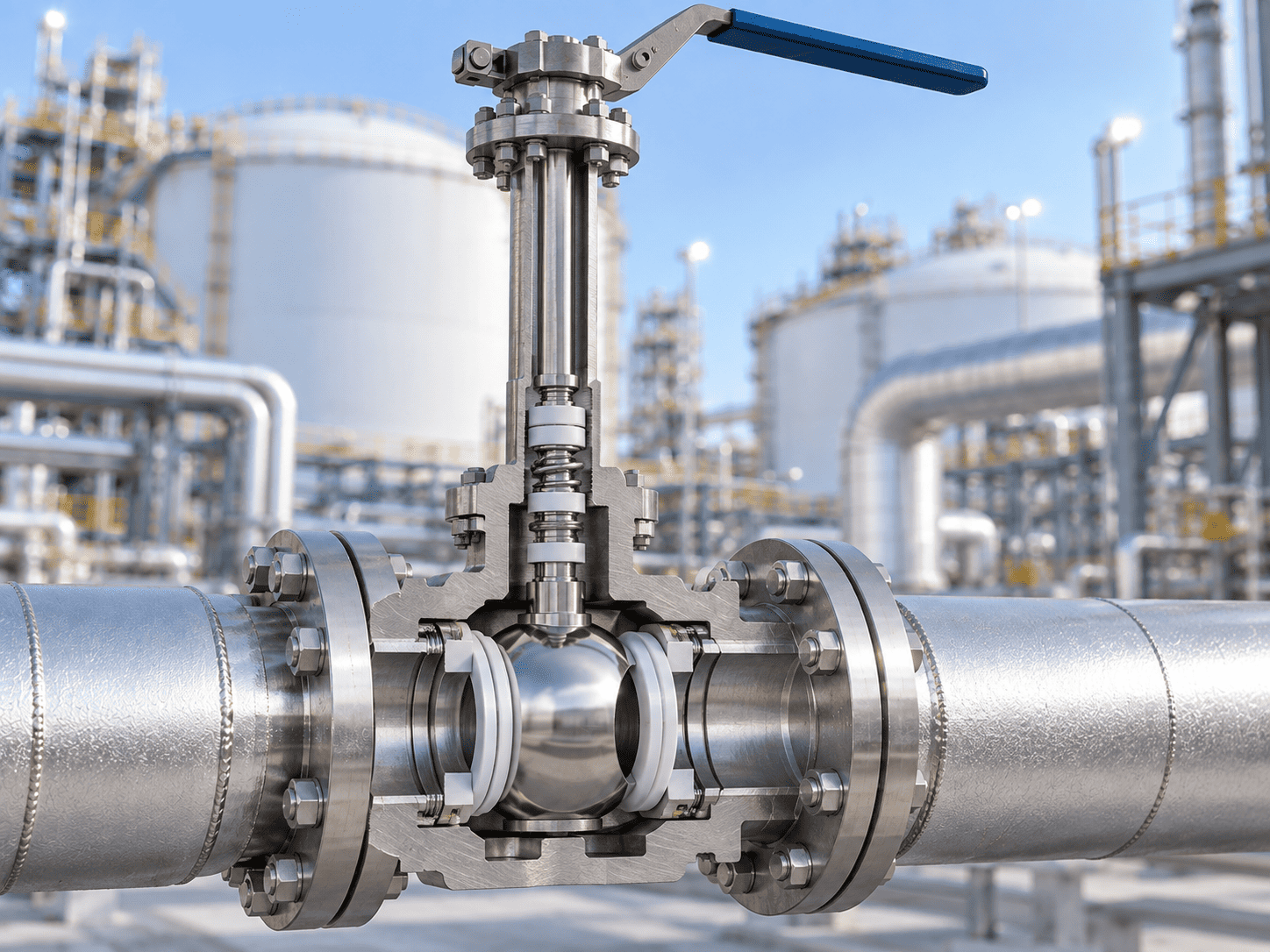
A seat that seals correctly at ambient temperature may shrink, harden or change contact stress when cooled to LNG temperature.
This is why buyers searching for a
PCTFE seat cryogenic ball valve
or another low-temperature seat configuration should evaluate both material properties and actual seat geometry.
| Seat Material | Typical Engineering Consideration | LNG Procurement Check |
|---|---|---|
| PCTFE | Frequently considered for cryogenic sealing because of dimensional stability at low temperature. | Confirm pressure, temperature, seat design and allowable leakage. |
| PTFE | Provides chemical resistance and low friction, but deformation and contraction must be considered. | Verify complete seat construction rather than approving by material name alone. |
| RPTFE | Reinforcement changes mechanical properties and dimensional behavior. | Confirm reinforcement type and cryogenic qualification. |
| PEEK | Provides high mechanical strength for selected valve designs. | Confirm minimum temperature and manufacturer-approved service range. |
| Metal Seat | May be used for selected severe-service or special project requirements. | Review leakage class, coating, torque and thermal contraction. |
A cryogenic valve seat should not be selected by polymer name alone. Seat geometry, preload, ball finish, pressure differential and thermal contraction all influence cold-condition sealing performance.
5. Thermal Contraction Changes Seat Preload and Operating Torque
The body, ball, stem and seat do not necessarily contract at identical rates when the valve is cooled.
This dimensional change alters contact pressure between the ball and the seat.
If the design does not adequately compensate for thermal contraction, the valve may experience increased leakage or excessive seat loading.
Excessive loading can also increase breakaway torque and actuator demand.
For an actuated cryogenic ball valve, actuator sizing should therefore consider the valve manufacturer’s low-temperature operating torque data instead of relying only on room-temperature torque.
6. LNG Ball Valve Cavity Pressure Relief
Ball valves contain a body cavity between the upstream and downstream seats.
Depending on the seat arrangement and valve position, LNG can become trapped inside this cavity.
When the trapped liquid absorbs heat, thermal expansion may cause cavity pressure to rise rapidly.
For this reason, cavity pressure relief is a critical consideration when selecting an
API 6D cryogenic ball valve
or other LNG pipeline ball valve.
Possible Cavity Relief Arrangements
- Pressure-equalizing hole in the ball.
- Self-relieving seat arrangement.
- Controlled relief toward the upstream side.
- External cavity relief device where specifically engineered.
The actual solution depends on the valve design and project specification.
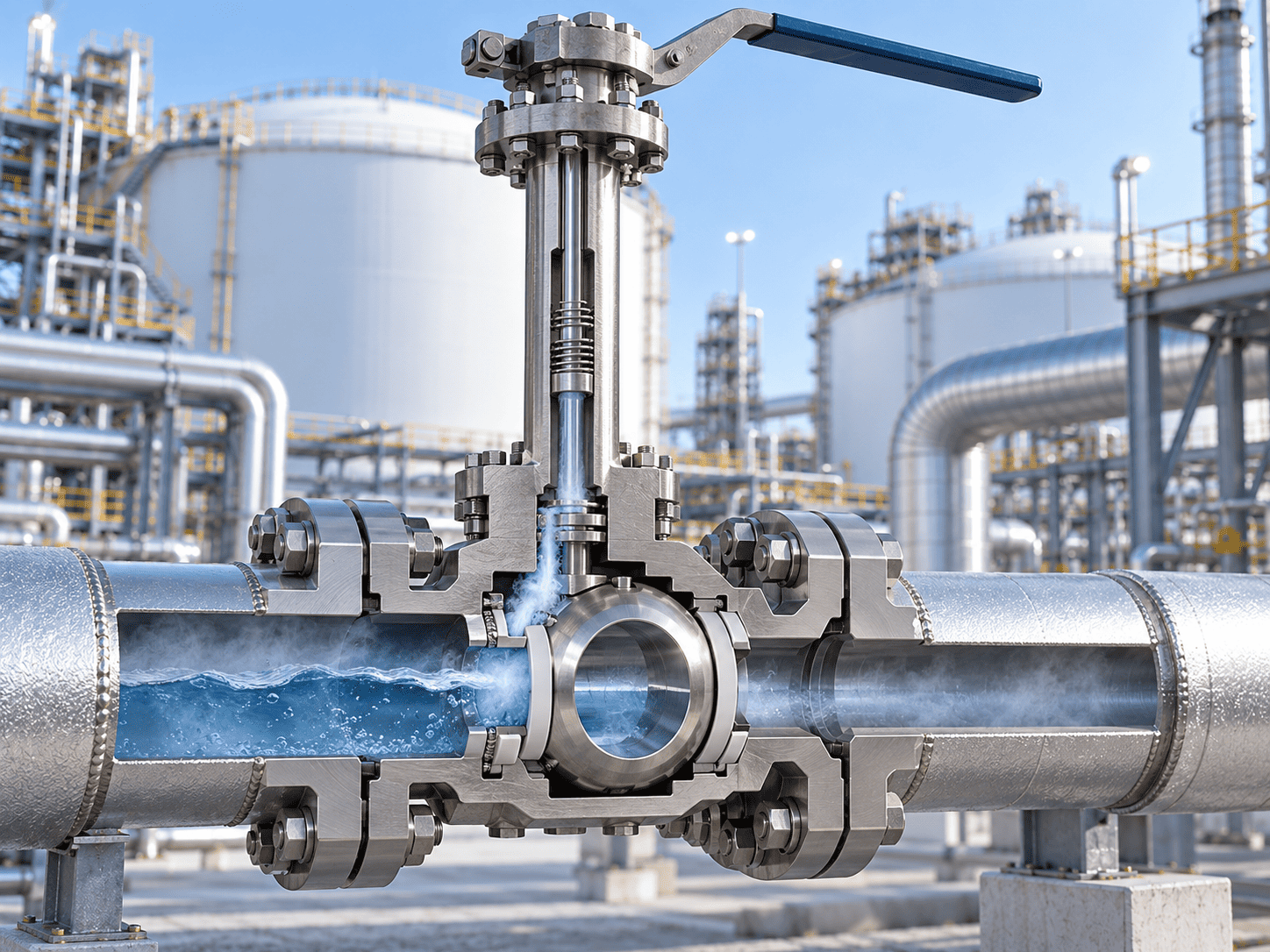
If the cavity relief arrangement is directional, the valve should clearly identify the upstream side or pressure-relief direction on the valve body, GA drawing and installation documentation.
7. Cryogenic Floating Ball Valve vs Cryogenic Trunnion Ball Valve
Both floating and trunnion-mounted constructions can be used in low-temperature service when properly engineered.
For larger LNG pipeline applications, a
cryogenic trunnion ball valve
is often evaluated because the supported-ball structure helps manage seat loads and operating torque at larger sizes and higher differential pressures.
Smaller-size LNG applications may use floating-ball designs depending on the pressure class, seat construction and project specification.
| Selection Factor | Floating Ball | Trunnion Ball |
|---|---|---|
| Ball support | Ball movement contributes to downstream seat sealing. | Ball is mechanically supported by stem and trunnion. |
| Typical application | Often considered for smaller sizes and suitable pressure ranges. | Frequently considered for larger LNG pipeline valves. |
| Operating torque | Can increase with size and differential pressure. | Supported ball helps manage loads in larger valves. |
| Cavity arrangement | Requires review for liquid trapping. | Requires detailed review of seat direction and cavity relief. |
A trunnion-mounted structure alone does not establish cryogenic suitability. Extended bonnet design, seat materials, cavity relief, stem sealing, minimum temperature and testing still need to be confirmed.
8. Cryogenic Ball Valve Testing for LNG Projects
An LNG valve can pass ambient hydrostatic and pneumatic tests yet still show unacceptable leakage after cooling.
Cryogenic testing is therefore commonly specified for critical LNG valves.
Buyers searching for
cryogenic ball valve testing
should define the complete test procedure rather than simply writing “cryogenic test required” on the RFQ.
A Cryogenic Test May Verify
- Seat leakage at low temperature.
- Stem and body-joint external leakage.
- Valve operating capability after cooling.
- Opening and closing torque where specified.
- Pressure performance under cryogenic conditions.
- Valve condition after thermal cycling where required.
The test standard, temperature, test pressure, cooling method, stabilization period, leakage acceptance criteria and witness requirements should be agreed before manufacturing.
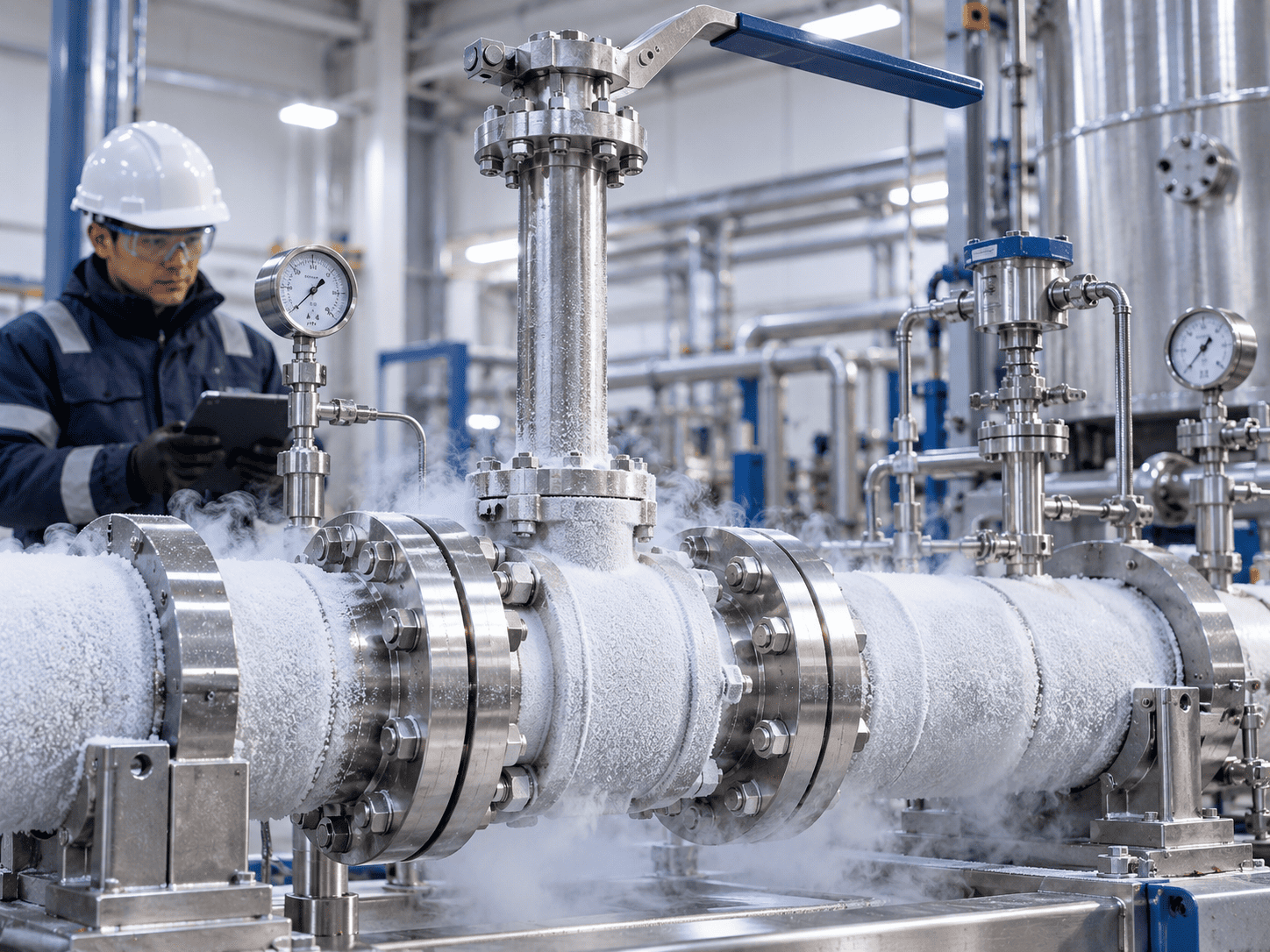
For an LNG valve RFQ, define the test temperature, test pressure, leakage criteria, test duration, witness requirement and report format before the supplier prepares the final quotation.
9. API 6D, API 608, ISO 28921 and ASME B16.34
LNG project specifications often list several standards, but these standards do not perform the same function.
| Standard | Application | Procurement Note |
|---|---|---|
| ISO 28921 | Low-temperature isolation valve requirements and testing. | Confirm the project-required edition and test scope. |
| API 608 | Metal ball valve product requirements. | May be combined with cryogenic project requirements. |
| API 6D | Pipeline valve requirements. | Frequently specified for LNG pipeline ball valves and trunnion designs. |
| ASME B16.34 | Valve pressure-temperature ratings and construction requirements. | Confirm body material, class and design temperature. |
When purchasing an API 6D cryogenic ball valve, buyers should still specify the cryogenic design requirement separately. API 6D compliance alone does not replace the need to define the required minimum temperature, extended bonnet, seat design and low-temperature test scope.
10. LNG Valve Leakage Requirements Must Be Specific
The phrase “zero leakage” is commonly used in LNG valve procurement but is not precise enough for engineering acceptance.
A technically complete specification should state:
- Seat leakage or external leakage requirement.
- Applicable test standard.
- Test medium.
- Test pressure.
- Test temperature.
- Maximum permissible leakage rate.
- Unidirectional or bidirectional test requirement.
These details are especially important for trunnion-mounted LNG ball valves because seat direction, DBB configuration and cavity relief philosophy can affect the test arrangement.
11. Stem Packing and Fugitive Emission Requirements
The extended bonnet moves the stem packing away from the coldest process zone, but it does not eliminate the need for an engineered packing system.
Packing material, compression, stem finish and thermal cycling should all be considered.
If the LNG terminal or EPC specification includes fugitive-emission testing, the required qualification standard should be listed separately from the cryogenic test requirement.
12. Cryogenic Qualification and Fire-Safe Qualification Are Different
A cryogenic test and a fire-safe test evaluate different operating conditions.
A valve that has passed a low-temperature test is not automatically fire-safe, and a fire-tested valve is not automatically suitable for LNG temperature.
If the LNG project requires both, the purchase specification should identify the applicable fire-safe and cryogenic test standards separately.
13. LNG Ball Valve Procurement Documents
For LNG valve procurement, documentation should be defined before production starts.
This is particularly important when sourcing from a cryogenic ball valve manufacturer for EPC, terminal, liquefaction, storage or transfer-line projects.
| Document | Purpose | Recommended Timing |
|---|---|---|
| Valve Datasheet | Defines size, pressure, temperature, materials, seat and operation. | Before quotation. |
| GA Drawing | Confirms F-F, connection dimensions, bonnet extension and operator orientation. | Approve before production. |
| MTC / EN 10204 3.1 | Provides material traceability. | Define in purchase order. |
| Impact-Test Report | Supports verification of low-temperature toughness where required. | Confirm before manufacturing. |
| PMI Report | Verifies alloy composition of specified components. | Define inspection percentage in ITP. |
| Cryogenic Test Procedure | Defines temperature, pressure and leakage acceptance. | Approve before testing. |
| Cryogenic Test Report | Records completed low-temperature test results. | Before shipment. |
| ITP / QCP | Defines hold points, witness points and inspection stages. | Approve before production. |
| NDE Reports | Documents RT, UT, MT or PT where specified. | According to project ITP. |
| Pressure / Leakage Test Report | Records shell and seat-test results. | Before shipment. |
14. Cryogenic Ball Valve RFQ Checklist
For buyers requesting a
cryogenic ball valve quotation,
the following information should be provided to the manufacturer:
- Medium: LNG, natural gas, nitrogen or other cryogenic fluid.
- Minimum design temperature.
- Operating and design pressure.
- Valve size: DN or NPS.
- Pressure class: Class 150, 300, 600, 900 or project-specific.
- Construction: floating or trunnion-mounted ball.
- Port: full bore or reduced bore.
- Body material.
- Seat material: PCTFE, PTFE, RPTFE, PEEK or metal seat.
- End connection: flanged, BW, SW or project-specific.
- Bonnet extension or insulation thickness.
- Cavity pressure relief requirement.
- Operation: lever, gearbox, pneumatic or electric actuator.
- Cryogenic testing requirement.
- Documentation requirement: MTC, PMI, NDE, GA, ITP and test reports.
Send the valve datasheet, piping specification and cryogenic test requirement together with the RFQ. This allows the cryogenic ball valve supplier to evaluate the correct seat design, bonnet extension, material scope, cavity relief arrangement and testing cost before quotation.
15. Quick LNG Ball Valve Selection Matrix
| Project Requirement | Selection Check | Why It Matters |
|---|---|---|
| LNG service near cryogenic temperature | Material toughness and minimum design temperature. | Reduces brittle-fracture risk. |
| Insulated pipeline | Extended bonnet height. | Keeps packing and operator accessible. |
| Tight shut-off | PCTFE or other cryogenic seat design and cold leakage test. | Ambient sealing does not prove cryogenic sealing. |
| Large LNG pipeline | Cryogenic trunnion ball valve construction. | Helps manage loads and operating torque. |
| Possible trapped LNG | Cavity pressure-relief arrangement. | Thermal expansion can create excessive cavity pressure. |
| Automated operation | Cold-condition torque and actuator sizing. | Torque may change under cryogenic conditions. |
| EPC procurement | Datasheet, GA, ITP, cryogenic test procedure and MTC. | Prevents technical and documentation gaps. |
16. Cryogenic Ball Valve Supplier for LNG Projects
Vcore Valve supplies project-based cryogenic ball valve configurations for LNG terminals, LNG transfer pipelines, liquefaction systems, industrial gas plants and other low-temperature services.
For buyers searching for a
cryogenic ball valve supplier
or
cryogenic ball valve manufacturer,
the valve configuration can be reviewed according to the project datasheet rather than selecting only from a standard catalog model.
Available project configurations can include:
- Floating cryogenic ball valves.
- Cryogenic trunnion ball valves.
- Extended bonnet cryogenic ball valves.
- Full-bore or reduced-bore designs.
- PCTFE, PTFE, RPTFE, PEEK or project-specified seat systems.
- Flanged or butt-weld connections.
- Gear-operated, pneumatic or electric actuated valves.
- Project-specific cryogenic testing and documentation.
Cryogenic Ball Valve for LNG and Low Temperature Service
Designed for LNG and low-temperature pipeline isolation where body material, extended bonnet design, seat system, cavity pressure relief and cryogenic testing must be reviewed as one complete valve specification.
For LNG ball valve procurement, please provide:
medium, minimum design temperature, size, pressure class, body material, seat requirement, connection standard, insulation thickness, operation method and test requirement.
For low-temperature applications requiring globe-valve flow-control characteristics rather than quarter-turn ball-valve isolation, see the
Cryogenic Globe Valve for LNG and Low Temperature Service.
17. Final LNG Ball Valve Procurement Considerations
A
cryogenic ball valve for LNG
should be selected as an integrated low-temperature valve system.
The body material must retain suitable low-temperature properties, the extended bonnet must position the packing appropriately above the cold zone and insulation, and the seat system must maintain acceptable sealing while accommodating thermal contraction.
The valve cavity must also have an appropriate pressure-relief arrangement wherever trapped cryogenic liquid can occur.
For LNG valve procurement and EPC projects, the cryogenic test procedure, inspection requirements and documentation should be confirmed before manufacturing begins.
A technically complete LNG ball valve RFQ should therefore include the valve datasheet, minimum design temperature, pressure class, body and trim materials, seat requirement, bonnet extension, cavity relief philosophy, operating method and cryogenic test specification.
This provides a much stronger technical basis for comparing a
cryogenic ball valve quotation
than simply asking suppliers for the price of an “SS316 LNG ball valve.”
Frequently Asked Questions
1. What is a cryogenic ball valve for LNG?
It is a ball valve designed and qualified for low-temperature LNG service, with suitable body and trim materials, cryogenic seats, extended stem or bonnet construction, cavity pressure-relief provisions and project-specified low-temperature testing.
2. Why does an LNG ball valve need an extended bonnet?
The extended bonnet moves the stem packing and operating mechanism farther from the cryogenic process zone and also provides clearance above pipeline insulation.
3. Is PCTFE suitable for cryogenic ball valve seats?
PCTFE is frequently considered for cryogenic ball valve seats because of its dimensional stability at low temperature. However, actual suitability depends on valve design, pressure, minimum temperature and leakage requirements.
4. Why is cavity pressure relief required in LNG ball valves?
LNG can become trapped inside a closed valve cavity. If the trapped liquid warms and expands, cavity pressure can increase significantly, so the valve design may require a defined pressure-relief path.
5. Is a cryogenic trunnion ball valve better for large LNG pipelines?
Trunnion-mounted construction is commonly considered for larger sizes and higher-pressure LNG pipeline applications because the ball is mechanically supported. However, cryogenic suitability still depends on seats, materials, bonnet design, cavity relief and testing.
6. What information is required for an LNG ball valve RFQ?
Buyers should provide the medium, minimum design temperature, valve size, pressure class, body material, seat requirement, connection type, bonnet extension, cavity relief requirement, operation method and cryogenic testing specification.
7. How do I request a cryogenic ball valve quotation?
Send the project valve datasheet or specify the LNG service conditions, minimum design temperature, size, pressure class, seat material, end connection, operation method and testing requirements so the manufacturer can prepare a technically matched quotation.
8. What documents should a cryogenic ball valve supplier provide?
Depending on project requirements, documentation may include the GA drawing, valve datasheet, MTC, impact-test records, PMI report, ITP, NDE reports, pressure-test reports, cryogenic test procedure and final cryogenic test report.
Looking for a Cryogenic Ball Valve Supplier for an LNG Project?
Vcore Valve supports LNG ball valve procurement for terminals, transfer pipelines, industrial gas systems and other low-temperature projects.
If you need a cryogenic ball valve quotation, send us your RFQ, valve datasheet or project specification.
Please include the LNG medium, minimum design temperature, size, pressure class, body material, seat requirement, connection standard, insulation thickness, operation method and cryogenic testing requirements.
Our team can review the required cryogenic ball valve configuration and prepare the corresponding technical proposal, GA drawing and inspection requirements before production.