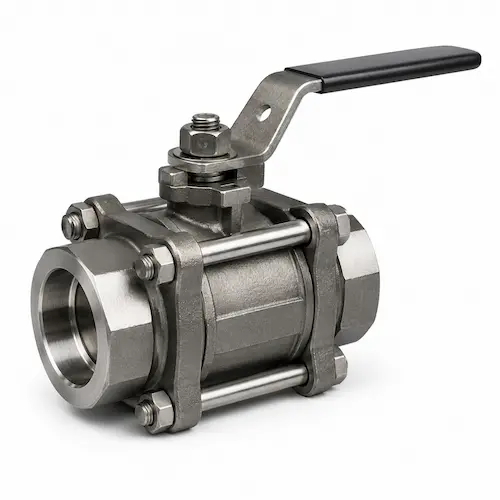
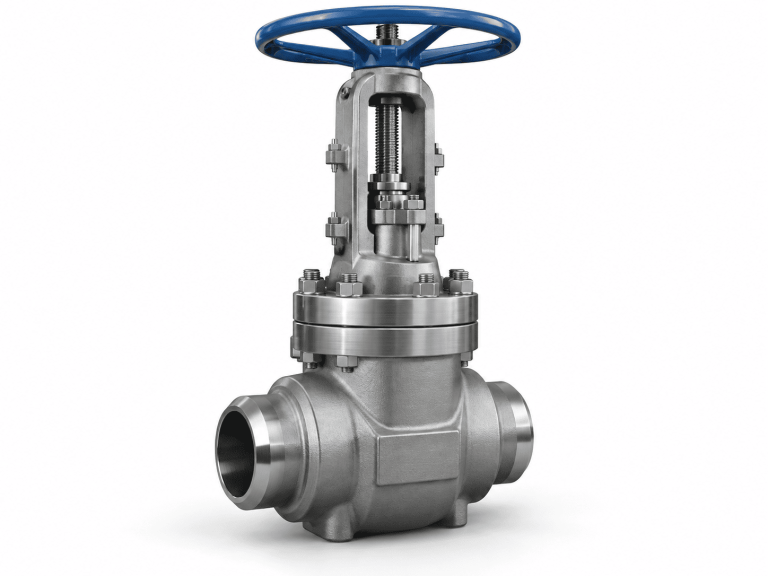
This connection removes the need for threaded joints or flange bolts and is commonly considered for high-pressure oil, gas, steam, chemical, power and industrial utility systems. Socket weld ball valves are normally used for fully open or fully closed service rather than continuous throttling. For other ball valve structures, visit our ball valve category.
Product Overview
| Product Name | Socket Weld Ball Valve |
|---|---|
| Valve Type | Quarter-turn welded-end ball valve |
| Connection | Socket weld ends |
| Body Construction | Two-piece, three-piece or forged compact body |
| Ball Design | Floating ball; special supported designs available according to size and pressure |
| Body Material | Forged carbon steel, stainless steel, low-temperature steel, alloy steel or duplex stainless steel |
| Seat Material | PTFE, RPTFE, PCTFE, PPL, PEEK or metal seat |
| Port Type | Full port or reduced port |
| Operation | Lever, gearbox, pneumatic actuator or electric actuator |
| Typical Applications | Oil, gas, steam, chemical service, power plants, high-pressure utilities, drain and vent lines |
What Is a Socket Weld Ball Valve?
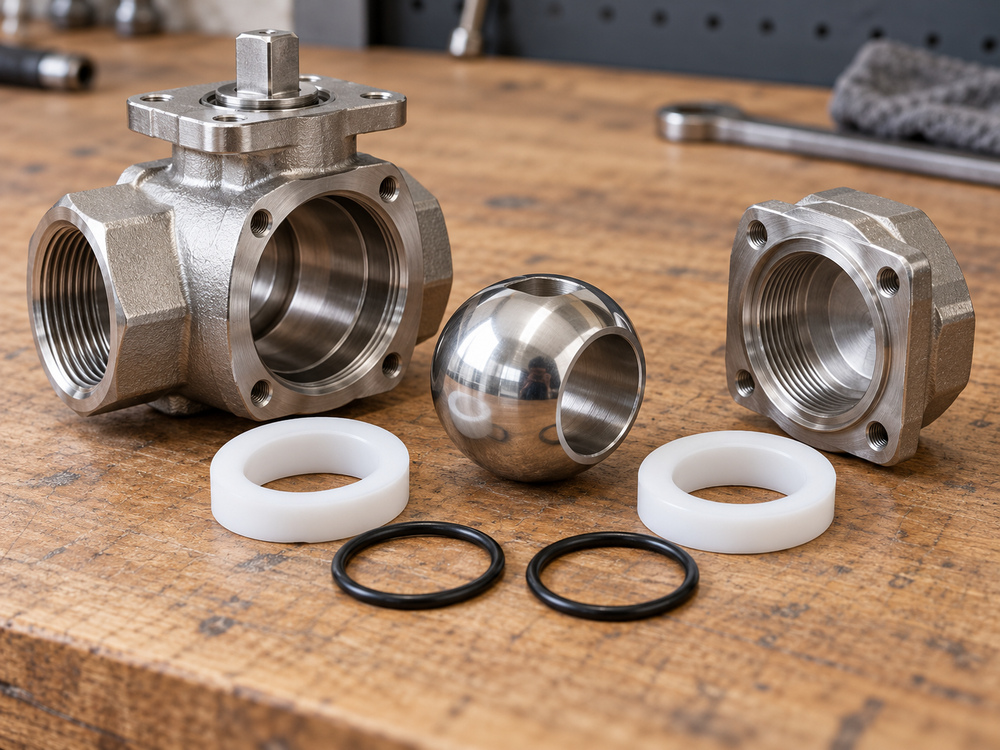
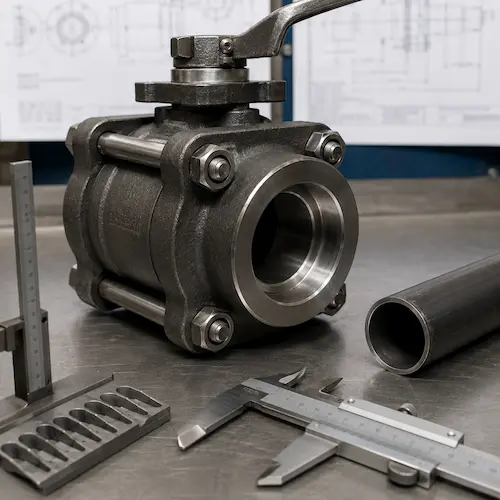
A socket weld ball valve has recessed sockets machined into both valve ends. During installation, the pipe is inserted into each socket and joined by an external fillet weld. The result is a compact permanent connection without external flange joints or tapered pipe threads.
The valve controls flow through a drilled ball positioned between two seats. When the bore is aligned with the pipeline, the valve is open. Rotating the stem and ball by 90 degrees places the solid side of the ball across the flow path and closes the valve.
Socket weld construction is mainly associated with small-bore process piping. If the application requires a removable screwed connection, compare our Threaded Ball Valve. For larger pipelines requiring bolted joints, see our Flanged Ball Valve.
 How the Socket Weld Connection Works
 How the Socket Weld Connection Works
The pipe end enters the valve socket before welding. The external fillet weld joins the pipe to the socket wall and creates a strong pressure-containing connection. Pipe outside diameter, socket dimensions, material grade, welding procedure and required assembly clearance must match the approved piping specification.
The pipe should not be forced into the socket without considering the required welding clearance. Installation must follow the applicable welding procedure specification, project standard and piping code. Incorrect fit-up can introduce local stress, poor weld geometry or installation misalignment.
Heat from welding can also affect soft seats and elastomer seals. On serviceable three-piece designs, the center body can often be removed before welding the end caps into the pipeline. On other designs, welding sequence, heat input and cooling should follow the manufacturer’s instructions.
Main Connection Features
- Compact welded joint for small-bore process piping.
- No threaded leakage path at the pipe-to-valve connection.
- No flange bolts or external gasket required at the welded ends.
- Strong pipeline attachment for pressure, vibration and process service.
- Permanent installation that requires cutting or weld work for complete removal unless a serviceable body design is used.
Body Construction Options
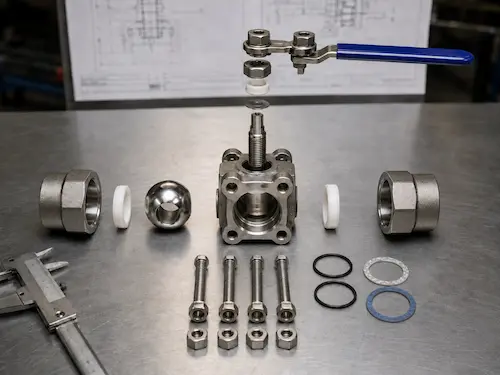
Socket weld ball valves can be supplied in two-piece, three-piece and compact forged constructions. The body design affects maintenance access, pressure capability, installation method and overall dimensions.
| Body Design | Main Feature | Typical Use |
|---|---|---|
| Two-Piece Socket Weld Ball Valve | Compact body with one main section and one body connector | General industrial shutoff where compact dimensions are important. |
| Three-Piece Socket Weld Ball Valve | Two welded end caps and a removable center body | Systems requiring easier seat, seal or ball maintenance. |
| Forged Compact Ball Valve | High-strength forged body with reduced external dimensions | High-pressure drain, vent, utility and process lines. |
| Full-Port Design | Ball bore is close to the connected pipe bore | Lower pressure drop, higher flow capacity and cleaning access. |
| Reduced-Port Design | Ball bore is smaller than the connected pipe bore | Compact and economical shutoff where some pressure drop is acceptable. |
For a serviceable center-body construction, compare our 3-Piece Ball Valve. For forged welded-end construction, see our 3-Piece Forged Welded Ball Valve.
Material Options
The body, ball, stem, seat and packing must be selected as one material system. Pressure rating alone is not enough. The medium, temperature, corrosion risk, welding procedure, startup conditions and required shutoff performance must also be considered.
| Part | Common Materials | Selection Guide |
|---|---|---|
| Body | ASTM A105, A350 LF2, A182 F304/F316, F51/F53, F11/F22 or project-specified material | Select according to pressure, temperature, corrosion, low-temperature and welding requirements. |
| Ball | Stainless steel 304/316, duplex stainless steel, coated alloy or project-specified material | The ball surface should match corrosion, hardness and sealing requirements. |
| Stem | Stainless steel, duplex steel, alloy steel or project-specified material | Stem material should match operating torque, corrosion and cycle frequency. |
| Seat | PTFE, RPTFE, PCTFE, PPL, PEEK or metal seat | Select according to pressure, temperature, chemical compatibility and shutoff requirement. |
| Packing | PTFE, graphite, flexible graphite or low-emission packing system | Consider temperature, fugitive-emission requirements and stem cycling. |
| Body Bolting | Stainless steel, alloy steel or project-specified bolting | Bolting must match body design, pressure class, temperature and corrosion conditions. |
Technical Specifications
| Specification Item | Typical / Available Options |
|---|---|
| Product Type | Socket weld ball valve |
| Valve Function | Fast on-off shutoff and pipeline isolation |
| Common Size Range | DN8–DN100 / 1/4″–4″; larger sizes depend on design and project specification |
| Pressure Rating | Class 150, 300, 600, 800, 1500, 2500 or project-specified rating depending on valve design |
| Body Construction | Two-piece, three-piece, compact forged or project-specific design |
| Connection Type | Socket weld ends |
| Socket Weld Reference | ASME B16.11 or project piping specification where applicable |
| Design Reference | API 608, ASME B16.34, ISO 17292 or agreed project specification |
| Testing Reference | API 598, EN 12266 or agreed inspection and testing specification |
| Body Material | Forged carbon steel, stainless steel, low-temperature steel, alloy steel or duplex steel |
| Seat Material | PTFE, RPTFE, PCTFE, PPL, PEEK, metal seat or project-selected material |
| Port Design | Full port or reduced port |
| Operation | Lever, gearbox, pneumatic actuator or electric actuator |
| Suitable Media | Oil, natural gas, process gas, steam, condensate, chemical media, compressed air and industrial utilities |
| Special Options | Fire-safe design, anti-static device, locking handle, extended stem, low-emission packing and actuator mounting |
| Documentation | Pressure test report, material certificate, dimensional report, welding-end details, operation manual and packing photos |
 Applications in High-Pressure and Small-Bore Pipelines
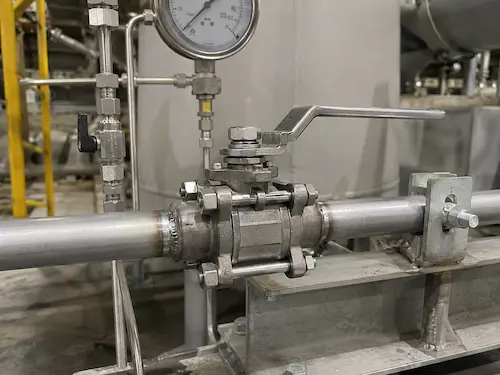 Applications in High-Pressure and Small-Bore Pipelines
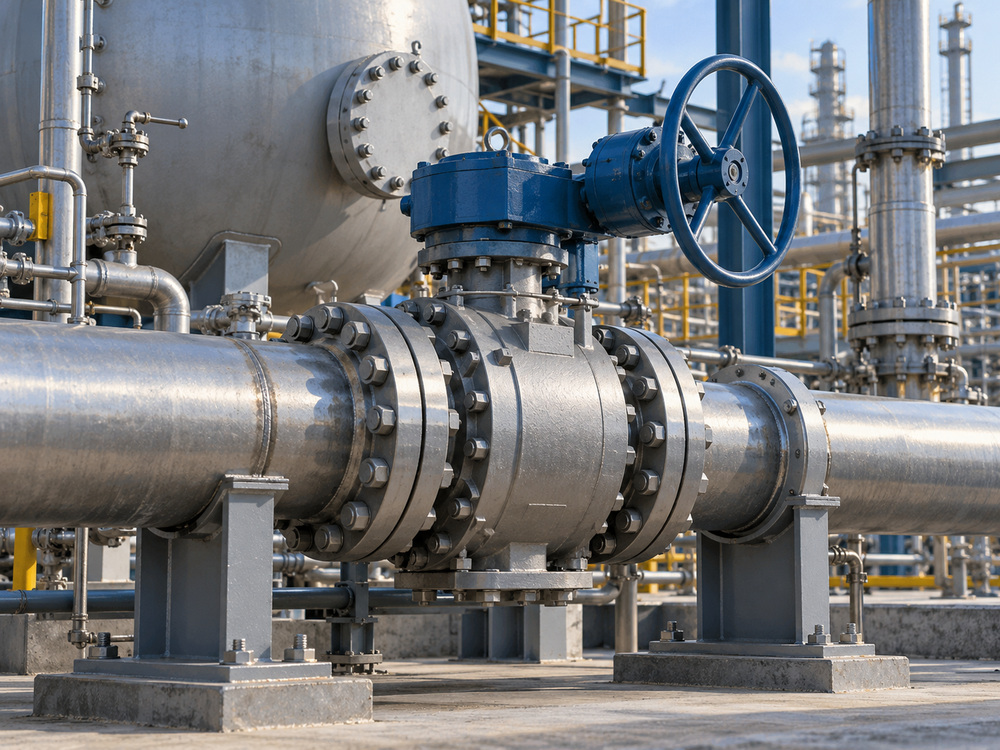
Socket weld ball valves are mainly used in small-bore process systems where a compact welded connection is preferred. They are often installed on branch lines, equipment connections, drains, vents, bypass lines and utility circuits.
For gas-related valve selection, see our guide to ball valves for gas service. For chemical applications, review our guide to industrial valves for chemical processing.
- Oil and natural gas process lines
- High-pressure plant utility systems
- Steam and condensate lines with suitable seats and packing
- Chemical injection and transfer lines
- Power plant auxiliary piping
- Instrument isolation lines
- Equipment drains and vents
- Compressor and pump auxiliary piping
- Thermal oil and compatible high-temperature service
- Hydrogen or special gas service with project-approved materials and testing
Seat Selection by Service Condition
The seat determines the practical pressure, temperature, leakage and cycling limits of the valve. A forged body does not automatically make the valve suitable for every high-pressure or high-temperature application. Seat, packing, body material and pressure-temperature rating must be reviewed together.
| Seat Material | Typical Strength | Important Limitation |
|---|---|---|
| PTFE | Low friction and broad compatibility for many general fluids | Temperature, pressure and creep limits must be checked. |
| RPTFE | Improved mechanical strength compared with standard PTFE | Chemical compatibility depends on filler and process medium. |
| PCTFE | Good dimensional stability and useful low-temperature properties | Final suitability depends on pressure, temperature and media. |
| PPL | Higher-temperature capability than standard PTFE in suitable service | Confirm chemical compatibility and actual temperature rating. |
| PEEK | High mechanical strength for demanding pressure and temperature conditions | Higher cost and media compatibility still require review. |
| Metal Seat | Suitable for selected high-temperature or abrasive applications | Leakage class, operating torque and surface coating must be specified. |
Socket Weld vs Threaded, Butt Weld and Flanged Ball Valves
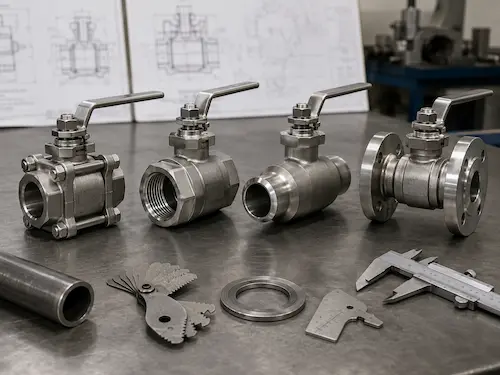
Connection type should be selected according to pipe size, pressure, leakage risk, maintenance method and installation practice. Socket weld connections are compact, but they are not the best choice for every pipeline.
| Connection Type | Main Advantage | Main Limitation | Typical Use |
|---|---|---|---|
| Socket Weld Ball Valve | Compact and strong welded joint for small-bore piping | Removal requires welding work or serviceable body construction | High-pressure small-bore process and utility lines |
| Threaded Ball Valve | Easy installation without welding | Threaded joints require correct sealing and may not suit all critical services | Water, air, oil, gas and general utility piping |
| Butt Weld Ball Valve | Continuous welded flow path and strong pipeline integrity | More demanding end preparation and welding procedure | Permanent process piping, pipelines and larger welded systems |
| Flanged Ball Valve | Easy valve removal and maintenance access | Larger, heavier and requires flange bolting and gaskets | Medium and large industrial process pipelines |
Welding and Installation Notes
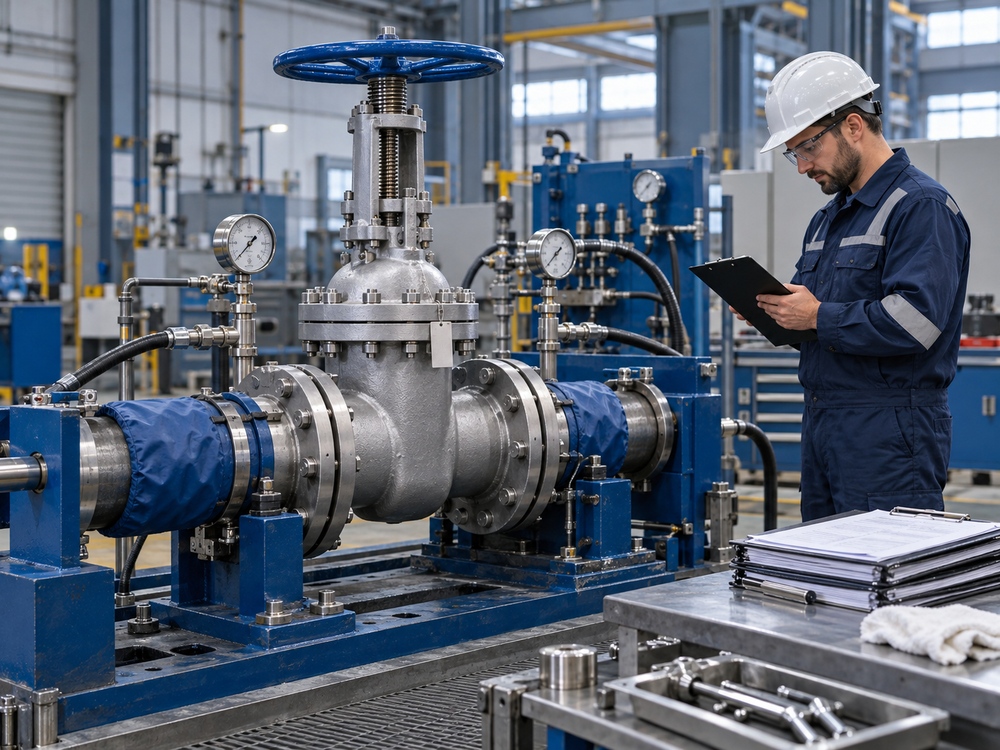
Socket weld valve installation should be completed by qualified personnel using an approved welding procedure. The valve material and pipe material must be weld-compatible, and the socket dimensions must match the pipe size and project specification.
- Confirm valve flow bore, pipe size and socket dimensions before welding.
- Follow the required pipe insertion clearance and approved fit-up procedure.
- Clean oil, rust, scale and contamination from the socket and pipe end.
- Keep the valve correctly aligned with the pipeline before tack welding.
- Control welding heat to protect seats, packing and body seals.
- Remove the serviceable center body before welding when instructed by the manufacturer.
- Do not use the valve handle or actuator to support pipeline weight.
- Inspect the finished weld according to the applicable project procedure.
- Flush the pipeline before operating the valve.
- Do not use a standard soft-seated ball valve for continuous throttling.
Manual and Actuated Operation
Small socket weld ball valves are commonly operated by lever. Lockable handles can be supplied where unauthorized operation must be prevented. Pneumatic or electric actuators are available for remote or automated shutoff.
| Operation Type | Typical Application | Selection Note |
|---|---|---|
| Lever Handle | Local manual isolation | Simple and suitable for small valves with accessible installation. |
| Lockable Handle | Maintenance isolation and controlled access | Useful for lockout procedures and operating safety. |
| Pneumatic Actuator | Fast automated shutoff | Confirm air pressure, fail position, accessories and required torque. |
| Electric Actuator | Remote operation where compressed air is unavailable | Confirm voltage, control signal, duty cycle and enclosure rating. |
Inspection, Testing and Packing
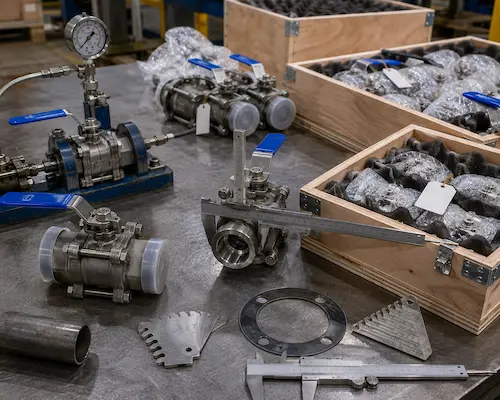
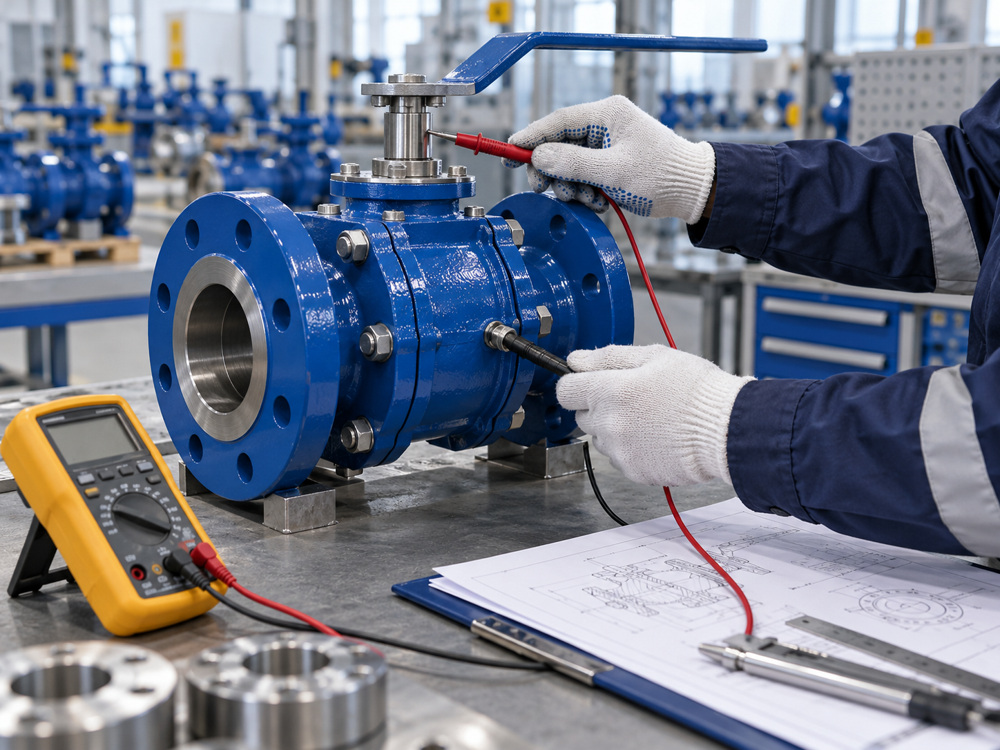
Inspection should cover body material, socket dimensions, ball surface, seat condition, stem sealing, operating torque and pressure test results. Socket ends must remain clean and protected against impact, corrosion and contamination before installation.
| Inspection Item | Purpose |
|---|---|
| Material verification | Confirm body, ball, stem, seats, packing and bolting against the order specification. |
| Socket dimension inspection | Check socket diameter, depth, alignment and end preparation. |
| Visual and surface inspection | Check forging surface, machining, ball finish, stem and valve assembly. |
| Operation test | Confirm smooth 90-degree movement and correct open/closed indication. |
| Shell pressure test | Verify pressure-containing body integrity according to the agreed standard. |
| Seat leakage test | Confirm shutoff performance in the specified flow direction and test condition. |
| Actuator test | Check opening, closing, torque margin and position feedback when actuated. |
| Packing inspection | Protect socket ends, ball bore, handle, actuator and accessories during transport. |
Export packing can include plastic socket protectors, anti-rust protection, moisture-resistant wrapping, foam separation, cartons, plywood cases and palletized loading. Stainless steel sealing and welding surfaces should be protected from carbon steel contamination and scratches.
Information to Confirm Before Ordering
- Valve size and quantity
- Pressure class and design pressure
- Working and design temperature
- Pipeline medium, concentration and phase
- Pipe material, schedule and outside diameter
- Socket weld dimensional standard
- Two-piece, three-piece or compact forged body
- Full-port or reduced-port design
- Body, ball, stem, seat, packing and bolting materials
- Manual, pneumatic or electric operation
- Fire-safe, anti-static, low-emission, NACE or special testing requirements
- Material certificates, NDE, pressure testing and inspection documents
- Welding procedure or installation restrictions
- Packing method and delivery schedule
FAQ
1. What is a socket weld ball valve used for?
A socket weld ball valve is used for fast on-off isolation in small-bore industrial pipelines. Common applications include oil, gas, steam, chemical, power plant, drain, vent and high-pressure utility lines where a compact welded connection is required.
2. What is the difference between a socket weld and threaded ball valve?
A socket weld ball valve is welded permanently to the pipe, while a threaded ball valve is screwed onto matching pipe threads. Socket weld joints provide a compact welded connection, while threaded valves are easier to install and remove without welding.
3. Is a socket weld ball valve suitable for high pressure?
Socket weld ball valves are commonly available for demanding pressure service, especially with forged steel bodies. Final suitability depends on the valve design, body material, pressure-temperature rating, seat material, pipe specification and applicable project standard.
4. Should the valve be disassembled before welding?
On many three-piece designs, removing the center body before welding can protect soft seats and seals from heat. The correct procedure depends on the valve construction and manufacturer instructions. Welding should follow an approved procedure and project specification.
5. Can a socket weld ball valve be used for throttling?
A standard socket weld ball valve is mainly intended for fully open or fully closed service. Continuous operation in a partly open position can concentrate velocity on the ball and seats, increasing wear. A V-port ball valve or control valve is usually more suitable for accurate flow regulation.