Y Type Globe Valve Selection Guide: Rising Stem vs Non-Rising Stem, A105 Forged vs WCB Cast Body
A Y Type Globe Valve, also called a Y-pattern globe valve, is commonly considered for steam, thermal oil, refinery, power generation and other industrial services where a globe valve is required but pressure loss should be lower than with a conventional straight-pattern globe valve.
However, selecting or manufacturing a Y-pattern globe valve requires much more information than valve size and pressure class. Buyers may need to decide between a rising stem and a non-rising stem, choose between an ASTM A105 forged steel body and an ASTM A216 Grade WCB cast steel body, confirm whether standard dimensions can be used, and determine whether the valve is suitable for high-temperature service such as 425°C steam.
These decisions become particularly important when a valve is manufactured according to an existing drawing or sample. A difference of only a few millimeters in face-to-face length, flange dimensions, stem height or connection geometry can make a replacement valve impossible to install without modifying the pipeline.
This guide explains the main engineering and procurement points that should be reviewed before ordering a standard or customized Y Type Globe Valve.
Quick Summary
- A Y Type Globe Valve uses an inclined stem and seat arrangement to create a more streamlined flow path than a conventional globe valve.
- Industrial Y-pattern globe valves commonly use rising-stem construction because it provides clear valve-position indication and keeps critical stem threads away from the process medium. Non-rising designs exist but should not be assumed without confirming the actual valve structure.
- ASTM A105 is a specification for forged carbon steel pressure components, while ASTM A216 Grade WCB is a cast carbon steel commonly used for valve pressure-containing bodies.
- Forging is often attractive for compact, high-pressure and small-bore valves. Casting provides greater freedom for complex and larger body shapes.
- A customized WCB casting can cost more than an A105 forged valve when a new casting pattern or mold is required for a small order. Casting is not inherently more expensive than forging in every application.
- For drawing-based customization, confirm face-to-face length, bore, end connection, flange dimensions, body geometry, stem travel, overall height, handwheel size, pressure-boundary dimensions and trim details before production.
- At approximately 425°C, A105 and WCB carbon steel are operating near an important high-temperature design boundary. Pressure-temperature derating, packing, gasket, trim, bolting and long-term material suitability must all be reviewed.
What Is a Y Type Globe Valve?
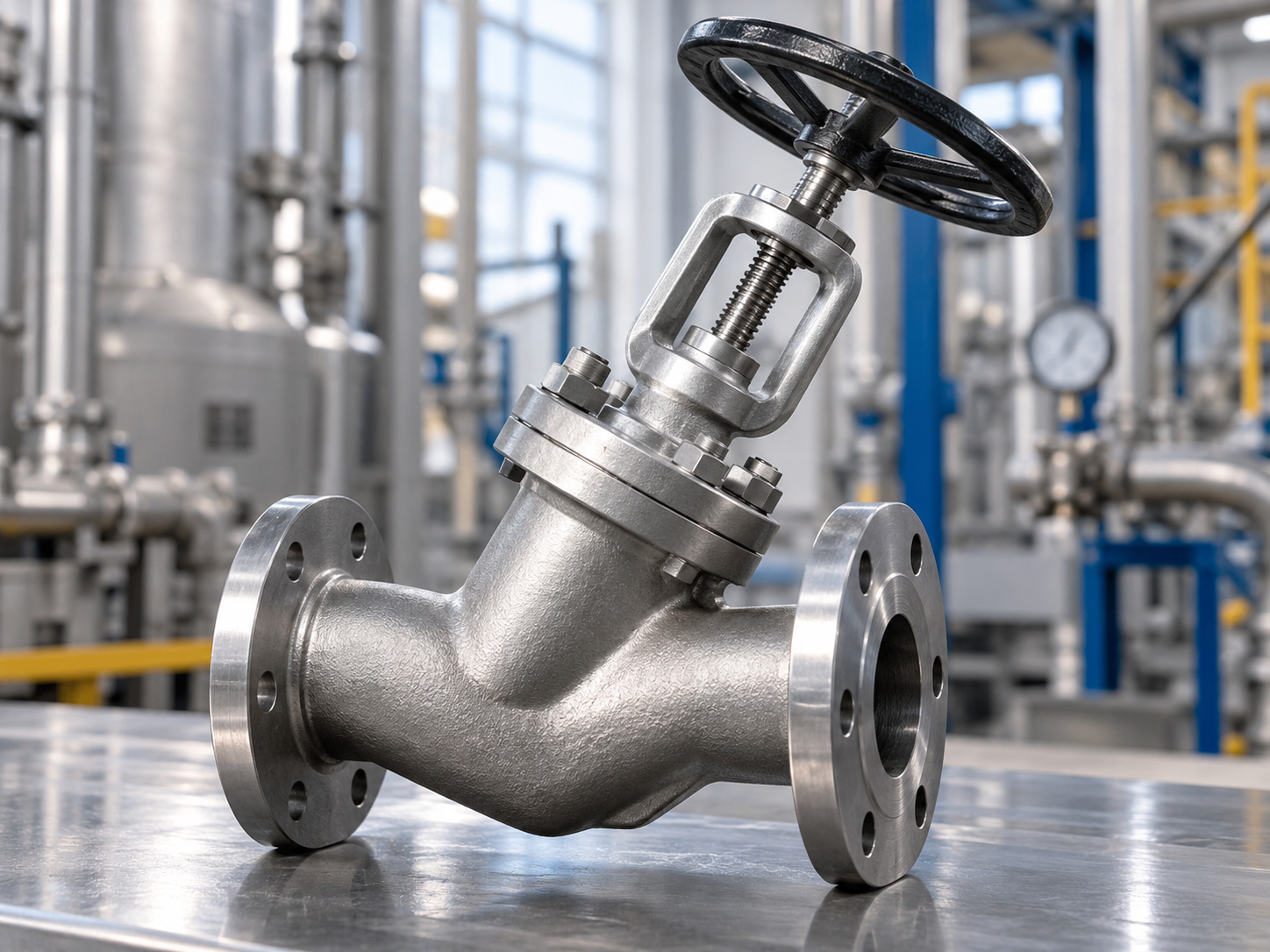
A Y Type Globe Valve is a variation of the conventional globe valve in which the stem, disc and seat are installed at an inclined angle to the main pipeline axis. The resulting flow passage is more direct than the tortuous flow path of a traditional T-pattern globe valve.
This configuration can reduce flow resistance and improve flow capacity while retaining the throttling and shut-off characteristics associated with globe-valve trim.
Typical applications include:
- High-temperature steam pipelines
- Boiler auxiliary systems
- Power generation plants
- Refinery process lines
- Thermal oil systems
- Petrochemical plants
- High-pressure utility lines
- Oil and gas process equipment
- Industrial process isolation and throttling
The Y-pattern body alone does not determine whether a valve is suitable for a particular pressure, temperature or fluid. The complete pressure boundary, body material, trim material, bonnet design, connection, wall thickness, packing and applicable pressure-temperature rating must be evaluated together.
For a broader explanation of Y-pattern geometry, flow characteristics and steam applications, see Vcore’s
Y-Pattern Globe Valve for Steam and High-Flow Applications.
Y Type Globe Valve: Rising Stem vs Non-Rising Stem
Stem construction is an important design point when a customer provides an existing valve drawing or requests a customized replacement.
The terms rising stem and non-rising stem describe how the stem behaves externally while the valve disc moves toward or away from the seat.
For industrial globe valves, especially Y-pattern valves used in steam and high-temperature applications, rising-stem construction is generally more common. A non-rising arrangement should therefore be treated as a project-specific design rather than assumed to be interchangeable with a standard rising-stem valve.
What Is a Rising Stem Globe Valve?
In a rising-stem design, opening the valve causes the stem to move axially upward. The external stem position therefore provides a visible indication of valve travel.
In many industrial configurations, the operating threads are positioned outside the pressure-containing process area. This makes the stem mechanism easier to inspect and helps separate critical thread surfaces from direct contact with the process medium.
Advantages of a Rising Stem
- Valve position is easier to identify visually.
- Stem movement can be inspected during operation.
- External stem threads are easier to lubricate and maintain.
- It is widely used for industrial steam and high-temperature globe valves.
- The design is familiar to operators and maintenance teams.
Points to Consider
- Additional vertical clearance is required.
- The open-valve height can be considerably greater than the closed-valve height.
- The exposed stem should be protected from mechanical damage and contamination.
What Is a Non-Rising Stem Globe Valve?
A non-rising stem arrangement limits or eliminates the external axial movement of the stem. Internal thread geometry converts stem rotation into movement of the closure element.
This arrangement can reduce the external space required for valve operation, but it is less common in heavy-duty industrial Y-pattern globe valves than a conventional rising-stem design.
Potential Advantages
- More compact external installation envelope.
- Useful where overhead clearance is restricted.
- Stem position remains relatively constant outside the valve.
Potential Limitations
- Open or closed position may not be obvious from external stem height.
- Internal operating threads may require greater attention to lubrication, media compatibility and wear.
- The design may not match an existing rising-stem valve even if nominal size and pressure class are identical.
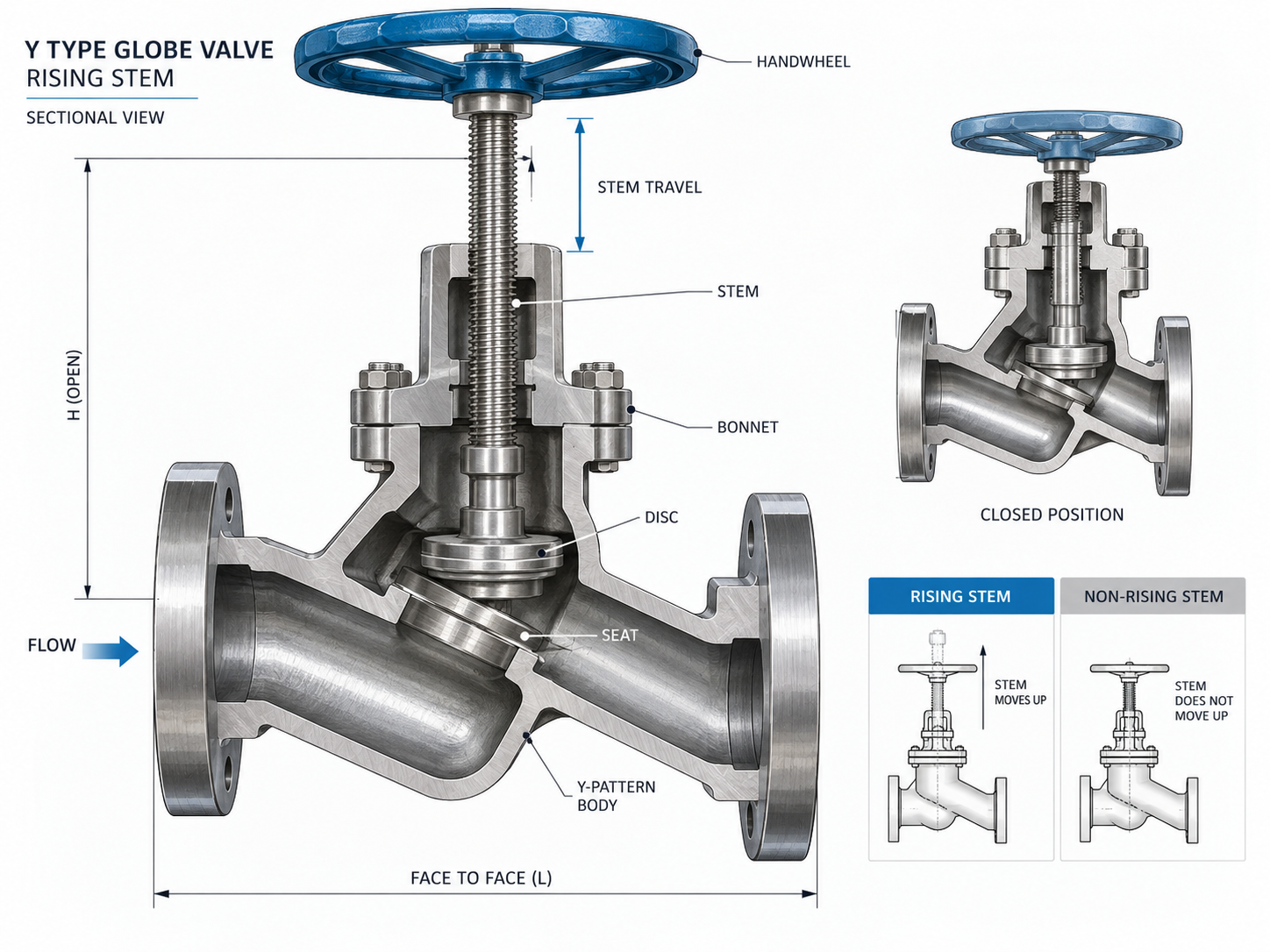
Rising Stem vs Non-Rising Stem Comparison
| Selection Point | Rising Stem | Non-Rising Stem |
|---|---|---|
| External Stem Movement | Stem moves upward when opening | Limited or no external axial travel |
| Position Indication | Easy to observe | May require another indicator |
| Installation Height | More clearance required | More compact |
| Thread Location | Often outside the process pressure area | Depends on internal mechanism |
| Maintenance Visibility | Higher | Lower |
| Typical Industrial Y-Pattern Use | Common | Less common / project-specific |
ASTM A105 Forged Steel vs ASTM A216 WCB Cast Steel
Body material is another common source of confusion in Y Type Globe Valve quotations.
Two quotations may describe both valves as “carbon steel”, while one supplier proposes ASTM A105 forged steel and another proposes ASTM A216 Grade WCB cast steel.
These are not simply two names for the same manufacturing route.
What Is ASTM A105?
ASTM A105/A105M covers forged carbon steel piping components used in pressure systems at ambient and elevated temperatures. Valve bodies, flanges, fittings and similar pressure-containing components can be produced from A105 material when the product design and applicable standard permit it.
The starting steel is heated and mechanically deformed during forging. The forged blank is then heat treated as required and machined into the required body or component geometry.
A simplified production route is:
Steel billet → heating → forging → heat treatment → machining → inspection → assembly → pressure testing.
What Is ASTM A216 Grade WCB?
ASTM A216/A216M Grade WCB is a cast carbon steel widely used for pressure-containing valve bodies, flanges, fittings and similar components intended for elevated-temperature service.
Instead of mechanically forming a solid billet into shape, molten steel is poured into a mold containing the required body cavity. After solidification, the casting is cleaned, heat treated as required, inspected and machined.
A simplified production route is:
Pattern and mold preparation → melting → pouring → solidification → shakeout and cleaning → heat treatment → inspection/NDT as required → machining → assembly → pressure testing.
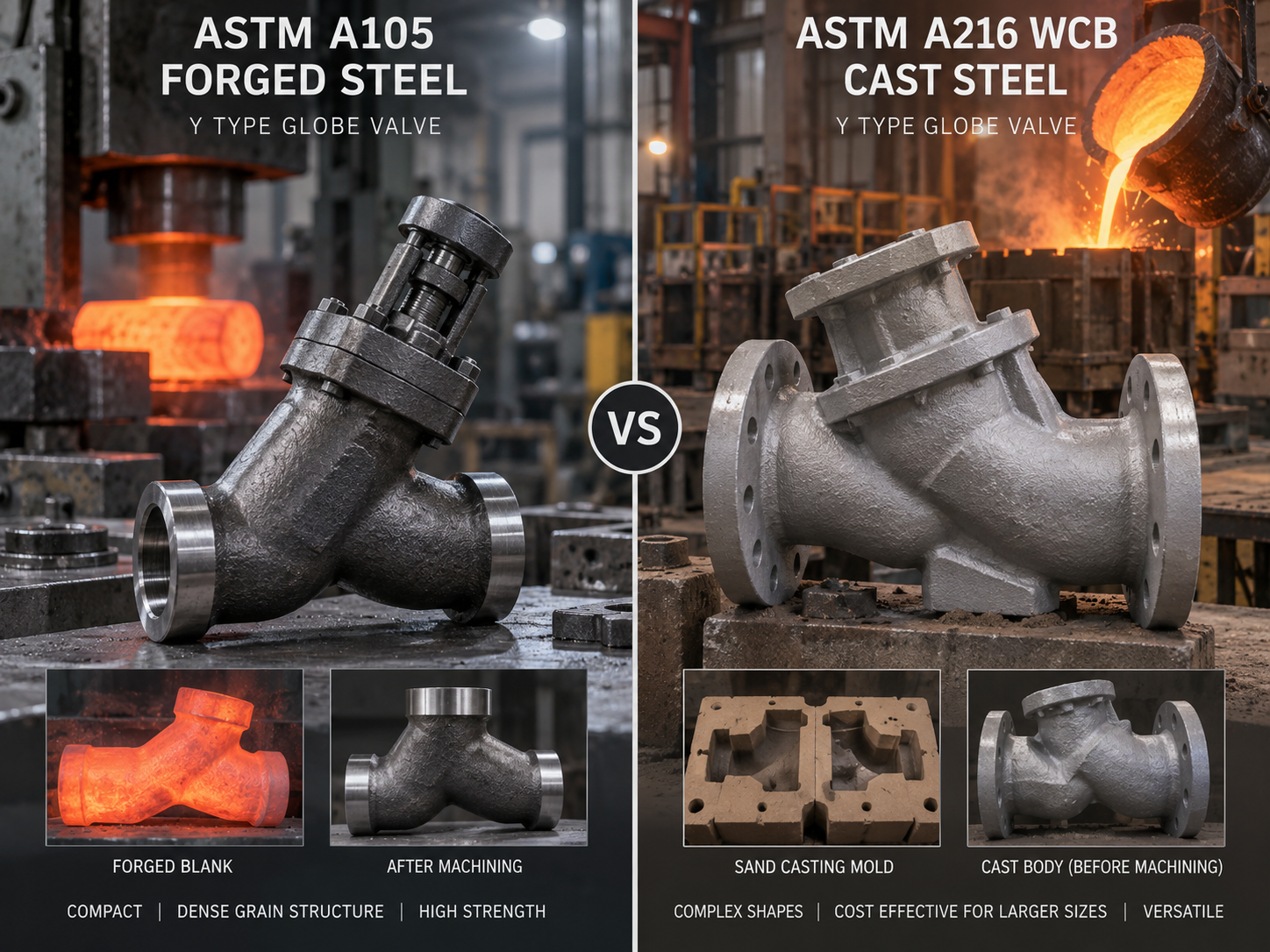
A105 vs WCB: Key Differences for Globe Valve Buyers
| Item | ASTM A105 | ASTM A216 WCB |
|---|---|---|
| Product Form | Forged carbon steel | Cast carbon steel |
| Manufacturing Process | Plastic deformation of heated steel | Molten steel poured into a mold |
| Body Geometry | Best for relatively compact geometries | Well suited to larger and more complex shapes |
| Typical Valve Size Trend | Common in small and medium forged valves | Common in medium and large cast valves |
| Internal Discontinuity Risk | Forging generally provides refined directional grain flow | Casting quality depends strongly on foundry control and inspection |
| Pattern / Mold | Usually no dedicated casting pattern required | Casting pattern and mold system required |
| Low-Quantity Custom Order | Can be economical when suitable standard forging stock exists | Pattern and setup cost can make small quantities expensive |
| Large Complex Valve Body | Machining and forging complexity may increase significantly | Casting often becomes more practical |
Is A105 Always Better Than WCB?
No.
Forged construction is often associated with high-integrity pressure components because the forging process can produce a dense and controlled material structure. However, this does not mean that a WCB cast valve is automatically an inferior product.
A properly designed, correctly heat-treated and adequately inspected ASTM A216 WCB valve body is widely used in industrial pressure systems.
The correct choice depends on:
- Valve size
- Pressure class
- Operating temperature
- Body geometry
- Production quantity
- Applicable valve design standard
- Required wall thickness
- Customer material specification
- Inspection and NDT requirements
- Existing tooling and manufacturing route
The material grade should therefore be selected as part of the complete valve design rather than because “forged is always better” or “cast is always cheaper.”
Why Can a Cast WCB Valve Be More Expensive Than a Forged A105 Valve?
This question frequently appears when a buyer receives a quotation for a customized valve.
A common assumption is:
Forging = expensive; casting = cheap.
That assumption is not reliable.
For standard high-volume production, casting can be very economical, particularly for large or complex valve bodies. But for a small customized order, a WCB cast body may cost considerably more than a standard forged A105 valve.
1. New Casting Tooling May Be Required
If the required valve body does not match an existing casting pattern, the manufacturer may need to produce new tooling.
This can include:
- Pattern development
- Core-box development
- Mold preparation
- Engineering review
- Trial casting
- Dimensional correction
If the customer orders only one, five or ten valves, the tooling cost must be distributed across a very small number of units.
2. Custom Body Geometry Creates Foundry Setup Cost
A special face-to-face dimension, unusual bonnet connection, special wall thickness or customer-specific Y-pattern body may require a casting configuration different from the manufacturer’s standard product.
This creates engineering and process setup costs even before machining begins.
3. Casting Requires Process Control After Pouring
A cast body does not leave the foundry ready for assembly.
Depending on the specification and quality plan, production may involve:
- Cleaning and fettling
- Heat treatment
- Visual examination
- Dimensional inspection
- Magnetic particle examination
- Liquid penetrant examination
- Radiographic or ultrasonic examination when specified
- Repair evaluation and controlled repair where permitted
- Machining of flange, seat, bonnet and packing surfaces
4. Standard Forgings May Already Be Available
For small-bore valves, a manufacturer may already have standard A105 forging dies, forged blanks or semi-finished bodies available.
In that case, the manufacturing route can be much simpler:
Existing forged blank → CNC machining → assembly → testing.
The absence of a new casting pattern can make the forged alternative less expensive for a small customized order.
5. Quantity Changes the Cost Comparison
The economics may reverse when order quantity increases.
Once casting tooling exists and its cost is distributed across hundreds or thousands of valves, casting can become highly economical.
When Should You Consider an A105 Forged Y Type Globe Valve?
A forged A105 configuration may be attractive when:
- The valve is relatively small.
- A compact high-pressure body is required.
- The manufacturer already has suitable forging tooling.
- Socket-weld, threaded or butt-weld connections are required.
- The project specifies forged construction.
- Small order quantity makes a new casting pattern uneconomical.
- High structural integrity and compact wall sections are important.
For related forged valve configurations, see Vcore’s
Forging Stop Valve.
When Should You Consider a WCB Cast Y Type Globe Valve?
A WCB cast body may be more practical when:
- The valve size is medium or large.
- The body geometry is difficult to manufacture economically from a forging.
- Flanged construction is required.
- An existing casting pattern is available.
- Production quantity justifies the casting tooling.
- The customer drawing specifies ASTM A216 Grade WCB.
- A cast pressure-containing design is already established and qualified by the manufacturer.
Custom Y Type Globe Valve: Which Drawing Dimensions Must Be Confirmed?
When manufacturing a valve according to a customer drawing, the drawing should never be treated only as a picture of the required valve.
A replacement valve must interface correctly with the existing piping, supports, insulation and operating space.
For this reason, dimensional confirmation can be just as important as body material.
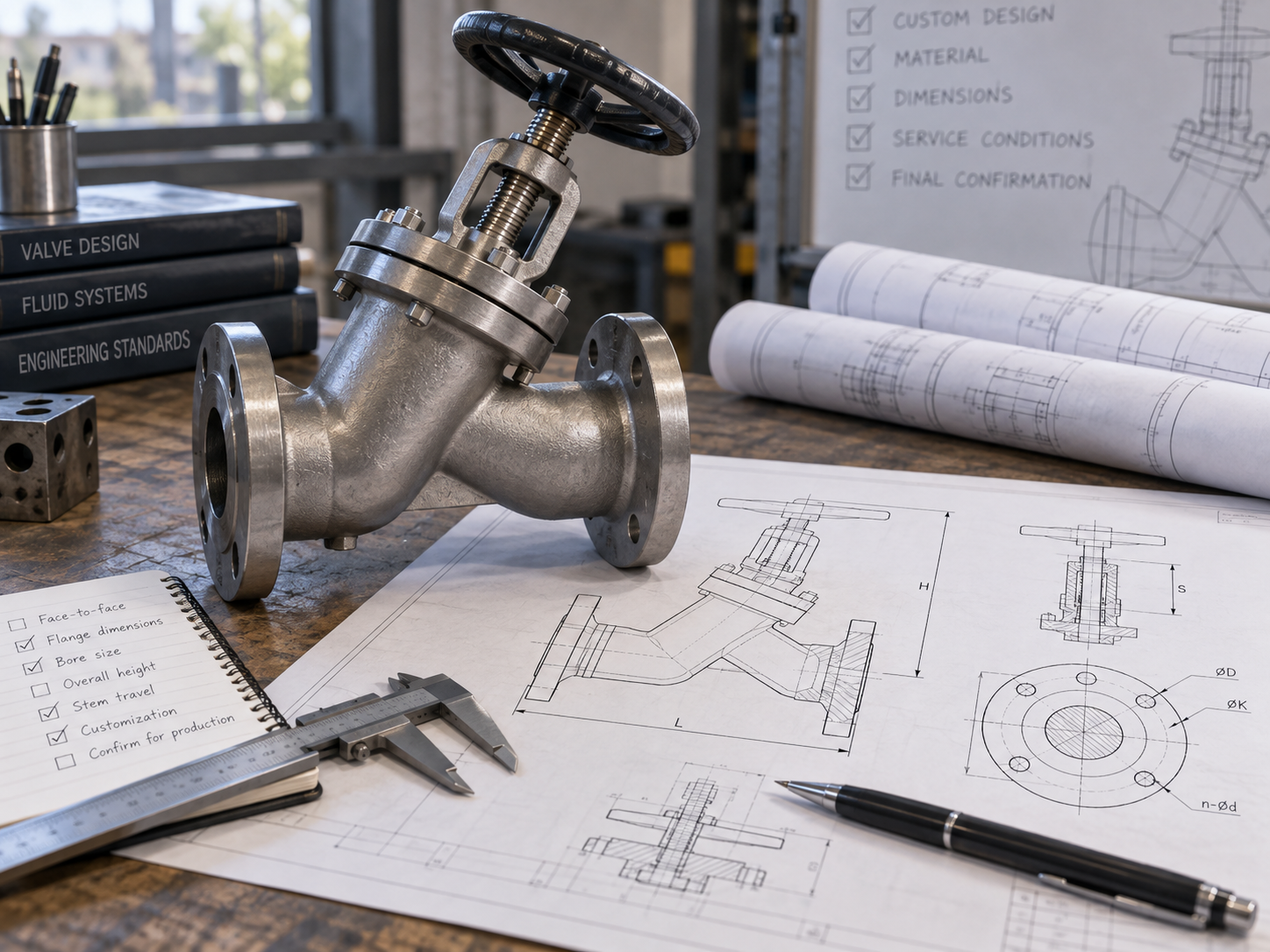
1. Face-to-Face Dimension — F/F
The face-to-face dimension is one of the most important values for a replacement flanged valve.
It is the distance between the two pipeline connection faces.
If the existing pipe gap is 230 mm and the replacement valve has a 250 mm face-to-face dimension, the new valve cannot simply be installed without modifying the piping.
Where applicable, standard face-to-face dimensions can be checked against standards such as ASME B16.10. However, a customer drawing may specify a non-standard dimension that must be maintained for interchangeability.
2. End Connection Type
Confirm whether the required ends are:
- Flanged
- Butt weld
- Socket weld
- Threaded
- Special project connection
The connection type can significantly change body length and manufacturing construction.
3. Flange Dimensions
For a flanged valve, confirming only “Class 300 flange” may not be enough for a drawing-based replacement.
Check:
- Flange outside diameter
- Pitch circle diameter / bolt circle diameter
- Number of bolt holes
- Bolt-hole diameter
- Flange thickness
- Raised-face diameter and height
- RF, FF or RTJ facing
- Applicable flange standard
4. Bore or Flow Passage Diameter
The internal bore should be confirmed because nominal pipe size does not automatically define the complete internal flow geometry of the valve.
For a Y-pattern globe valve, bore dimensions, seat throat and internal flow passage can affect:
- Flow capacity
- Velocity
- Pressure drop
- Seat erosion
- Required wall thickness
5. Overall Height
The total valve height should be confirmed in both the relevant operating positions where necessary.
For a rising-stem valve, buyers should particularly check:
- Height with valve closed
- Height with valve fully open
- Maximum stem extension
- Clearance required above the handwheel or actuator
6. Stem Diameter and Stem Travel
Stem dimensions affect strength, guidance, packing performance and operating mechanism geometry.
Important values include:
- Stem diameter
- Thread dimensions
- Stem travel
- Stem-to-disc connection
- Backseat geometry where applicable
7. Handwheel Diameter
A handwheel is not simply a cosmetic component.
Handwheel diameter influences available manual operating torque. If a replacement valve uses a much smaller handwheel than the original, the operator may require substantially greater effort to open or close the valve.
8. Y-Body Angle and Bonnet Orientation
Because a Y-pattern valve has an inclined stem axis, the body and bonnet angle should be confirmed when site clearance is restricted.
Changing this geometry can affect:
- Overall installation envelope
- Accessibility of the handwheel
- Insulation clearance
- Stem removal space
- Maintenance access
9. Body Wall Thickness
Pressure-containing wall thickness must be based on the applicable valve design requirements, material, pressure-temperature condition and manufacturing allowances.
The original customer’s sketch should not be treated as sufficient pressure-boundary design evidence if critical wall dimensions are missing.
10. Bonnet Connection
Confirm whether the valve uses:
- Bolted bonnet
- Welded bonnet
- Pressure seal bonnet
- Union bonnet or another project-specific arrangement
High-pressure and high-temperature systems may require a different bonnet configuration from ordinary low-pressure service.
For severe steam applications, compare the project requirement with Vcore’s
Pressure Seal Globe Valve.
11. Disc and Seat Dimensions
For a custom valve, the manufacturer should review:
- Seat bore
- Seat angle
- Disc diameter
- Disc profile
- Seat-ring attachment
- Hardfacing requirement
- Required shut-off performance
A drawing that only shows the external body may not contain enough information to reproduce the original internal performance.
12. Packing and Gland Dimensions
Packing chamber geometry affects stem sealing and packing compression.
For high-temperature service, this area deserves particular attention because packing materials can relax or degrade as temperature increases.
Custom Valve Drawing Checklist
| Drawing Parameter | What to Confirm | Why It Matters |
|---|---|---|
| F/F | Face-to-face length | Pipeline interchangeability |
| DN / NPS | Nominal valve size | Pipeline compatibility |
| Pressure Class | Class / PN plus design pressure | Pressure boundary design |
| Flange | OD, bolt circle, holes, facing, thickness | Connection compatibility |
| Bore | Flow passage dimensions | Capacity and pressure drop |
| Overall Height | Open and closed envelope | Site clearance |
| Stem | Diameter, thread and travel | Strength and operation |
| Handwheel | Diameter and position | Manual operating torque and clearance |
| Body Angle | Y-pattern stem/bonnet inclination | Installation envelope |
| Wall Thickness | Minimum pressure-boundary thickness | Pressure integrity |
| Body / Trim Materials | Exact ASTM grades | Temperature, strength and corrosion suitability |
| Flow Direction | Required installation direction | Disc loading and operating behavior |
Can A105 or WCB Be Used at 425°C?
This question must be answered carefully.
ASTM A105 forged carbon steel and ASTM A216 Grade WCB cast carbon steel are both used for elevated-temperature pressure components. However, 425°C is already a demanding temperature for carbon steel valve service.
The correct question is not simply:
“Can WCB withstand 425°C?”
The engineering question should be:
“Can the complete valve, at its selected material group and pressure class, satisfy the required design pressure at 425°C for the expected service life and operating conditions?”
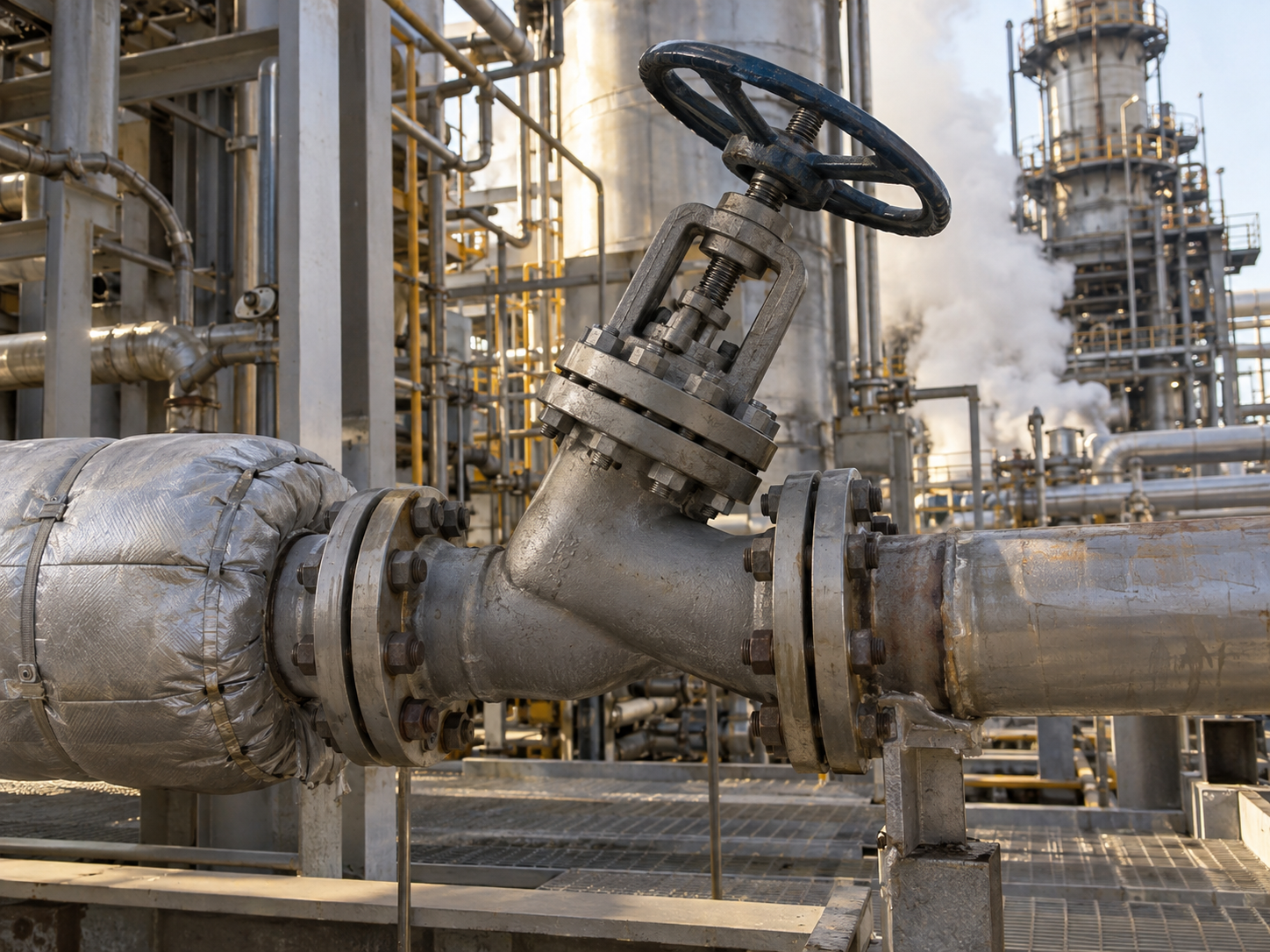
425°C High-Temperature Service: What Should Buyers Check?
1. Pressure-Temperature Rating
Pressure class does not mean that the valve can withstand the same pressure at every temperature.
As temperature increases, the allowable working pressure for a carbon steel valve decreases.
For example, a Class 300 valve should not be selected at 425°C simply because the pipeline operating pressure is below the room-temperature Class 300 rating.
The required operating and design pressure must be checked against the applicable pressure-temperature rating for the actual valve material and governing design standard.
2. Carbon Steel Is Near an Important High-Temperature Boundary
At approximately 425°C, prolonged carbon steel service requires particular attention.
For severe continuous operation around or above this temperature, the project engineer may need to evaluate whether an alloy steel body such as a chromium-molybdenum grade is more suitable than carbon steel.
Depending on the governing code and project specification, alternatives may include cast grades such as WC6 or WC9 or corresponding forged alloy-steel grades.
Material substitution should never be made only from temperature. Pressure, service duration, medium, design code, pipe material and project material specification also need to be considered.
3. Packing Material
Ordinary low-temperature soft packing should not automatically be used for 425°C service.
Flexible graphite packing is frequently considered for high-temperature steam and thermal service, but the final packing arrangement must match:
- Temperature
- Pressure
- Stem material
- Stem surface finish
- Emission requirements
- Fire-safety requirements where applicable
- Expected operating cycles
4. Bonnet Gasket
The body-to-bonnet gasket is exposed to both pressure and temperature.
Depending on valve construction and project requirements, high-temperature solutions may include graphite-based or metal/graphite gasket systems.
Gasket selection must correspond to flange geometry, bolt loading, pressure and thermal cycling.
5. Stem and Trim Materials
The valve body is only one part of the high-temperature design.
Stem, disc, seat and seat hardfacing should be reviewed for:
- High-temperature strength
- Wear resistance
- Galling risk
- Erosion caused by pressure drop
- Thermal expansion
- Required shut-off performance
Depending on the service, stainless trim, hardened 13Cr-type trim, Stellite hardfacing or project-specified alloy trim may be considered.
6. Thermal Expansion
At 425°C, valve components expand substantially compared with ambient-temperature dimensions.
The design must allow appropriate clearances between:
- Stem and guides
- Disc and seat
- Bonnet and body
- Packing and stem
Insufficient allowance can cause excessive friction, stem seizure or difficulty operating the valve after reaching service temperature.
7. Stem Packing Relaxation
Repeated heating and cooling can change packing compression.
A valve that seals correctly during a room-temperature hydrostatic test may behave differently after thermal cycling.
This is why high-temperature stem sealing requires both suitable material and correct packing-chamber design.
8. Bolting Material
Body-bonnet bolting should be reviewed as part of the pressure-temperature design rather than treated as a generic fastener.
The required bolt and nut grades must correspond to the design temperature, pressure class and applicable project specification.
9. Flow Direction
Globe valves normally have a defined preferred flow direction depending on trim and valve design.
For high differential-pressure steam service, incorrect installation can alter disc loading, operating torque, vibration and seat behavior.
The manufacturer’s GA drawing should clearly identify the required flow direction.
10. Insulation and Operator Temperature
Steam valves may be insulated at site, but insulation should not prevent access to packing adjustment, gland bolts, lubrication points or bonnet maintenance.
The handwheel, gearbox or actuator should also be reviewed for heat transfer from the valve body.
425°C Service Checklist
| Item | What to Review |
|---|---|
| Design Pressure | Required pressure at 425°C, not ambient-temperature rating |
| Body Material | A105/WCB suitability or need for alloy steel |
| Packing | High-temperature graphite or project-approved system |
| Gasket | Temperature and pressure-compatible bonnet sealing |
| Stem | Strength, expansion, wear and surface finish |
| Seat / Disc | Hardfacing, erosion and thermal behavior |
| Bolting | High-temperature strength and project specification |
| Bonnet | Bolted, welded or pressure-seal design as required |
| Flow Direction | Confirm manufacturer’s intended direction |
| Thermal Cycling | Packing, gasket and bolting behavior during repeated heating/cooling |
How Should a Custom Y Type Globe Valve Project Proceed?
For a custom valve, manufacturing should follow a controlled engineering sequence rather than proceeding directly from a preliminary customer sketch.
A practical workflow is:
Customer drawing / sample
→ service-condition review
→ dimensional clarification
→ material confirmation
→ preliminary GA drawing
→ customer drawing approval
→ manufacturing drawing
→ tooling / material preparation
→ production
→ dimensional inspection
→ pressure testing
→ final documentation
→ packing and shipment
The drawing revision used for production should be clearly controlled.
If F/F, material, stem design or flange dimensions change during technical discussions, the updated drawing should receive a new revision before manufacturing starts.
For more information on pressure boundary, sealing, operation and project-specific valve design, see
Industrial Valve Design Considerations: 10 Engineering Factors.
What Should Be Inspected Before Shipment?
Depending on the purchase specification, final inspection may include:
- Material certificate review
- Body and bonnet material verification
- Dimensional inspection
- Face-to-face measurement
- Flange dimensional check
- Stem movement inspection
- Handwheel operation
- Shell pressure test
- Seat leakage test
- Backseat test where applicable
- Visual inspection
- NDT where specified
- Coating inspection
- Nameplate and marking inspection
- Final drawing verification
- Packing inspection
Testing requirements should be agreed before production. For industrial valves where API 598 or another inspection standard is specified, the exact standard edition and acceptance criteria should be confirmed in the purchase documents.
Y Type Globe Valve RFQ Checklist
Providing complete technical information allows the manufacturer to quote the correct valve instead of making assumptions.
| RFQ Item | Example / Requirement | Why It Matters |
|---|---|---|
| Valve Type | Y Type / Y-Pattern Globe Valve | Confirms body geometry |
| Size | 1″, 2″, DN50, etc. | Pipeline compatibility |
| Quantity | Qty per size | Affects casting/tooling economics |
| Operating Pressure | Actual normal pressure | Defines service condition |
| Design Pressure | Maximum design condition | Pressure-boundary verification |
| Operating Temperature | For example 400°C | Packing and material selection |
| Design Temperature | For example 425°C | Pressure-temperature rating |
| Medium | Steam, thermal oil, gas, process fluid | Material and trim compatibility |
| Body Material | ASTM A105 / ASTM A216 WCB / alloy steel | Manufacturing and temperature suitability |
| Trim Material | 13Cr, SS, Stellite or project grade | Wear and sealing performance |
| Stem Type | Rising / non-rising | Structure and installation space |
| Bonnet | Bolted / welded / pressure seal | Pressure and maintenance requirements |
| Connection | Flanged / BW / SW / threaded | Pipeline connection |
| F/F | Standard or customer-specific | Replacement compatibility |
| Flange Standard | ASME / EN / DIN / JIS | Bolt-up compatibility |
| Operation | Handwheel / gear / actuator | Operating arrangement |
| Testing | API 598 or project specification | Acceptance requirements |
| Documents | GA, MTC, test reports, inspection records | Project acceptance |
| Existing Drawing | PDF / DWG / dimensions / sample | Custom manufacturing reference |
Common Mistakes When Ordering a Custom Y Type Globe Valve
1. Comparing A105 and WCB Prices Without Comparing the Design
A forged valve and a cast valve may use different dimensions, wall thicknesses, bonnet structures, manufacturing processes and testing scopes.
Price comparison is meaningful only after the technical scope is aligned.
2. Assuming a Drawing Is Complete Because It Shows the Main Dimensions
Some customer drawings show only:
- Overall length
- Overall height
- Flange diameter
But important information such as wall thickness, trim material, seat geometry, stem diameter, packing arrangement or design pressure may still be missing.
3. Ignoring F/F on a Replacement Valve
Face-to-face mismatch is one of the easiest ways to create a site installation problem.
Always confirm whether standard F/F or the existing valve’s actual measured F/F has priority.
4. Specifying 425°C Without Giving Pressure
Temperature alone is not enough.
A valve body material that may be acceptable at one pressure can be unsuitable at another pressure at the same temperature.
Provide the complete design pressure-temperature combination.
5. Treating Class Rating as a Constant Pressure
Class 150, Class 300 or Class 600 identifies a rating class. It does not mean that the allowable pressure remains unchanged from ambient temperature to 425°C.
6. Choosing A105 Only Because It Is Forged
Forged construction has important advantages, but it does not automatically make A105 the correct material for every Y-pattern globe valve.
Valve size, body geometry, design temperature, pressure, code requirements and project material specification must still be checked.
7. Assuming Cast WCB Should Always Be Cheaper
For a low-quantity custom order, casting-tooling cost alone can change the economics dramatically.
A105 or WCB: Which One Should You Choose?
Use the following table as an initial procurement comparison rather than a substitute for project engineering.
| Project Situation | Typical Direction to Evaluate |
|---|---|
| Small-bore high-pressure valve | Evaluate forged A105 construction |
| Existing standard forged tooling available | A105 may offer better small-quantity economics |
| Large, complex valve body | Evaluate WCB casting |
| Large production quantity | Casting tooling can become economical |
| Customer drawing explicitly specifies WCB | Do not substitute without approval |
| Customer drawing explicitly specifies A105 | Confirm forged-body manufacturing feasibility |
| Continuous severe service around 425°C | Verify carbon-steel suitability and evaluate alloy alternatives where required |
Related Vcore Globe Valve Resources
For additional engineering and procurement information, review the following Vcore resources:
Y-Pattern Globe Valve for Steam and High-Flow Applications
— explains Y-pattern flow geometry, throttling behavior, pressure drop and steam-service selection.
Industrial Globe Valve Product Range
— compare industrial globe valve configurations for steam, oil, gas, chemical, power and general process service.
Forging Stop Valve
— review forged-body stop valve configurations for compact high-pressure industrial service.
Pressure Seal Globe Valve
— review pressure-seal configurations commonly evaluated for high-pressure and high-temperature steam systems.
Industrial Valve Design Considerations
— understand pressure boundary, sealing, flow path, materials, operation and inspection requirements for customized valves.
Frequently Asked Questions
What is the difference between a Y Type Globe Valve and a normal globe valve?
A Y Type Globe Valve uses an inclined stem, disc and seat arrangement that creates a more streamlined flow path. Compared with a conventional T-pattern globe valve, the Y-pattern design can reduce flow resistance while retaining globe-valve throttling and shut-off characteristics.
Is a Y Type Globe Valve normally rising stem or non-rising stem?
Industrial Y-pattern globe valves commonly use rising-stem construction, particularly in steam, high-pressure and high-temperature service. Non-rising arrangements exist but are less common and should be confirmed from the actual design or customer drawing.
What is the difference between ASTM A105 and ASTM A216 WCB?
ASTM A105 is a forged carbon steel specification used for pressure-containing piping components, while ASTM A216 Grade WCB is a cast carbon steel grade used for valves and other pressure-containing components. Their manufacturing processes, geometry capability and production economics are different.
Is A105 stronger than WCB?
Forging produces a different material structure and is often preferred for compact high-integrity pressure components, but material selection should not be reduced to a simple stronger-versus-weaker comparison. The complete valve design, pressure-temperature rating, dimensions, inspection and applicable standard determine whether the valve is suitable for service.
Why can a WCB cast valve cost more than an A105 forged valve?
For low-quantity customized valves, a WCB body may require a new pattern, core tooling, foundry setup, heat treatment and additional inspection. If a manufacturer already has standard A105 forged blanks or forging tooling, the forged valve can therefore be less expensive for a small order.
Which dimension is most important when copying an existing globe valve?
Face-to-face length is one of the most critical installation dimensions, but it is not the only one. Flange OD, bolt pattern, bore, overall height, body angle, stem travel, handwheel diameter, bonnet arrangement and connection standard should also be confirmed.
Can ASTM A105 be used at 425°C?
A105 is used for elevated-temperature pressure components, but 425°C requires careful verification of the applicable pressure-temperature rating and the complete valve design. Long-term high-temperature service may also require evaluation of alloy-steel alternatives depending on pressure, service duration and project requirements.
Can ASTM A216 WCB be used at 425°C?
WCB is used for elevated-temperature valve bodies, but at approximately 425°C carbon steel is approaching an important high-temperature design boundary. The allowable working pressure is significantly affected by temperature, and sustained severe service may justify evaluation of alloy-steel materials.
What packing is commonly considered for a 425°C globe valve?
Flexible graphite packing is commonly considered for high-temperature steam and thermal service. Final packing selection should also account for pressure, stem material, emission requirements, operating cycles and the complete valve design.
Should I manufacture directly from an old valve drawing?
Not without technical review. An old drawing may omit the operating medium, design pressure, design temperature, material details, minimum wall thickness, test requirements or internal trim dimensions. Critical information should be clarified and an approved manufacturing drawing should be issued before production.
What information should I send for a customized Y Type Globe Valve quotation?
Provide the valve size, quantity, operating and design pressure, operating and design temperature, medium, body and trim materials, pressure class, end connection, face-to-face requirement, stem type, operation method, test requirements and available drawings or samples.
Need a Customized Y Type Globe Valve?
A customized Y Type Globe Valve should be selected from the actual operating conditions rather than from size and pressure class alone.
If you already have an existing valve, drawing or sample, provide as much information as possible, including:
- Valve size and quantity
- Operating pressure
- Design pressure
- Operating temperature
- Design temperature
- Working medium
- Body and trim materials
- Connection type
- Face-to-face dimension
- Stem configuration
- Flange or welding-end dimensions
- Applicable standards
- Inspection requirements
- Required documentation
Vcore Valve can review project specifications, customer drawings and dimensional requirements before quotation. For customized valves, the final configuration can be confirmed through technical clarification and drawing review before production.
Contact Vcore Valve for Y Type Globe Valve technical review and quotation.